
In my extensive experience within the foundry industry, addressing defect formation is a cornerstone of process optimization and quality assurance. Among the various challenges, porosity in casting stands out as a particularly pervasive and critical issue, especially within the Lost Foam Casting (LFC) process. This phenomenon, characterized by the formation of voids or cavities within the solidified metal, predominantly manifests as subcutaneous blowholes. These defects severely compromise the mechanical integrity, pressure tightness, and surface finish of cast components. The pursuit of sound, dense castings necessitates a deep, systematic understanding of the root causes of gas entrapment. This article synthesizes my firsthand observations and technical analyses into a comprehensive exploration of the mechanisms behind porosity in casting in LFC and presents a detailed framework of countermeasures, leveraging data tables and fundamental principles to encapsulate the knowledge.
The LFC process, while offering exceptional design flexibility and excellent dimensional accuracy, introduces unique pathways for gas generation and entrapment. Unlike traditional green sand casting, the LFC process involves the vaporization of a foam pattern surrounded by unbonded sand. The kinetics of foam decomposition, gas evolution from coatings and sand, and the dynamics of metal filling create a complex environment where gas management is paramount. Failure to control this environment inevitably leads to porosity in casting. The primary sources of this gas can be meticulously categorized, and their interactions often compound the problem.
1. The Foam Pattern: A Primary Gas Source
The expandable polystyrene (EPS) or similar copolymer pattern is the heart of the process and the first major contributor to potential porosity in casting. Even after the initial bead expansion and molding or after machining from foam boards, the pattern retains residual moisture and low-molecular-weight hydrocarbons within its cellular structure. Upon contact with the molten metal, the pattern undergoes rapid thermal degradation. The idealized complete reaction for EPS can be represented as:
$$(C_8H_8)_n + nO_2 \rightarrow 8nC_{(s)} + 4nH_2O_{(g)} \quad \text{(Incomplete, Pyrolysis)}$$
In reality, within the oxygen-deficient environment of the mold, the decomposition is complex, producing a mixture of gaseous and liquid pyrolysis products: styrene monomers, dimers, and a significant volume of hydrogen and carbon-rich gases. If the pattern contains moisture, steam ($H_2O_{(g)}$) is added to this gas cocktail. The pressure build-up from these gases, if not efficiently evacuated, forces its way into the solidifying metal, creating voids.
Key Control Parameters & Mitigation:
| Factor | Problem | Optimal Parameter / Measure | Rationale |
|---|---|---|---|
| Pattern Moisture | Residual water vaporizes, adding gas volume. | Pre-dry patterns at 40-50°C for >24 hours. Store machined boards in dry conditions for >1 month before use. | Reduces the $H_2O_{(g)}$ partial pressure in the decomposition front. |
| Pattern Density | Low density foam has higher gas yield per volume. | Use higher density, tightly packed beads (e.g., 24-28 $kg/m^3$ for ferrous). | Minimizes total mass of decomposable polymer, thus total gas volume $V_{gas}$. $$V_{gas} \propto \rho_{foam}^{-1} \cdot Y$$ where $Y$ is gas yield per mass. |
| Coating Permeability | Impermeable coating traps pattern gases. | Ensure coating has high high-temperature permeability. | Allows gases to diffuse through coating into sand bed. |
2. The Refractory Coating: A Critical Gas Barrier and Source
The aqueous refractory coating applied to the foam pattern serves multiple functions: it provides a smooth metal surface, supports the sand, and must be permeable enough to allow pattern decomposition gases to escape. However, it can also become a significant secondary source of porosity in casting. An inadequately dried coating will release steam violently upon metal entry. Furthermore, if the coating layer is excessively thick, it increases the diffusion path length for gases, raising the back-pressure at the metal-foam interface.
The gas flux $J$ through the coating can be approximated by Darcy’s law for flow through a porous medium, simplified for this context:
$$J \approx \frac{k}{\mu \cdot L} \Delta P$$
where $k$ is the coating’s intrinsic permeability, $\mu$ is the gas viscosity, $L$ is the coating thickness, and $\Delta P$ is the pressure differential across the coating. Clearly, a large $L$ (thick coating) reduces the gas flux $J$, promoting gas entrapment.
Key Control Parameters & Mitigation:
| Factor | Problem | Optimal Parameter / Measure |
|---|---|---|
| Coating Drying | Residual water in coating slurry. | Dry thoroughly at 40-60°C with forced air circulation for >8 hours. Ensure humidity is removed from drying chamber. |
| Coating Thickness | High thickness increases flow resistance. | Apply a consistent, thin layer. Primary coating: 0.3-0.8 mm. Use a slightly more diluted slurry for the first coat to ensure even coverage. |
| Coating Permeability | Low permeability traps gases. | Optimize binder content and particle size distribution of refractory flour to create interconnected pores after drying. |
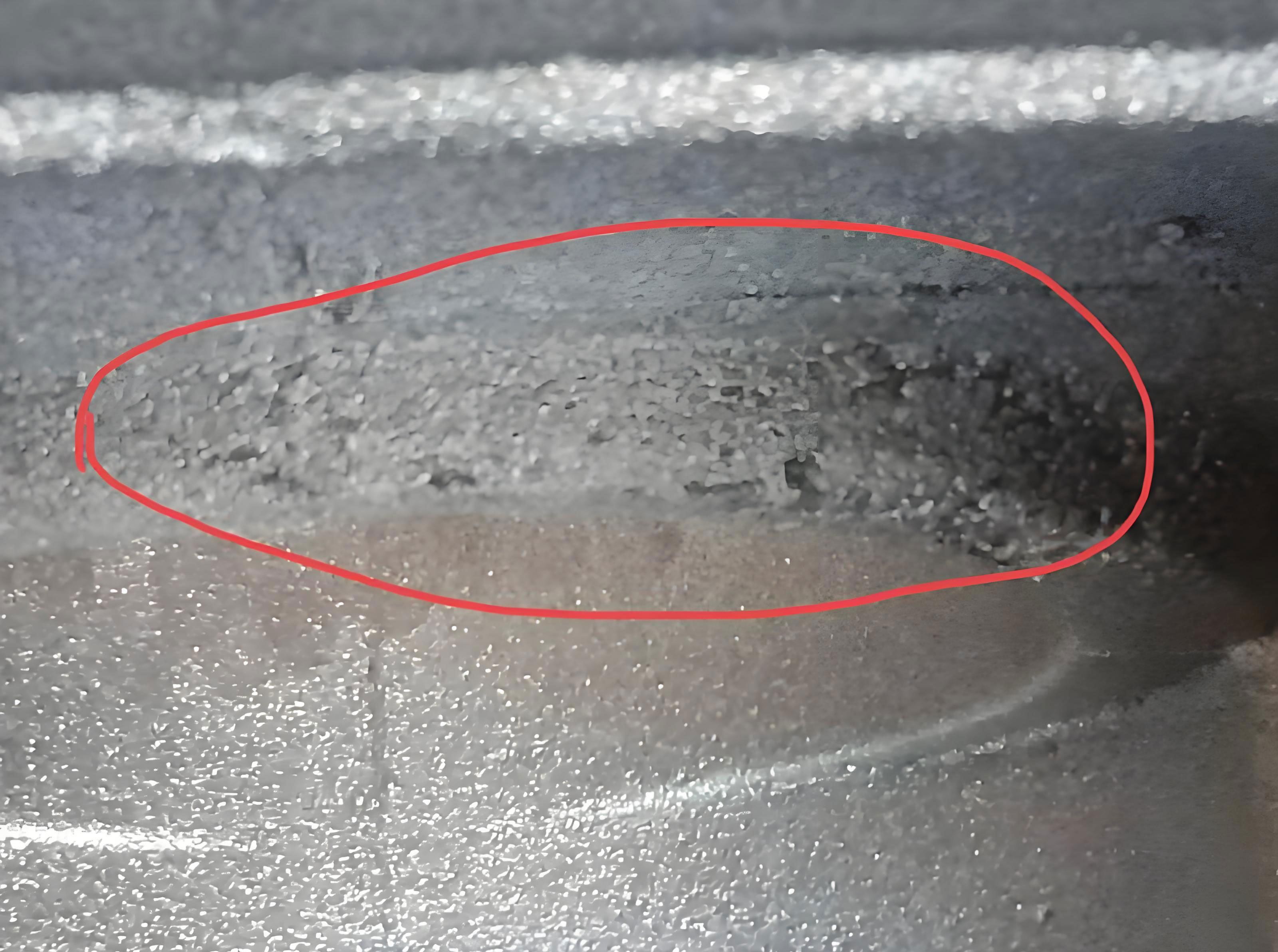
3. Metal Melt: The Inherent Gas Carrier
The molten metal itself can be a potent source of gas that contributes to final porosity in casting. During melting, reactions with the atmosphere, moisture from charge materials, and decomposition of organic contaminants can lead to dissolution of gases like hydrogen ($H_2$) in aluminum or hydrogen and nitrogen ($N_2$) in steel. Upon solidification, the solubility of these gases in the metal drops precipitously, as described by Sieverts’ Law for diatomic gases:
$$S = k \sqrt{P_{gas}}$$
where $S$ is solubility, $k$ is the equilibrium constant, and $P_{gas}$ is the partial pressure of the gas. The rejected gas forms bubbles that may be trapped as the dendritic network grows.
Key Control Parameters & Mitigation:
| Factor | Problem | Optimal Parameter / Measure |
|---|---|---|
| Charge Materials | Rust, oil, moisture on scrap/pre-alloys. | Use clean, pre-heated (to >200°C) charge materials. Avoid damp or contaminated returns. |
| Melting Atmosphere & Slag | Reaction with $H_2O$ and $O_2$ from air. | Employ protective atmospheres (e.g., argon blanket) where feasible. Use effective fluxing slags to absorb oxides. |
| Deoxidation/Degassing | Insufficient removal of dissolved gases. | For steel: Use sequential deoxidation (e.g., Al + FeSi). For Al: Use rotary degassing with inert gas (Ar, $N_2$). |
4. Vacuum (Negative Pressure): The Driving Force for Gas Evacuation
In LFC, applying a vacuum to the sand mold is not optional; it is the principal force that maintains mold rigidity and, crucially, extracts the gaseous products from the pattern decomposition zone. Inadequate vacuum level or poor sand permeability means gases are not evacuated fast enough. They accumulate, increasing the local pressure $P_{local}$ at the metal front. When $P_{local}$ exceeds the metal head pressure $P_{metal}$ plus the capillary pressure restraining bubble entry, gas intrusion occurs, directly causing porosity in casting.
$$P_{local} > P_{metal} + \frac{2\gamma \cos\theta}{r}$$
where $\gamma$ is surface tension, $\theta$ is contact angle, and $r$ is pore radius in the coating.
Key Control Parameters & Mitigation:
| Factor | Problem | Optimal Parameter / Measure |
|---|---|---|
| Vacuum Level | Insufficient suction to evacuate gases. | Maintain a vacuum of 0.04 – 0.06 MPa (300-450 mm Hg) for ferrous castings during pour and solidification. |
| Vacuum Timing | Delayed application or early release. | Initiate vacuum before pouring. Maintain until the casting has fully solidified. |
| Sand & Mold Permeability | High resistance to gas flow. | Use dry, coarse, round-grain silica sand (e.g., AFS GFN 40-70). Ensure uniform compaction around pattern. |
5. Molding Sand: The Gas Transport Medium
The unbonded sand must serve as a highly permeable conduit for gases to reach the vacuum source. Two primary sand-related factors induce porosity in casting: fine grain size and moisture content. Fine sand reduces the interstitial spaces, dramatically lowering permeability. Moisture, either from initially damp sand or ambient humidity absorption, turns to steam during pouring. This is a massive, localized gas source that can exceed the evacuation capacity of the system.
The permeability $P$ of a sand bed can be estimated by:
$$P \propto \frac{d^2 \phi^3}{(1-\phi)^2}$$
where $d$ is the effective sand grain diameter and $\phi$ is the porosity (void fraction). This shows the powerful influence of grain size ($d^2$). Moisture condensing on the pattern coating also severely degrades its permeability and strength.
Key Control Parameters & Mitigation:
| Factor | Problem | Optimal Parameter / Measure |
|---|---|---|
| Sand Grain Size | Fine grains reduce permeability. | Use sand with AFS Grain Fineness Number (GFN) ≤ 70, preferably 40-55. Avoid excessive fines. |
| Sand Moisture | Water vaporizes, creating steam pressure. | Dry sand to moisture content < 1% before use. Store sand in a dry environment. Re-circulate sand through a thermal reclaimer. |
| Sand Fines & Temperature | Fines and ash clog pores; hot sand causes condensation. | Implement continuous sand cooling and classification to remove fines and cool sand below dew point. |
6. Adhesives and Sealants: Localized Gas Generators
The glues and pastes used to assemble complex patterns or repair surface imperfections have high gas yields upon thermal decomposition. Their localized application creates “hot spots” of intense gas generation that the evacuation system may not be able to handle locally, leading to pinpoint porosity in casting clusters near joints or repaired areas.
Key Control Parameters & Mitigation:
| Factor | Problem | Optimal Parameter / Measure |
|---|---|---|
| Adhesive Quantity | Excessive glue volume. | Minimize use. Prefer single, molded patterns over assemblies. Use glues with low gas yield (< 200 cc/g). Apply thin, even layers. |
| Adhesive Type | High gas-yield, water-based adhesives. | Select specialized, low-fume LFC adhesives (e.g., hot-melt types or certain cyanoacrylates). Allow full cure before coating. |
7. Gating System Design: Controlling Metal and Gas Flow
An improperly designed gating system can exacerbate porosity in casting by causing turbulent metal entry, which entraps air, or by failing to establish a rapid, metallostatic pressure head. The gating must ensure a quiescent, progressive fill to help push decomposition gases ahead of the metal front. A key principle is the use of a choked (smallest cross-section) sprue base or runner to create a rapid fill and seal off the gates quickly, preventing “suck back” or aspiration of gases from unfilled parts of the foam cluster.
A common area ratio for pressurized systems in LFC for ferrous metals is:
$$A_{sprue} : A_{runner} : A_{ingates} \approx 1.0 : 1.2 : 1.4$$
For ductile iron or aluminum, a slightly more pressurized system (e.g., 1:1.1:1.2) may be beneficial. The filling time $t_f$ can be approximated using Bernoulli’s equation, accounting for the diminishing head as the mold fills:
$$t_f \approx \frac{V_{mold}}{C_d \cdot A_{choke} \cdot \sqrt{2gH}}$$
where $V_{mold}$ is mold cavity volume, $C_d$ is discharge coefficient, $A_{choke}$ is choke area, $g$ is gravity, and $H$ is effective sprue height. A short $t_f$ is generally desired to outrun gas generation.
Comprehensive Strategy Table for Mitigating Porosity
The fight against porosity in casting is systemic. It requires simultaneous control across all fronts. The following table integrates the key measures into a pre-production and production checklist.
| Process Stage | Control Objective | Specific Actions & Target Values | Monitoring Method |
|---|---|---|---|
| Pattern Shop | Minimize gas mass & moisture. | 1. Use qualified, dense foam (≥24 $kg/m^3$). 2. Dry patterns at 45±5°C for >24h. 3. Minimize glue; use low-fume type. 4. Store raw boards in <40% RH. |
Weight checks, drying logs, humidity meters. |
| Coating & Drying | Ensure permeability and dryness. | 1. Control slurry viscosity for 0.5-0.7 mm coat. 2. Dry at 50±10°C with airflow >8h. 3. Measure coating weight pre/post drying. |
Zahn cup, thickness gauge, weigh scale. |
| Mold Making | Maximize gas evacuation path. | 1. Use dry, cool sand (GFN 40-70, <1% H₂O). 2. Ensure uniform sand compaction. 3. Connect vacuum lines properly. |
Sand lab tests (AFS, LOI, temperature). |
| Melting & Pouring | Deliver clean, degassed metal. | 1. Pre-heat charge. 2. Execute proper degassing/deoxidation. 3. Pour at optimal temperature. 4. Maintain vacuum at 0.05±0.01 MPa. |
Thermal analysis, Reduced Pressure Test (for Al), vacuum gauge logs. |
| System Design | Promote laminar, rapid filling. | 1. Design gating with proper choke (area ratio ~1:1.2:1.4). 2. Use adequate filters in the runner. 3. Optimize pouring basin design. |
Simulation software (flow & porosity), first-article inspection. |
In conclusion, defeating porosity in casting in the Lost Foam process is an engineering challenge that demands a holistic, quantified approach. It is not merely about fixing one parameter but about orchestrating the entire process chain—from foam density and coating permeability to sand grain size and vacuum dynamics—to manage the generation, transport, and evacuation of gases. Each variable interacts with others, often in non-linear ways, as hinted at by the fundamental physical relationships governing gas flow, solubility, and pressure. The persistent occurrence of porosity in casting signals a breakdown in this systemic control. By methodically addressing each source outlined here, establishing robust process windows (as summarized in the tables), and continuously monitoring key parameters, foundries can significantly reduce this costly defect, moving towards the production of reliably sound and high-integrity lost foam castings.