
In my extensive experience within precision investment casting foundries, addressing defects related to porosity in casting has been a paramount concern for ensuring product quality and mechanical integrity. Porosity in casting manifests in various forms, but among the most persistent and challenging to eliminate is invasive porosity, also known as侵入性气孔. This article delves deeply into the mechanisms, root causes, and particularly effective remediation strategies for invasive porosity in casting, drawing from hands-on case studies and theoretical principles. I will share detailed analyses, incorporate mathematical models, and present practical data to provide a thorough understanding of this defect. The keyword ‘porosity in casting’ will be frequently reiterated to emphasize its centrality to our discussion.
Porosity in casting fundamentally refers to the formation of voids or gas pockets within a solidified metal component. These defects can severely compromise tensile strength, fatigue resistance, and pressure tightness. Generally, porosity in casting is categorized into three primary types: entrapped air porosity, precipitated gas porosity, and invasive gas porosity. A concise comparison is presented in Table 1.
| Type of Porosity | Formation Mechanism | Typical Appearance | Primary Influencing Factors |
|---|---|---|---|
| Entrapped Air Porosity | Result of turbulent metal flow entrapping air from the mold cavity or gating system. | Spherical or elongated voids near the surface or along flow paths. | Gating design, pouring speed, mold cavity geometry. |
| Precipitated Gas Porosity | Caused by dissolved gases in the molten metal (e.g., hydrogen, nitrogen) precipitating during solidification. | Finely dispersed, often microscopic pores throughout the cross-section. | Metal melt chemistry, melting practice, solidification rate. |
| Invasive Gas Porosity | Generated when gases from the mold itself (due to heat) invade the molten metal before solidification. | Larger, irregular pores often located near the mold-metal interface or in thermal hotspots. | Mold material composition, binder burnout, pattern residue, pouring temperature. |
The focus here is squarely on invasive porosity in casting. The fundamental physical principle governing its formation can be expressed by a pressure imbalance condition. For gas invasion to occur, the pressure of gases generated within the mold ($P_{gas}$) must exceed the local metallostatic pressure of the molten metal ($P_{metal}$) plus any opposing pressures from surface tension or ambient conditions. This can be formulated as:
$$P_{gas} > P_{metal} + \Delta P_{resist}$$
Where $P_{metal} = \rho g h$, with $\rho$ being the molten metal density, $g$ the gravitational acceleration, and $h$ the height of metal above the point in question. $\Delta P_{resist}$ represents minor resistive pressures. This inequality is the cornerstone of understanding invasive porosity in casting.
In a specific production case I managed, we consistently observed invasive porosity in casting of certain steel components. These were relatively small parts produced using a single, top-gated runner system designed to enhance feeding and reduce shrinkage. Despite stringent controls on metal quality—such as using clean charge materials, implementing extended mold firing to improve permeability, optimizing pouring techniques (slow pour, tilted mold), and rigorous deoxidation practices—the porosity defect persisted. The recurring nature of this porosity in casting prompted a more forensic investigation into the mold shells themselves.
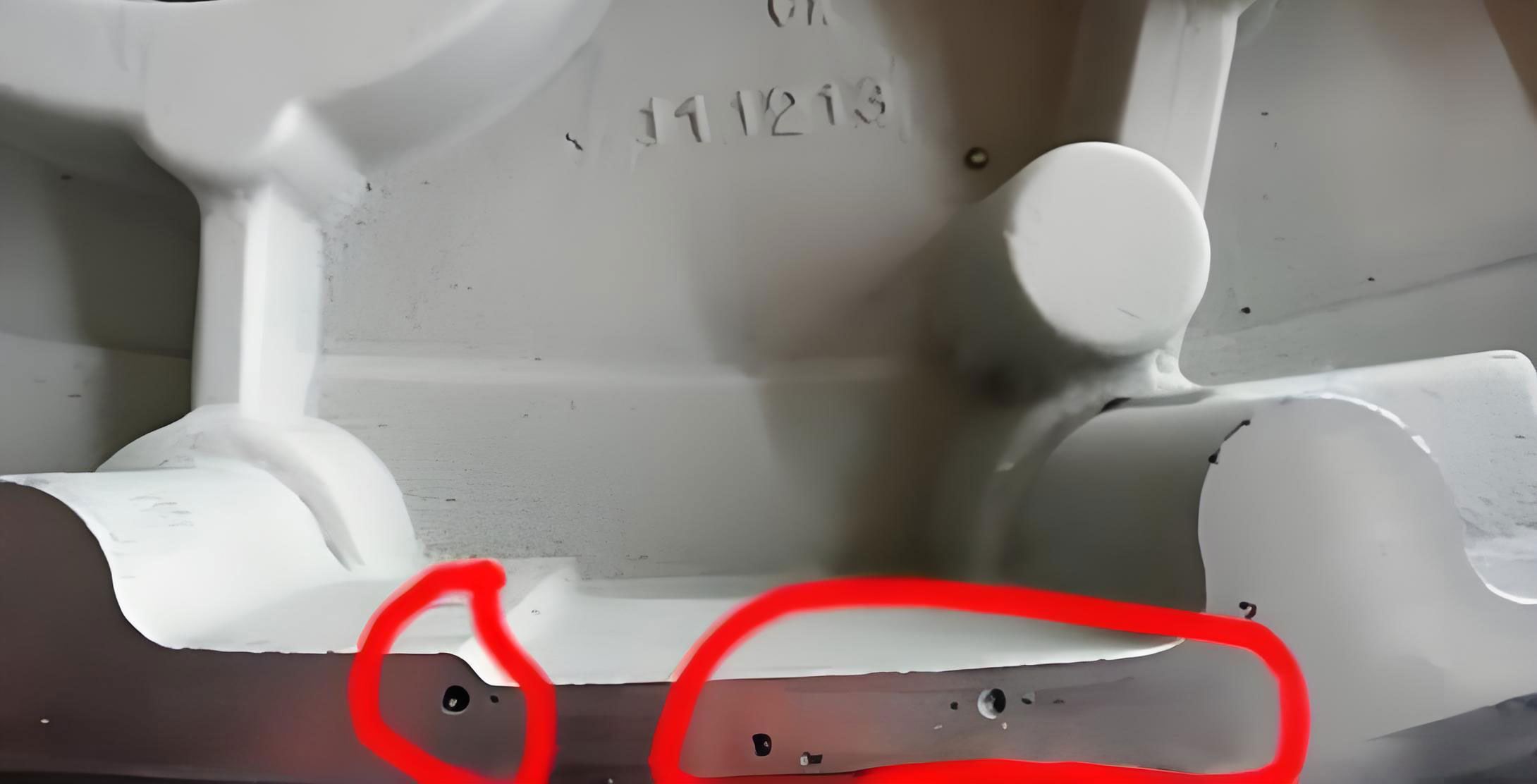
Post-firing, we destructively examined the ceramic shells. The discovery was revealing: significant amounts of carbonaceous soot or “carbon dust” were embedded within the shell walls, particularly in regions adjacent to the problematic casting areas. This finding redirected our hypothesis. The shells were produced using a water-soluble, medium-temperature wax pattern. The standard practice involved autoclave dewaxing with high-pressure steam. It was theorized that not all pattern material was being completely removed during this initial dewaxing. Residual wax, trapped in isolated pockets within the complex shell geometry, would then carbonize during the high-temperature mold preheat (firing) stage. When the molten steel (at temperatures exceeding 1500°C) filled the cavity, it would contact this carbon residue, triggering a violent endothermic gas-generating reaction (e.g., $C_{(s)} + FeO_{(l)} \rightarrow CO_{(g)} + Fe$ or similar). The rapid generation of gas at the metal-mold interface could locally satisfy the invasion condition $P_{gas} > P_{metal}$, leading to the formation of invasive porosity in casting.
The root cause was traced to the recyclability of the wax material. After multiple reclamation cycles, the medium-temperature wax accumulates impurities, additives, and degradation products. These contaminants alter the melting and flow characteristics of the wax, making complete drainage during dewaxing more difficult. Furthermore, the geometry of the tree—with a single, top gate—created areas where the hydraulic pressure during steam dewaxing was insufficient to force out all viscous wax residues. The relationship between residue potential and process parameters can be modeled. The efficiency of wax removal ($\eta_{dewax}$) can be considered a function of several variables:
$$\eta_{dewax} = f(P_{steam}, t_{hold}, T_{wax}, \mu_{wax}, A_{flow})$$
where $P_{steam}$ is steam pressure, $t_{hold}$ is holding time, $T_{wax}$ is wax temperature during dewaxing, $\mu_{wax}$ is the viscosity of the wax (heavily influenced by impurity content), and $A_{flow}$ is the effective flow area for wax egress. As $\mu_{wax}$ increases due to impurity buildup, $\eta_{dewax}$ decreases, leading to a higher probability of residual carbon formation and subsequent porosity in casting.
To quantify the risk, we can define a Residue Risk Index ($RRI$):
$$RRI = \frac{\mu_{wax} \cdot L_{path}}{P_{steam} \cdot A_{flow} \cdot t_{hold}}$$
Here, $L_{path}$ represents the flow path length the wax must travel to escape. A higher $RRI$ indicates a greater propensity for residual wax and associated porosity in casting. For our top-gated design, $L_{path}$ was large for cavities furthest from the gate, and $A_{flow}$ was limited, resulting in a high $RRI$.
Two primary solutions were devised to combat this specific source of invasive porosity in casting. Their feasibility and impact are summarized in Table 2.
| Solution | Description | Advantages | Disadvantages / Challenges | Impact on Porosity in Casting |
|---|---|---|---|---|
| 1. Modified Gating Design | Add additional in-gates or dedicated wax drainage vents at suspected residue locations. | Directly reduces $L_{path}$ and increases $A_{flow}$, lowering $RRI$. Mechanically simple. | Lowers casting yield significantly (8%+ in our case). Increases finishing work. May not be feasible for all geometries. | Potentially eliminates defect by preventing residue formation. |
| 2. Secondary Dewaxing Process | A post-standard-dewaxing operation where fired shells are filled with water and subjected to a rapid steam pressure cycle. | High effectiveness. Low direct cost. Maintains high casting yield. Applicable to existing trees. | Adds an extra process step. Requires careful control of pressure cycle. | Directly removes residual wax before firing, preventing carbon formation. |
Given the economic imperative of maintaining yield, the secondary dewaxing process was selected for in-depth implementation and validation. The procedure is as follows: After the initial autoclave dewaxing and subsequent shell firing (but before final pouring), the cooled shell is carefully filled with clean water. The water level must reach just below the pour cup rim. This water-filled shell is then placed into the dewaxing autoclave. The pressure is rapidly increased—targeting a rise to 0.6 MPa within 14 seconds. Upon reaching a peak pressure of approximately 0.75 MPa, the pressure is swiftly released. This rapid depressurization creates a strong negative pressure differential (vacuum) inside the shell cavities. The physics can be approximated by the ideal gas law applied to the steam-water mixture. The sudden pressure drop ($\Delta P/\Delta t$) causes violent boiling and vapor expansion, creating a scrubbing action. The water is violently agitated and forced into the microscopic channels, mechanically displacing and entraining any residual semi-solid wax or carbonizable material, flushing it out through the gating system.
The efficacy of this method hinges on the impulsive force generated. The impulse ($J$) applied to the residue can be related to the pressure differential and time:
$$J = \int F dt \approx A_{pore} \cdot \int (P_{internal}(t) – P_{external}(t)) dt$$
During the rapid venting, $P_{external}$ drops nearly instantaneously, while $P_{internal}$ lags slightly due to vapor formation, creating a large integrand value and thus a high impulse for removal. This process effectively reduces the residual wax mass ($m_{res}$) to near zero, altering the earlier gas generation model. The potential gas volume ($V_{gas}$) from residue is proportional to $m_{res}$:
$$V_{gas} = k \cdot m_{res}$$
where $k$ is a reaction constant. By making $m_{res} \approx 0$, $V_{gas} \approx 0$, thereby preventing the pressure condition for invasive porosity in casting.
We conducted a controlled study, monitoring porosity in casting rates over 50 production batches. The results were clear. Batches processed with only standard dewaxing showed an invasive porosity defect rate of approximately 18%. Batches treated with the secondary dewaxing process saw that rate drop to below 1%. This dramatic reduction underscores the method’s effectiveness. The process parameters were optimized and are summarized in Table 3.
| Process Parameter | Target Value | Tolerance | Physical Rationale |
|---|---|---|---|
| Water Fill Level | ~5 mm below pour cup top | ±2 mm | Ensures adequate water volume for scrubbing without spillover into autoclave. |
| Pressure Rise Time to 0.6 MPa | 14 seconds | Max 16 s | Ensures rapid heat transfer to water, creating uniform steam generation. |
| Peak Pressure | 0.75 MPa | ±0.02 MPa | Provides sufficient energy for effective subsequent venting and impulse generation. |
| Vent Time (to atmospheric) | < 2 seconds | Max 3 s | Maximizes the pressure differential ($\Delta P/\Delta t$), creating strong scrubbing action. |
| Shell Temperature at Water Fill | Ambient (25-40°C) | — | Prevents flash boiling before pressure cycle, ensuring water fully fills cavities. |
The implementation of this secondary process required no major capital investment, only a procedural adaptation. It directly addresses the core issue of pattern residue, a often-overlooked contributor to invasive porosity in casting. This experience highlights a critical paradigm: in investment casting, the completeness of pattern removal is as crucial as mold permeability or metal cleanliness. The recurring use of medium-temperature waxes, while economical, necessitates vigilant monitoring of wax quality and proactive measures to ensure complete elimination. The secondary dewaxing process serves as a robust, cost-effective insurance against this specific failure mode.
In conclusion, invasive porosity in casting, particularly that stemming from carbonizable pattern residues, is a defect with a clear mechanistic cause rooted in process chemistry and physics. Through systematic investigation, we identified the link between wax impurity, incomplete dewaxing, carbon formation, and gas invasion. The development and optimization of a secondary hydrodynamic dewaxing process proved to be a highly effective solution, dramatically reducing the incidence of porosity in casting. This approach reinforces the principle that controlling every stage of the investment casting process—from pattern making to shell preparation—is essential for suppressing porosity in casting. Future work may involve modeling the fluid dynamics of the secondary dewaxing process more precisely or developing inline sensors to detect residual carbon in fired shells. However, the present method stands as a testament to practical problem-solving in the relentless pursuit of quality, where understanding and mitigating porosity in casting remains a central, enduring challenge.