
In the demanding field of heavy-duty component manufacturing, the production of engine blocks stands as a significant challenge. These parts are characterized by intricate internal geometries, stringent dimensional accuracy requirements, and a critical need for structural integrity. As a researcher focused on advancing foundry techniques, I have extensively studied the lost foam casting process. This method offers distinct advantages for such complex shapes, including exceptional design flexibility, the elimination of traditional sand cores, simplified post-casting cleanup, and potentially higher production efficiency. My work centers on leveraging numerical simulation to unlock the full potential of this process, transforming it from an art into a predictable science. In this detailed account, I will explain the methodology, analysis, and optimization strategies that can lead to flawless castings.
The core of the lost foam casting process involves a sacrificial foam pattern, which is an exact replica of the desired part, coated with a refractory coating and embedded in unbonded sand. When molten metal is poured, it replaces the decomposing foam pattern, precisely replicating its shape. While this eliminates core-making and parting lines, it introduces unique challenges in controlling the filling behavior and solidification to prevent defects like shrinkage porosity, gas entrapment, and folds. These challenges are amplified for large, thick-walled components like a 12-cylinder engine block, where thermal management is paramount.
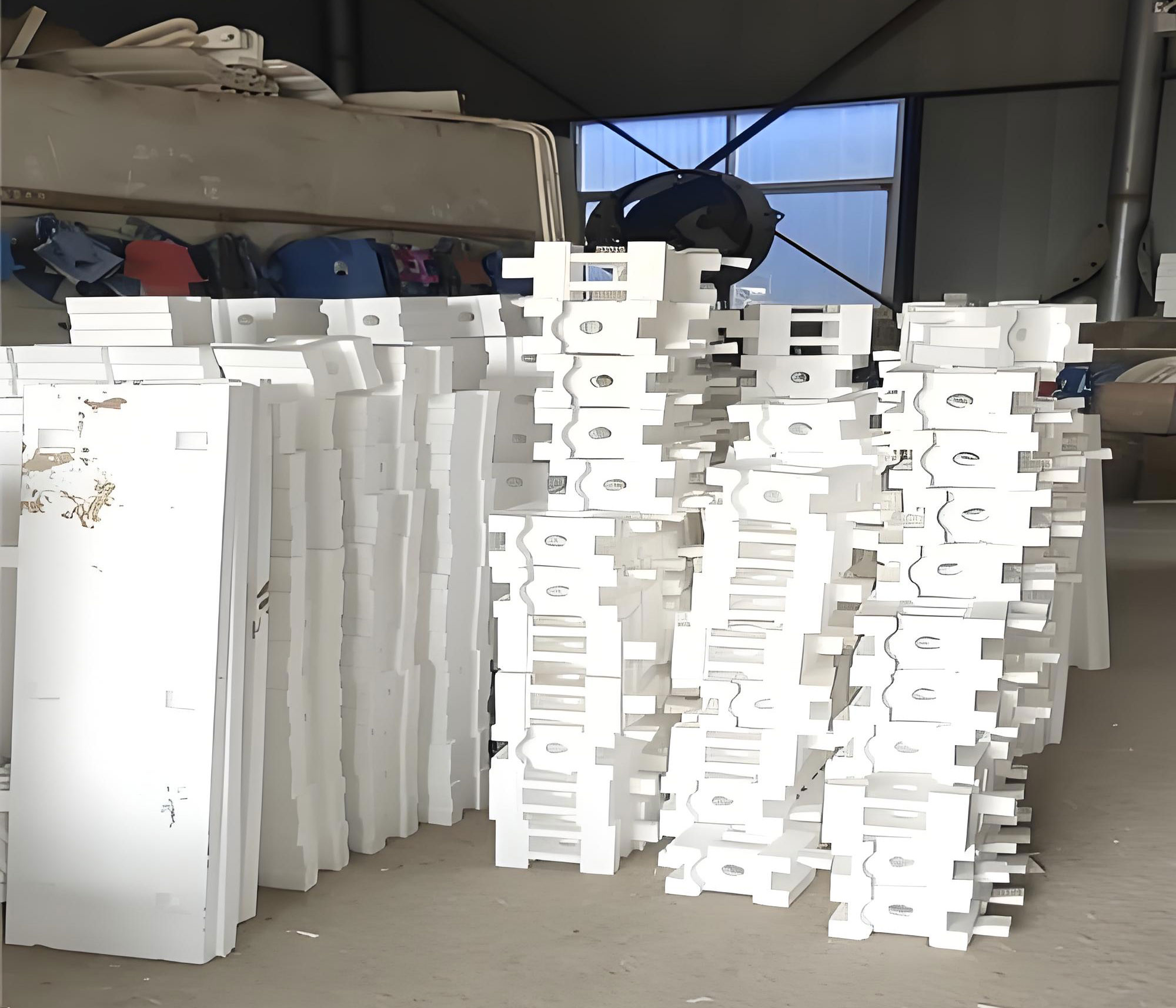
1. Foundational Principles and Numerical Methodology
To systematically tackle these challenges, I employ a comprehensive numerical simulation approach. The goal is to create a virtual prototype of the entire lost foam casting process, allowing for the prediction of defect formation and the evaluation of design changes before any metal is poured. The cornerstone of this analysis is a robust simulation setup that accurately models the coupled physics of foam decomposition, fluid flow, heat transfer, and solidification.
1.1. Geometric Definition and Meshing Strategy
The first step involves translating the complex 3D CAD model of the cylinder block and its gating system into a format suitable for simulation. This model, with an overall envelope of approximately 1225 mm x 800 mm x 680 mm and a mass of around 640 kg, is imported. A critical, often underappreciated, task is the repair of any geometric imperfections in the surface model to ensure a watertight mesh. Following this, a discretization strategy is implemented. The casting and gating system are meshed with a fine resolution (e.g., 10 mm element size) to capture critical features and thermal gradients. The surrounding sand mold can be meshed more coarsely (e.g., 50 mm) to reduce computational cost without sacrificing overall accuracy. The final computational domain typically consists of several million finite elements. The fidelity of this mesh is foundational; it must be fine enough to resolve thin walls (as thin as 9 mm in this block) yet coarse enough to allow for iterative simulation runs in a practical timeframe.
1.2. Material Property Definition
The accuracy of the simulation hinges on the correct definition of material thermophysical properties across a wide temperature range. This is particularly true for the lost foam casting process due to the transient nature of the foam. The key materials are defined as follows:
| Material | Density (kg/m³) | Specific Heat (kJ/kg·K) | Latent Heat (kJ/kg) | Thermal Conductivity (W/m·K) | Solidus Temp. (°C) | Liquidus Temp. (°C) |
|---|---|---|---|---|---|---|
| Cast Iron (HT250) | ~7150 | 0.50 – 1.12 (T-dependent) | ~256 | 29 – 53 (T-dependent) | ~1130 | ~1220 |
| EPS Foam Pattern | ~25 | ~3.7 | ~100 | ~0.15 | ~330 (Degradation) | ~350 (Degradation) |
| Quartz Sand Mold | ~1500 | ~1.1 | N/A | ~0.5 – 1.5 | N/A | N/A |
The behavior of the Expanded Polystyrene (EPS) foam is modeled using a degradation law. As the metal front advances, the foam thermally decomposes into gaseous and liquid products, creating a gap. The heat transfer through this dynamic gap zone is complex. A simplified but effective approach is to define an effective thermal conductivity for this interfacial region. A common parameter used in simulation is the `FOAMTHC` value, which represents this effective conductivity. For instance, a value of 1 W/(m·K) can be used to model the heat transfer through the pyrolysis products between the metal and the uncooled foam pattern ahead of it.
The heat flux ($q$) across this interface can be conceptually described as part of a larger system governed by Fourier’s law and boundary conditions:
$$ q = h(T_{metal} – T_{mold}) $$
Where $h$ is the interfacial heat transfer coefficient (HTC), a critical parameter that changes during the process—initially between foam and sand, and later between metal and sand.
1.3. Boundary Conditions and Process Parameters
Simulating the lost foam casting process requires defining a set of realistic boundary conditions that mirror the foundry environment.
| Parameter | Value / Setting | Physical Significance |
|---|---|---|
| Casting Method | Lost Foam / Evaporative Pattern | Activates the foam decomposition algorithms. |
| Gravity Direction | -Z (Downwards) | Defines the direction of buoyancy forces and natural convection. |
| Pouring Temperature | 1540 °C | Superheat above liquidus, driving fluidity and foam degradation. |
| Pouring Time | 80 seconds | Controls filling velocity and thermal history. |
| Mold Vacuum (Negative Pressure) | -0.06 MPa | Stabilizes the mold, assists in removing pyrolysis gases, and can influence filling. |
| Initial Mold Temperature | 25 °C (Ambient) | Initial condition for the sand mold. |
| Interfacial Heat Transfer Coefficient (HTC) | Foam/Sand: ~100 W/(m²·K) Metal/Sand: ~500 W/(m²·K) |
Governs the rate of heat extraction at different stages of the process. |
2. Analysis of an Initial Gating Design
My investigation began with a traditional gating design for the lost foam casting process of this V-configuration block. The initial design featured a central downsprue with a horizontal runner branching to multiple ingates along the bottom centerline of the block, which was oriented with its V-shape upright. This bottom-gating approach is often chosen to promote tranquil filling. Additionally, slag traps were incorporated at the top of the casting to capture non-metallic inclusions.
2.1. Filling and Solidification Dynamics
The simulation of this initial design revealed a generally stable filling sequence. Metal progressed upward from the ingates, gradually replacing the foam. However, the analysis of the solidification phase uncovered a critical issue. The simulation’s porosity prediction module, often based on the well-known Niyama criterion or a direct thermal gradient analysis, highlighted several regions at high risk of shrinkage defects.
These predicted defects were predominantly located in the thick, heavy sections at the outer apexes of the “V” shape. The cause is classic: these isolated heavy sections, or hot spots, remain liquid longer than the surrounding thinner walls and feeding paths. When they finally solidify, the volumetric contraction (shrinkage) cannot be compensated by incoming liquid metal because the feeding paths have already frozen. The total volumetric shrinkage ($V_{shrinkage}$) in a region can be related to the temperature drop and the material’s shrinkage coefficient ($\beta$):
$$ V_{shrinkage} \approx \beta V_0 (T_{liquidus} – T_{solidus}) $$
Where $V_0$ is the initial volume of liquid metal in that region. In these hot spots, $V_0$ is large, leading to a significant isolated shrinkage volume that manifests as porosity.
2.2. First Iterative Improvement: Adding Feeders (Risers)
To address this, the first logical optimization step within the lost foam casting process was implemented virtually: the addition of conventional feeders, or risers, directly atop the identified hot spots. Six risers were designed and placed on the top of the casting. The simulation was re-run.
The results showed marked improvement. The filling remained stable. More importantly, during solidification, the risers now acted as reservoirs of hot metal, providing the necessary feed metal to compensate for the shrinkage in the thick V-sections. The solidification sequence became more directional, progressing from the thin walls towards the risers. The porosity prediction showed a significant reduction, with only minor residual risk areas remaining. This validated the function of the risers but also introduced new considerations: the added weight of the risers (lower yield), the energy required to melt them, and the labor for their removal.
3. A Paradigm Shift: Radical Optimization of the Process
While adding risers was effective, my objective was to explore a more elegant and efficient solution inherent to the flexibility of the lost foam casting process. I proposed a radical change: inverting the entire casting orientation by 180 degrees. In this new configuration, the original top of the block (with its complex open deck) became the bottom of the mold, and the closed “V” of the crankcase sat at the top. The gating system was redesigned as a central top-gating system, pouring metal directly into what was originally the bottom of the V.
3.1. Advantages of the Inverted Orientation
This inversion leverages fundamental principles of solidification control:
- Natural Thermal Gradient: In this orientation, the thick, heavy V-sections are now at the highest point of the mold cavity. During pouring, they are filled last and therefore receive the hottest metal. This establishes a natural temperature gradient from the hot top (V-sections) down to the cooler bottom (deck area).
- Directional Solidification: This favorable thermal gradient promotes directional solidification from the bottom (thin sections, which freeze first) upwards towards the heavy V-sections at the top. The heavy sections remain liquid longest and can be fed by the metal below them as it solidifies and contracts. Effectively, the entire lower part of the casting acts as a feed path for the top.
- Atmospheric Pressure Assist: With the heavy sections at the top, any slight depression forming during solidification is more effectively acted upon by atmospheric pressure transmitted through the permeable sand mold, further aiding feeding.
- Simplification: This scheme potentially eliminates the need for any external risers, dramatically improving the casting yield and simplifying finishing operations.
The modified filling can be modeled by considering the pressure head ($P_h$):
$$ P_h(t) = \rho g h(t) $$
Where $\rho$ is the metal density, $g$ is gravity, and $h(t)$ is the changing height of the metal column above a given point. In the inverted orientation, the final and critical heavy sections are under the maximum pressure head for the longest time.
3.2. Simulation Results of the Optimized Process
The simulation of this inverted, top-gated lost foam casting process was highly instructive.
Filling: The metal entered from the top center and flowed downwards and outwards to fill the inverted casting. The simulation confirmed a tranquil fill without turbulent splashing or excessive front fragmentation, which is crucial for avoiding fold defects in the lost foam casting process.
Solidification & Defect Prediction: The temperature field evolution clearly showed the desired gradient. The lower, thinner deck areas solidified rapidly. The thermal center, or last point to solidify, was located within the heavy V-sections at the very top of the mold. Crucially, because this region was connected through still-molten channels to the large mass of metal below it until the very end of solidification, it remained “feedable.” The porosity prediction algorithm showed a complete absence of shrinkage porosity or macro-shrinkage cavities in the final casting. The simulation indicated that a sound, dense casting could be achieved without any auxiliary feeders.
| Aspect | Initial Design (Upright + Risers) | Optimized Design (Inverted, No Risers) |
|---|---|---|
| Casting Orientation | V-shape Upright | V-shape Inverted (at top) |
| Gating Type | Bottom Gating | Top/Middle Gating |
| Number of Risers | 6 | 0 |
| Simulated Shrinkage Defects | Minor residual defects predicted | No defects predicted |
| Directional Solidification | Moderate, assisted by risers | Excellent, natural gradient |
| Estimated Casting Yield | Lower (metal in risers is wasted) | Higher (no riser metal) |
| Mold Complexity | Higher (riser pattern attachments) | Lower (simpler pattern) |
4. Physical Validation and Concluding Insights
Based on the compelling numerical evidence, the optimized lost foam casting process—featuring the inverted orientation and top-central gating without risers—was put into production. The physical castings produced were subjected to rigorous non-destructive testing, including X-ray radiography. The results confirmed the simulation predictions: no internal shrinkage porosity or holes were detected in the critical sections of the blocks. Furthermore, destructive testing and mechanical property evaluation confirmed that the material met all specified strength and hardness requirements.
This case study powerfully demonstrates the transformative role of numerical simulation in the modern lost foam casting process. It enables a deep understanding of the complex, coupled physics that are otherwise invisible during the actual pour. Key takeaways from this research are:
- Predictive Power: Simulation accurately identified defect-prone areas in the initial design, preventing costly trial-and-error in the foundry.
- Optimization Enabler: It facilitated the exploration of radical design changes (like full inversion) that are low-risk to test virtually but high-impact in reality, leading to a more robust and economical process.
- Mechanistic Understanding: The simulation provides visual and quantitative data (temperature fields, solid fraction, velocity vectors) that explain why a defect forms or why an optimization works, building fundamental process knowledge.
- Holistic Improvement: The final optimized process not only improved casting quality (zero shrinkage defects) but also enhanced production efficiency by eliminating risers, increasing yield, and simplifying pattern-making and finishing.
In conclusion, the integration of advanced numerical simulation tools is indispensable for mastering the lost foam casting process, especially for critical components like engine blocks. It shifts the paradigm from reactive defect correction to proactive process design and optimization, ensuring high-quality results, reduced costs, and accelerated development cycles. The methodology detailed here—from precise geometric and material modeling to the iterative virtual testing of design hypotheses—provides a robust framework for tackling complex casting challenges across industries.