
In our foundry, we recently undertook the production of a series of large, high-integrity wheel hubs for belt conveyor systems. The successful execution of this project was entirely reliant on the meticulous planning and quantitative control of every stage within the lost foam casting process. The hub’s specifications presented significant challenges: a major diameter of 1250 mm, a finished weight of approximately 1500 kg, with a thick central web of 70 mm. The material specification was ZG270-500 (a cast carbon steel similar to ASTM A27 Grade 70-40), requiring good weldability, freedom from defects like sand inclusions, gas porosity, and slag, and a final heat-treated microstructure of ferrite and pearlite. This document details the comprehensive, parameter-quantified approach we developed and implemented for this lost foam casting process.
1. Project Definition and Core Challenges
The primary objective was to achieve first-pass quality for a limited batch of eight hubs under a tight schedule. The lost foam casting process was selected for its ability to produce complex geometries with excellent surface finish and dimensional consistency, which is crucial for minimizing machining allowance. The key challenges were managing the dimensional stability of the large foam pattern, ensuring defect-free filling and solidification, and controlling the cooling rate to achieve the desired metallurgical properties. All decisions were driven by quantitative parameters to ensure repeatability.
| Parameter | Specification / Target | Rationale for Lost Foam Process |
|---|---|---|
| Major Diameter | 1250 mm | Requires stable pattern; sand compaction is critical. |
| Finished Weight | ~1500 kg | Significant metal mass impacts gating/risering design and pouring time. |
| Critical Section Thickness | 70 mm (web) | Solidification control is paramount to avoid shrinkage. | Material | ZG270-500 (Cast Carbon Steel) | Good castability but requires controlled cooling. |
| Key Quality Requirements | No internal defects (slag, gas, porosity); Uniform machining allowance; Ferrite-Pearlite microstructure. | Lost foam casting process excels at surface finish and dimensional accuracy; Process parameters control defect formation and microstructure. |
2. Pattern Assembly: Precision from the Start
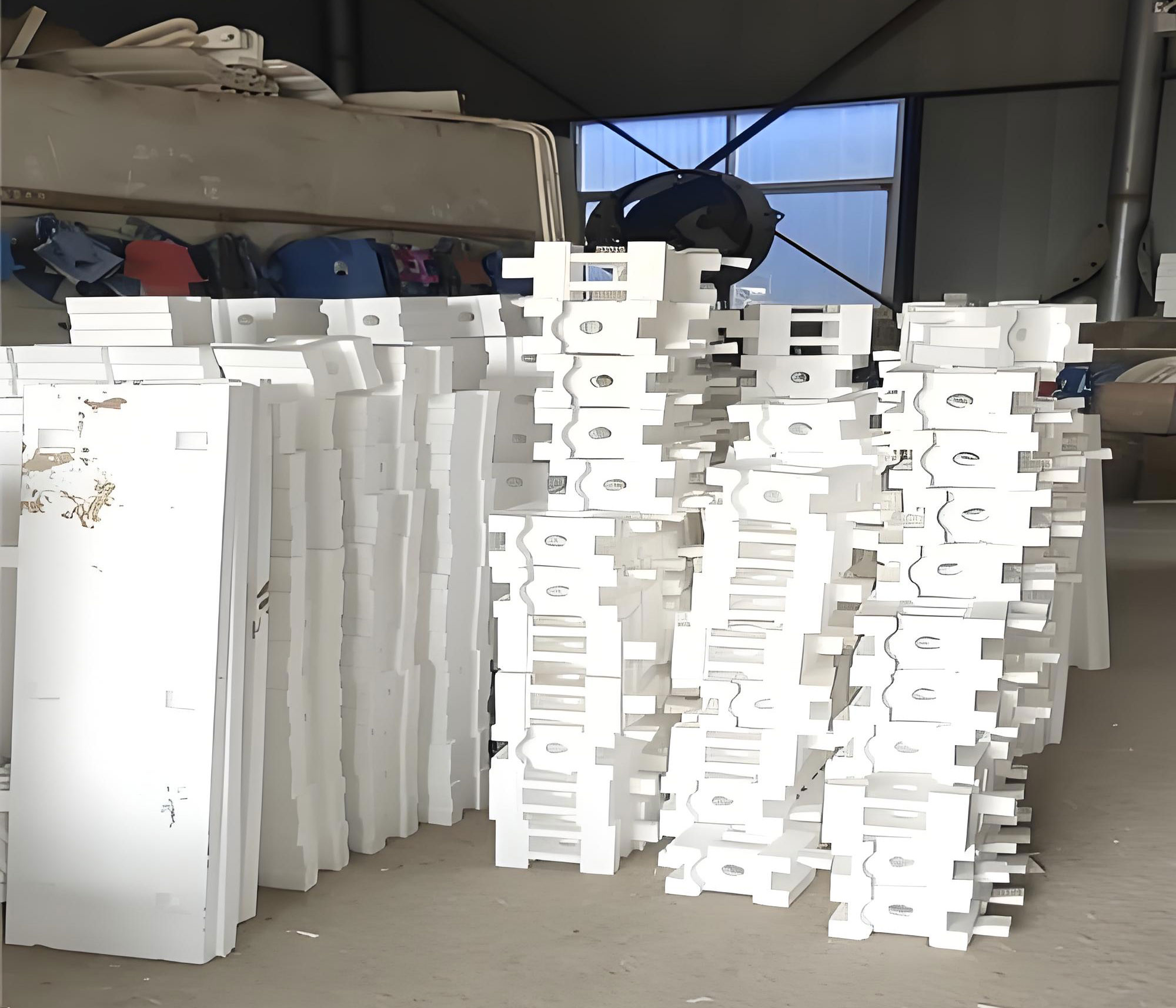
The foundation of a successful lost foam casting process is a dimensionally accurate and robust pattern. Given the size and single-batch nature of the project, manual assembly from expanded polystyrene (EPS) blocks was the most practical approach. The pattern was decomposed into three primary segments: the outer rim, the central hub section, and the connecting web. A critical parameter was the density of the EPS material. We selected a higher density of 22 g/L for the main hub structure to enhance its rigidity and resist distortion during coating, drying, and sand filling. For the gating system and risers, a lower density of 14 g/L EPS was used to minimize gas generation during the pour.
Machining allowances were applied strategically. A uniform 10 mm allowance was applied to all radial surfaces. Accounting for potential longitudinal contraction during cooling, an additional 3 mm was added to the axial (height) dimension. Assembly was conducted on a precision-leveled surface plate to ensure concentricity between the central hub and the outer rim, verifying dimensions with laser tracking. The bonding adhesive was applied with controlled bead size to prevent gaps that could lead to veining defects.
3. Gating and Risering System Design: A Multi-Level Approach
The gating design is the heart of the lost foam casting process, dictating fill velocity, temperature gradient, and slag control. For this tall, cylindrical geometry, a vertical, multi-level step-gating system was designed to ensure bottom-up, quiescent filling.
The system comprised a primary sprue (65 mm x 65 mm cross-section) feeding into a bottom runner (65 mm x 60 mm). Slag traps (100 mm long extensions) were placed at both ends of this runner. From the runner, two symmetrical ingates (60 mm x 50 mm) introduced metal at the base of the wheel. A second-level ingate (65 mm x 50 mm), angled at 45°, connected to the upper section of the central hub. A third-level ingate (65 mm x 50 mm), also at 45°, fed directly into the side of the main riser.
The risering strategy employed two distinct types: a slag collector and a feed riser. The slag collector riser (100 mm cube) was placed diametrically opposite the second-level ingate on the hub’s top face. It was designed to collect first-front metal and debris pushed ahead by the rising metal front. The primary feed riser was a large, truncated pyramid (top: 350×430 mm, bottom: 200×430 mm, height: 400 mm) placed centrally on top of the hub. The strategic connection of the third-level gate ensured the final, hottest metal entered this riser, maximizing its feeding efficiency and allowing for a 30% volume reduction compared to a conventional top riser. The layout is best visualized in the following diagram:
The fill dynamics can be modeled by considering the pressure balance. The ferrostatic pressure at any point during fill must overcome the gas pressure from decomposing foam and the flow resistance:
$$ P_{metal}(h) = \rho g h > P_{gas} + P_{friction} $$
where $P_{metal}$ is the metallostatic pressure, $\rho$ is the liquid metal density, $g$ is gravity, and $h$ is the height of metal above the point. The multi-level gates ensure $h$, and thus $P_{metal}$, is sufficient at all stages to maintain positive, controlled advancement.
4. Coating Application: Creating the Barrier Layer
The refractory coating in the lost foam casting process serves multiple critical functions: it provides a barrier between the sand and the metal, supports the pattern, allows gas permeability, and must withstand thermal shock. A zirconia-based coating was formulated for its high refractoriness and thermal stability.
| Component | Function | Quantity (per batch) | Processing Parameter |
|---|---|---|---|
| Zircon Flour | Primary Refractory Aggregate | 200 kg | 200 mesh minimum |
| Quartz Flour | Secondary Aggregate / Filler | 50 kg | 200 mesh |
| Phenolic Resin | Organic Binder (High-Temp Strength) | 20 kg | Dissolved in carrier |
| Latex (PVA-based) | Inorganic Binder (Green Strength) | 8 kg | Pre-diluted |
| Sodium Carboxymethyl Cellulose (CMC) | Composite Binder & Suspension Aid | 15 kg | Pre-soaked to gel state |
| Lithium-based Bentonite | Suspension Agent (Thixotropy) | 5 kg | Pre-hydrated for 30-40 min |
| Defoamer | Prevent Air Entrapment | 5 kg | Added last during mixing |
| Water | Carrier Liquid | To achieve target viscosity | — |
The mixing sequence was parameterized: 1) Hydrate bentonite, 2) Dissolve CMC, 3) Combine liquid binders with refractory aggregates in a high-shear mixer, 4) Add bentonite slurry and CMC gel, 5) Adjust viscosity with water, 6) Mix for a minimum of 120 minutes, 7) Transfer to holding tank for maturation.
The coating was applied by dipping the fully assembled pattern (with gating system). The process was quantified:
– Coats: 3 total coats.
– Application Thickness per Coat: 1.0 mm (wet).
– Drying Temperature: 45-50°C.
– Drying Time per Coat: 12 hours minimum.
– Final Inspection: No uncoated areas (“white spots”) permitted.
The pattern was oriented vertically during coating and drying to prevent sagging. The third coat was applied selectively to hot spots (gate connections, riser bases) to a thickness of 1.2 mm for extra erosion resistance.
5. Molding and Sand System: Ensuring Dimensional Fidelity
A dedicated flask was constructed with internal dimensions 1500 mm (L) x 1500 mm (W) x 2300 mm (H) to accommodate the pattern with adequate sand cover. The sand system parameters are vital for a stable lost foam casting process.
| Parameter | Specification | Purpose |
|---|---|---|
| Flask Vacuum System | Bottom + Single Side Draw; Dual Ø70 mm pipes | Ensure rapid vapor removal > vapor generation rate. |
| Sand Type | Ceramic (Zircon/Aluminosilicate) Beads | High thermal stability, low expansion, excellent flowability. |
| Minimum Sand Cover | Bottom: 200 mm, Sides: 150 mm, Top: 400 mm | Ensure structural support and thermal mass. |
| Vibration Compaction | 3D Vibration; 5 cycles of 2 min each | Achieve uniform, high sand density around the pattern. |
| Vibration Frequency & Acceleration | 30 Hz, 10 m/s² | Optimized for bead sand fluidization and packing. |
| Strategic Refractory Backup | 40 mm thick Magnesia-Carbon brick at sprue/runner junction | Prevent erosion from prolonged metal flow. |
The vibration compaction process followed a strict sequence at five predetermined locations (as indexed in the diagram) to eliminate any loose sand areas. The vacuum level was tested prior to pouring, requiring a static hold of at least 0.06 MPa.
6. Melting, Pouring, and Process Control
Metal preparation and the pouring event are the most dynamic phases of the lost foam casting process. Control here directly dictates internal soundness.
Charge & Melting: Steel was melted in a 3-ton medium frequency induction furnace with a silica sand lining. Charge materials were selected to limit residuals: scrap with $C \le 0.35\%$, $P \le 0.035\%$, $S \le 0.035\%$, preferring heavy sections (>6mm) over light gauge to minimize oxide formation. Target bath chemistry before tapping was: $C \le 0.30\%$, $Mn = 0.60-0.80\%$, $Si = 0.17-0.37\%$.
Tapping & Pouring:
$$ T_{tap} = 1680 – 1700\,^\circ\mathrm{C} $$
Deoxidation was performed in the furnace with 4.5 kg of aluminum. The ladle was preheated to >700°C (dark red). After tapping, 10 kg of rice hull insulator was added to the ladle to minimize temperature loss. Pouring was done using a bottom-pour stopper rod ladle with a 50 mm bore nozzle.
The pouring protocol was rigorously defined:
– Start Vacuum: 0.06 MPa, initiated 5 minutes before pour.
– Pouring Vacuum: Maintained at 0.05 – 0.06 MPa.
– Pouring Temperature ($T_{pour}$): 1660 – 1670°C.
– Pouring Technique: “Slow-Fast-Slow”. Initial slow fill to establish the metal front in the sprue, transitioning to a fast fill rate to maintain a consistent rise velocity, tapering off at the end to avoid violent impact into the riser. The pouring basin was kept full to prevent vortex formation.
The fill time ($t_f$) can be estimated by the continuity equation, relating the metal flow rate from the nozzle to the volume of the cavity and gating system:
$$ Q_{nozzle} = A_n \cdot v_n \approx \frac{V_{casting} + V_{gating}}{t_f} $$
where $A_n$ is the nozzle area, $v_n$ is the theoretical velocity ($v_n \approx \sqrt{2gh_{ladle}}$), and $V$ represents volumes. For our system, $t_f$ was targeted to be approximately 60-90 seconds.
7. Post-Casting Operations: Solidification Management
The lost foam casting process does not end at pour. Controlled cooling and handling are essential.
In-Mold Cooling: The casting was held under vacuum for 10 minutes post-pour, then the vacuum was released, but the casting remained in the sand for a total minimum of 12 hours. This ensured cooling to below 300°C before shakeout, preventing thermal shock and crack formation due to uneven section cooling rates. The cooling curve in the critical web section must avoid the brittle temperature ranges for the steel grade.
Shakeout & Finishing: After shakeout, the gating and riser system were removed via oxy-fuel cutting. The main riser required multiple cutting passes to limit heat input and prevent local hardening or micro-cracking. The cutoff allowance was set at 3 mm from the casting body.
8. Heat Treatment: Achieving the Required Microstructure
The final mechanical properties and microstructure are set by heat treatment. The goal was a fully ferrite-pearlite structure, eliminating any as-cast Widmanstätten or dendritic formations. The cycle was defined by precise parameters:
– Austenitizing Temperature ($T_A$): 910°C.
– Soak Time ($t_s$): 2.5 hours. The time was calculated based on the section thickness ($D_{max}$=~0.43 m from riser contact) using a standard rule-of-thumb for through-heating: $t_s (hours) \approx D_{max}^2 (in)\, / \,4$. In metric approximation for this mass: $t_s \propto (0.43)^2 / \alpha$, where $\alpha$ is thermal diffusivity.
– Cooling Rate: Furnace cool to below 300°C before unloading.
This full anneal cycle ensures complete transformation to the soft, ductile ferrite-pearlite aggregate, meeting the specified mechanical properties: $\sigma_s \ge 345\, \mathrm{MPa}$, $\sigma_b \ge 590\, \mathrm{MPa}$, $\delta_5 \ge 14\%$, $\psi \ge 35\%$.
9. Conclusion and Process Validation
The batch of eight wheel hubs was completed within the 15-day schedule, with all castings meeting dimensional, non-destructive testing (radiographic), and mechanical property specifications. The success was a direct result of treating the lost foam casting process as a series of quantifiable, interconnected steps. From the density of the EPS and the viscosity of the coating to the vibration frequency, pouring temperature, and annealing soak time, every critical variable was defined, measured, and controlled.
This project demonstrates that for large, heavy-section steel castings, the lost foam casting process is not only viable but highly effective when underpinned by a rigorous, parameter-driven methodology. The quantitative framework developed—encompassing pattern engineering, fluid dynamics-based gating, controlled sand compaction, and precise thermal management—provides a reliable blueprint for scaling the lost foam casting process to other demanding components, ensuring quality, efficiency, and competitiveness in the production of complex castings.