
As an engineer specializing in casting process design, I have extensively worked on improving the quality of steel castings produced via the lost foam casting process. In this article, I will detail my approach to optimizing the lost foam casting process for a critical component: the manifold throttle valve. This valve is integral to pressure control systems in oil and gas wells, where leak-tightness and structural integrity are paramount. The client reported a rejection rate nearing 60% due to shrinkage porosity and leakage issues, necessitating a thorough investigation and process redesign. My methodology centered on leveraging numerical simulation with ProCAST software to predict and mitigate defects, followed by systematic optimization of the gating system, riser placement, and key process parameters. The lost foam casting process, while advantageous for complex geometries, presents unique challenges in controlling shrinkage defects, making such optimization essential.
The manifold throttle valve casting, as analyzed, has external dimensions of 470 mm × 346 mm × 154 mm, with a weight of 33.6 kg and a volume of 23,460 cm³. Its structure features a large central cavity reinforced by four equidistant ribs, with wall thicknesses varying from 11 mm to 26 mm. The material specified is ZG230-450 cast steel, whose chemical composition is critical for understanding its solidification behavior. The primary technical requirement is a dense internal structure free from defects like shrinkage cavities, porosity, cold shuts, and gas holes. The initial lost foam casting process employed a bottom-gating system with two ingates, two horizontal runners (15 mm × 10 mm), and a vertical runner (15 mm × 15 mm), supplemented by five risers placed on the ribs and a small annular face. Process parameters included a pouring temperature of 1,600°C, a vacuum pressure of 0.05 MPa, and a polystyrene foam pattern density of 20 kg/m³. Despite this setup, dissection of rejected parts revealed significant shrinkage porosity at junctions such as the large flange and pipe body, compromising sealing performance.
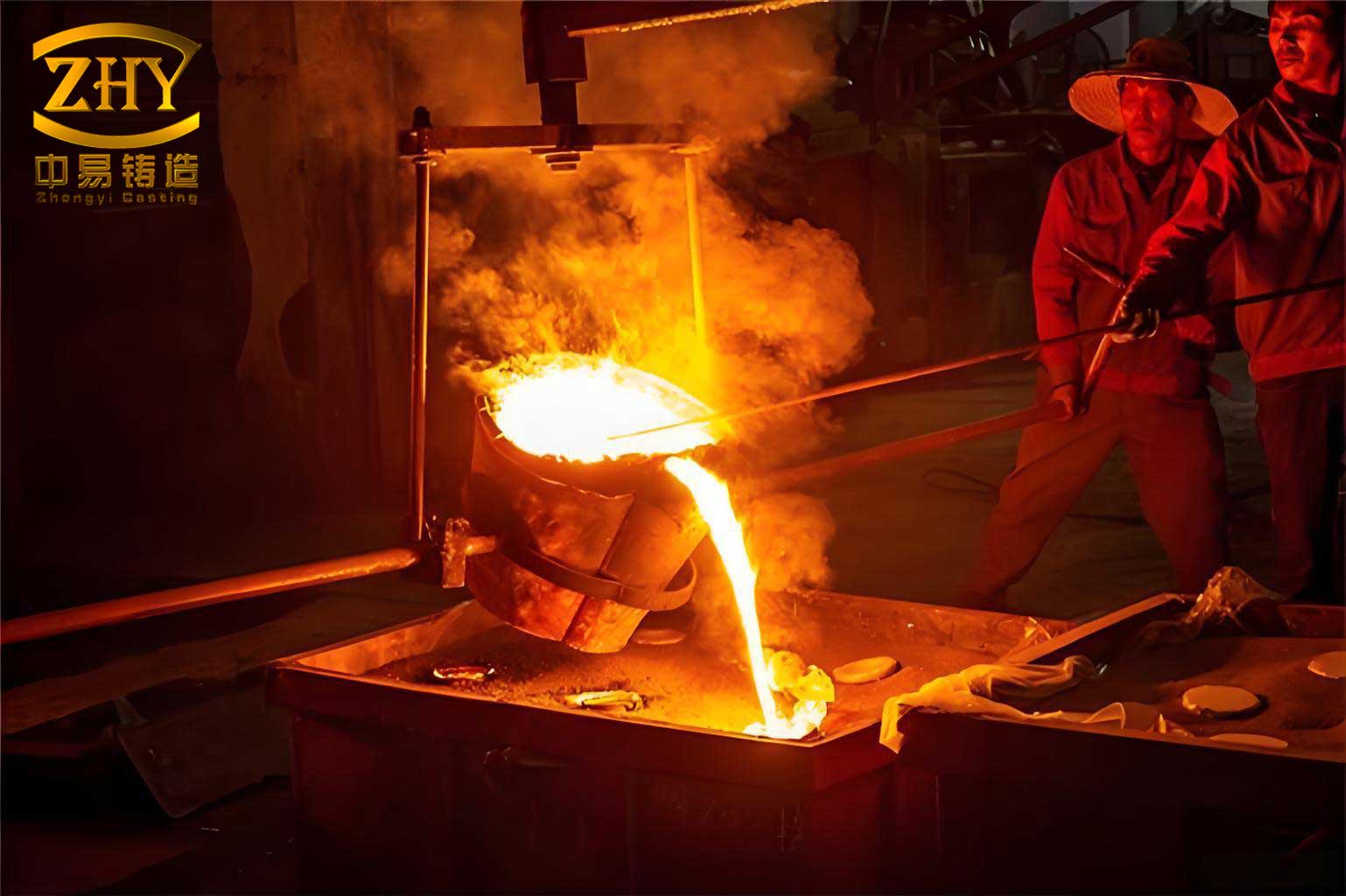
To address these issues, I initiated a simulation-driven optimization of the lost foam casting process. Using ProCAST, a finite element-based software for casting simulation, I modeled the thermal and flow dynamics during mold filling and solidification. The software solves governing equations for fluid flow, heat transfer, and phase change, enabling prediction of defect sites. For the lost foam casting process, key model inputs include the thermophysical properties of the steel, foam pattern characteristics, and interfacial heat transfer coefficients. The initial simulation under original parameters predicted a shrinkage porosity rate of 21.3%, concentrated at thick sections and riser roots, aligning with actual defects. This confirmed that the original risers, positioned directly above hot spots, solidified prematurely due to contact with cooler sand, failing to provide adequate feeding. Moreover, metal entry at thick sections caused local overheating, exacerbating shrinkage.
My first optimization focused on the gating system for the lost foam casting process. I redesigned it to a bottom-gating system with side entrance, introducing molten metal through thinner wall sections to promote directional solidification toward risers. The new design features three ingates with a cross-sectional area of 30 mm × 12 mm, a horizontal runner of 45 mm × 15 mm, and a cylindrical vertical runner of 32 mm diameter. This configuration reduces thermal concentration in thick areas. Simulation of this revised lost foam casting process showed a decrease in shrinkage porosity rate to 13.3%, indicating improvement but not full elimination. The need for better feeding led to riser optimization. I repositioned risers adjacent to, rather than directly above, hot spots to maintain thermal gradient and effective feeding. The revised layout includes risers placed near thick junctions, as illustrated in later simulations.
Further refinement involved optimizing process parameters through design of experiments. I selected three critical factors for the lost foam casting process: pouring temperature (T), vacuum pressure (P), and foam pattern density (ρ). A three-factor, three-level orthogonal array (L9) was employed, with shrinkage porosity percentage from ProCAST as the response variable. The factor levels were: T at 1,600°C, 1,640°C, and 1,680°C; P at 0.04 MPa, 0.05 MPa, and 0.06 MPa; and ρ at 19 kg/m³, 20 kg/m³, and 21 kg/m³. Each combination was simulated, and results were analyzed to identify the optimal set for minimizing defects in the lost foam casting process.
| Experiment No. | Pouring Temperature (°C) | Vacuum Pressure (MPa) | Foam Pattern Density (kg/m³) | Shrinkage Porosity Rate (%) |
|---|---|---|---|---|
| 1 | 1,600 | 0.04 | 19 | 14.4 |
| 2 | 1,600 | 0.05 | 20 | 13.3 |
| 3 | 1,600 | 0.06 | 21 | 13.5 |
| 4 | 1,640 | 0.05 | 19 | 10.4 |
| 5 | 1,640 | 0.06 | 20 | 13.6 |
| 6 | 1,640 | 0.04 | 21 | 12.7 |
| 7 | 1,680 | 0.06 | 19 | 12.5 |
| 8 | 1,680 | 0.04 | 20 | 13.2 |
| 9 | 1,680 | 0.05 | 21 | 13.3 |
The optimal combination for the lost foam casting process was identified as T = 1,640°C, P = 0.05 MPa, and ρ = 19 kg/m³, yielding the lowest shrinkage rate of 10.4%. This set was adopted for final simulations and production trials. To quantify the influence of each parameter, I performed an analysis of variance (ANOVA) based on the simulation data. The response can be modeled using a linear regression approach, where the shrinkage rate (S) is expressed as a function of the factors. A simplified empirical formula derived from the data highlights the relationships:
$$ S = k_0 + k_1 \cdot T + k_2 \cdot P + k_3 \cdot \rho + \epsilon $$
where \( k_0, k_1, k_2, k_3 \) are coefficients, and \( \epsilon \) is error. From the experimental data, increasing pouring temperature initially reduces shrinkage by improving fluidity and feeding, but excessive temperature can increase thermal stresses. Vacuum pressure affects mold stability and gas evacuation in the lost foam casting process, with an optimum around 0.05 MPa for this configuration. Lower foam density (19 kg/m³) reduces gas generation during decomposition, minimizing porosity. These insights are crucial for tailoring the lost foam casting process to specific castings.
With the optimized gating, riser placement, and parameters, I conducted a final ProCAST simulation. The results showed negligible shrinkage porosity in the valve body, with only minor defects isolated to the runner system, which is inconsequential. The predicted shrinkage rate dropped to near zero in critical areas, confirming the efficacy of the lost foam casting process optimization. Production trials were then carried out using the optimized lost foam casting process. The castings exhibited dense microstructure, no leakage defects, and met all technical specifications. The rejection rate fell from 60% to below 10%, achieving a product qualification rate over 90%. This demonstrates the power of integrating numerical simulation into the lost foam casting process design.
To generalize the findings, I developed a set of guidelines for optimizing the lost foam casting process for similar steel castings. Key principles include: using side-entry bottom gating to control metal flow, placing risers adjacent to hot spots for effective feeding, and fine-tuning parameters via simulation. The interaction between process variables can be further explored using response surface methodology. For instance, the combined effect of temperature and vacuum on shrinkage can be modeled with a quadratic equation:
$$ S = \beta_0 + \beta_1 T + \beta_2 P + \beta_3 T^2 + \beta_4 P^2 + \beta_5 TP $$
where \( \beta_i \) are coefficients. Such models allow for predictive control of the lost foam casting process. Additionally, the solidification time (\( t_s \)) in the lost foam casting process can be estimated using Chvorinov’s rule, modified for foam decomposition:
$$ t_s = C \left( \frac{V}{A} \right)^n $$
where \( V \) is volume, \( A \) is surface area, \( C \) is a constant dependent on mold material and process conditions, and \( n \) is an exponent typically around 2. For the throttle valve, the modulus \( V/A \) was calculated for critical sections to ensure risers solidify last. This theoretical foundation supports the practical adjustments made in the lost foam casting process.
In discussing the lost foam casting process, it’s important to consider the role of foam pattern properties. The density affects both the pattern strength and the amount of gaseous products during metal pouring. Lower density patterns, as optimized here, reduce residual carbon and gas defects. However, too low density may compromise pattern integrity. The decomposition kinetics can be described by an Arrhenius-type equation:
$$ k = A \exp\left(-\frac{E_a}{RT}\right) $$
where \( k \) is decomposition rate, \( A \) is pre-exponential factor, \( E_a \) is activation energy, \( R \) is gas constant, and \( T \) is temperature. In the lost foam casting process, controlling this decomposition is vital to prevent mold collapse or gas porosity. The vacuum pressure aids in removing these gases, and the optimal value of 0.05 MPa balanced evacuation with mold stability.
Another aspect of the lost foam casting process is the heat transfer at the metal-foam interface. The interfacial heat transfer coefficient (IHTC) is a critical parameter in simulations. For this study, an IHTC of 500 W/m²·K was used based on prior calibration. The IHTC varies with time and pressure, and its accurate representation enhances simulation fidelity. The general heat transfer equation during the lost foam casting process is:
$$ \rho c_p \frac{\partial T}{\partial t} = \nabla \cdot (k \nabla T) + Q $$
where \( \rho \) is density, \( c_p \) is specific heat, \( k \) is thermal conductivity, and \( Q \) is heat source from metal latent heat. ProCAST solves this numerically to predict temperature fields and solidification sequences. The success of the lost foam casting process optimization hinges on such detailed modeling.
To further illustrate the parameter effects, I compiled a comparative table of shrinkage rates under varying conditions for the lost foam casting process. This table summarizes additional simulation runs beyond the orthogonal array, providing a broader view of the process window.
| Case | Pouring Temperature (°C) | Vacuum Pressure (MPa) | Foam Density (kg/m³) | Riser Design | Shrinkage Rate (%) |
|---|---|---|---|---|---|
| A | 1,600 | 0.05 | 20 | Original | 21.3 |
| B | 1,600 | 0.05 | 20 | Optimized | 13.3 |
| C | 1,640 | 0.05 | 19 | Optimized | 10.4 |
| D | 1,640 | 0.04 | 19 | Optimized | 11.2 |
| E | 1,640 | 0.06 | 19 | Optimized | 11.8 |
| F | 1,680 | 0.05 | 19 | Optimized | 12.1 |
| G | 1,640 | 0.05 | 21 | Optimized | 12.9 |
The data underscores that the lost foam casting process is most effective with the optimal trio of parameters and riser design. Case C represents the best scenario, with shrinkage minimized. The economic impact of this lost foam casting process optimization is significant, reducing material waste and rework costs. For high-integrity applications like manifold throttle valves, such improvements are essential.
In conclusion, my work on optimizing the lost foam casting process for the manifold throttle valve casting demonstrates a systematic approach combining numerical simulation with experimental design. The key achievements include redesigning the gating system to a side-entry bottom format, repositioning risers for better feeding, and identifying optimal process parameters: pouring temperature of 1,640°C, vacuum pressure of 0.05 MPa, and foam pattern density of 19 kg/m³. These changes reduced shrinkage porosity to negligible levels, boosting product qualification above 90%. The lost foam casting process, when finely tuned, can produce high-quality steel castings with complex geometries. Future work could explore real-time monitoring and adaptive control for the lost foam casting process, further enhancing consistency. This case study serves as a blueprint for similar optimization efforts in the lost foam casting process across various industries.
Reflecting on the journey, the integration of ProCAST simulation was invaluable in visualizing defect formation and testing alternatives virtually. The lost foam casting process involves multifaceted physics, and simulation tools bridge the gap between theory and practice. I encourage fellow engineers to embrace such technologies for advancing the lost foam casting process. Moreover, continuous learning about material behaviors and decomposition dynamics will refine the lost foam casting process further. As demand for precision castings grows, the lost foam casting process will remain a vital manufacturing method, and its optimization through scientific methods will drive quality and efficiency.