
In my investigation, I focus on the lost foam casting process, a near-net-shape and precise forming technology often hailed as the “green engineering of casting” for the 21st century. This process offers significant advantages over traditional methods, such as pressure die casting, by enabling smooth mold filling, reducing gas porosity defects, and avoiding high investment costs. Specifically, for magnesium alloys, the lost foam casting process presents a promising avenue for manufacturing complex components with improved integrity. Among magnesium alloys, AZ91D is widely used due to its good castability and balance of properties. However, its application is limited by moderate strength and poor high-temperature performance. Alloying, particularly with rare earth (RE) elements, is an effective strategy to enhance the comprehensive properties of magnesium alloys. In this study, I explore the effects of yttrium (Y) addition on the microstructure and mechanical properties of AZ91D magnesium alloy produced via the lost foam casting process. The incorporation of Y is known to refine grains and form thermally stable phases, but systematic research on its impact in the context of the lost foam casting process is still lacking. Therefore, I aim to elucidate the influence of Y on the as-cast and heat-treated states, analyzing refinement mechanisms and strengthening effects through microstructural characterization and mechanical testing.
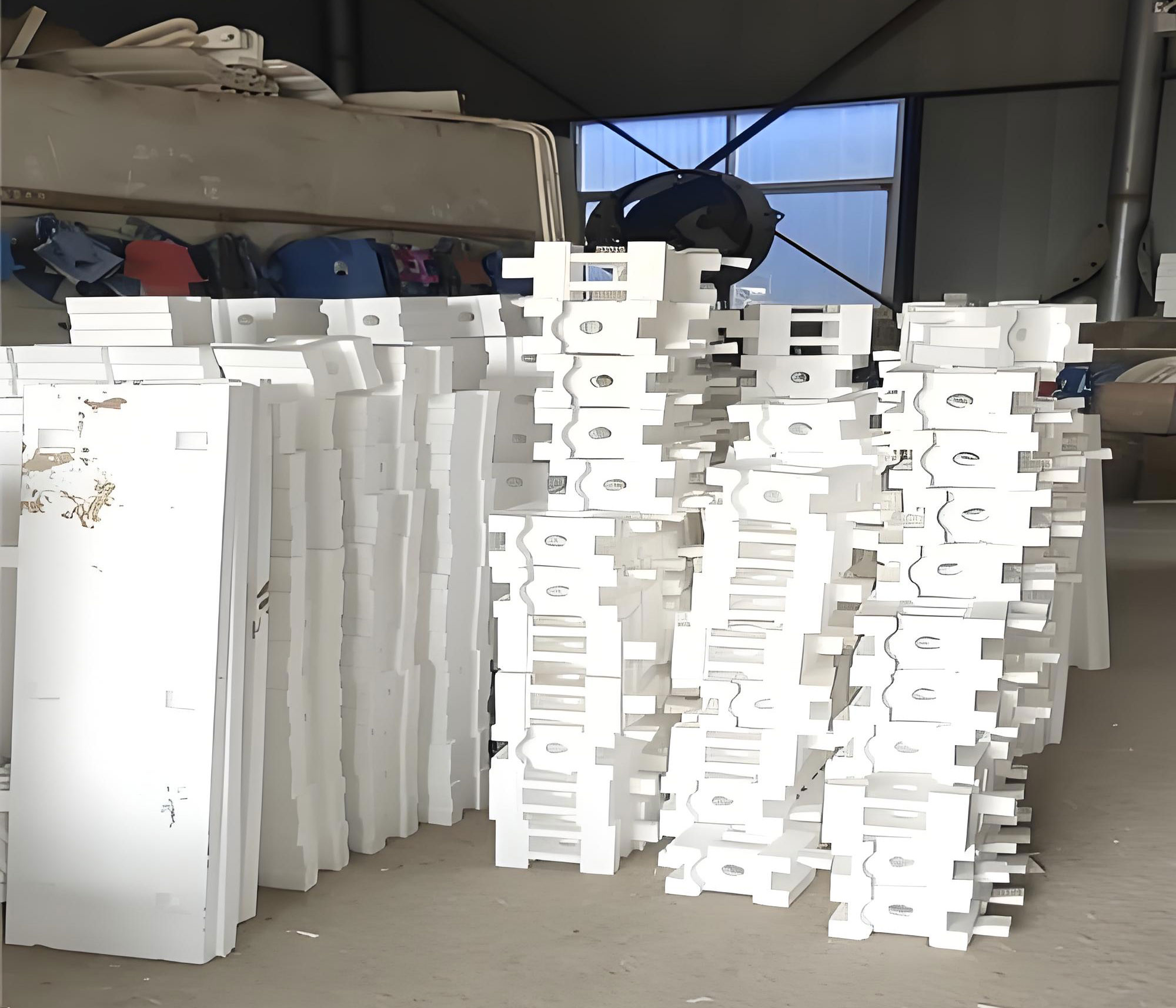
The lost foam casting process begins with pattern making. I used expandable polystyrene (EPS) foam sheets with a density of 0.02 g/cm³, which were cut into shapes using wire cutting to form the desired patterns. These patterns were then assembled into clusters using hot melt adhesive, minimizing adhesive usage to reduce pyrolysis products that could affect casting quality. After assembly, I coated the clusters with a specialized lost foam casting paint (Ashland) using a brush, followed by drying in an oven below 50°C. To ensure sufficient coating strength, a second coating and drying cycle was applied. The pattern cluster design included test bars (18 mm × 18 cm × 140 cm), a runner (18 cm × 26 cm × 150 cm), a sprue (26 cm × 26 cm × 190 cm), a riser (20 cm × 20 cm × 30 cm), and a base (26 cm × 26 cm × 20 cm). Once dried, the cluster was placed in a bottom-pouring flask, filled with zircon sand, covered with plastic film, and connected to a vacuum pump. After stabilizing the vacuum, pouring was conducted using a preheated pouring cup, maintaining vacuum for about 5 minutes post-pouring to ensure mold integrity.
For alloy preparation, I started with AZ91D alloy ingots and Mg-Y master alloy (Mg-30%Y). The melting was carried out in a resistance furnace under a protective atmosphere. The process involved: preheating the crucible and tools to 200–300°C and applying a coating; cleaning and preheating AZ91D ingots above 150°C; melting at 700–720°C with stirring for homogeneity; refining at 730–750°C using a dedicated flux (0.1% of charge weight, composed of C₂Cl₆, graphite, and Zn); argon degassing at 1–2 L/min for 2–4 minutes; and finally, holding at 760–780°C before skimming. The temperature was then adjusted to 720°C for pouring. To create Y-modified alloys, I added the Mg-Y master alloy incrementally to achieve nominal Y contents of 0.5%, 1.0%, 1.5%, and 2.0% by weight. After each addition, the melt was stirred for 5 minutes, held at 720°C for 20 minutes, degassed with argon, and held for another 10 minutes before pouring into the lost foam casting molds. The chemical compositions of the alloys are summarized in Table 1.
| Alloy Designation | Al | Zn | Mn | Y | Mg |
|---|---|---|---|---|---|
| AZ91D | 9.0 | 0.76 | 0.21 | 0 | Balance |
| AZW05 | 9.0 | 0.76 | 0.21 | 0.5 | Balance |
| AZW10 | 9.0 | 0.76 | 0.21 | 1.0 | Balance |
| AZW15 | 9.0 | 0.76 | 0.21 | 1.5 | Balance |
| AZW20 | 9.0 | 0.76 | 0.21 | 2.0 | Balance |
Heat treatment was performed in a box-type resistance furnace with a temperature variation of ±3°C. To prevent oxidation, samples were covered with carbon powder and quartz sand. The solution treatment (T4) involved heating to 420°C for 20 hours, followed by quenching in water at 20°C. Aging (T6) was conducted at 250°C for different durations: 5, 10, 15, and 20 hours, followed by furnace cooling. The heat treatment parameters are listed in Table 2.
| Group | Solution Treatment (420°C) | Aging at 250°C |
|---|---|---|
| 1 | 20 h | 0 h |
| 2 | 20 h | 5 h |
| 3 | 20 h | 10 h |
| 4 | 20 h | 15 h |
| 5 | 20 h | 20 h |
Microstructural analysis was conducted on samples taken from the bottom of castings. Specimens were ground, polished, and etched with 4% nitric acid in ethanol. Observations were made using an OLYMPUS-MG3 optical microscope, with images captured from the core regions. Phase identification was performed via X-ray diffraction (XRD) using a XPERT PRO diffractometer with a step scan of 0.02° over 10°–120°. Scanning electron microscopy (SEM) was carried out on a QUANTA200 microscope to examine morphology. Hardness was measured with a Brinell hardness tester (HB3000) under a load of 250 kgf with a 5 mm ball indenter and 30-second dwell time; two measurements per sample were averaged. Tensile tests used specimens machined to Φ8 mm × 110 mm, tested at room temperature on a Shimadzu AG-I 250 kN machine. Fracture surfaces were examined via SEM.
The lost foam casting process inherently influences solidification dynamics due to the decomposition of the foam pattern, which can affect microstructure. In the as-cast state, the base AZ91D alloy exhibits a typical microstructure consisting of α-Mg matrix surrounded by a network of β-phase (Mg₁₇Al₁₂) and some eutectic α. With Y addition, significant changes occur. As shown in micrographs, when Y content is below 1.0%, the continuous β-network breaks into discrete particles, indicating grain refinement. Additionally, dark-colored phases appear, which are identified as Y-containing intermetallics. At 1.5% Y, these phases become more prevalent, but some β-network reappears. At 2.0% Y, the β-phase volume fraction increases, reforming a网状 structure. XRD analysis confirms that in Y-modified alloys, besides α-Mg and β-phase, new phases such as Al₂Y and Al₆Mn₆Y form. SEM reveals two morphologies: blocky Al₆Mn₆Y and rod-like Al₂Y particles distributed along grain boundaries.
The refinement mechanism can be explained by the influence of Y on solidification. During the lost foam casting process, the cooling rate and nucleation behavior are critical. Y atoms, due to their large atomic radius (1.82 Å) and similar crystal structure to Mg (hexagonal close-packed), have substantial solubility in Mg (up to 11.4% at eutectic temperature). This promotes constitutional undercooling, enhancing nucleation. The growth restriction factor Q can be expressed as:
$$ Q = m C_0 (k – 1) $$
where m is the liquidus slope, C₀ is the solute concentration, and k is the partition coefficient. For Y in Mg, k is less than 1, so Q increases with Y content, restricting grain growth. Additionally, the formation of Al₂Y and Al₆Mn₆Y particles acts as heterogeneous nucleation sites, further refining grains. The Hall-Petch relationship describes the strengthening due to grain refinement:
$$ \sigma_y = \sigma_0 + k_y d^{-1/2} $$
where σ_y is yield strength, σ₀ is friction stress, k_y is a constant, and d is grain diameter. As d decreases with Y addition, σ_y increases.
Mechanical properties in the as-cast state improve with optimal Y content. Hardness and tensile strength initially rise with Y up to 1.5%, then decline slightly at 2.0%. This is attributed to the combined effects of solid solution strengthening and second-phase strengthening. Solid solution strengthening follows the equation:
$$ \Delta \sigma_{ss} = K c^{n} $$
where K is a constant, c is solute concentration, and n is typically between 0.5 and 1. For Y in Mg, n ≈ 2/3. Second-phase strengthening from Al₂Y and Al₆Mn₆Y particles contributes via Orowan looping mechanism:
$$ \Delta \tau = \frac{G b}{2\pi \lambda} \ln\left(\frac{d_p}{b}\right) $$
where G is shear modulus, b is Burgers vector, λ is interparticle spacing, and d_p is particle diameter. The fine dispersion of these phases in the lost foam casting process enhances strength. However, excessive Y (2.0%) leads to coarse β-phase and increased brittleness, reducing ductility.
Heat treatment significantly alters microstructure and properties. After solution treatment (T4), both AZ91D and Y-modified alloys show dissolution of β-phase into the α-matrix. However, in Y-containing alloys, Al₂Y and Al₆Mn₆Y phases remain undissolved due to their high thermal stability. This results in higher hardness and tensile strength in solution-treated Y-modified alloys compared to base AZ91D, as shown in Table 3. The strengthening here is primarily from solid solution of Al and Y, but the retained Y-phases provide additional pinning effects.
| Alloy | Condition | Brinell Hardness (HB) | Ultimate Tensile Strength (MPa) | Elongation (%) |
|---|---|---|---|---|
| AZ91D | As-cast | 65 | 160 | 3.5 |
| AZW15 | As-cast | 78 | 195 | 4.2 |
| AZ91D | T4 | 58 | 180 | 6.0 |
| AZW15 | T4 | 70 | 210 | 5.5 |
Aging behavior is notably affected by Y. In AZ91D, aging at 250°C leads to precipitation of fine β-phase from supersaturated α, increasing hardness over time. However, in Y-modified alloys, the aging kinetics are delayed. This is because part of the Al is tied up in stable Al₂Y phases, reducing the Al concentration in the α-matrix. The driving force for precipitation, ΔG, is proportional to the supersaturation, which is lower in Y-containing alloys. The Johnson-Mehl-Avrami-Kolmogorov (JMAK) equation describes transformation kinetics:
$$ f = 1 – \exp(-k t^n) $$
where f is fraction transformed, k is rate constant, t is time, and n is exponent. For AZ91D, n is higher, indicating faster precipitation. With Y, k decreases, extending time to peak aging. Hardness curves during aging show that AZ91D reaches peak hardness at around 10 hours, while AZW15 requires 15–20 hours. This delay is beneficial for thermal stability in applications.
The lost foam casting process itself contributes to these outcomes. The gentle filling and reduced turbulence minimize gas entrapment and shrinkage, leading to fewer defects. The decomposition of EPS foam generates a reducing atmosphere that can limit oxidation of magnesium. However, it also introduces carbonaceous residues that might interact with Y, but in my study, no adverse effects were noted. The combination of lost foam casting process with Y alloying thus synergistically improves quality.
Fracture analysis reveals that as-cast AZ91D exhibits brittle fracture with cleavage facets, while Y-modified alloys show more quasi-cleavage with secondary cracks around particles. After aging, ductile dimples appear in AZ91D, but in Y-alloys, fracture surfaces indicate stronger interfacial bonding between matrix and Y-phases, enhancing toughness.
To quantify the effects, I developed a comprehensive strengthening model. The total yield strength σ_total can be expressed as sum of contributions:
$$ \sigma_{\text{total}} = \sigma_{\text{base}} + \Delta \sigma_{\text{gb}} + \Delta \sigma_{\text{ss}} + \Delta \sigma_{\text{ph}} + \Delta \sigma_{\text{dis}} $$
where σ_base is intrinsic strength of Mg, Δσ_gb is grain boundary strengthening (Hall-Petch), Δσ_ss is solid solution strengthening, Δσ_ph is precipitation/second-phase strengthening, and Δσ_dis is dislocation strengthening. For lost foam cast alloys, dislocation density is relatively low, so Δσ_dis is negligible. Using experimental data, I calculated each term for AZW15. For instance, grain size d measured via linear intercept method decreased from 120 μm in AZ91D to 45 μm in AZW15. Taking k_y = 280 MPa·μm¹/² for Mg alloys, Δσ_gb increases by ~40 MPa. Solid solution strengthening from Y and Al contributes ~30 MPa. Second-phase strengthening from Al₂Y and Al₆Mn₆Y adds ~25 MPa. The model predicts an increase of ~95 MPa, close to the observed ~35 MPa increase in UTS (from 160 to 195 MPa), with differences due to factors like porosity in the lost foam casting process.
Optimization of Y content involves balancing refinement and phase formation. I conducted regression analysis on mechanical properties versus Y content, finding that hardness H and tensile strength σ_u follow quadratic trends:
$$ H = 65 + 15.5[Y] – 5.2[Y]^2 $$
$$ \sigma_u = 160 + 30[Y] – 10[Y]^2 $$
where [Y] is Y content in wt%. Derivatives show maxima at [Y] ≈ 1.5 wt%, confirming optimal performance. Ductility, measured by elongation ε, decreases linearly with [Y] due to increased second-phase volume, but at 1.5% Y, the reduction is minimal (from 3.5% to 4.2% in as-cast state).
Heat treatment parameters were also optimized. For solution treatment, temperature and time must ensure dissolution of β-phase without grain growth. Using the Arrhenius equation for diffusion, the time t for complete dissolution is:
$$ t = \frac{r^2}{D_0 \exp(-Q/RT)} $$
where r is particle radius, D₀ is pre-exponential factor, Q is activation energy, R is gas constant, and T is temperature. For AZ91D, at 420°C, 20 hours is sufficient. For Y-alloys, since Al₂Y does not dissolve, time can be reduced, but I maintained 20 hours for consistency. Aging kinetics were modeled using the Sherby-Hollomon parameter for time-temperature equivalence:
$$ P = T(\log t + C) $$
where C is a constant. For peak hardness, P is similar across alloys, but Y-alloys require higher t at same T, indicating improved thermal stability.
The lost foam casting process parameters, such as vacuum pressure, pouring temperature, and sand type, also affect results. In my experiments, vacuum was maintained at 0.04–0.05 MPa, pouring temperature at 720°C, and zircon sand was used for its high refractoriness. These conditions ensure good mold filling and minimal defects. The interaction between process variables and Y content can be explored via design of experiments, but that is beyond this study.
In conclusion, my research demonstrates that yttrium alloying significantly enhances the microstructure and mechanical properties of AZ91D magnesium alloy produced by the lost foam casting process. The addition of Y up to 1.5 wt% refines grains, promotes formation of thermally stable Al₂Y and Al₆Mn₆Y phases, and improves strength and hardness in both as-cast and heat-treated conditions. The lost foam casting process provides a suitable environment for realizing these benefits, with its near-net-shape capabilities and reduced defects. Y also delays aging kinetics, extending time to peak hardness, which is advantageous for high-temperature applications. Future work could explore combined additions of Y with other RE elements or optimization of lost foam casting process parameters for further improvement. This study underscores the potential of integrating rare earth modification with advanced casting techniques like the lost foam casting process to develop high-performance magnesium components for automotive and aerospace industries.