
In my extensive experience with the lost foam casting process, I have encountered and addressed numerous challenges related to defect prevention, particularly gas shrinkage porosity and sand inclusion. These defects can significantly compromise the quality and integrity of cast components, such as transmission housings and covers. Through systematic experimentation and process optimization, I have developed effective strategies to mitigate these issues, which I will elaborate on in this article. The lost foam casting process, known for its ability to produce complex geometries with high dimensional accuracy, requires meticulous control over various parameters to ensure defect-free outcomes. Here, I will share insights from practical implementations, supported by data tables and mathematical models, to enhance understanding and application of this advanced casting technique.
The lost foam casting process involves creating a foam pattern coated with a refractory material, embedding it in unbonded sand, and then pouring molten metal to replace the foam, resulting in a precise casting. However, this process is prone to defects like gas shrinkage porosity, caused by gas evolution from the decomposition of the foam or coatings, and sand inclusion, where sand particles are entrapped in the metal. My focus has been on optimizing core design, coating systems, and gating configurations to minimize these defects. Throughout this discussion, I will repeatedly emphasize the importance of the lost foam casting process, as it forms the foundation for all improvements described.
One critical aspect I addressed is gas evolution, which directly influences the formation of gas shrinkage porosity in castings. In the lost foam casting process, gas generation can stem from multiple sources, such as the foam pattern itself, coatings, or sand cores. For instance, in a production scenario involving gray iron castings, I implemented two key measures to reduce gas evolution. First, I eliminated the coating immersion step for resin-coated sand cores, which previously contributed to gas generation due to the volatilization of coating materials. This simple modification removed a significant source of gas, as described by the gas evolution rate equation: $$G = k \cdot A \cdot t \cdot e^{-E/(RT)}$$ where \(G\) is the total gas evolved, \(k\) is a rate constant, \(A\) is the surface area, \(t\) is time, \(E\) is activation energy, \(R\) is the gas constant, and \(T\) is temperature. By removing the coating, the surface area \(A\) for gas generation was reduced, thereby lowering \(G\).
Second, I modified the core-making process to create hollow sand cores instead of solid ones. This was achieved by injecting resin-coated sand into a heated core box, allowing the resin near the walls to melt briefly, then inverting the box to pour out the unmelted sand from the center. After cooling, the core formed a hollow shell structure. This change not only reduced the mass of the core but also minimized the amount of resin that could decompose and generate gas during metal pouring. The weight reduction was significant, as shown in Table 1, which summarizes the core properties before and after modification. This adjustment aligns with principles of the lost foam casting process, where reducing material mass can decrease thermal mass and gas evolution.
| Parameter | Original Solid Core | Modified Hollow Core |
|---|---|---|
| Weight (g) | 370 | 284 |
| Gas Evolution Potential | High (due to coating and resin) | Low (coating eliminated, resin reduced) |
| Thermal Mass | High | Low |
After implementing these measures, the gas shrinkage porosity in specific castings, such as the GK-001 component, was effectively controlled. This success underscores the importance of tailored interventions in the lost foam casting process to address root causes of defects. The reduction in gas evolution can be quantified using the ideal gas law approximation: $$P \cdot V = n \cdot R \cdot T$$ where \(P\) is pressure, \(V\) is volume, \(n\) is moles of gas, \(R\) is the gas constant, and \(T\) is temperature. By decreasing \(n\) through process changes, the pressure buildup in the mold cavity is minimized, preventing porosity formation.
Turning to sand inclusion defects, which are prevalent in the lost foam casting process, I conducted a series of investigations to identify key factors and solutions. Sand inclusion occurs when sand particles from the mold or coating are dislodged and entrapped in the molten metal, leading to surface or internal defects. Over a three-year period, I analyzed various components, such as gearbox housings, and implemented multiple corrective actions. These efforts centered on improving the quality of pouring cups, enhancing the coating system, optimizing gate design, and refining operational details. Each of these elements plays a crucial role in the overall efficacy of the lost foam casting process.
The quality of pouring cups emerged as a critical factor. In one instance, I observed a spike in sand inclusion rejection rates from 1.0% to 3.5% over two months, which correlated with the use of pouring cups from a supplier that had inconsistent refractoriness and strength. These cups tended to crack during pouring, allowing sand to infiltrate the mold through the cracks. To validate this, I tracked castings associated with cracked pouring cups and recorded the sand inclusion rates, as detailed in Table 2. The data clearly shows that cracking during pouring significantly increases the likelihood of sand inclusion, with the highest rates occurring when cracks form early in the pour.
| Pouring Cup Cracking Timing | Number of Cups Cracked | Number of Castings with Sand Inclusion | Sand Inclusion Rate (%) |
|---|---|---|---|
| Cracking at Pour Start | 24 | 6 | 25.00 |
| Cracking During Pour | 66 | 3 | 4.55 |
| Cracking at Pour End | 72 | 2 | 2.78 |
| No Cracking | 85 | 0 | 0.00 |
Upon switching to higher-quality pouring cups with better refractoriness (above 1550°C) and strength, the cracking incidents ceased, and the sand inclusion rate dropped back to 1%. This improvement highlights how material selection in the lost foam casting process can directly impact defect rates. The refractoriness of a pouring cup can be modeled using the Arrhenius equation for thermal degradation: $$r = A \cdot e^{-E_a/(R \cdot T)}$$ where \(r\) is the degradation rate, \(A\) is a pre-exponential factor, \(E_a\) is activation energy, \(R\) is the gas constant, and \(T\) is temperature. Higher refractoriness corresponds to a lower degradation rate at pouring temperatures, reducing the risk of cracking.
Another vital aspect is the coating system used on the foam patterns. In the lost foam casting process, the coating serves as a barrier between the foam and the sand, preventing sand erosion and inclusion. I found that increasing the coating thickness and enhancing its strength and refractoriness are key to minimizing sand inclusion. For example, for a heavy casting weighing around 87 kg, I increased the coating thickness on the gating system to over 2 mm, up from the standard 1.5 mm used for lighter components. This was achieved by applying additional coats of a refractory coating based on bauxite (with 74% Al2O3) as the aggregate. The relationship between coating thickness \(d\) and its resistance to erosion can be expressed as: $$F_{erosion} = \frac{\rho \cdot v^2 \cdot A}{2 \cdot \sigma}$$ where \(F_{erosion}\) is the erosion force, \(\rho\) is metal density, \(v\) is flow velocity, \(A\) is area, and \(\sigma\) is the coating’s tensile strength. By increasing \(d\), the effective \(\sigma\) is improved due to better sintering and bonding, thereby reducing \(F_{erosion}\).
To illustrate the impact of coating optimization, consider a specific component where sand inclusion rejection reached 15%. After increasing the coating thickness to over 2 mm by applying four coats instead of three, the rejection rate fell to 1.4%. Similarly, for another part with a complex gating system, enhancing the coating thickness to 2.5 mm resulted in a breakthrough in sand inclusion control. These outcomes reinforce the principle that in the lost foam casting process, robust coating systems are essential for defect prevention. The coating’s performance can be summarized by a quality index \(Q_c\): $$Q_c = \frac{S \cdot R_f}{d \cdot \rho_c}$$ where \(S\) is strength, \(R_f\) is refractoriness, \(d\) is thickness, and \(\rho_c\) is coating density. Higher \(Q_c\) values correlate with better sand inclusion resistance.
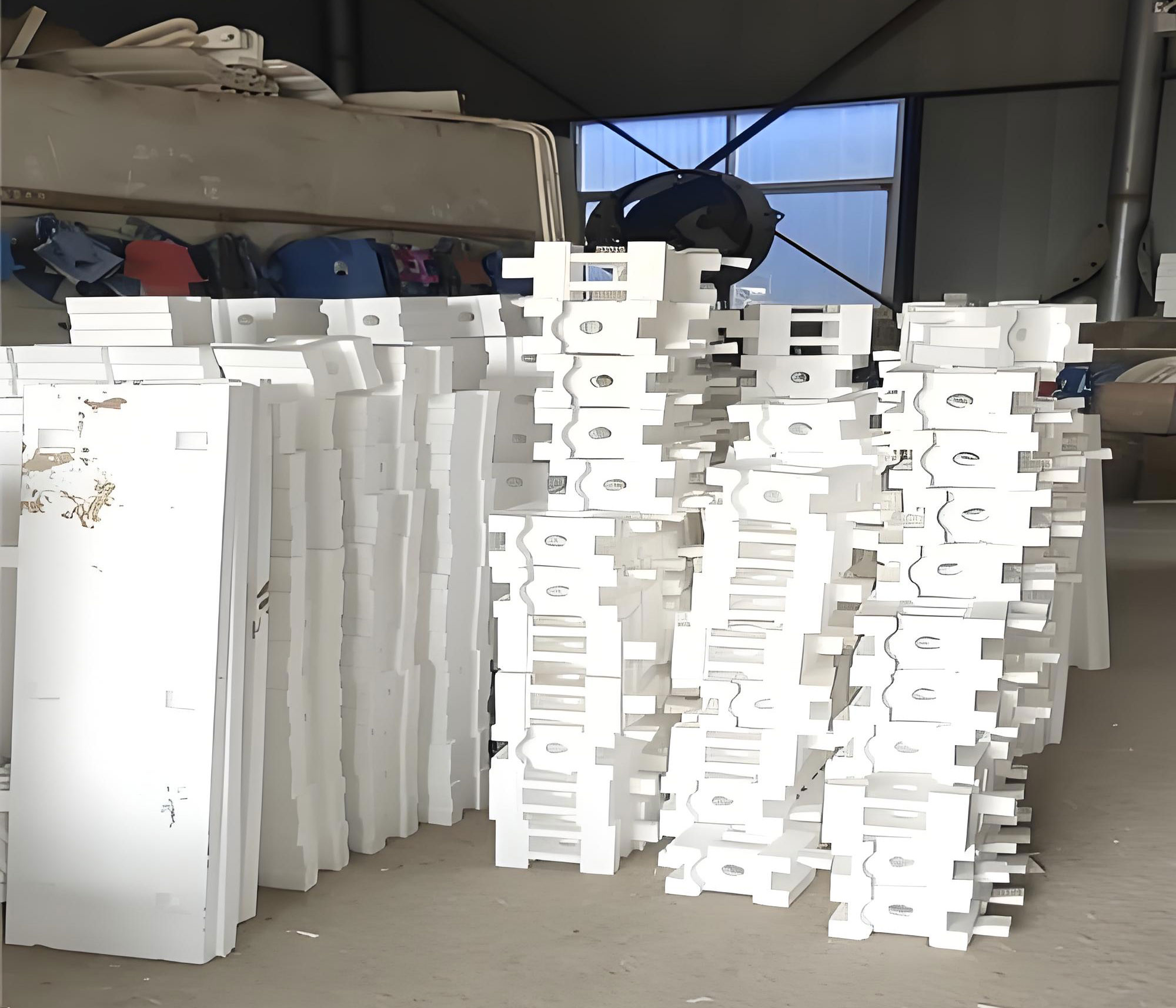
The positioning of gates within the gating system also profoundly affects sand inclusion in the lost foam casting process. I experimented with different gate locations and found that placing gates at the bottom of the casting, rather than at the middle, reduces sand inclusion. This is because bottom gating promotes smoother metal flow with lower velocity, minimizing冲刷 on the coating. For instance, in one component, relocating the gate from the mid-section to the bottom decreased the sand inclusion rejection rate from 8% to a much lower level. The fluid dynamics can be described using Bernoulli’s principle: $$P + \frac{1}{2} \rho v^2 + \rho g h = \text{constant}$$ where \(P\) is pressure, \(\rho\) is density, \(v\) is velocity, \(g\) is gravity, and \(h\) is height. Bottom gating reduces \(v\) at the gate entrance, lowering the dynamic pressure that can erode the coating.
Moreover, I observed that阶梯式浇注系统 (step gating systems) with multiple gates are more prone to sand inclusion compared to single-gate systems, due to increased flow complexity and冲刷. However, for certain castings, step gating is necessary to ensure proper filling. In such cases, I compensated by further increasing the coating thickness on the gating system. This balance between gating design and coating integrity is a key consideration in the lost foam casting process. Table 3 compares sand inclusion rates for different gating configurations, highlighting the trade-offs involved.
| Gating Configuration | Number of Gates | Typical Coating Thickness (mm) | Sand Inclusion Rate (%) |
|---|---|---|---|
| Single Bottom Gate | 1 | 1.5-2.0 | 1.0-2.0 |
| Step Gating (Multiple Gates) | 3 | 2.0-2.5 | 2.5-5.0 |
| Mid-Section Gate | 1 | 1.5 | 8.0+ |
Beyond these primary factors, I identified several operational details that can influence sand inclusion in the lost foam casting process. For example, excessive adhesive used during pattern assembly can impair coating adhesion, leading to thin spots prone to erosion. I recommend trimming excess adhesive to ensure uniform coating application. Additionally, during mold preparation, it is crucial to remove any sand from the film covering the pouring cup, as疏忽 can introduce sand into the mold. Furthermore, any damage to the coating during handling must be repaired with a thick补刷 of refractory coating and re-drying, especially in machined areas. These practices, though seemingly minor, collectively enhance the reliability of the lost foam casting process.
To synthesize these insights, I developed a comprehensive model for defect prevention in the lost foam casting process. The overall defect rate \(D\) can be expressed as a function of multiple variables: $$D = f(G, C, P, O)$$ where \(G\) represents gas evolution factors, \(C\) denotes coating system quality, \(P\) accounts for gating and pouring parameters, and \(O\) covers operational细节. By optimizing each variable through the measures described—such as hollow cores, improved pouring cups, thicker coatings, and bottom gating—the defect rate can be minimized. Empirical data from my implementations show a reduction in gas shrinkage porosity to near zero and sand inclusion rates below 2% for most components.
In conclusion, the lost foam casting process offers significant advantages for producing complex castings, but it demands careful attention to defect prevention. My实践经验 demonstrates that through targeted interventions—eliminating gas sources, enhancing coating systems, optimizing gating, and refining operations—both gas shrinkage porosity and sand inclusion can be effectively controlled. The integration of mathematical models and data-driven adjustments, as outlined in this article, provides a robust framework for improving quality in the lost foam casting process. As the industry evolves, continuous innovation in materials and techniques will further enhance the capabilities of this versatile casting method, ensuring its relevance for high-integrity applications.
Reflecting on these experiences, I emphasize that the lost foam casting process is inherently dynamic, requiring adaptability and rigorous quality control. The measures I implemented are not standalone fixes but part of a holistic approach that considers the entire production chain. For instance, the hollow core design not only reduces gas evolution but also improves cooling rates, which can be modeled using Fourier’s law: $$q = -k \cdot \nabla T$$ where \(q\) is heat flux, \(k\) is thermal conductivity, and \(\nabla T\) is temperature gradient. Similarly, coating thickness adjustments align with principles of fluid mechanics and materials science. By sharing these insights, I hope to contribute to the broader adoption and refinement of the lost foam casting process across the manufacturing sector.
Finally, I encourage practitioners to document their own experiences and data, as collective learning is key to advancing the lost foam casting process. Through collaboration and continuous improvement, we can overcome common defects and unlock the full potential of this innovative casting technology. The journey from defect-prone production to reliable output underscores the importance of persistence and analytical thinking in the lost foam casting process, making it a rewarding field for engineers and foundry specialists alike.