
As a team dedicated to advancing urban infrastructure, we embarked on a project to revolutionize drainage inspection wells. Traditional materials like plastic, concrete, or brick often fall short in durability, sealing, and environmental sustainability. To address these issues, we developed a ductile iron inspection well chamber produced entirely via the lost foam casting process. This innovative approach leverages the flexibility and precision of lost foam casting to create robust, seamless components that outperform conventional alternatives. In this article, I will detail our研发 journey, emphasizing how lost foam casting enabled us to achieve superior strength, cost-effectiveness, and ease of installation.
Drainage inspection wells serve as critical hubs in urban管网 systems, facilitating inspection, cleaning, and疏通. They come in various types: flow-channel wells versus sediment chamber wells based on internal structure; straight, elbow, tee, or cross wells based on shape; and普通, water-seal, or drop wells based on function. Interface types include T-type, K-type, and flange connections. Our goal was to design a well that integrates all these variations with enhanced performance. By adopting lost foam casting, we could整铸 complex geometries without the need for extensive tooling, reducing模具 costs and production time significantly.
The core of our innovation lies in the lost foam casting process. This technique involves creating a foam pattern of the desired component, coating it with a refractory material, embedding it in sand, and then pouring molten metal to replace the foam, resulting in a precise, near-net-shape casting. For our ductile iron inspection wells, we utilized existing pipe fitting molds to produce modular foam片, which were then assembled into various well configurations. This modularity allowed us to quickly adapt to different design requirements, such as沉泥式 or流槽式 chambers, with minimal additional investment. The lost foam casting process ensured excellent dimensional accuracy and surface finish, critical for achieving tight seals and reducing post-casting machining.
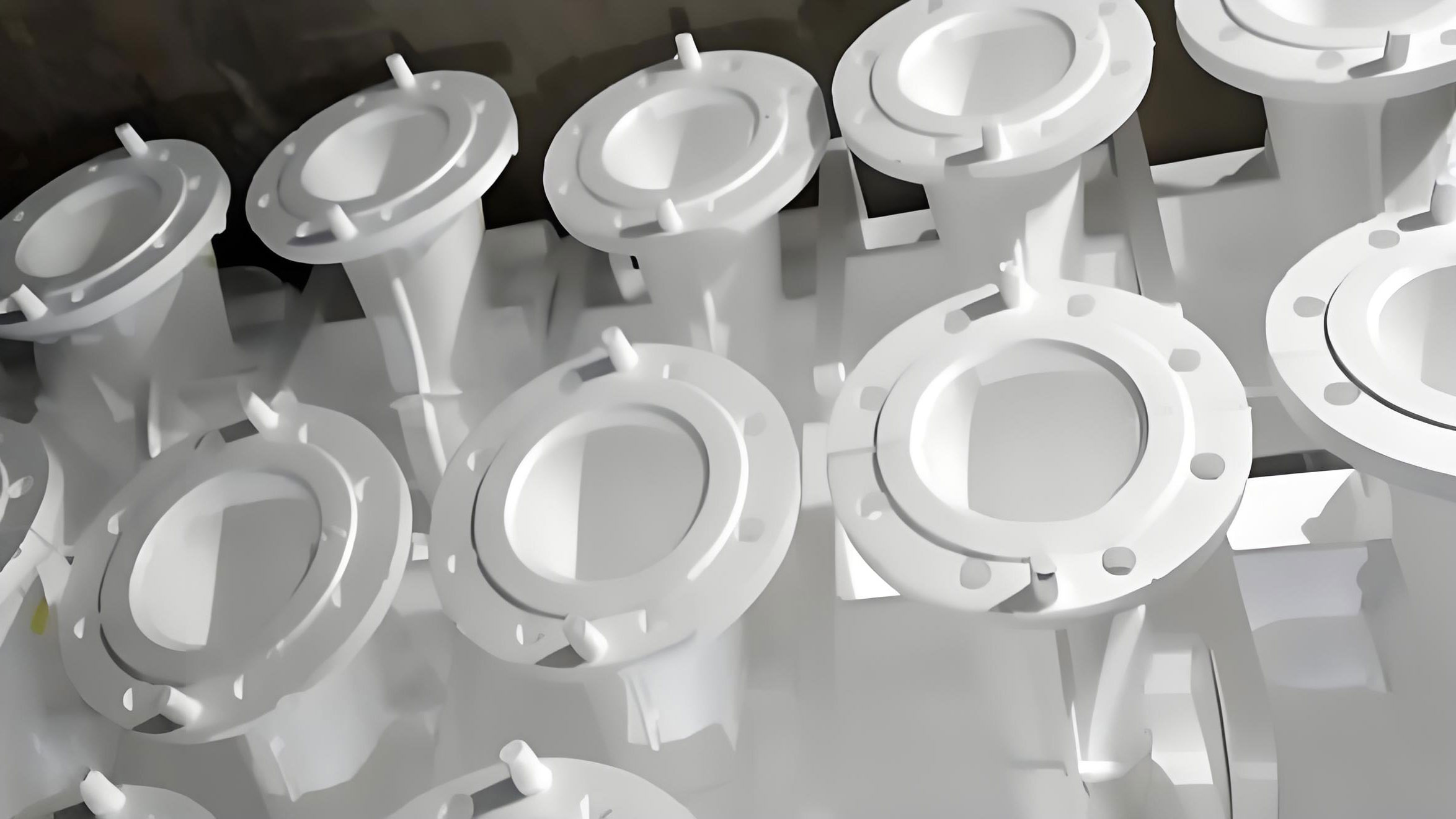
Our production workflow for the inspection wells involved several key stages, each optimized for the lost foam casting method. First, we prepared the molten iron using a combination of blast furnace and medium-frequency furnace短流程工艺. The raw iron composition was carefully controlled to ensure high-quality ductile iron with optimal球化 properties. We maintained the composition within specific ranges, as summarized in Table 1. The chemical control is crucial for achieving the desired mechanical properties in the final casting, and lost foam casting allows for consistent replication of these properties due to its stable thermal conditions.
| Element | Control Range (wt.%) |
|---|---|
| C | 3.7–4.2 |
| Si | 0.5–1.5 |
| Mn | ≤0.4 |
| P | ≤0.10 |
| S | ≤0.03 |
| Fe | Balance |
The球化 treatment was performed using wire feeding, with an addition rate of 20–30 m/t, adjusted based on residual magnesium levels. Inoculation with Fe-Si was applied to enhance石墨 formation. The final molten iron composition after treatment is shown in Table 2. This precise control is integral to the lost foam casting process, as it ensures the铁水 has adequate fluidity and solidification characteristics to fill the complex foam patterns without defects.
| Element | Control Range (wt.%) |
|---|---|
| C | 3.1–3.7 |
| Si | 2.2–2.8 |
| Mn | ≤0.4 |
| P | ≤0.10 |
| S | ≤0.02 |
| Mg | 0.035–0.06 |
| RE | ≤0.02 |
| Fe | Balance |
Foam pattern preparation was a critical step in the lost foam casting process. We used expanded polystyrene (EPS) beads to create模片 with existing molds, then assembled them into full-scale models of inspection wells. These models were coated with a refractory slurry to form a barrier against metal penetration and improve surface quality. The coating thickness, $ d_c $, was optimized based on the well size and浇注 parameters, following the relation: $$ d_c = k \cdot \sqrt{t_f} $$ where $ k $ is a material constant and $ t_f $ is the foam decomposition time. After drying, the patterns were placed in sand molds with a vacuum system to maintain stability during pouring.
For浇注, we designed two types of gating systems depending on the well size. Large wells (e.g., DN1600) had internal gating to ensure proper feeding, while small wells used external systems. The浇注 temperature, $ T_p $, was controlled between 1450°C and 1520°C, with higher temperatures for smaller castings to prevent premature solidification. The浇注 rate, $ v_p $, was modulated to achieve smooth filling, governed by the Bernoulli equation for fluid flow: $$ \frac{P}{\rho g} + \frac{v_p^2}{2g} + h = \text{constant} $$ where $ P $ is pressure, $ \rho $ is density, $ g $ is gravity, and $ h $ is height. Vacuum pressure in the sand mold was kept at 0.05–0.06 MPa to evacuate foam decomposition gases, a key advantage of lost foam casting that reduces porosity and improves integrity.
Post-casting operations included shakeout, cutting of gating systems, shot blasting, machining, and coating. The wells were made of QT420-5 ductile iron, with mechanical properties exceeding 420 MPa tensile strength, 270 MPa yield strength, and 5% elongation. Graphite球化等级 was maintained above grade 3, and石墨 size above grade 6. Specifications ranged from DN300 to DN2600, with weights from 50 kg to 2500 kg and wall thicknesses from 9.6 mm to 37.2 mm. The lost foam casting process ensured uniform wall thickness and minimal residual stress, enhancing the well’s resistance to基础沉降.
Interface connections were designed for compatibility with existing pipelines. We adopted T-type and K-type socket connections, as well as flange interfaces, all sealed with rubber gaskets. The accuracy afforded by lost foam casting allowed for tight tolerances on承插口, ensuring leak-proof joints. Assembly was simplified, requiring only basic tools for field installation, which reduced施工 time and labor costs. Additionally,防腐 coatings were applied internally and externally, using富锌漆 or epoxy systems, to extend service life in corrosive environments.
To quantify the benefits, we conducted a comprehensive analysis across multiple dimensions. In terms of quality, the lost foam casting process yielded wells with high dimensional stability and structural integrity. The ductile iron material offered superior mechanical properties compared to plastics or concrete, as summarized in Table 3. The lost foam casting technique minimized defects like shrinkage and冷隔, which are common in traditional casting methods.
| Material | Tensile Strength (MPa) | Yield Strength (MPa) | Elongation (%) | Key Advantages |
|---|---|---|---|---|
| Ductile Iron (Lost Foam) | ≥420 | ≥270 | ≥5 | High strength, good ductility, excellent castability |
| Plastic (e.g., HDPE) | 20–30 | N/A | 500–1000 | Lightweight, corrosion-resistant, but low strength |
| Concrete | 3–5 | N/A | Brittle | Low cost, but prone to cracking and渗漏 |
| Brick | Varies | N/A | Brittle | Traditional, but labor-intensive and permeable |
Production efficiency was greatly enhanced by lost foam casting. The modular pattern system reduced模具 lead time to under one week for batch production. Assembly and installation could be completed rapidly, with a crew of two installing up to 20 wells per day, compared to 1–2 wells per day for brick or concrete alternatives. This efficiency stems from the precision of lost foam casting, which minimizes on-site adjustments. We derived a formula for production time savings, $ S_t $, based on well complexity: $$ S_t = \frac{T_{traditional} – T_{lost foam}}{T_{traditional}} \times 100\% $$ where $ T_{traditional} $ and $ T_{lost foam} $ are the times for conventional and lost foam casting methods, respectively. For complex shapes, savings exceeded 50%.
Environmental benefits were significant. Ductile iron is fully recyclable, aligning with circular economy principles, whereas plastics pose降解 challenges and concrete generates construction waste. The lost foam casting process itself is relatively eco-friendly, as it uses sand that can be reclaimed and reused. Energy consumption during melting and浇注 was optimized through process control, reducing the carbon footprint. We estimated the environmental impact using a life-cycle assessment (LCA) model, where the lost foam casting method showed lower embodied energy per well compared to alternatives.
Cost-effectiveness was analyzed from both production and lifecycle perspectives. Initial模具 costs were low due to the reuse of existing molds, and the lost foam casting process reduced machining expenses. Installation and maintenance costs were minimized thanks to the durable design and easy assembly. Table 4 provides a comparative economic analysis. The lost foam casting approach enabled us to achieve a lower total cost of ownership, even with higher material costs for ductile iron, because of extended lifespan and reduced downtime.
| Well Type | Material Cost ($) | Production Cost ($) | Installation Cost ($) | Maintenance Cost ($/year) | Expected Lifespan (years) | Total Lifecycle Cost ($) |
|---|---|---|---|---|---|---|
| Ductile Iron (Lost Foam) | 150 | 100 | 50 | 5 | 50+ | 500 |
| Plastic | 80 | 70 | 40 | 10 | 20 | 390 |
| Concrete | 60 | 90 | 100 | 15 | 30 | 700 |
| Brick | 40 | 120 | 120 | 20 | 25 | 740 |
Social and market implications are profound. With urbanization accelerating, annual demand for drainage inspection wells in China alone exceeds 4 million units, translating to a potential market of 800,000 tons per year for ductile iron wells. Our lost foam casting technology positions us to capture this market by offering a superior product. The wells have been deployed in over 20 provinces for河道治理,管廊 projects, and埋地 systems, demonstrating reliability in diverse conditions. The lost foam casting process ensures consistency across batches, which is crucial for large-scale infrastructure projects.
From a technical perspective, we encountered challenges during development, such as controlling foam decomposition gases and ensuring coating integrity. Through iterative testing, we optimized parameters like vacuum pressure and浇注 speed. We developed empirical formulas to predict casting quality, such as the defect probability index, $ D_p $, for lost foam casting: $$ D_p = \alpha \cdot \exp(-\beta \cdot T_p) + \gamma \cdot V_g $$ where $ \alpha $, $ \beta $, and $ \gamma $ are constants, $ T_p $ is浇注 temperature, and $ V_g $ is gas evacuation rate. By minimizing $ D_p $, we achieved a rejection rate below 2%, showcasing the robustness of lost foam casting.
Future work involves scaling up the lost foam casting process for even larger components and exploring automation to further reduce costs. We are also researching advanced coatings to enhance corrosion resistance, leveraging the smooth surfaces produced by lost foam casting. The integration of digital tools, such as simulation software for mold filling and solidification, will refine our process control. We believe that lost foam casting holds immense potential for other infrastructure components, paving the way for smarter, more sustainable cities.
In conclusion, our研发 of ductile iron drainage inspection wells using lost foam casting has yielded a product that excels in strength, durability, and ease of installation. The lost foam casting process enabled us to overcome limitations of traditional methods, offering a cost-effective and environmentally friendly solution. As we continue to innovate, lost foam casting remains at the core of our strategy, driving advancements in urban排水 systems. The成功 of this project underscores the transformative power of lost foam casting in modern manufacturing, and we are committed to expanding its applications for the benefit of society.