
The pursuit of lightweight, high-performance components drives the development of multi-material structures. Among these, Al/Mg bimetal components, which combine the advantageous properties of aluminum (e.g., good castability, corrosion resistance) and magnesium (e.g., low density, high specific strength), hold significant promise for automotive and aerospace applications. Fabricating a reliable metallurgical bond between these dissimilar metals, however, presents a considerable challenge. Lost foam casting (LFC) emerges as a highly suitable near-net-shape process for manufacturing such complex bimetal castings. Its advantages include the ability to securely position solid inserts within the foam pattern without additional fixtures and the generation of a reducing atmosphere from foam decomposition, which minimizes oxidation of both the molten metal and the solid insert.
While heat treatment is a standard post-processing step to optimize the microstructure and properties of monolithic castings, its application to bimetal systems like Al/Mg is far more complex. Traditional heat treatment protocols designed for single alloys may not be suitable, as they must accommodate two distinct metal matrices with different physical and metallurgical properties, along with the often brittle intermetallic compound (IMC) layers formed at the interface. The development of specialized heat treatment strategies is therefore critical to manage the interface integrity, control IMC growth, and ultimately enhance the performance of lost foam casting bimetal components. This work systematically investigates the effects of different heat treatment parameters—namely cooling method, homogenization time, and the implementation of multi-step cycles—on the interfacial microstructure of solid-liquid compound Al/Mg bimetals produced via lost foam casting.
1. Principles of Solid-Liquid Compound Casting via Lost Foam
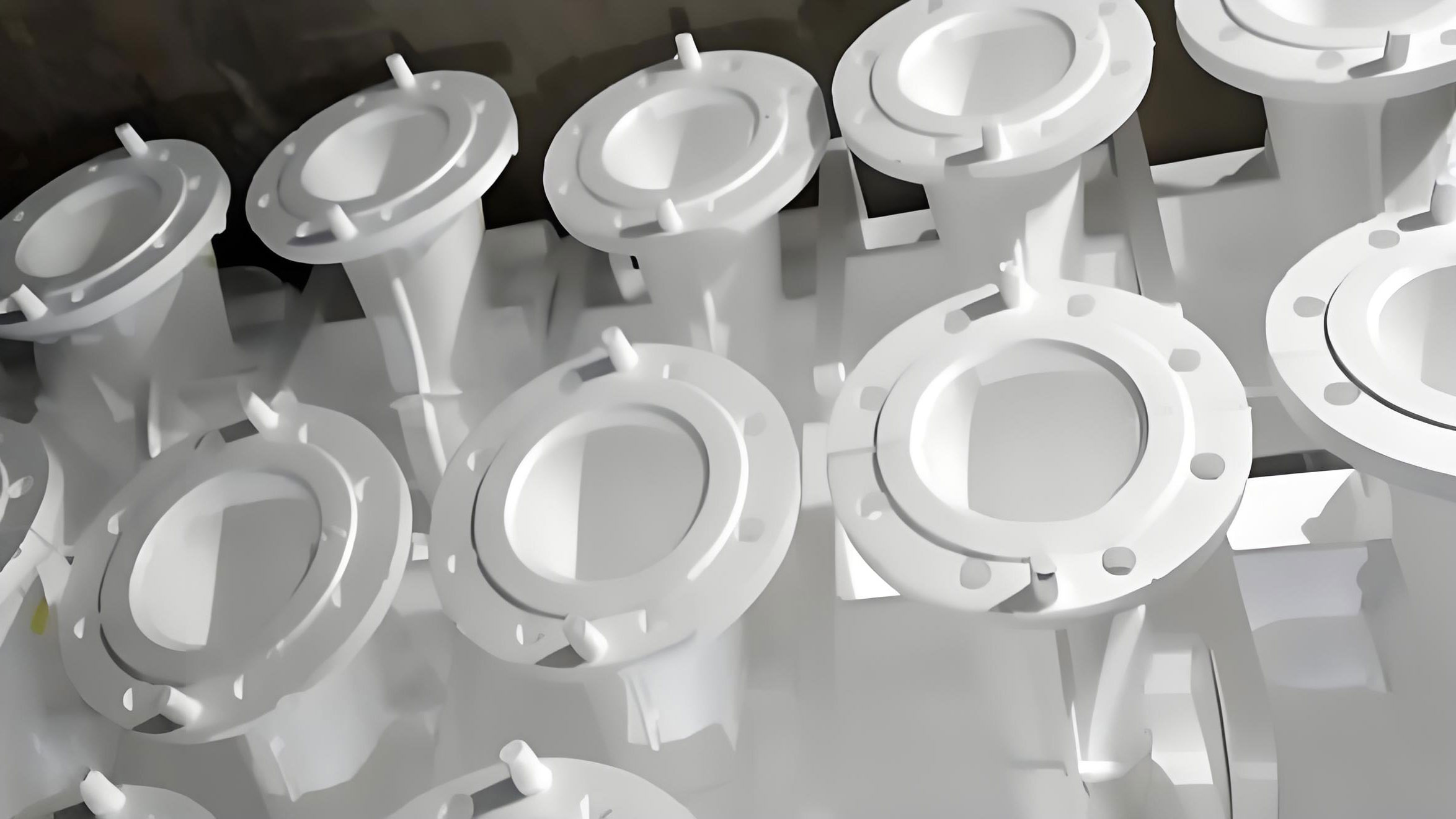
The solid-liquid compounding process using lost foam casting involves embedding a solid metal insert (e.g., an aluminum alloy preform) within a expandable polystyrene (EPS) foam pattern of the desired component geometry. The assembly is then coated with a refractory slurry, dried, and placed in a flask filled with unbonded sand. When molten metal (e.g., magnesium alloy) is poured into the pattern, the EPS foam rapidly decomrades due to the heat, and the resulting cavity is filled by the melt, which consequently surrounds and bonds with the solid insert. A key feature of this process is the establishment of a direct metallurgical bond at the Al/Mg interface through interdiffusion and reaction during the casting process.
2. As-Cast Interface Characteristics
Prior to heat treatment, the interface of the Al/Mg bimetal produced by lost foam casting exhibits a characteristic multi-layer structure resulting from the interdiffusion of Al and Mg atoms and the reaction with alloying elements like Si. Typically, the interface zone can be delineated into three distinct reaction layers, as summarized in Table 1.
| Layer Designation | Location (from Al side) | Primary Phase Composition | Approximate Characteristics |
|---|---|---|---|
| Reaction Layer I | Adjacent to Al matrix | Al3Mg2 + Mg2Si particles | Brittle IMC layer, often continuous. |
| Reaction Layer II | Intermediate | Al12Mg17 + Mg2Si particles | Another IMC layer, may contain porosity. |
| Reaction Layer III | Adjacent to Mg matrix | Al12Mg17 + δ-Mg eutectic | Eutectic mixture, transition to Mg matrix. |
In the Mg matrix, the Al12Mg17 phase typically exists as a coarse, continuous network along the grain boundaries. The integrity of this as-cast interface is generally good, without macroscopic cracks. However, the presence of these brittle IMC layers and the microstructural inhomogeneity are detrimental to mechanical properties, necessitating controlled heat treatment.
3. Influence of Cooling Method Post-Homogenization
The choice of cooling method after high-temperature homogenization annealing is crucial for interface integrity. Homogenization was performed at 420°C, followed by either air cooling (AC) or furnace cooling (FC).
3.1 Air Cooling: Crack Formation
Following homogenization with air cooling, significant crack defects were observed at the interface. Cracking primarily occurred at two critical locations:
- The junction between the Al matrix and Reaction Layer I (Al3Mg2 + Mg2Si).
- The boundary between Reaction Layer II and Reaction Layer III.
This phenomenon is attributed to the thermal stresses generated during rapid cooling. The coefficient of thermal expansion (CTE) mismatch between the Al matrix, the Mg matrix, and the various IMCs induces significant residual stresses. The brittle IMC layers, with limited ductility, cannot accommodate these stresses, leading to interfacial decohesion and crack propagation. The stress concentration at the interfaces between layers with different mechanical properties further exacerbates this issue. A simplified model for the thermal stress ($\sigma_{th}$) at the interface can be considered:
$$
\sigma_{th} \approx E \cdot \Delta \alpha \cdot \Delta T
$$
where $E$ is the effective Young’s modulus, $\Delta \alpha$ is the difference in CTE between adjacent layers, and $\Delta T$ is the temperature change during cooling. The rapid $\Delta T$ in air cooling maximizes this stress.
3.2 Furnace Cooling: Diffusion Layer Formation
In contrast, furnace cooling effectively prevented interface cracking. The slow cooling rate allows for stress relaxation and minimizes the thermal shock to the brittle interface layers. More importantly, this controlled cooling condition promoted significant microstructural evolution. A new, distinct diffusion layer formed between the Al matrix and Reaction Layer I. This layer was not present in the as-cast state or after air cooling.
Microchemical analysis via EDS revealed this new layer to be composed of an Al(Mg) solid solution matrix with dispersed Mg2Si particles. The formation mechanism involves the interdiffusion of Al and Mg atoms across the initial Al/IMC boundary during the extended period at high temperature and the subsequent slow cool. The slow cooling allows for a more equilibrium-like transformation, avoiding the quenched-in stresses of air cooling. The thickness of this new layer after a 6h homogenization + FC was approximately 60 µm.
The furnace cooling process also affected the Mg-side microstructure. The Al12Mg17 phase in the Mg matrix largely dissolved into the α-Mg primary phase during the homogenization soak, and the slow cool did not cause its reprecipitation in a coarse form.
| Cooling Method | Interface Cracking | New Layer Formation | Mg Matrix Al12Mg17 | Key Reason |
|---|---|---|---|---|
| Air Cooling (AC) | Severe (at two locations) | None | Mostly dissolved | High thermal stress from CTE mismatch. |
| Furnace Cooling (FC) | None | Yes: Al(Mg) SS + Mg2Si (~60µm) | Mostly dissolved | Stress relaxation; promotes diffusion. |
4. Effect of Homogenization Time with Furnace Cooling
To understand the kinetics of interfacial evolution, homogenization at 420°C was conducted for different durations (6h, 14h, 22h), all followed by furnace cooling. The primary variable of interest was the growth of the new diffusion layer between the Al matrix and Reaction Layer I.
The thickness of this Al(Mg)+Mg2Si diffusion layer increased with homogenization time. The growth is governed by diffusion laws. Assuming a simplified planar diffusion couple, the layer thickness ($x$) can be related to time ($t$) by a parabolic growth law:
$$
x = k \sqrt{D t}
$$
where $k$ is a constant and $D$ is the effective interdiffusion coefficient for the rate-limiting species in the forming layer. The data from our lost foam casting samples showed that the thickness increase was more pronounced between 6h and 14h, tending to saturate at longer times (22h), as indicated in the derived data below.
| Homogenization Time (h) | Diffusion Layer Thickness, x (µm) | $\sqrt{\text{Time}}$ (√h) | Observations on Reaction Layer III |
|---|---|---|---|
| 6 | ~60 | 2.45 | Fine δ-Mg in eutectic. |
| 14 | ~120 | 3.74 | Coarsened δ-Mg grains. |
| 22 | ~135 | 4.69 | Further coarsening of δ-Mg. |
The growth trend can be visualized by plotting thickness against the square root of time, confirming the diffusion-controlled mechanism. Furthermore, prolonged annealing significantly coarsened the δ-Mg grains within the Al12Mg17+δ-Mg eutectic of Reaction Layer III. This is due to the gradual dissolution of the Al12Mg17 phase into the δ-Mg phase and Ostwald ripening during the extended thermal exposure, described by the Lifshitz-Slyozov-Wagner theory for particle coarsening. The average radius $\bar{r}$ increases with time:
$$
\bar{r}^3 – \bar{r}_0^3 = \frac{8 \gamma D C_{\infty} V_m}{9 R T} t
$$
where $\gamma$ is interfacial energy, $D$ is diffusion coefficient, $C_{\infty}$ is solubility, $V_m$ is molar volume, $R$ is gas constant, and $T$ is temperature.
In the Mg matrix, the network of Al12Mg17 continued to dissolve into the α-Mg primary phase with increasing time, and by 22h, it was almost completely in solid solution. The phase compositions within the original Reaction Layers I and II remained largely unchanged, indicating their relative stability at this temperature.
5. Multi-Step Homogenization and Aging Treatment
A more advanced thermal cycle was designed to achieve better homogenization and controlled precipitation. The cycle consisted of: a first step at 380°C for 8h, followed by a second step at 420°C for 14h (both furnace cooled), and finally a low-temperature aging treatment at 200°C for 20h (furnace cooled).
This multi-step treatment yielded several superior outcomes compared to single-step homogenization:
- Interface Integrity and Homogeneity: No cracks were observed. The overall interface appeared more uniform, with a more even distribution of Mg2Si particles within Reaction Layers I and II.
- Controlled Precipitation in Mg Matrix: The most striking effect was in the Mg matrix. During the slow cool from the second homogenization step and the subsequent aging, the Al12Mg17 phase that was in solid solution precipitated out. Crucially, it did not reform the coarse continuous network seen in the as-cast state. Instead, it precipitated as fine, discontinuous lamellae or platelets. This morphology is far less detrimental to ductility and can potentially improve strength via precipitation strengthening, following the Orowan bypass mechanism where strengthening $\Delta \sigma$ is inversely related to precipitate spacing $\lambda$:
$$
\Delta \sigma \propto \frac{G b}{\lambda}
$$
where $G$ is shear modulus and $b$ is Burgers vector. - Diffusion Layer: The thickness of the Al(Mg)+Mg2Si diffusion layer was not markedly increased compared to the single-step 420°C/14h treatment, suggesting the kinetics are primarily governed by the highest temperature step.
This multi-step process demonstrates the potential of tailored heat treatments for lost foam casting bimetals to not only preserve the interface but also to engineer the microstructure of the constituent alloys for improved combined properties.
| Treatment Type | Interface Cracks | Interface Homogeneity | Mg Matrix Al12Mg17 Phase | Overall Outcome |
|---|---|---|---|---|
| Single-Step (420°C/14h+FC) | No | Moderate | Dissolved | Safe; forms diffusion layer. |
| Multi-Step (380°C/8h → 420°C/14h + 200°C/20h, all FC) | No | High (more uniform) | Fine lamellar precipitates | Optimized; homogenizes interface & strengthens matrix. |
6. Conclusions
This investigation into the heat treatment of solid-liquid compound Al/Mg bimetals fabricated by lost foam casting leads to the following key conclusions:
- The cooling method after homogenization is critical. Air cooling induces severe interfacial cracking due to thermal stresses arising from the CTE mismatch between matrices and IMC layers. Furnace cooling is essential to maintain interface integrity and, moreover, promotes the formation of a beneficial Al(Mg) solid solution + Mg2Si diffusion layer between the Al matrix and the initial Al3Mg2-based reaction layer.
- Under furnace-cooled conditions, the thickness of this new diffusion layer follows parabolic growth kinetics, increasing with the square root of homogenization time. Concurrently, prolonged annealing coarsens the δ-Mg grains in the eutectic reaction layer and facilitates the complete dissolution of the Al12Mg17 network in the Mg matrix.
- A designed multi-step homogenization and aging treatment surpasses single-step processing. It ensures a crack-free interface with improved microstructural and compositional homogeneity across the interface zone. Most significantly, it enables the controlled precipitation of the Al12Mg17 phase in the Mg matrix as fine lamellae, which is expected to enhance the mechanical properties compared to its as-cast coarse network form.
These findings underscore that the heat treatment of lost foam casting bimetal components requires specialized protocols that account for the complex interfacial system. The avoidance of rapid cooling and the implementation of multi-stage thermal cycles are effective strategies to not only prevent damage but also to actively improve the interfacial and bulk microstructures, paving the way for higher-performance Al/Mg bimetal castings.