
In my extensive experience with lost foam casting, particularly in the production of ductile iron pipe fittings, addressing ovality deformation has been a critical challenge. This defect, where circular interfaces become elliptical, compromises dimensional accuracy and structural integrity, especially in high-volume production. Through systematic analysis and practical experimentation, I have developed and refined a method to control this deformation, significantly improving product quality. This article delves into the intricacies of ovality in lost foam casting, presenting a first-person account of the problem, its root causes, the development of the wet sleeve sand ring technique, and its successful implementation. The lost foam casting process, while efficient for complex geometries, is susceptible to such distortions due to the inherent properties of the expandable polystyrene (EPS) pattern and the dynamics of mold filling and compaction.
The phenomenon of ovality deformation manifests primarily at the socket and spigot interfaces of pipe fittings. In our production line, which handles specifications from DN400 to DN2600, the incidence of ovality increased proportionally with the size of the fitting. This correlation suggested a relationship between the structural rigidity of the EPS pattern and its susceptibility to deformation during the various stages of the lost foam casting process. A preliminary statistical tracking, as summarized in Table 1, clearly illustrated this trend.
| Pipe Fitting Specification (DN) | Initial Ovality Defect Rate (%) | Primary Suspected Cause |
|---|---|---|
| 400 | 5.2 | Lower pattern rigidity |
| 600 | 8.7 | Pattern handling and coating |
| 800 | 12.3 | Vibration compaction forces |
| 1000 | 18.5 | Pattern weight and sand flow |
| 1200 | 25.1 | Combined factors of size and process |
To understand the fundamental causes, I investigated each stage of the lost foam casting sequence: pattern assembly, coating, drying, sand ring installation, molding, and compaction. The traditional method employed a dry sand ring—a resin-bonded sand core—fitted onto the coated and dried EPS pattern (the “yellow model”) before assembly into the flask. This dry-sleeving approach aimed to bolster the pattern’s roundness. However, close observation revealed several inadequacies. The coating, after drying, often had an uneven surface due to flow during application. When the rigid sand ring was forced onto this surface, it could cause localized stress, leading to coating cracks or an imperfect fit, as shown in the following conceptual stress relationship. The contact pressure \( P_c \) between the sand ring and the coated pattern can be approximated by:
$$ P_c = \frac{E_s \cdot \Delta r}{r} $$
where \( E_s \) is the effective modulus of the dried coating, \( \Delta r \) is the radial interference fit, and \( r \) is the nominal radius. A non-uniform \( \Delta r \) due to coating irregularities leads to uneven \( P_c \), causing localized failure. Measurements of the yellow models prior to molding confirmed inherent ovality, with deviations (\( \delta \)) often exceeding 2 mm for larger specifications. The ovality \( O \) can be defined as:
$$ O = \frac{D_{max} – D_{min}}{D_{nominal}} \times 100\% $$
where \( D_{max} \) and \( D_{min} \) are the maximum and minimum diameters measured. This pre-existing distortion was a primary contributor to the final casting defect in the lost foam casting process.
The molding and compaction phase introduced further deformation. In lost foam casting, the dry sand is vibrated to achieve compaction around the foam pattern. The vibration forces can distort the pattern if it is not uniformly supported. Our flask configuration used lateral vibrators, creating a directional flow of sand. By mapping the ovality orientation of defective castings back to their position in the flask, a clear pattern emerged: the major axis of the ellipse consistently aligned perpendicular to the line connecting the two vibrators, while the minor axis aligned with it. This indicated that the dynamic pressure \( P_d \) from the flowing sand during vibration was the deforming force. The pressure exerted on the pattern can be modeled as a function of vibration parameters and sand properties:
$$ P_d(t) = \rho_s \cdot a_v(t) \cdot h + \sigma_{sand} $$
Here, \( \rho_s \) is the sand density, \( a_v(t) \) is the vibration acceleration (which varies with frequency and amplitude), \( h \) is the sand head height, and \( \sigma_{sand} \) is the static sand pressure. The net force causing ovality, \( F_{oval} \), arises from the pressure difference across the pattern. If the pattern lacks sufficient hoop strength, it deforms. The critical buckling pressure \( P_{cr} \) for a thin cylindrical EPS pattern coated with ceramic slurry is given by:
$$ P_{cr} \approx \frac{2 \cdot E_{eff} \cdot t^3}{(1 – \nu^2) \cdot r^3} $$
where \( E_{eff} \) is the effective composite modulus of the EPS and coating, \( t \) is the wall thickness, \( \nu \) is Poisson’s ratio, and \( r \) is the radius. For larger diameters (r increases), \( P_{cr} \) decreases dramatically, making the pattern more susceptible to deformation from \( P_d \). This explained the size-dependent trend in ovality rates. The traditional dry sand ring, often loosely fitted or misaligned during handling, failed to provide the continuous support needed to raise the system’s effective \( P_{cr} \) above the applied \( P_d \).
Driven by this analysis, I led a series of experiments to find a robust solution within the constraints of our existing lost foam casting line. The core objective was to ensure perfect, gap-free integration between the reinforcing sand ring and the EPS pattern before the pattern encountered any handling or compaction forces. This led to the development of the “wet sleeve sand ring” technique. The innovation was straightforward yet profound: instead of attaching the sand ring after the pattern coating was dried, we attached it immediately after the final coating dip, while the ceramic slurry was still wet. The sand ring, precision-machined to a perfect circle, was slid onto the pattern. The wet slurry filled any microscopic gaps between the pattern surface and the sand ring, creating a seamless interface. The entire assembly—pattern, wet coating, and sand ring—was then dried together in the oven.
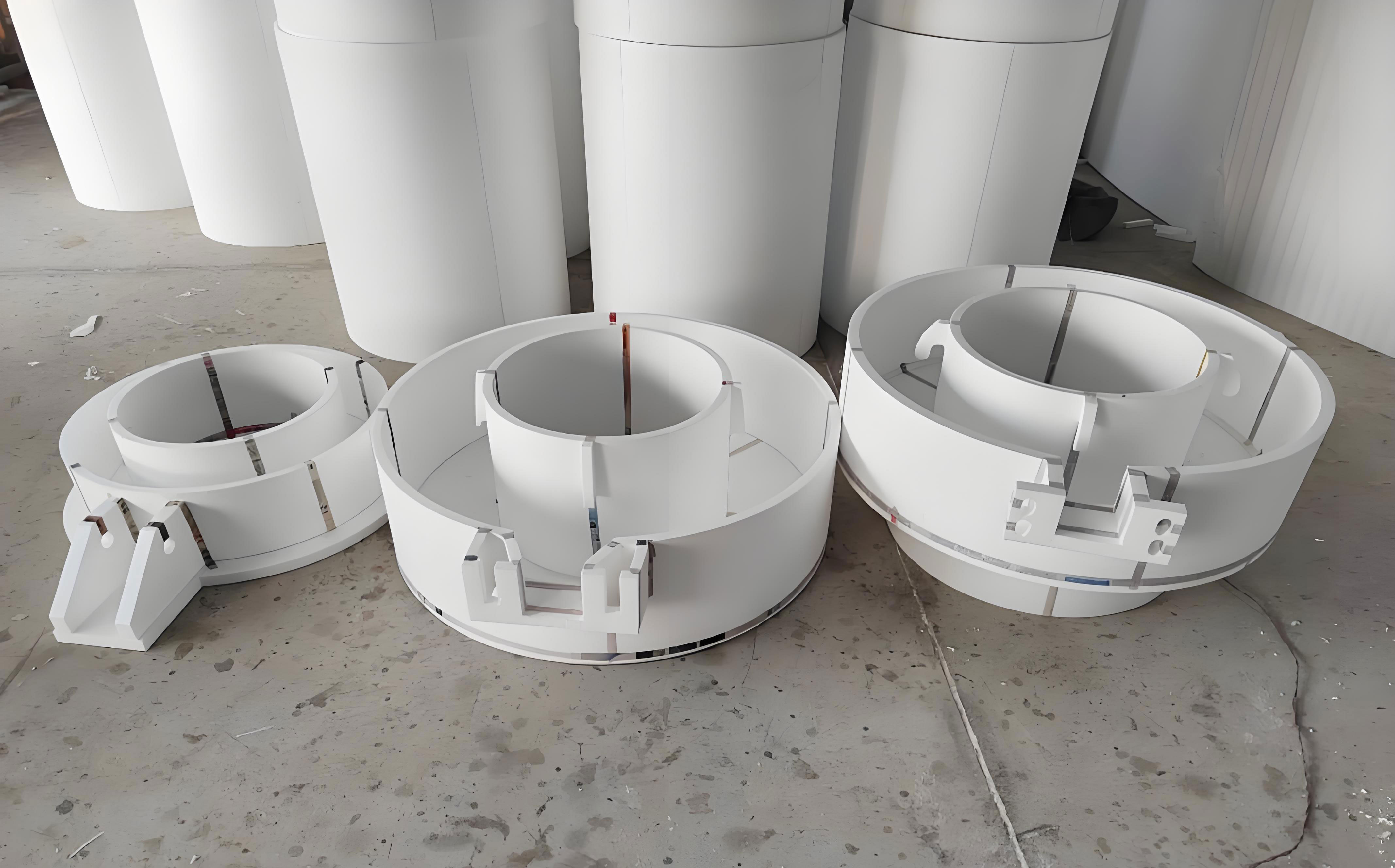
The physical transformation during drying is key. As the coating dries and shrinks, it bonds chemically and mechanically to both the EPS and the sand ring. The sand ring acts as a rigid mandrel, constraining the pattern and coating against any warping or ovality during the thermal cycle. The final dried assembly behaves as a single, integral unit with significantly enhanced bending and hoop stiffness. The effective composite modulus \( E_{eff}^{wet} \) for this wet-sleeved system is much higher than that of the dry-sleeved or unsleeved pattern because the sand ring carries a substantial portion of the load. We can express the improved resistance to deformation by considering the second moment of area \( I \) of the composite section. For a hollow cylinder (pattern) reinforced with a concentric sand ring, the combined \( I \) is:
$$ I_{total} = I_{pattern} + I_{sandring} + A_{pattern} \cdot d_{pattern}^2 + A_{sandring} \cdot d_{sandring}^2 $$
where \( A \) is the cross-sectional area and \( d \) is the distance from the composite section’s neutral axis. The drastic increase in \( I_{total} \) directly translates to a higher bending resistance against the asymmetric pressures of sand flow in lost foam casting. Implementing this wet sleeve process required careful control. The timing was critical: sand ring installation had to occur within a short “wet window” after coating, before surface drying started, to ensure optimal slurry flow and bonding. Furthermore, consistency in the EPS pattern dimensions was paramount. We instituted rigorous quality checks on the foam patterns, ensuring the diameter at the sleeving location had a tolerance of less than ±1 mm. This guaranteed a consistent interference fit for the sand ring, optimized for slurry filling without excessive buildup.
The transition to wet sleeving was followed by comprehensive testing and monitoring. We evaluated the roundness of the yellow models post-drying and pre-molding using coordinate measuring techniques. The data, compared against the old dry method, was compelling. Table 2 summarizes the improvement in pattern roundness achieved by the wet sleeve sand ring technique in our lost foam casting operation.
| Process Stage | Metric | Dry Sand Ring Method (Avg.) | Wet Sleeve Sand Ring Method (Avg.) | Improvement |
|---|---|---|---|---|
| Post-Drying Pattern | Ovality \( O \) (%) | 1.8% | 0.4% | 77.8% reduction |
| Post-Drying Pattern | Diameter Deviation \( \delta \) (mm) | 2.5 mm | 0.6 mm | 76.0% reduction |
| Handling & Transfer | Incidence of Ring Loosening | 15% of boxes | < 1% of boxes | Near elimination |
| Pre-Molding Inspection | Coating Crack Incidence | 8% | 0.2% | 97.5% reduction |
During the molding process itself, visual confirmation was obtained. The wet-sleeved assemblies showed no signs of ring rotation or separation during sand filling and vibration compaction. They behaved as monolithic units. This robust integrity throughout the lost foam casting process directly translated to superior casting quality. After implementing the wet sleeve technique plant-wide for specifications from DN400 to DN1200, we tracked the ovality defect rate in final castings over a production period of six months. The results, plotted against the historical baseline, demonstrated the efficacy of the method. The ovality defect rate, which previously ranged from 5% to over 25% depending on size, was stabilized below 3% for all specifications. This level of control is exceptional in high-volume lost foam casting production of thin-walled components.
The success of the wet sleeve sand ring method can be analyzed through the lens of process stability. In lost foam casting, every variable amplifies through the chain from pattern to casting. The method essentially decouples the pattern’s dimensional stability from the mechanical disturbances of handling and compaction. By creating a pre-consolidated, high-rigidity assembly at the earliest possible stage (post-coating), it eliminates multiple failure modes. The bonding mechanism can be further analyzed. The shear strength \( \tau_{bond} \) of the coating-sand ring interface after drying is crucial. It must withstand the shear stresses \( \tau_{applied} \) induced during vibration. For a sand ring of length \( L \) and radius \( r \), the maximum shear force from sand pressure difference is \( F_{shear} \approx \Delta P_d \cdot \pi r^2 \). The applied shear stress is:
$$ \tau_{applied} = \frac{F_{shear}}{2\pi r L} = \frac{\Delta P_d \cdot r}{2L} $$
The wet process ensures a full, void-free interfacial area, maximizing \( \tau_{bond} \) and ensuring \( \tau_{bond} > \tau_{applied} \). The dry method, with its potential gaps and point contacts, results in a much lower effective bond strength, leading to ring slippage and loss of support. Beyond ovality control, the method yielded ancillary benefits in lost foam casting. It reduced the occurrence of related defects like veining or folds at the interface, which could stem from pattern movement. It also simplified the logistics of pattern handling before molding, as the integrated assembly was less fragile.
In conclusion, the practice of employing a wet sleeve sand ring has proven to be a highly effective and reliable solution for controlling ovality deformation in the lost foam casting of medium and small-sized ductile iron pipe fittings. This first-hand experience underscores the importance of addressing root causes in the lost foam casting sequence—specifically, the mechanical integrity of the foam pattern assembly before it enters the molding stage. The technique leverages the fundamental principles of composite structures and precise process timing to create a pattern system with exceptional dimensional stability. The wet sleeve method transforms the reinforcing sand ring from an external, often poorly fitted accessory into an integral, load-bearing component of the pattern itself. This approach has not only solved a persistent quality issue but also enhanced the overall robustness and repeatability of our lost foam casting process. The principles established here—of early integration, perfect interface bonding, and the use of a rigid mandrel during the thermal cycle—are broadly applicable to other lost foam casting applications involving thin-walled or circular components prone to distortion. The continued refinement and understanding of such practical techniques are essential for advancing the reliability and expanding the application scope of the lost foam casting process in modern foundry engineering.