
In my experience with metal casting, the lost foam casting process has been widely adopted for producing complex components due to its ability to create intricate shapes with minimal post-processing. However, this method is not without challenges, particularly when dealing with heavy-duty parts like rollers. I recently encountered a significant issue in the production of rollers made from ZG35CrMnSi steel using lost foam casting, where cracks appeared after rough machining, leading to high rejection rates and economic losses. This article delves into a comprehensive analysis of the cracking causes and outlines改进措施 based on my practical investigations, focusing on aspects such as casting工艺性, chemical composition, riser design, and heat treatment. The goal is to provide insights that can enhance the reliability of lost foam casting for similar applications.
The lost foam casting process involves creating a foam pattern that is embedded in sand and then replaced by molten metal, resulting in a precise replica. For rollers weighing approximately 2,500 kg (with a net weight of 1,680 kg), the scale introduces unique complexities. The inherent characteristics of lost foam casting, such as gas evolution from foam decomposition and sand mold constraints, can exacerbate internal stresses. In this case, cracks were observed on the \(\phi\)440 step end faces and inner holes after machining, indicating underlying defects. Through systematic analysis, I identified several key factors contributing to this problem, which I will discuss in detail, emphasizing the role of lost foam casting parameters.
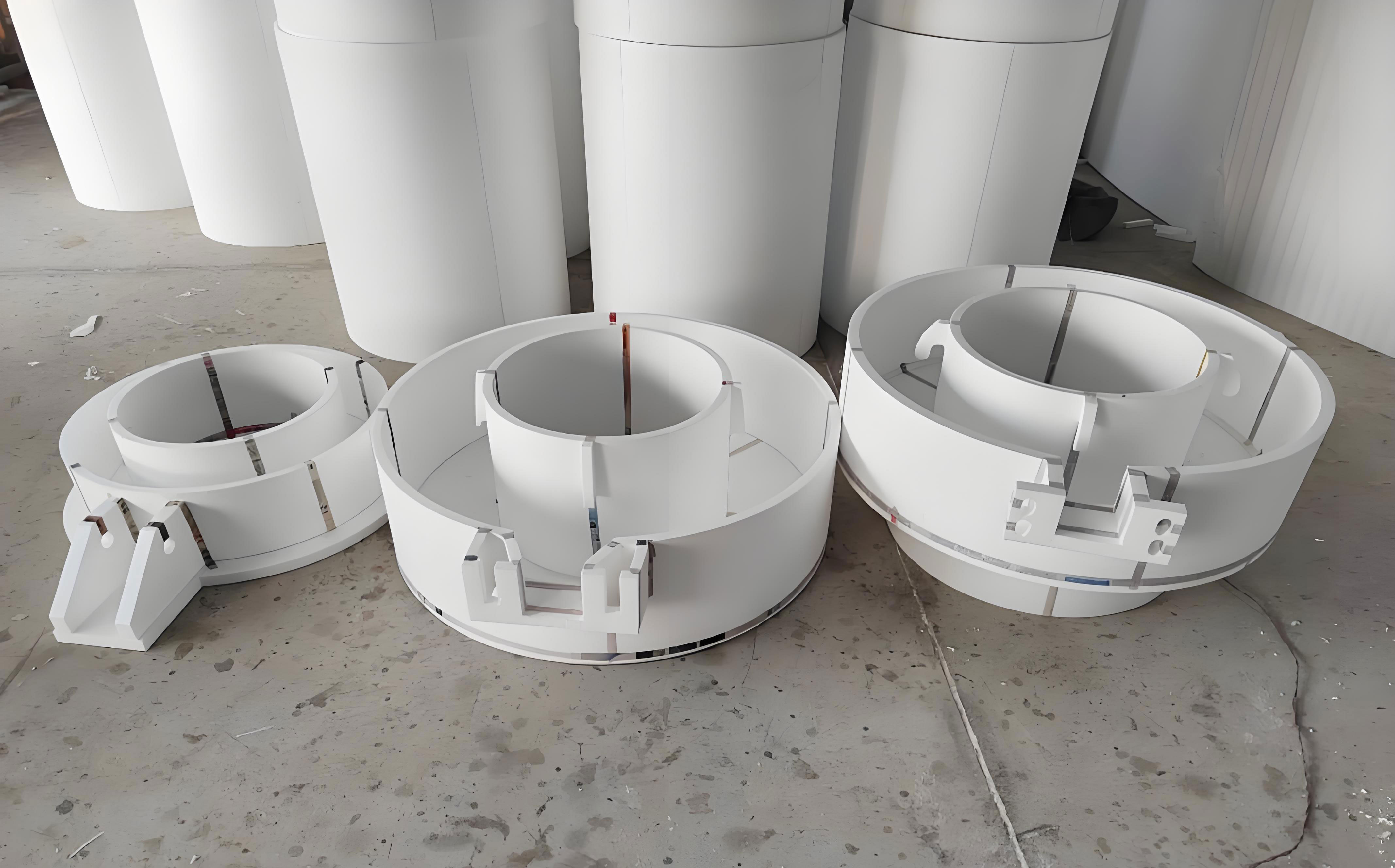
First, the casting工艺性 of ZG35CrMnSi steel in lost foam casting plays a crucial role in crack formation. Alloying elements like chromium and manganese reduce thermal conductivity, leading to higher residual stresses during solidification. The phase transformations and carbide formation can induce micro-cracks that propagate under stress. In lost foam casting, the large mass of the roller means that foam combustion generates substantial gases, requiring extended pressure maintenance in the mold. This delays cooling and increases the risk of hot tearing or cold cracks due to restricted shrinkage. The non-uniform wall thickness, with abrupt changes creating “hot spots,” further complicates solidification. To quantify this, the thermal stress (\(\sigma\)) can be estimated using the formula:
$$ \sigma = E \cdot \alpha \cdot \Delta T $$
where \(E\) is Young’s modulus, \(\alpha\) is the coefficient of thermal expansion, and \(\Delta T\) is the temperature gradient. In lost foam casting, \(\Delta T\) can be significant due to uneven cooling, leading to stresses exceeding the material’s yield strength. Additionally, the cooling rate (\(r\)) in lost foam casting affects grain structure, as given by:
$$ r = \frac{dT}{dt} $$
where \(dT/dt\) is the temperature change over time. Slower cooling in thick sections can promote coarse grains, reducing toughness. Therefore, optimizing the lost foam casting process to control these factors is essential to mitigate cracks.
Second, chemical composition deviations were a major contributor. For ZG35CrMnSi steel, carbon content must be tightly controlled to avoid brittleness. I analyzed five cracked rollers and found that carbon levels exceeded specifications, as shown in Table 1. High carbon increases hardness but reduces ductility, making the material prone to cracking during heat treatment. This highlights the importance of precise炉前 analysis in lost foam casting to adjust composition实时ly. The effect of carbon on crack susceptibility can be modeled using empirical relations, such as the crack sensitivity index (\(C_s\)):
$$ C_s = f(C, Cr, Mn) $$
where higher \(C\) values elevate \(C_s\). In lost foam casting, maintaining composition within limits is critical to prevent such issues.
| Element | Specified Range (%) | Measured Values (%) in Samples |
|---|---|---|
| C | 0.30–0.40 | 0.40, 0.41, 0.47, 0.49, 0.46 |
| Si | 0.50–0.75 | 0.55–0.70 (typical) |
| Mn | 0.90–1.20 | 0.95–1.15 (typical) |
| Cr | 0.50–0.80 | 0.60–0.75 (typical) |
| S | ≤0.04 | ≤0.035 (typical) |
| P | ≤0.045 | ≤0.040 (typical) |
Table 1: Chemical composition of ZG35CrMnSi steel, showing carbon超标 in lost foam casting rollers.
Third, riser design and cutting in lost foam casting directly impact shrinkage defects. Improper riser size or placement can lead to insufficient feeding, causing micro-shrinkage in最后凝固 zones. These defects act as crack initiation sites under thermal or mechanical stress. For the roller, I calculated the热节 using geometrical methods to optimize riser dimensions. The riser volume (\(V_r\)) should satisfy:
$$ V_r \geq \frac{V_c \cdot \beta}{\eta} $$
where \(V_c\) is the casting volume, \(\beta\) is the shrinkage factor, and \(\eta\) is the riser efficiency. In lost foam casting, \(\eta\) may be lower due to foam residues, necessitating larger risers. Moreover, cutting risers while the casting is hot is vital to avoid thermal shock cracks. I implemented hot-cutting at temperatures above 500°C, which reduced stress concentrations. The temperature during cutting (\(T_c\)) should be maintained to prevent brittleness:
$$ T_c > T_{db} $$
where \(T_{db}\) is the ductile-to-brittle transition temperature. This adjustment in lost foam casting practice significantly lowered crack incidence.
Fourth, heat treatment工艺 is paramount for stress relief and microstructure refinement. Initially, a full annealing process was used, but cracks still occurred, indicating inconsistencies. I revised the工艺 to include normalizing and tempering, with strict control over heating and cooling rates. The optimized parameters are summarized in Table 2. The heating rate (\(v_h\)) was set at 150°C/h to allow gradual stress释放, described by:
$$ \sigma_{relief} = \sigma_0 \cdot e^{-kt} $$
where \(\sigma_0\) is the initial stress, \(k\) is a material constant, and \(t\) is time. Normalizing at 850–900°C followed by tempering at 550–600°C produced fine pearlite, enhancing machinability and toughness. In lost foam casting, where residual stresses are high, such precise heat treatment is indispensable to prevent crack propagation during service.
| Heat Treatment Step | Temperature Range (°C) | Heating Rate (°C/h) | Holding Time (h) | Cooling Method |
|---|---|---|---|---|
| Normalizing | 850–900 | 150 | 2–3 | Air cooling |
| Tempering | 550–600 | 100 | 3–4 | Furnace cooling |
Table 2: Optimized heat treatment parameters for lost foam casting rollers to mitigate cracks.
Fifth, other factors like impurity inclusion can initiate cracks. In lost foam casting, foam degradation products or sand inclusions may concentrate in upper sections, creating weak points. I improved mold preparation and pouring techniques to minimize such defects. The probability of impurity entrapment (\(P_i\)) can be reduced by controlling pouring velocity (\(v_p\)):
$$ P_i \propto \frac{1}{v_p} $$
where slower pouring allows better slag separation. Implementing these measures in lost foam casting helped achieve cleaner castings.
Based on my analysis, I implemented several改进措施 that collectively addressed the cracking issue. These are summarized in Table 3, which links causes to specific actions in the context of lost foam casting. By refining each aspect, the crack rate dropped substantially, meeting production requirements. The success underscores the need for a holistic approach in lost foam casting, where工艺 parameters, material science, and thermal management intersect.
| Crack Cause | Improvement Measure | Impact on Lost Foam Casting |
|---|---|---|
| High carbon content | Strict炉前 analysis and adjustment | Enhances ductility and reduces brittleness |
| Inadequate riser design | Optimize riser size using热节 calculations | Improves feeding and reduces shrinkage |
| Cold riser cutting | Implement hot-cutting above 500°C | Minimizes thermal shock cracks |
| Inconsistent heat treatment | Adopt normalizing and tempering with controlled rates | Relieves stresses and refines microstructure |
| Impurity inclusion | Enhance mold quality and pouring control | Reduces crack initiation sites |
| Non-uniform cooling | Modify lost foam casting parameters to balance cooling | Lowers thermal gradients and stresses |
Table 3: Summary of crack causes and improvement measures for lost foam casting rollers.
In conclusion, the cracking problem in ZG35CrMnSi rollers produced via lost foam casting was multifaceted, involving工艺性 flaws, composition errors, riser issues, and heat treatment inconsistencies. Through detailed analysis and targeted改进, I successfully mitigated these defects. The key takeaway is that lost foam casting, while advantageous, demands meticulous control over every stage—from pattern making to final heat treatment. By emphasizing precise chemical composition, optimized riser design, proper cutting techniques, and tailored heat treatment, the integrity of heavy castings can be assured. Future work could explore advanced simulation tools to predict stress distributions in lost foam casting, further reducing trial-and-error. Ultimately, this experience reinforces the importance of integrating theoretical knowledge with practical adjustments in the dynamic field of lost foam casting.
To generalize, the principles discussed here can be applied to other alloys and geometries in lost foam casting. For instance, the stress analysis formula
$$ \sigma = \int_{0}^{T} E(T) \cdot \alpha(T) \cdot \frac{dT}{dz} \, dz $$
where \(z\) is the spatial coordinate, can help model thermal stresses in complex lost foam casting setups. Regularly monitoring and adjusting这些 parameters will enhance yield rates and product quality, making lost foam casting a more reliable manufacturing method for critical components.