
The lost foam casting process is renowned within the foundry industry for its numerous advantages, including relatively low capital investment, reduced energy consumption, improved working environments, high production efficiency, and minimal pollutant emissions. These attributes make it particularly suitable for the high-volume production of complex, high-precision castings. However, like all casting methods, lost foam casting possesses inherent limitations. Among these, the persistent issue of slag inclusion defects stands as a significant challenge that can severely impact yield and cost-effectiveness. This article details a first-hand investigation into a severe slag inclusion problem encountered during the production of a brake caliper housing via the lost foam casting process, where scrap rates soared to approximately 40%. Through systematic analysis, experimental validation, and process refinement, the root cause was identified and effectively mitigated.
The subject component was a brake caliper housing, a structurally simple yet high-demand part. The material specification was HT250 (a gray iron grade), with a casting weight of 14.5 kg. Critical quality requirements included full machining of both top and bottom faces as well as the internal bore, with absolutely no allowances for defects such as slag inclusions or gas porosity. After transitioning the production of this part to lost foam casting, frequent slag inclusion defects were observed on the machined surfaces of the top, bottom, and internal bore. These defects manifested as irregular shapes containing unidentified foreign material, typically penetrating about 2 mm into the casting wall. The high scrap rate directly threatened production schedules and elevated unit costs, jeopardizing the feasibility of volume production using this method.
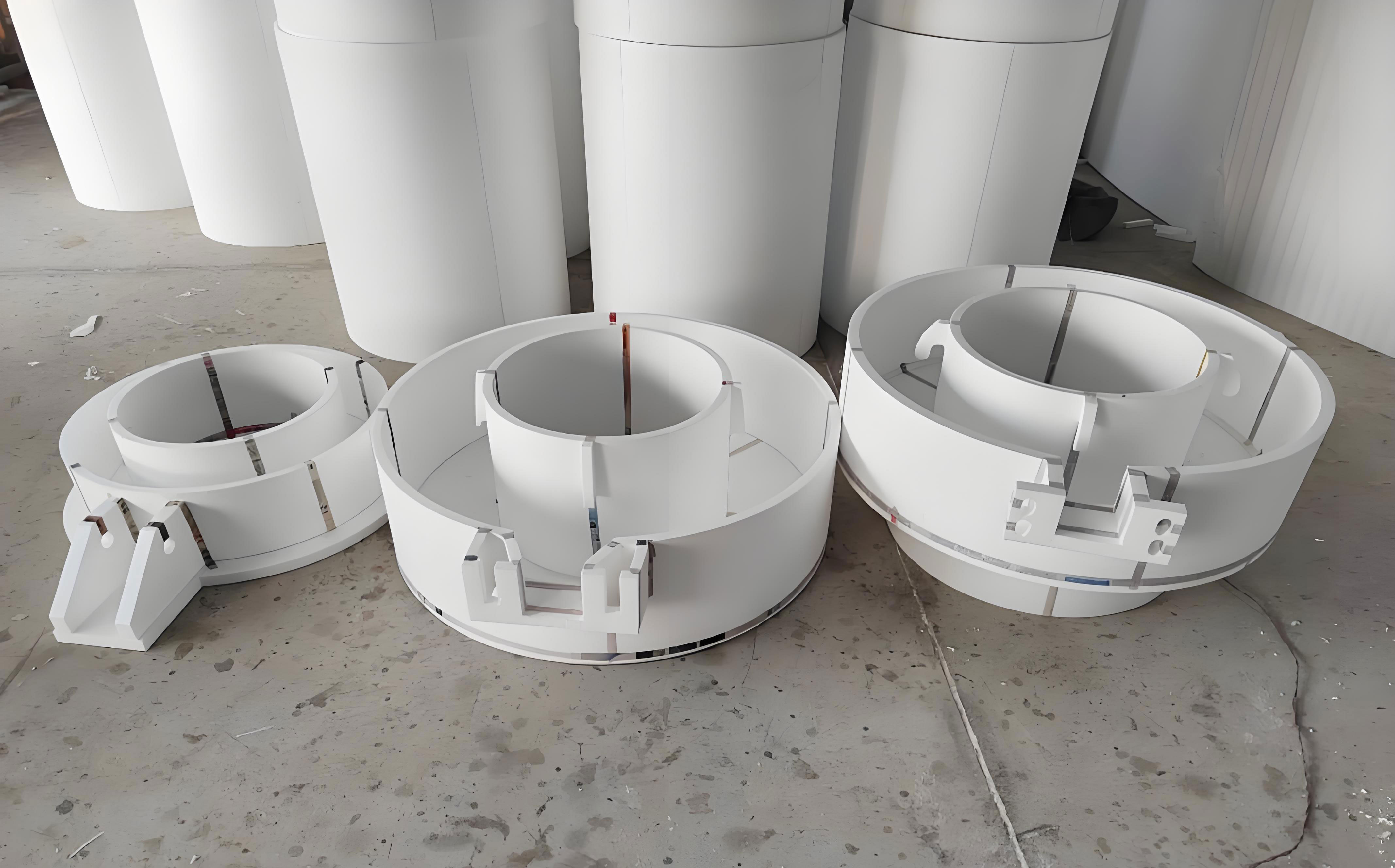
The initial process, developed through prior experimentation to minimize other defects, utilized STMMA foam material (replacing EPS) with a density of 22–24 g/L. The gating system consisted of a sprue (ø40 mm x 400 mm), a horizontal runner with a cross-section of 30 mm x 45 mm, and an ingate with a cross-section of 8 mm x 40 mm. A slag trap screen was incorporated into the gating system. The pattern was coated with three layers of a water-based, high-alumina refractory coating, achieving a total coating thickness of 1.2–1.5 mm. The pouring temperature was maintained between 1480°C and 1510°C. Cluster assembly involved multiple patterns arranged around a central downgate.
To move beyond empirical guesswork, a fundamental analysis of the defect morphology and composition was essential. Samples were extracted from defective areas on different castings and batches for scanning electron microscopy (SEM) and energy-dispersive X-ray spectroscopy (EDS) analysis. The results were revealing. The slag inclusion zones showed significantly elevated levels of silicon (Si), aluminum (Al), and manganese (Mn) compared to the base iron matrix. Notably, spherical particulate matter was observed within the defects. EDS point analysis on these particles revealed an extremely high aluminum content, exceeding 32 wt%. Furthermore, the manganese content in the defect area was 3 to 5 times higher than in the nominal base iron composition.
| Element | Defect Area (Avg.) | Base Iron (Typical) | Notes |
|---|---|---|---|
| Fe | ~61-65% | >95% | Diluted by inclusions |
| Al | >7% (Up to 32% in particles) | < 0.1% | Primary indicator of coating origin |
| Si | ~10-16% | 1.8-2.4% | Elevated |
| Mn | ~2-3% | 0.6-0.9% | Significantly elevated |
| O | ~11-28% | Trace | Indicates oxides |
Since the coating used was a high-alumina type, primarily composed of Al2O3, the high aluminum content pointed directly toward coating material as the source of the inclusions. The spherical particles observed under SEM had diameters ranging from 40 to 60 μm. This particle size distribution closely matched the known grain size of the refractory骨料 (aggregate) in the coating, which was typically 40–75 μm. This correlation provided strong circumstantial evidence that the coating was failing and being entrained into the molten metal. Two primary failure mechanisms were hypothesized: 1) insufficient refractoryness of the coating, leading to degradation and erosion under the high-temperature molten iron, or 2) the pouring temperature was simply too high for the coating’s capability.
A controlled experiment was designed to test the coating hypothesis. Two groups of molds were prepared using identical cluster geometry and process parameters (negative pressure: -0.05 MPa, pouring time: 20-23 s). The only variable was the coating. Group A utilized a new, alternative铸铁涂料 (cast iron coating) from a different supplier, while Group B continued with the original coating. Both groups were poured from the same heat of iron at a starting temperature of 1490°C.
| Test Group | Coating Used | Number of Castings | Castings with Slag Defects | Defect Rate |
|---|---|---|---|---|
| A | New Coating | 18 | 3 | 16.7% |
| B | Original Coating | 12 | 6 | 50% |
The results were telling. While not perfect, Group A (new coating) showed a markedly lower defect rate. It’s important to note that one defect in Group A was clearly identified as a molding fault (uncleaned coating from the gating area), not a systemic erosion issue. This test strongly supported the conclusion that the coating was a major contributing factor. However, the question remained: was the root cause the coating’s properties or the process parameters? To isolate the temperature variable, a second experiment was conducted. The pouring temperature was significantly reduced to 1420°C ± 10°C, a range more typical for gray iron in lost foam casting. Again, Groups A (new coating) and B (original coating) were compared.
| Test Group | Coating Used | Pouring Temp. | Number of Castings | Castings with Slag Defects | Defect Rate |
|---|---|---|---|---|---|
| A | New Coating | 1420±10°C | 18 | 0 | 0% |
| B | Original Coating | 1420±10°C | 18 | 1 | 5.6% |
The results of the second experiment were conclusive. By lowering the pouring temperature, the defect rate plummeted. Group A achieved a 100% sound casting rate, and even Group B with the original coating showed only a single, minor defect. This definitively proved that the primary root cause of the chronic slag inclusion problem was a combination of a coating with marginally low refractoryness and an excessively high pouring temperature. The thermal load imposed by the 1490-1510°C iron exceeded the coating’s integrity, causing it to break down, erode, and become entrained as slag inclusions.
The mechanism can be described by considering the thermal stress on the coating and the fluid dynamics of the molten metal. The coating’s ability to withstand thermal shock and erosion is critical. The heat flux from the metal can be described conceptually by:
$$ q” = h (T_{melt} – T_{coating\ surface}) $$
where $q”$ is the heat flux, $h$ is the heat transfer coefficient (very high in lost foam casting due to the decomposing foam), $T_{melt}$ is the molten metal temperature, and $T_{coating\ surface}$ is the temperature at the coating interface. An excessively high $T_{melt}$ drastically increases $q”$, potentially leading to coating sintering, cracking, and mechanical erosion by the flowing metal. The eroded particles, with diameters $d_p$ similar to the coating aggregate size, are then transported by the turbulent flow of the molten iron. The tendency for these particles to become trapped instead of floating to the top can be related to the modified Reynolds number for particles and the flow conditions within the mold cavity.
$$ Re_p = \frac{\rho_f u d_p}{\mu} $$
Where $\rho_f$ is fluid density, $u$ is flow velocity, $d_p$ is particle diameter, and $\mu$ is dynamic viscosity. Higher turbulence (higher $Re_p$) promotes particle entrainment throughout the melt rather than allowing for buoyant separation.
Based on the root cause analysis, a three-pronged corrective action plan was implemented to ensure robust production using lost foam casting:
- Optimization of Pouring Temperature: The pouring temperature was strictly controlled within the range of 1410°C to 1430°C. This reduced the thermal load on the coating, bringing it within its functional refractory limits. The relationship between defect probability ($P_d$) and pouring temperature ($T_p$) was found to be highly non-linear above a critical threshold $T_c$, which was approximately 1450°C for the original coating system:
$$ P_d \propto e^{k(T_p – T_c)} \quad \text{for} \quad T_p > T_c $$
where $k$ is a process-specific constant. - Upgrading Coating Material: The original coating was replaced with a premium-grade, high-refractoriness coating specifically formulated for the demands of lost foam casting of ferrous alloys. Key properties such as high-temperature strength, erosion resistance, and sintering point were prioritized.
- Enhancement of Pattern Quality: The foam pattern density was maintained at the upper end of the specified range (closer to 24 g/L). A higher density pattern results in a smoother surface finish with fewer and smaller inter-bead gaps. This minimizes the depth and quantity of coating penetration into the pattern surface during dipping, thereby reducing the total amount of coating material that is vulnerable to erosion at the metal-front interface. The coating penetration depth $\delta$ can be crudely modeled as a function of bead fusion quality and coating rheology:
$$ \delta \approx C \sqrt{\frac{\gamma \cos\theta}{\rho g R}} $$
where $C$ is a constant, $\gamma$ is surface tension, $\theta$ is contact angle, $\rho$ is coating density, $g$ is gravity, and $R$ is effective pore radius. Better bead fusion increases $R$, reducing penetration.
The successful resolution of this slag inclusion problem underscores several critical principles in lost foam casting. First, defect analysis must progress from observation to fundamental material investigation; SEM/EDS analysis was indispensable in correctly identifying the exogenous source of the inclusions. Second, process parameters cannot be considered in isolation. The interplay between material properties (coating refractoryness) and process conditions (pouring temperature) is often the key. A coating that performs adequately at one temperature may fail catastrophically at another. Finally, this case reinforces that lost foam casting, while versatile, demands a holistic and controlled approach to all elements: pattern quality, coating performance, gating design, and thermal management. By systematically addressing the coating-temperature incompatibility, the production of the brake caliper housing was stabilized, scrap rates were reduced to acceptable levels, and the economic advantages of the lost foam casting process for this high-volume component were successfully realized.