
In the realm of advanced casting techniques, lost foam casting has emerged as a pivotal method for producing complex components with high dimensional accuracy and excellent surface finish. My extensive experience in designing molds for heavy-duty applications, particularly for heavy truck transmission housings, has underscored the critical role of meticulous mold engineering in harnessing the full potential of lost foam casting. This article delves into the comprehensive design process, drawing from practical insights to address the unique challenges posed by such intricate parts. The transmission housing, a key component in vehicular systems, demands exceptional quality standards—superior外观质量, tight dimensional tolerances, and consistent performance—all of which are achievable through optimized lost foam casting practices. Here, I will elaborate on the mold structures and工艺 strategies that ensure stable foam pattern formation, smooth demolding, enhanced operational efficiency, and最终铸造 precision, thereby reducing labor intensity and elevating product reliability.
The heavy truck transmission housing, typically cast in HT200 iron with a mass of around 90 kg, features a labyrinthine internal geometry characterized by thin walls, internal partitions, multiple apertures, and enclosed sections. This complexity, while ideal for lost foam casting due to its ability to replicate fine details, introduces significant hurdles in mold design. Through hands-on involvement in production and collaboration with molding specialists, I have identified and overcome six primary design challenges that are common in such projects. First, the housing walls are as thin as 8 mm, making foam pattern formation prone to inconsistencies. Second, internal partitions with central holes necessitate side-core retractable mechanisms. Third, open faces on both sides increase the risk of pattern distortion. Fourth, large internal cavities complicate demolding. Fifth, the fully enclosed nature requires splitting the pattern into two halves for粘接 assembly. Sixth,倒拔模 angles on divided sections mandate additional side-core actions. Addressing these issues systematically is essential for successful lost foam casting implementation.
To set the foundation, the mold must adhere to stringent制作 requirements that guarantee铸件 integrity. Based on my observations, these criteria can be summarized in a comprehensive table to clarify each aspect:
| Requirement Category | Specification | Rationale | |
|---|---|---|---|
| Dimensional Accuracy | Ensure castings fall within drawing tolerances | Critical for component functionality and assembly | |
| Surface Quality | Mold cavity roughness ≤ 0.8 μm (Ra) | Minimizes pattern defects and improves finish | |
| Material Selection | High thermal conductivity materials (e.g., aluminum alloys) | Facilitates uniform heating/cooling for consistent foam expansion | |
| Structural Design | Thin-shell conformal structure with adequate strength | Reduces cycle time and withstands process stresses | |
| Shot Placement | Optimized for complete cavity filling | Prevents voids and ensures dense patterns | |
| Venting System | Proper vent valve positioning and area calculation | Enables even steam distribution and pattern compaction | |
| Durability | Corrosion resistance to water/steam, long service life | Lowers maintenance costs and ensures consistency | |
| Machine Integration | Secure mounting and precise alignment with成型机 | Enhances automation and repeatability | |
| Operational Ease | User-friendly manufacturing and handling | Reduces setup errors and improves productivity |
Moving to工艺设计, the initial step involves pattern parting. For the transmission housing, I advocate splitting the foam pattern along the axis connecting the three bore centers into two segments: Part A and Part B. This approach, illustrated in conceptual terms, simplifies both pattern formation and subsequent粘接, whether manual or automated. To counteract distortion, anti-deformation ribs are added to the top cover surface, and transition radii are increased at critical junctions—these measures bolster pattern stability during lost foam casting. Regarding allowances, a uniform machining allowance of 4 mm is applied, except for specific localized requirements. The shrinkage compensation is a vital parameter; for this iron alloy, I use a linear shrinkage factor of 1.5%, which can be expressed mathematically for dimensional adjustments. If the nominal dimension is $L_0$, the mold dimension $L_m$ accounts for shrinkage as:
$$L_m = \frac{L_0}{1 – s}$$
where $s = 0.015$ for the 1.5% shrinkage. Additionally, draft angles are maximized at 1° for general surfaces, but increased for thick cores or易变形 areas to ease demolding. Shot locations are strategically placed at both ends along the mold’s length,配合自动料枪 for two-stage feeding. This ensures that pre-expanded beads flow unobstructed into remote cavities, promoting sequential filling and reducing defects. The efficacy of bead filling can be modeled using fluid dynamics principles, where the pressure drop $\Delta P$ across the cavity relates to bead flow rate $Q$ and vent area $A_v$ via an empirical equation:
$$\Delta P = k \cdot \frac{Q^2}{A_v^2}$$
with $k$ as a material constant for the foam beads. This underscores the importance of vent design in lost foam casting.
Delving into模具设计 details, material selection is paramount. For mold frames and cores, I specify ZL104 aluminum alloy castings, heat-treated before machining to relieve stresses. Plates and bases use LY12R rolled aluminum plate under T6 condition, offering a balance of strength and thermal response. Bronze alloys (e.g., tin bronze) are employed for ejector pins and bushings, while stainless steel fasteners ensure durability in humid environments. The mold wall thickness is optimized at 13–15 mm in conformal regions to accelerate thermal cycles—this thin-shell design minimizes steam consumption and enhances efficiency in lost foam casting. The underlying principle involves heat transfer dynamics; the time $t_h$ for the mold to reach a uniform temperature during steaming can be approximated by:
$$t_h = \frac{\rho c_p d^2}{2\alpha}$$
where $\rho$ is density, $c_p$ specific heat, $d$ wall thickness, and $\alpha$ thermal diffusivity. Thinner walls reduce $t_h$, improving productivity. Reinforcement ribs on external surfaces maintain rigidity, with frame thicknesses ≥20 mm.
The steam chamber design is crucial for uniform energy distribution. Each mold half incorporates a chamber height ≥30 mm to buffer steam before it permeates through vent plugs into the cavity. Inlet and outlet ports are positioned strategically—inlets direct steam in, while outlets at chamber bottoms drain condensate to prevent cooling inefficiencies. Vent plugs, typically point-style with diameters of 8–10 mm, are spaced ≤25 mm apart, denser in thick sections, and staggered on opposing walls to avoid steam channeling. The total vent area $A_{total}$ must satisfy a minimum ratio relative to cavity volume $V_c$ for effective degassing, often expressed as:
$$A_{total} = C \cdot V_c^{2/3}$$
with $C$ as an experience-based coefficient (e.g., 0.05–0.1 mm²/mm³ for lost foam casting). This ensures beads fuse properly during expansion.
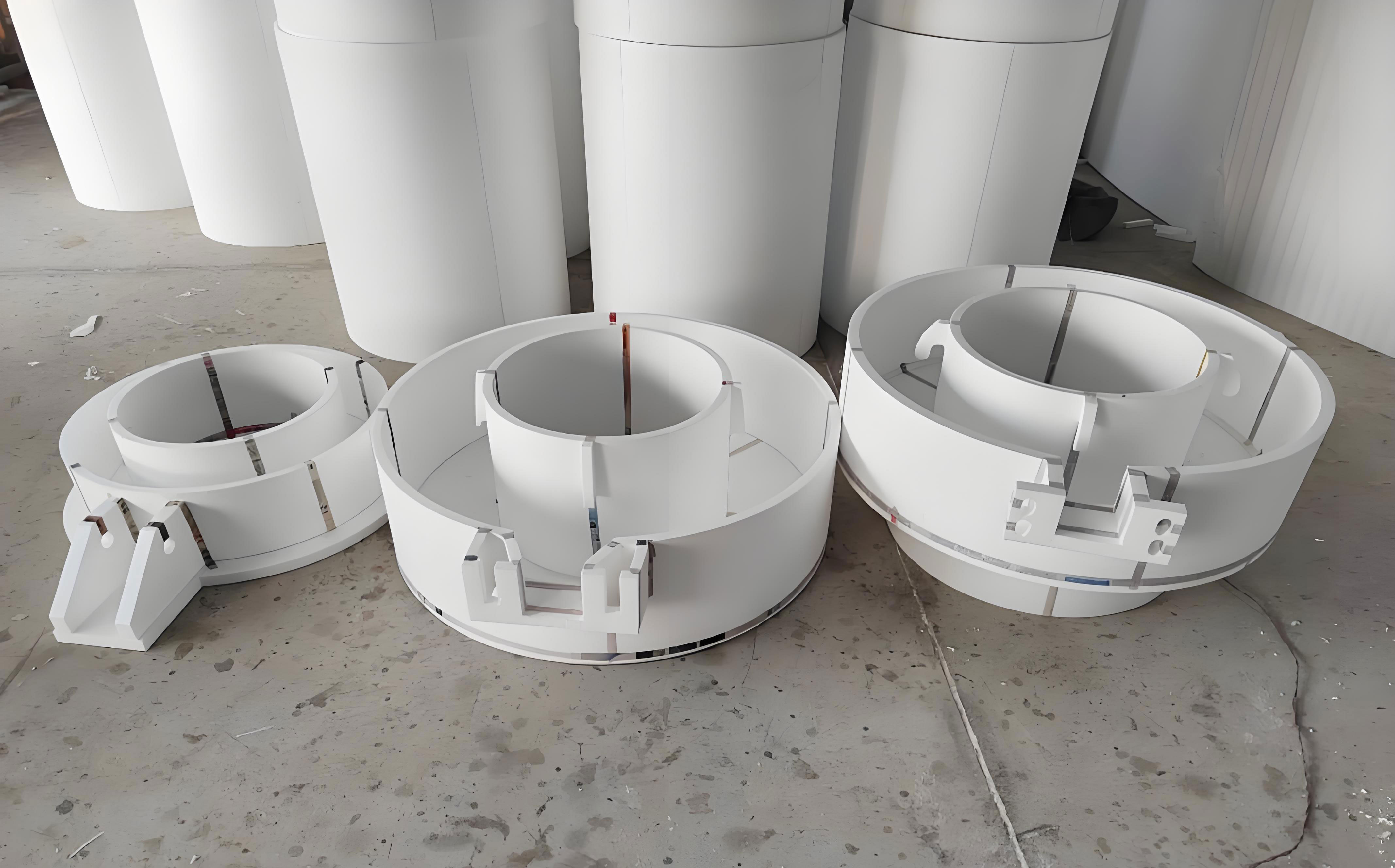
Core-pulling and loose-piece mechanisms address internal undercuts. For partition holes and类似 features, manual loose pieces made of forged aluminum provide wear resistance. For side cores with倒拔模, pneumatic actuators are integrated. These cores feature bronze dovetail guides for precision alignment and include built-in vent plugs connected to the upper steam chamber via ports—this allows steam and cooling water access, ensuring uniform foam formation on core faces. The force $F_c$ required for core retraction depends on friction and pattern adhesion, estimated as:
$$F_c = \mu N + A_p \cdot \sigma_a$$
where $\mu$ is friction coefficient, $N$ normal force, $A_p$ pattern contact area, and $\sigma_a$ adhesive stress. Proper lubrication and Teflon coating mitigate these forces.
Cooling systems are differentiated between mold halves. The upper chamber uses copper pipes with drilled holes (0.5–0.8 mm) for water spray, while the lower chamber employs nozzle-based cooling for faster heat extraction. The cooling time $t_c$ to solidify the foam pattern can be derived from Newton’s law of cooling:
$$t_c = \frac{m c \Delta T}{h A \Delta T_m}$$
where $m$ is pattern mass, $c$ specific heat, $\Delta T$ temperature drop, $h$ heat transfer coefficient, $A$ cooling area, and $\Delta T_m$ log mean temperature difference. Optimizing $h$ via nozzle design reduces $t_c$, boosting cycle rates in lost foam casting.
Ejection mechanisms employ a full-plate自动顶出 system with 4–8 bronze-tipped pins driven by pneumatic cylinders. To prevent pattern distortion, the ejection force $F_e$ is distributed evenly, calculated as:
$$F_e = n \cdot \frac{E \epsilon A_p}{L}$$
with $n$ number of pins, $E$ foam modulus, $\epsilon$ strain, $A_p$ pin contact area, and $L$ pattern thickness. Bronze bushings reduce wear. Cylinders are shielded to avoid damage during maintenance.
Mold alignment combines dowel pins and register surfaces. Three bronze guide pin-and-bushing sets, with 30–40 mm engagement, ensure accurate closure, complemented by 5 mm register lips that also increase clamping height for better bead compaction. Sealing is achieved with dual silicone gaskets on all interfaces—between mold and machine plates, parting surfaces, and actuator mounts—to maintain steam pressure integrity. Surface treatment with Teflon reduces demolding forces and eases cleaning, directly benefiting pattern quality in lost foam casting.
The operational sequence of the mold is methodical. After mounting on a vertical automatic molding machine and connecting all media lines, parameters like filling time, steam pressure, and cooling duration are fine-tuned. The process begins with mold closure, followed by vacuum-assisted bead injection through two gates. Steam is then introduced, causing bead expansion and fusion; after holding, cooling water is circulated. Once drained, side cores retract pneumatically, the mold opens, and ejector pins lift the pattern along with lower loose pieces for manual extraction. This automated workflow minimizes human intervention, aligning with the goals of efficiency and consistency in lost foam casting.
To further elucidate the interplay of design parameters, I present a summary table of key mold specifications for the transmission housing:
| Design Aspect | Specification | Impact on Lost Foam Casting |
|---|---|---|
| Pattern Split | Two halves (A/B) along bore axes | Facilitates demolding and粘接, reduces complexity |
| Shrinkage Allowance | 1.5% linear | Compensates for iron contraction, ensures dimensional accuracy |
| Wall Thickness | 13–15 mm (cavity), ≥20 mm (frame) | Balances thermal response and structural integrity |
| Vent Plug Density | ≤25 mm spacing, staggered | Promotes even steam distribution for uniform foam density |
| Core-Pulling Force | Pneumatic, with dovetail guides | Enables automation for倒拔模 areas, improves repeatability |
| Cooling Method | Upper: pipe spray; Lower: nozzles | Enhances cooling uniformity, shortens cycle time |
| Ejection System | Plate-based with bronze pins | Minimizes pattern damage during demolding |
| Sealing Strategy | Dual gaskets on all interfaces | Prevents steam leaks, maintains process stability |
In conclusion, the mold design for heavy truck transmission housings via lost foam casting is a multifaceted endeavor that demands a holistic approach. By integrating thin-wall conformal structures, precise venting, automated core-pulling, and efficient cooling, the模具 achieves stable foam patterns with minimal deformation. This, in turn, elevates casting precision and surface quality while reducing labor intensity—a testament to the advancements in lost foam casting technology. The successful implementation of such molds not only addresses the inherent challenges of complex geometries but also paves the way for broader adoption of lost foam casting in heavy-duty automotive components. Future refinements may focus on predictive modeling for shrinkage and thermal dynamics, further optimizing the symbiosis between mold design and casting outcomes. As the industry evolves, continued innovation in lost foam casting模具 will undoubtedly drive higher efficiencies and superior product performance.
Throughout this discussion, I have emphasized the iterative nature of mold design, where empirical insights from production feed back into engineering decisions. The formulas and tables provided here serve as guidelines, but real-world adaptation is key. For instance, the shrinkage factor $s$ may vary slightly with alloy composition, necessitating trial runs. Similarly, vent area calculations should be validated through prototype testing to fine-tune the $C$ coefficient. In my practice, monitoring pattern density $\rho_p$ as a function of steam pressure $P_s$ and time $t_s$ has proven valuable, often fitting a relationship like:
$$\rho_p = \rho_0 \cdot e^{-k P_s t_s}$$
where $\rho_0$ is initial bead density and $k$ a process constant. Such empirical models enhance control over lost foam casting parameters.
Moreover, the economic implications of mold design cannot be overlooked. A well-designed mold reduces scrap rates, shortens cycle times, and extends tool life—all contributing to lower total cost in lost foam casting operations. For example, the use of aluminum alloys, while initially more expensive than steel, pays off through faster thermal cycles and reduced energy consumption. The payoff period $T_p$ for such an investment can be estimated as:
$$T_p = \frac{C_m}{\Delta S \cdot R}$$
where $C_m$ is mold cost premium, $\Delta S$ savings per cycle, and $R$ production rate. In high-volume applications like truck transmissions, this often justifies advanced materials and automation features.
In summary, the journey from conceptual design to operational mold for a heavy truck transmission housing in lost foam casting is a blend of science and artistry. By adhering to the principles outlined—rigorous material selection, thermal management, mechanical robustness, and process integration—manufacturers can achieve remarkable results. As I reflect on past projects, the satisfaction of seeing a flawless casting emerge from a meticulously crafted foam pattern reaffirms the value of dedicated mold engineering. The future of lost foam casting holds even greater promise with digital twins and AI-driven optimization, but the fundamentals remain rooted in sound design practices. For now, this comprehensive approach ensures that heavy truck变速箱箱体 are produced with the precision and reliability demanded by modern automotive standards.