
In my extensive experience with precision manufacturing, the production of nozzles for critical applications has always presented significant challenges due to their complex geometry, high precision requirements, and stringent surface finish specifications. The conventional sand casting methods often fall short in achieving the desired surface quality and internal integrity, leading to defects such as cracks, shrinkage porosity, and inclusions. This compelled me to explore and refine the lost wax casting process, a technique renowned for its ability to produce near-net-shape components with exceptional detail and smooth surfaces. The following account details my comprehensive approach to developing a reliable lost wax casting production line for nozzles, emphasizing the meticulous control of parameters and the integration of advanced materials science principles.
The nozzle in question is a high-consumption casting for a major international corporation, weighing approximately 14 kg and fabricated from PH17-4, a precipitation-hardening stainless steel also known as 0Cr17Ni4Cu4Nb. This material is a controlled transformation type, offering superior corrosion resistance compared to standard martensitic stainless steels. The component’s intricate internal passages and external contours, combined with the requirement for an as-cast surface finish—free from machining—demanded a process capable of delivering flawless surfaces devoid of cracks, blisters, slag inclusions, and gas porosity, alongside a dense, sound internal structure without shrinkage cavities or microporosity. It became evident that only lost wax casting could meet these rigorous standards, prompting a dedicated study into its tailored application for this part.
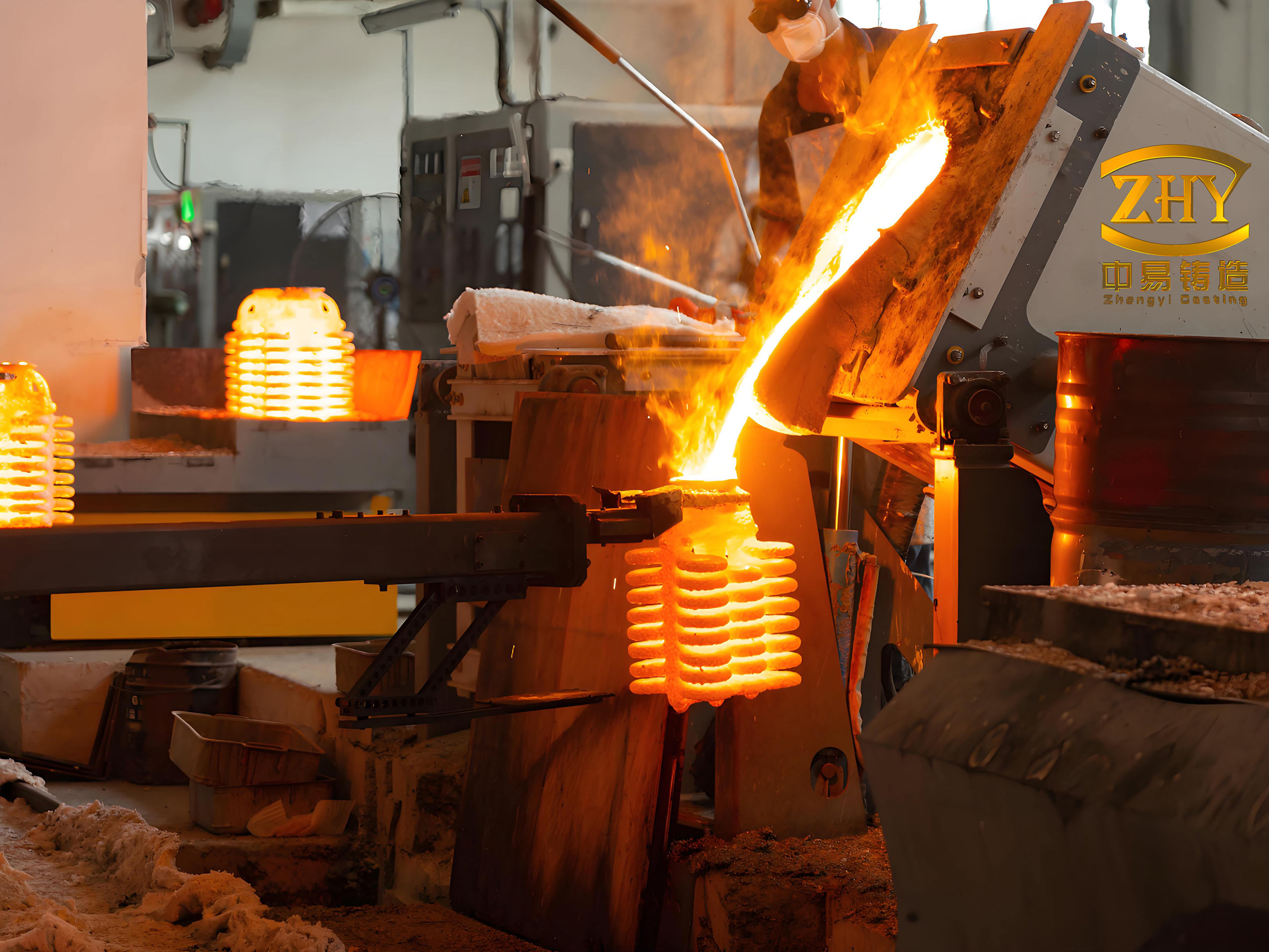
My production setup utilized standard but carefully selected lost wax casting equipment to ensure reproducibility and scale. The core machinery included an M225 series wax injection machine, an MFS60 fluidized sand bed, a ZL50 slurry dipping robot, a DN800/1000 electrically heated dewaxing autoclave, a YJX100×100-12RF high-temperature sintering furnace, and a KYPS 150 kg medium-frequency induction melting furnace. The choice of wax pattern material was critical to minimize distortion during handling and shell building. Given the nozzle’s structural complexity and the need to prevent deformation, I opted for a low-temperature wax blend based on paraffin and stearic acid. This formulation provides adequate strength at room temperature while ensuring easy removability during dewaxing. The alloy’s chemical composition, which dictates its mechanical and corrosion properties, was strictly controlled as per specifications, which can be summarized in the following table:
| Element | Minimum | Maximum / Target | Critical Role in Alloy Performance |
|---|---|---|---|
| C | – | ≤ 0.06 | Controls carbide formation; low carbon enhances corrosion resistance. |
| Si | 0.50 | 1.00 | Deoxidizer; improves fluidity but must be controlled to prevent slag. |
| Mn | – | ≤ 0.70 | Deoxidizer and strength enhancer. |
| P | – | ≤ 0.04 | Impurity; kept low to prevent embrittlement. |
| S | – | ≤ 0.03 | Impurity; kept low to prevent hot tearing. |
| Cr | 15.50 | 16.70 | Primary corrosion resistance element; promotes martensite formation. |
| Ni | 3.60 | 4.60 | Austenite stabilizer; aids in toughness and hardenability. |
| Cu | 2.80 | 3.50 | Key for precipitation hardening; forms strengthening phases. |
| Nb | 0.15 | 0.40 | Carbide former; improves strength and grain refinement. |
The heart of my lost wax casting process lies in the meticulous gating and feeding system design. The nozzle is a substantial casting with varying wall thicknesses, creating inherent hotspots prone to shrinkage defects. To facilitate complete mold filling, effective feeding for solidification shrinkage, and the establishment of directional solidification—a cornerstone of sound casting integrity—I devised a top-gating system. This system comprises a large, dedicated feeder head (sprue base) and two straight sprue channels. The feeder head acts as a thermal reservoir, supplying liquid metal to compensate for shrinkage until the casting fully solidifies. The mathematical rationale for feeder design often employs Chvorinov’s Rule, which states that solidification time (t) is proportional to the square of the volume-to-surface area ratio:
$$ t = k \left( \frac{V}{A} \right)^2 $$
where \( t \) is the solidification time, \( V \) is the volume of the casting or feeder, \( A \) is its surface area, and \( k \) is the mold constant. For the feeder to remain liquid longer than the casting, its modulus \( \left( \frac{V}{A} \right) \) must be greater than that of the casting’s critical sections. In this lost wax casting setup, I calculated the required feeder dimensions to ensure a modulus ratio (feeder modulus / casting modulus) of approximately 1.2. Furthermore, to withstand the metallostatic pressure during pour and prevent shell cracking (“run-out”), the ceramic shell needed enhanced strength, achieved by increasing the number of shell layers beyond typical applications.
For the wax pattern production, I designed a two-part aluminum mold, incorporating two separate core inserts (loose pieces) to accurately form the nozzle’s internal complexities. Aluminum was chosen for its lightweight nature, facilitating easier handling during the wax injection process. The mold design incorporated the gating system cavities. The large feeder head and the two φ50 mm x 40 mm sprue patterns were produced using dedicated mold sections. After injection, these were manually assembled to the main nozzle wax pattern using heated tools, forming a complete wax assembly tree. The wax injection parameters were finely tuned: injection pressure of 0.6-0.8 MPa, wax temperature of 48-52°C, and mold temperature of 20-25°C. These settings are crucial in lost wax casting to prevent wax pattern distortions, sink marks, and surface imperfections. After ejection, patterns underwent meticulous inspection and finishing to remove parting lines and flash, ensuring dimensional accuracy and surface smoothness.
The assembly of wax patterns into a cluster, known as a “tree,” is a strategic step in lost wax casting. I employed a single-casting-per-tree configuration to maximize control over the solidification dynamics for each individual nozzle. The wax pattern was attached via its gates to the large central feeder head using a heated spatula and precision-welding techniques. The complete tree, as conceptually represented, ensures an efficient and controlled path for metal flow and feeding.
| Process Stage | Parameter | Value / Specification | Rationale |
|---|---|---|---|
| Wax Pattern | Material | Paraffin-Stearic Acid Low-Temp Blend | Minimizes thermal expansion stress on shell, reduces distortion. |
| Injection Temperature | 50 ± 2 °C | Optimum viscosity for detail replication and easy flow. | |
| Cooling Time | 180-240 seconds | Ensures sufficient solidification to prevent deformation on ejection. | |
| Ceramic Shell Building | Binder System | Colloidal Silica (Silica Sol) | Provides high green strength, excellent fired strength, and smooth surface finish. |
| Primary Coat Slurry Viscosity | 30-32 seconds (Ford Cup #4) | Ensures a thin, uniform coating that perfectly replicates the wax surface. | |
| Stucco Sequence | 2 coats fine zircon sand (100-120 mesh), 4 coats coarse fused silica sand (30-60 mesh), 1.5 seal coats | Builds strength progressively; fine sand for surface finish, coarse for permeability and insulation. | |
| Intercoat Drying Time | 12-24 hours (Controlled Humidity <60% RH) | Allows complete hydrolysis and gelation of silica sol for layer bonding. | |
| Dewaxing & Firing | Dewaxing Method | High-Pressure Steam Autoclave | Rapid wax removal minimizes shell damage from expansion. |
| Firing Temperature & Time | 1050 °C for 30 minutes | Sinters the shell, eliminates volatiles, and preheats mold for casting. | |
| Melting & Pouring | Melting Furnace | 150 kg Medium-Frequency Induction | Efficient, clean melting with excellent temperature control and stirring action. |
| Target Pouring Temperature | 1590 ± 5 °C | Superheat above liquidus (~1480°C) ensures fluidity while minimizing gas absorption. | |
| Deoxidation Practice | Pre-deoxidation with Fe-Mn, Final deoxidation with Ca-Si alloy | Removes dissolved oxygen to prevent gas porosity and oxide inclusions. |
Building the ceramic shell is arguably the most defining phase in achieving high surface quality in lost wax casting. I employed a colloidal silica (silica sol) binder system due to its superior characteristics compared to ethyl silicate or water glass systems. Silica sol provides exceptional fired strength, low thermal expansion (reducing cracking risk), and yields a very fine, smooth surface texture on the final casting. The process is a cyclic one of dipping, draining, stuccoing, and drying. The total shell build consisted of 7.5 layers: two primary coats with fine zircon flour and stucco to capture detail, followed by four backup coats with coarser fused silica stucco for structural strength and permeability, and a final half-coat (seal coat) of pure slurry to bind loose sand particles. Each layer’s drying is governed by the diffusion and evaporation of water from the colloidal silica gel. The drying kinetics can be approximated by Fick’s second law for a slab geometry:
$$ \frac{\partial C}{\partial t} = D \frac{\partial^2 C}{\partial x^2} $$
where \( C \) is the moisture concentration, \( t \) is time, \( D \) is the diffusion coefficient, and \( x \) is the spatial coordinate. Ensuring complete drying between coats (typically 12-24 hours under controlled humidity) is paramount to prevent shell delamination or “soft spots” during subsequent processing.
Once the shell was fully dried and hardened, the wax was removed using high-pressure saturated steam in an autoclave. The rapid heating of the wax causes it to melt and expand, but the pressurized steam environment forces the molten wax out through the permeable shell walls. This method is fast and minimizes thermal shock to the ceramic. Following dewaxing, the hollow shell was fired at 1050°C for 30 minutes. This firing serves multiple purposes in the lost wax casting sequence: it completely eliminates any residual wax or organic matter, sinters the ceramic particles together dramatically increasing the shell’s hot strength, and preheats the mold to a high temperature. A preheated mold is essential for casting stainless steels like PH17-4 to prevent premature chilling of the metal, which can lead to mistruns and poor surface finish. The thermal energy balance during pouring into a preheated shell involves complex heat transfer, but a simplified energy equation can be considered:
$$ Q_{metal} = m_{metal} \cdot C_{p,metal} \cdot (T_{pour} – T_{solidus}) = Q_{shell\_absorbed} + Q_{shell\_loss} + Q_{latent} $$
where \( Q_{metal} \) is the heat content of the molten metal, \( m \) is mass, \( C_p \) is specific heat, \( T \) are temperatures, and the right side accounts for heat absorbed by the shell, heat lost to the environment, and the latent heat of fusion.
The melting and pouring operation required precise metallurgical control. The PH17-4 alloy was charged into the medium-frequency induction furnace. The electromagnetic stirring inherent to induction melting promotes homogeneity and accelerates the dissolution of alloying elements. Upon reaching a fully liquid state, a sample was taken for spectroscopic analysis to verify conformity with Table 1. After chemistry adjustment, the melt was subjected to a rigorous slag removal and deoxidation practice. Pre-deoxidation with ferromanganese was followed by a final deoxidation with a calcium-silicon alloy just before tap. This two-stage approach minimizes the formation of non-metallic inclusions, a critical factor for the nozzle’s internal soundness. When the superheat temperature reached 1590°C, the power was switched off, and the melt was poured directly from the furnace into the preheated ceramic shells. The pour was rapid and continuous to maintain a steady metal head in the feeding system. Immediately after pouring, an exothermic insulating compound was placed over the feeder head to prolong its solidification time, enhancing its feeding efficiency—a vital trick in successful lost wax casting of heavy-sectioned castings.
The initial production batch consisted of 15 nozzles. Throughout the pour, no incidents of shell fracture or metal run-out occurred, validating the robustness of the 7.5-layer silica sol shell system. After standard post-casting procedures—cooling, vibration decoring, shot blasting, and cutting off the gating system—the cast nozzles were inspected. The visual and tactile assessment revealed surfaces that were remarkably smooth and planar, completely free from the blisters, slag patches, and gas pinholes that often plague sand castings. Examination of the feeder neck break-off points showed a dense, shrunken structure indicative of effective feeding, with no macro- or microscopically detectable shrinkage cavities or porosity in the casting body. The success rate exceeded 90% in this first trial, a testament to the process optimization. The key differentiating factors of this lost wax casting approach versus conventional methods are quantifiable. The surface roughness (Ra) achievable with silica sol shells in lost wax casting is often below 3.2 µm, whereas sand casting typically yields Ra values above 12.5 µm. The dimensional accuracy, often expressed as a linear tolerance, is within ±0.5% of dimension for lost wax casting, compared to ±2% or more for sand casting. The ability to control solidification through mold preheat and gating design directly impacts mechanical properties. The yield strength (σ_y) of the cast PH17-4 can be related to secondary dendrite arm spacing (λ), which is a function of local solidification time (t_f):
$$ \lambda = a \cdot t_f^n $$
$$ \sigma_y = \sigma_0 + \frac{k}{\sqrt{\lambda}} $$
where \( a \), \( n \), \( \sigma_0 \), and \( k \) are material constants. The controlled, relatively slow solidification in a preheated ceramic mold promotes a finer microstructure (smaller λ) compared to a chill-inducing sand mold, thereby enhancing the as-cast strength.
In conclusion, the systematic development and implementation of this lost wax casting production line have decisively solved the quality challenges associated with manufacturing high-integrity nozzles. The integration of a low-temperature wax system, a multi-layer colloidal silica ceramic shell, a thermally optimized top-gating design, and a tightly controlled melting and pouring practice has resulted in a robust and repeatable process. This lost wax casting methodology not only fulfills the most demanding surface and internal quality criteria but also significantly elevates product yield and consistency. The economic implications are substantial; given the high volume demand for such components, transitioning to lost wax casting translates into considerable cost savings by eliminating scrap, reducing machining allowances, and enhancing component performance in service. The principles and parameters established here—encompassing material science, heat transfer, fluid dynamics, and process engineering—provide a scalable and adaptable framework. This framework can be confidently applied to the lost wax casting of a wide array of other complex, high-performance alloy components, solidifying lost wax casting’s position as an indispensable technology in advanced manufacturing.