
In my extensive experience with advanced manufacturing techniques, the lost wax investment casting process stands out as a critical method for producing high-precision, complex metal components. This process, often referred to simply as investment casting, involves creating a wax pattern, coating it with a ceramic shell, melting out the wax, and pouring molten metal into the cavity. The versatility and accuracy of lost wax investment casting make it indispensable in industries such as aerospace, automotive, and medical devices. However, ensuring defect-free castings requires meticulous process design, which can be significantly enhanced through computer-aided engineering (CAE) simulations. In this article, I will delve into how CAE tools, specifically focusing on a case study, can optimize the lost wax investment casting process, highlighting the integration of numerical modeling to predict and mitigate defects like shrinkage porosity.
The lost wax investment casting process begins with the fabrication of a wax pattern that replicates the final part. This pattern is then assembled into a tree-like structure, coated with multiple layers of ceramic slurry and stucco to form a robust shell. After dewaxing, the shell is fired to achieve necessary strength and thermal stability. Molten metal is poured into the preheated shell, and upon solidification, the shell is removed to reveal the cast component. One of the key challenges in lost wax investment casting is managing the solidification dynamics to avoid internal defects, particularly in sections with varying wall thickness or isolated hot spots. Traditional trial-and-error methods are time-consuming and costly, which is why CAE simulation has become a cornerstone in modern foundries.
CAE simulation software, such as InteCAST or similar systems, allows for virtual modeling of the entire casting process, including filling, solidification, and cooling. By applying finite element analysis (FEA) or finite volume methods, these tools solve governing equations for heat transfer and fluid flow. For instance, the energy equation during solidification can be expressed as:
$$ \rho c_p \frac{\partial T}{\partial t} = \nabla \cdot (k \nabla T) + L \frac{\partial f_s}{\partial t} $$
where \( \rho \) is density, \( c_p \) is specific heat, \( T \) is temperature, \( t \) is time, \( k \) is thermal conductivity, \( L \) is latent heat of fusion, and \( f_s \) is solid fraction. This equation accounts for phase change effects crucial in lost wax investment casting simulations. Additionally, criteria functions like the Niyama criterion are used to predict shrinkage porosity, given by:
$$ Ny = \frac{G}{\sqrt{\dot{T}}} $$
where \( G \) is temperature gradient and \( \dot{T} \) is cooling rate. Values below a threshold indicate potential defects. Through such mathematical frameworks, CAE enables predictive analysis, reducing reliance on physical prototypes.
In my application of CAE to lost wax investment casting, I often start with a detailed structural analysis of the component. Consider a typical bearing housing produced via lost wax investment casting, with dimensions approximately 260 mm × 150 mm × 150 mm and an average wall thickness of 15 mm. This part, used in mechanical assemblies, requires high dimensional accuracy per standards like GB6414-86 CT6, and critical zones must be free from shrinkage or cracks to prevent fluid leakage. The initial design exhibited multiple isolated hot spots at intersections, as illustrated in the following table summarizing key features:
| Feature | Description | Relevance to Lost Wax Investment Casting |
|---|---|---|
| Hot Spot C | Junction of walls in upper region | Prone to shrinkage due to poor feeding |
| Hot Spot D | Lower cavity area | Isolated liquid phase leads to porosity |
| Gating System | Multiple ingates for feeding | Essential for compensative solidification |
The original gating design for this lost wax investment casting component involved several ingates positioned near hot spots, based on the principle that each hot spot should have a dedicated feeder in small steel castings. However, preliminary simulations revealed shortcomings. Using InteCAST software, I performed a pure solidification heat transfer analysis under the assumption of “instantaneous filling with uniform initial temperature,” which simplifies the computation while maintaining accuracy for lost wax investment casting scenarios. The mesh generation involved uniform grid sizing—3 mm for the original scheme, resulting in over 1.2 million cells—to discretize the geometry for numerical solving.
Key process parameters for this lost wax investment casting simulation included material properties and boundary conditions. The alloy was ASTM A27 grade 450-240 steel, equivalent to ZG230-450, with liquidus and solidus temperatures of 1516°C and 1400°C, respectively. The ceramic shell, composed of sodium silicate binder and quartz sand, had a thickness of 8 mm with six layers, hardened by ammonium chloride. Process conditions were: pouring temperature 1530–1550°C, mold preheat temperature 700°C, pouring time 16–18 seconds, and yield rate 46%. These parameters are typical in lost wax investment casting to ensure proper flow and solidification.
The simulation results for the original scheme indicated severe defect risks. During solidification, at time \( t = 149.48 \) seconds, isolated liquid pockets formed in regions corresponding to hot spots C and D, as shown by the phase distribution. This isolation impeded directional feeding, leading to shrinkage cavities and porosity upon complete solidification at \( t = 748.39 \) seconds. The defect metrics summarized quantitatively are:
| Defect Type | Volume (ml) | Number of Zones |
|---|---|---|
| Shrinkage Porosity | 51.44 | 9 |
| Shrinkage Cavities | 144.85 | 9 |
The porosity boundary was set at 15.99% fraction with a critical porosity of 0.99%. These defects, predicted by CAE, aligned with actual production issues in lost wax investment casting, where X-ray inspection revealed flaws in critical sections. The root cause was the discontinuous thermal profile, preventing sequential solidification from ingates to remote hot spots.
To address this, I explored various modifications in the lost wax investment casting process. After several iterative simulations, I proposed altering the component geometry to enhance feeding efficiency, rather than adding more ingates or risers, which would reduce yield. By consulting with end-users, I adjusted the design to taper three recesses in area E, making the recess depth shallowest near the ingate and progressively deeper away from it. This modification created a gradual wall thickness variation, facilitating thermal gradients conducive to directional solidification. The revised geometry ensured that hot spots C and D were connected via a sound feeding path, embodying the principle of progressive solidification in lost wax investment casting.
The improved scheme was re-simulated with a finer mesh of 2.5 mm, totaling over 2.1 million cells to capture detailed thermal effects. The solidification analysis showed no isolated liquid phases throughout the process. At \( t = 285.33 \) seconds, the entire casting solidified uniformly, with feeding from ingates effectively compensating for shrinkage. The defect analysis post-solidification revealed a significant reduction in internal flaws, as tabulated below:
| Defect Type | Volume (ml) | Number of Zones |
|---|---|---|
| Shrinkage Porosity | 31.73 | 8 |
| Shrinkage Cavities | 156.34 | 8 (all in gating system) |
Notably, shrinkage cavities were entirely transferred to the gating system, leaving the casting body defect-free. This outcome validates the efficacy of CAE-guided optimization in lost wax investment casting. The underlying thermal dynamics can be further analyzed using the Fourier number for transient heat conduction:
$$ Fo = \frac{\alpha t}{L^2} $$
where \( \alpha \) is thermal diffusivity, and \( L \) is characteristic length. Higher \( Fo \) values in modified design indicate faster heat dissipation, reducing local superheating. Additionally, the feeding distance \( D_f \) in lost wax investment casting can be estimated by:
$$ D_f = \frac{k (T_p – T_s)}{\rho L} \cdot \frac{A}{P} $$
where \( T_p \) is pouring temperature, \( T_s \) is solidus temperature, \( A \) is cross-sectional area, and \( P \) is perimeter. By tapering walls, \( A/P \) ratio improves, extending \( D_f \) to reach remote sections.
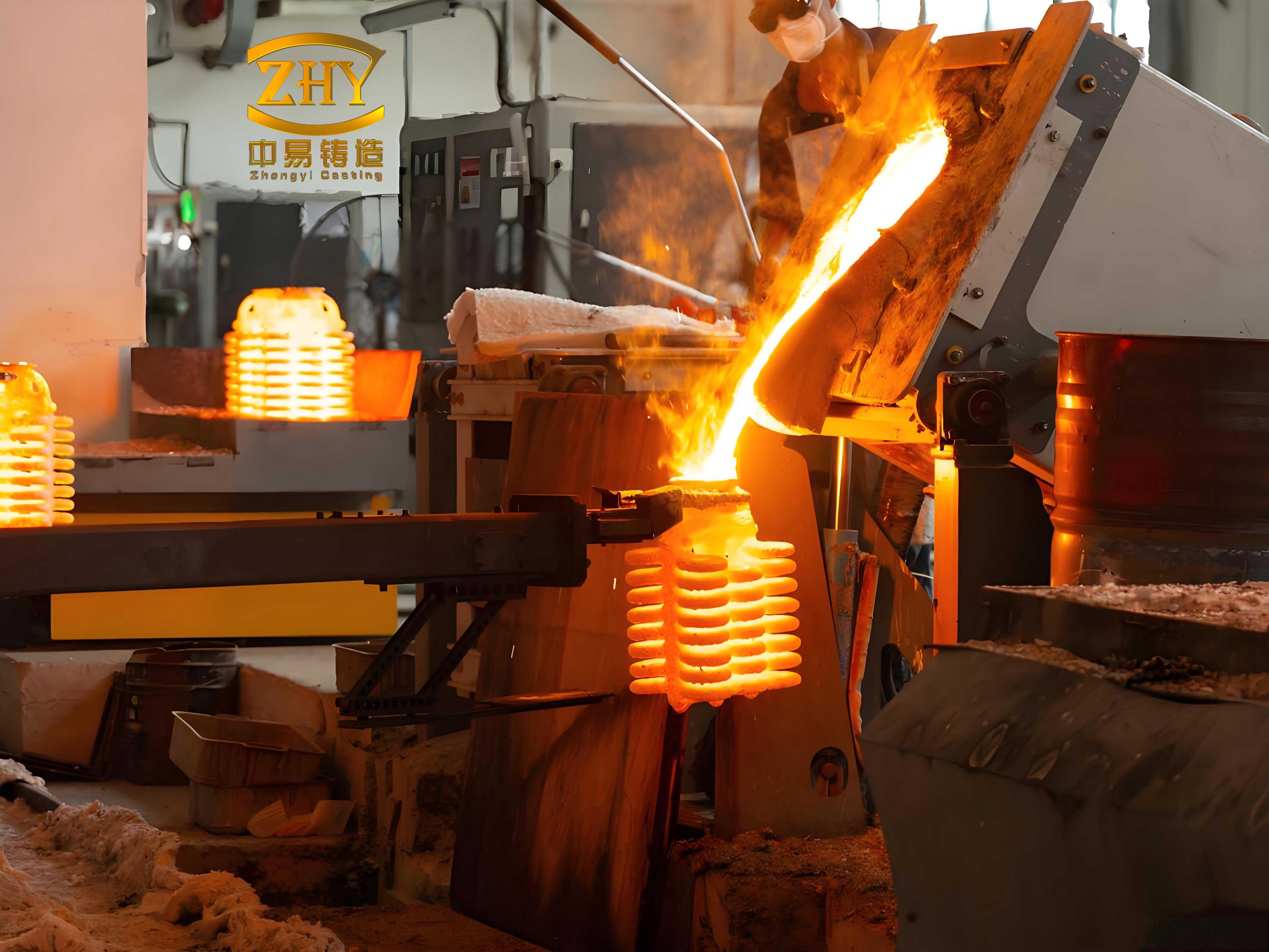
Production validation confirmed the simulation predictions. The revised wax patterns were assembled into trees, each containing two components, and processed through standard lost wax investment casting steps. The final castings underwent dimensional checks, magnetic particle inspection, and X-ray testing, all meeting stringent customer specifications without defects. This successful implementation underscores how CAE simulation can streamline the lost wax investment casting workflow, saving time and resources while enhancing quality.
Beyond this case, the integration of CAE in lost wax investment casting offers broader advantages. For example, sensitivity analyses can optimize process variables like pouring temperature or shell thickness. A multivariate regression model might relate defect probability to key factors:
$$ P_{defect} = \beta_0 + \beta_1 T_{pour} + \beta_2 t_{shell} + \beta_3 G_{avg} $$
where \( \beta \) coefficients are derived from simulation data. Such models empower foundries to preemptively adjust parameters for diverse lost wax investment casting projects. Furthermore, advanced modules can simulate mold filling dynamics, accounting for turbulent flow and air entrapment, though pure solidification analysis often suffices for defect prediction in steel castings.
In my practice, I’ve observed that the lost wax investment casting process particularly benefits from CAE due to the high cost of ceramic shells and wax patterns. Virtual prototyping reduces material waste and energy consumption. For instance, a typical lost wax investment casting cycle might involve dozens of design iterations; CAE cuts this to a handful, accelerating time-to-market. The software’s ability to visualize temperature fields and liquid fraction contours provides intuitive insights, as shown in the earlier phase diagrams. Engineers can identify hot spots interactively and implement design changes, such as adding chill plates or modifying gating, all within the digital realm.
To elaborate on the numerical methods, the CAE software solves the heat conduction equation with phase change using implicit time integration. The discretized form for each cell \( i \) is:
$$ \sum_j k_{ij} (T_i – T_j) + Q_i = \rho c_p V_i \frac{T_i^{n+1} – T_i^n}{\Delta t} $$
where \( j \) denotes neighboring cells, \( Q_i \) is latent heat source, \( V_i \) is volume, and superscripts indicate time steps. Convergence criteria ensure accuracy, typically with residuals below \( 10^{-6} \). For lost wax investment casting simulations, material properties are temperature-dependent, requiring iterative solvers. The following table compares thermal properties used in the simulation for shell and metal:
| Material | Thermal Conductivity (W/m·K) | Specific Heat (J/kg·K) | Density (kg/m³) |
|---|---|---|---|
| Ceramic Shell | 1.2 | 900 | 2200 |
| ZG230-450 Steel | 35 (liquid), 40 (solid) | 600 | 7800 |
These values influence cooling rates and gradient calculations, directly affecting defect predictions in lost wax investment casting. Moreover, the interfacial heat transfer coefficient between metal and shell is critical, often set empirically based on coating layers.
Another aspect is the economic impact of CAE in lost wax investment casting. By reducing scrap rates, foundries can achieve higher profitability. Suppose a traditional lost wax investment casting process has a defect rate of 10%; CAE optimization might lower it to 2%, saving significant costs per batch. The return on investment (ROI) can be approximated as:
$$ ROI = \frac{C_{savings} – C_{CAE}}{C_{CAE}} \times 100\% $$
where \( C_{savings} \) includes reduced rework and material, and \( C_{CAE} \) covers software and training. In many cases, ROI exceeds 200% within a year, making CAE indispensable for competitive lost wax investment casting operations.
Looking forward, emerging technologies like artificial intelligence (AI) and machine learning (ML) are poised to augment CAE for lost wax investment casting. AI algorithms can analyze historical simulation data to recommend optimal gating designs automatically, further reducing human intervention. For example, neural networks trained on thousands of lost wax investment casting simulations could predict defect zones from geometric inputs alone, expressed as:
$$ y = f(X; \theta) $$
where \( y \) is defect likelihood, \( X \) is feature vector (e.g., wall thickness ratios, curvature), and \( \theta \) are network weights. Such synergies will push the boundaries of precision in lost wax investment casting.
In conclusion, the lost wax investment casting process, when coupled with CAE simulation, achieves remarkable improvements in quality and efficiency. My experience with the bearing housing case demonstrates that even subtle geometric changes, guided by numerical analysis, can eliminate defects without compromising yield. The iterative simulation approach allows for exploring countless scenarios virtually, ensuring robust process design. As the industry advances, the integration of CAE will become standard practice in lost wax investment casting, driving innovation and reliability. I encourage foundries to adopt these tools to stay ahead in the competitive landscape of precision casting.