
The 21st century has witnessed a profound transformation in manufacturing, driven by the relentless advancement of computer technology. Digitalization, networking, and intelligent technologies have become the main engines of industrial development, providing novel technical pathways for quality control. In this context, many enterprises have implemented integrated management systems such as Enterprise Resource Planning (ERP) and Manufacturing Execution Systems (MES) to streamline operations. The foundry industry, particularly the sector specializing in sand castings, is a critical component of modern manufacturing, holding a pivotal position in the production of key automotive components like engine cylinder heads. However, the very nature of sand casting—characterized by complex, multi-stage processes, lengthy production cycles, and high-volume output—inherently leads to significant challenges: substantial quality fluctuations and formidable difficulties in tracing the root causes of defects. The industry’s shift towards automation and信息化, while generating vast amounts of production data from shop-floor equipment and management systems, has paradoxically created a state of “data explosion but knowledge scarcity.” Valuable insights into the relationships between process parameters and the final quality of sand castings remain largely buried within these databases. Consequently, the development and application of sophisticated data mining methodologies are not merely advantageous but essential for converting this dormant data wealth into actionable knowledge, thereby enabling superior quality管控 and effective defect溯源.
Data Mining, also known as Knowledge Discovery in Databases (KDD), is the interdisciplinary process of discovering previously unknown, valid, novel, potentially useful, and ultimately understandable patterns in large volumes of data. It involves the analysis of observational datasets to find unsuspected relationships and to summarize the data in novel ways that are both comprehensible and useful to the data owner. The core challenge lies in extracting implicit, non-trivial information from often noisy and incomplete data sources. This technology has matured and found successful applications across diverse fields like finance, insurance, and management science. However, its adoption within the specific domain of sand castings production remains in a nascent stage. The efficacy of data mining is intrinsically linked to data volume; stable and reliable patterns emerge only when the analysis is performed on sufficiently large datasets. Modern foundry ERP and MES systems are perfectly positioned to provide this necessary data foundation, making them an ideal platform for deploying data mining solutions to tackle the perennial quality issues in sand castings.
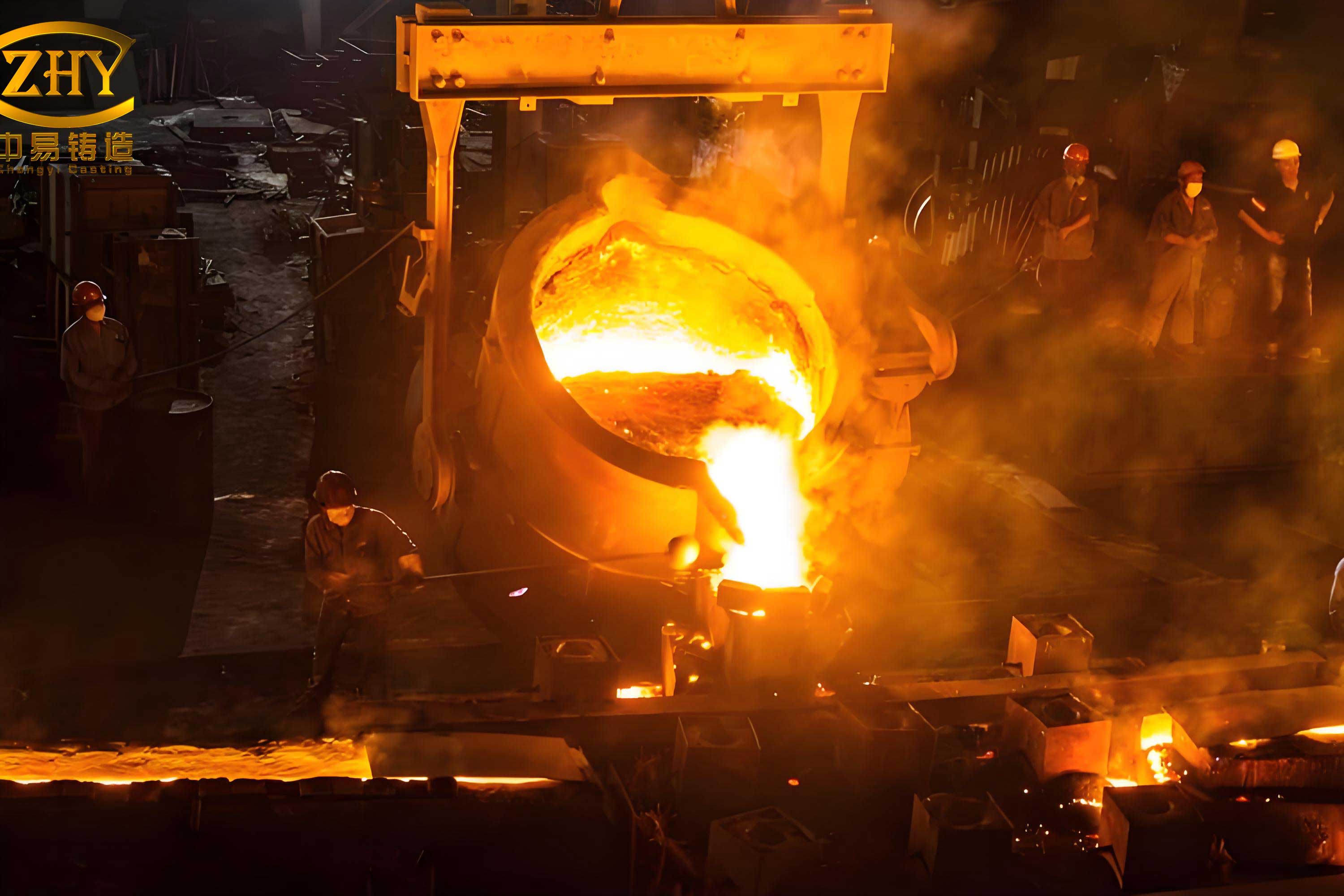
Data Acquisition and Integration in a Foundry ERP Ecosystem
The proposed data mining framework is built upon a dedicated foundry ERP system, which serves as the central nervous system for enterprise-wide data aggregation. The core business logic of such a system is designed to be customer-centric and order-driven, integrating all critical functions from sales and procurement to production planning, execution, and shipping. For a high-volume producer of sand castings like engine blocks and heads, the ERP workflow typically follows a sequence: Order Entry -> Process Planning (including route definition, Bill of Materials (BOM) creation, and casting工艺 assignment) -> Production Preparation (encompassing mold management, raw material inventory, and采购) -> Production Scheduling -> Manufacturing Execution -> Sales and Dispatch.
Data acquisition within this ecosystem is twofold: automated and manual. Automated data collection interfaces directly with shop-floor equipment—such as molding machines, furnace controllers, and spectrometer—capturing real-time parameters like sand compactibility, pouring temperature, metal chemistry, and cycle times. Concurrently, manual data entry through ERP client modules captures transactional and qualitative information. Key manual inputs include order details, process card specifications, quality inspection results (noting defects like shrinkage, porosity, or inclusions), and final shipping records. This holistic approach ensures every individual sand casting unit, often tracked by a unique identifier, is associated with a comprehensive digital thread containing its entire production history.
| Table Name | Primary Key | Key Attributes (Examples) | Association Target (Foreign Key) |
|---|---|---|---|
| Order_Details | Order_ID, Casting_ID | Customer_ID, Part_Number, Quantity, Due_Date | Customer_Info, Dispatch_Record |
| Production_Schedule | Schedule_ID, Casting_ID | Plan_Date, Mold_ID, Route_Code | Process_Card, Mold_Registry |
| Process_Card | Process_ID | Pouring_Temp_Target, Sand_Type, Core_Assy_Spec | Associated with a Part_Number |
| Production_Parameter_Log | Log_ID, Equipment_ID, Timestamp | Parameter_Type (e.g., Temp), Parameter_Value | Linked via Timestamp/Casting_ID to production events |
| Quality_Inspection | Inspection_ID, Casting_ID | Inspection_Date, Defect_Code, Defect_Location, Severity | Casting_ID (links to all production data) |
| Dispatch_Record | Dispatch_ID | Order_ID, Casting_ID, Dispatch_Date | Order_Details |
The Proposed Data Mining Model: Association and Prediction
The cornerstone of the proposed framework is a relational data mining model specifically architected for the complex data landscape of sand castings manufacturing. Given that the underlying ERP database is a relational SQL database, the model heavily utilizes association analysis. The fundamental entity for mining is the unique casting identifier (Casting_ID). This identifier acts as the primary key to traverse and join multiple related tables, constructing a complete digital profile for each cast part.
The model operates on multiple levels of association. At the first level, the Casting_ID directly links to three primary fact tables: the order details, the quality inspection record, and the production schedule record. The order details can be further traversed to analyze customer demand patterns and shipping performance. The production schedule record provides a link to the specific process card (工艺) used for that batch or part. Most critically, the quality inspection record serves as the anchor for defect analysis. It can be associated in two powerful ways: 1) Temporally, by joining inspection dates/times with the production parameter logs from all relevant process stations (molding, core-making, melting, pouring, cooling), enabling a detailed audit trail of the conditions present when a defective sand casting was produced. 2) Logically, by linking the defect code to the process card parameters, allowing for statistical analysis of which工艺 settings correlate with specific defect types.
This interconnected model can be formally represented as a set of relations. Let \( C \) represent the set of all sand castings. For a given casting \( c \in C \), its full data profile \( P(c) \) is the union of associated tuples from related tables:
$$ P(c) = O(c) \cup Q(c) \cup S(c) \cup \bigcup_{t \in T(c)} L(t) \cup D(c) $$
Where:
- \( O(c) \) : Tuples from Order_Details for casting \( c \).
- \( Q(c) \) : Tuples from Quality_Inspection for casting \( c \).
- \( S(c) \) : Tuples from Production_Schedule for casting \( c \), which links to process card \( R \).
- \( T(c) \) : Set of timestamps associated with the production of casting \( c \).
- \( L(t) \) : Tuples from Production_Parameter_Log around timestamp \( t \).
- \( D(c) \) : Tuples from Dispatch_Record for casting \( c \).
The ultimate objective is to find a pattern or function \( F \) that maps the influencing parameters to quality outcome \( y \) (e.g., a binary pass/fail or a defect severity score). The association model helps identify the relevant parameters \( x_i \) from \( P(c) \).
$$ y = F(x_1, x_2, x_3, …, x_n; \theta) + \epsilon $$
where \( x_i \) could be parameters like pouring temperature deviation (\( \Delta T \)), sand moisture content (\( M_s \)), or mold hardness (\( H_m \)), \( \theta \) represents the model parameters, and \( \epsilon \) is noise.
From Association to Prediction: A Neural Network Application
The established associative relationships create a labeled dataset ideal for supervised learning. By treating the various process parameters (\( x_i \)) extracted via the association model as input features and the final quality inspection result (\( y \)) as the target label, a predictive model can be trained. Artificial Neural Networks (ANNs) are particularly suited for this task due to their ability to model complex, non-linear relationships inherent in the physics of sand castings production.
Consider a multi-layer perceptron (MLP) with one hidden layer. For a sand casting with an input feature vector \( \mathbf{x} \in \mathbb{R}^n \), the network’s prediction \( \hat{y} \) is computed as:
$$ \mathbf{z} = \sigma(\mathbf{W}^{(1)} \mathbf{x} + \mathbf{b}^{(1)}) $$
$$ \hat{y} = g(\mathbf{W}^{(2)} \mathbf{z} + b^{(2)}) $$
Here, \( \mathbf{W}^{(1)}, \mathbf{b}^{(1)} \) are the weights and biases of the hidden layer, \( \sigma \) is a non-linear activation function (e.g., ReLU), \( \mathbf{W}^{(2)}, b^{(2)} \) are the weights and bias of the output layer, and \( g \) is the output function (e.g., sigmoid for binary classification). The network is trained by minimizing a loss function \( \mathcal{L}(y, \hat{y}) \), such as binary cross-entropy, over the historical dataset of sand castings:
$$ \min_{\mathbf{W}, \mathbf{b}} \frac{1}{N} \sum_{c=1}^{N} \mathcal{L}(y_c, \hat{y}_c) $$
Once trained, this model can serve as a virtual quality predictor. For a new sand casting order, even before production begins, the planned process parameters can be fed into the network to estimate the probability of a quality defect. This enables proactive process adjustment.
| Layer | Neurons | Activation | Input/Output Description |
|---|---|---|---|
| Input | n (e.g., 8) | – | Features: Pouring Temp, Mold Hardness, Sand Moisture, Carbon Equivalent, Inoculant Amount, Pouring Time, Chill Presence (0/1), Mold Age. |
| Hidden | 10 | ReLU | Learns non-linear interactions between process parameters. |
| Output | 1 | Sigmoid | Output: Scalar between 0 and 1 representing defect probability. |
Use Cases and Applications of the Mining Results
The output of the data mining framework is multifaceted, providing actionable insights across management and engineering functions. Results are typically presented through a combination of summary tables and rich visualizations directly within the ERP or a connected analytics dashboard.
1. Descriptive Analytics and Visualization: Basic statistical aggregation provides a clear overview of performance.
- Quality Performance Tables: Summarize defect rates by part number, shift, or month.
- Trend Charts: Scatter plots of daily production volume reveal output trends and potential capacity constraints. Line charts can track key parameter drift over time.
- Defect Analysis Charts: Pareto charts (bar charts) clearly identify the most frequent defect types. Pie charts can illustrate the monthly contribution of different product lines to total output or scrap.
These visual tools transform raw data into immediately comprehensible information for daily management meetings.
2. Root Cause Analysis and Traceability: This is the core investigative application. When a spike in a specific defect (e.g., shrinkage porosity) is detected, the associative model allows rapid filtering. An analyst can query all sand castings produced with that defect code within a specified period. The system then retrieves the complete \( P(c) \) profile for each defective unit. Common patterns across these profiles are sought:
- Were all defective castings poured from the same furnace batch or ladle?
- Was there a consistent deviation in pouring temperature or speed in the parameter logs?
- Were they all produced using molds from a specific pattern or core box that might be worn?
- Did the defect rate increase after a change in sand supplier or reclaiming system settings?
This capability dramatically reduces the time for physical investigation on the shop floor.
3. Predictive Quality Control: The deployed neural network model shifts the paradigm from reactive to proactive control. Engineers can use it as a “what-if” simulation tool. For instance, the impact of changing a critical parameter can be assessed:
$$ \text{Predicted Defect Probability} = \text{NN}(T_{pour}=1450^{\circ}C, M_{sand}=3.2\%, …) $$
$$ \text{Predicted Defect Probability} = \text{NN}(T_{pour}=1475^{\circ}C, M_{sand}=3.2\%, …) $$
Comparing the two outputs quantifies the risk associated with the temperature change. This supports data-driven decision-making for process optimization and new工艺 validation for sand castings.
| Analysis Type | Metric / Finding | Visualization | Actionable Insight |
|---|---|---|---|
| Defect Pareto | Shrinkage accounts for 42% of total scrap; next is Sand Inclusion at 28%. | Bar Chart (Pareto) | Focus process improvement efforts on solidification control and sand system maintenance. |
| Parameter Correlation | Strong negative correlation (r = -0.78) between mold hardness and sand inclusion defects for Part “X”. | Scatter Plot with Trendline | Increase target mold hardness for Part “X” to reduce sand wash/inclusion. |
| Neural Network Prediction | For proposed new parameters, predicted shrinkage risk is 8.5%, down from a baseline of 15.2%. | Dashboard Gauge / Comparison Table | Proceed with the proposed process change for trial, as virtual prediction shows significant improvement. |
| Customer Quality Performance | Customer A has a 0.5% rejection rate at their incoming inspection vs. 2.1% for Customer B for the same part. | Table / Pie Chart by Customer | Investigate potential differences in handling, storage, or inspection criteria with Customer B. |
Conclusion
The integration of a structured data mining framework within a foundry’s ERP system represents a significant leap forward for the quality management of sand castings. By leveraging the inherent relational structure of production data and applying a combination of association analysis and machine learning techniques, the pervasive challenge of “data explosion, knowledge scarcity” can be effectively addressed. The proposed model transforms disparate data points from order entry, process parameters, and quality checks into a coherent, traceable digital thread for each casting. The applications extend from straightforward descriptive statistics and powerful root cause analysis to forward-looking predictive quality control using neural networks. This empowers foundries to move beyond reactive fire-fighting, enabling proactive process optimization, enhanced traceability, and ultimately, a more robust and predictable production of high-quality sand castings. The future lies in deepening these models, potentially incorporating more advanced algorithms like ensemble methods or deep learning for even more complex pattern recognition, and integrating real-time data streams for closed-loop process control.