
In the realm of advanced manufacturing, lost wax investment casting stands out for its unparalleled ability to produce components of exceptional geometric complexity, superior surface finish, and high metallurgical integrity. This process is particularly favored for steel alloys, which are essential for demanding applications in aerospace, automotive, and energy sectors due to their excellent strength and toughness. However, the very complexity that makes lost wax investment casting so valuable also introduces significant challenges in process design. Traditional methods rely heavily on trial-and-error, often leading to prolonged development cycles, high scrap rates, and inconsistent quality. Defects such as shrinkage porosity, gas entrapment, and mistuns are common and costly. The advent of Computer-Aided Engineering (CAE) simulation technology has revolutionized this field, providing a virtual foundry where engineers can visualize, analyze, and optimize the entire casting process before a single mold is made. This article delves into the comprehensive application of CAE technology, specifically through numerical simulation, to diagnose and eliminate defects in a critical steel casting produced via lost wax investment casting, thereby establishing a robust framework for process optimization.
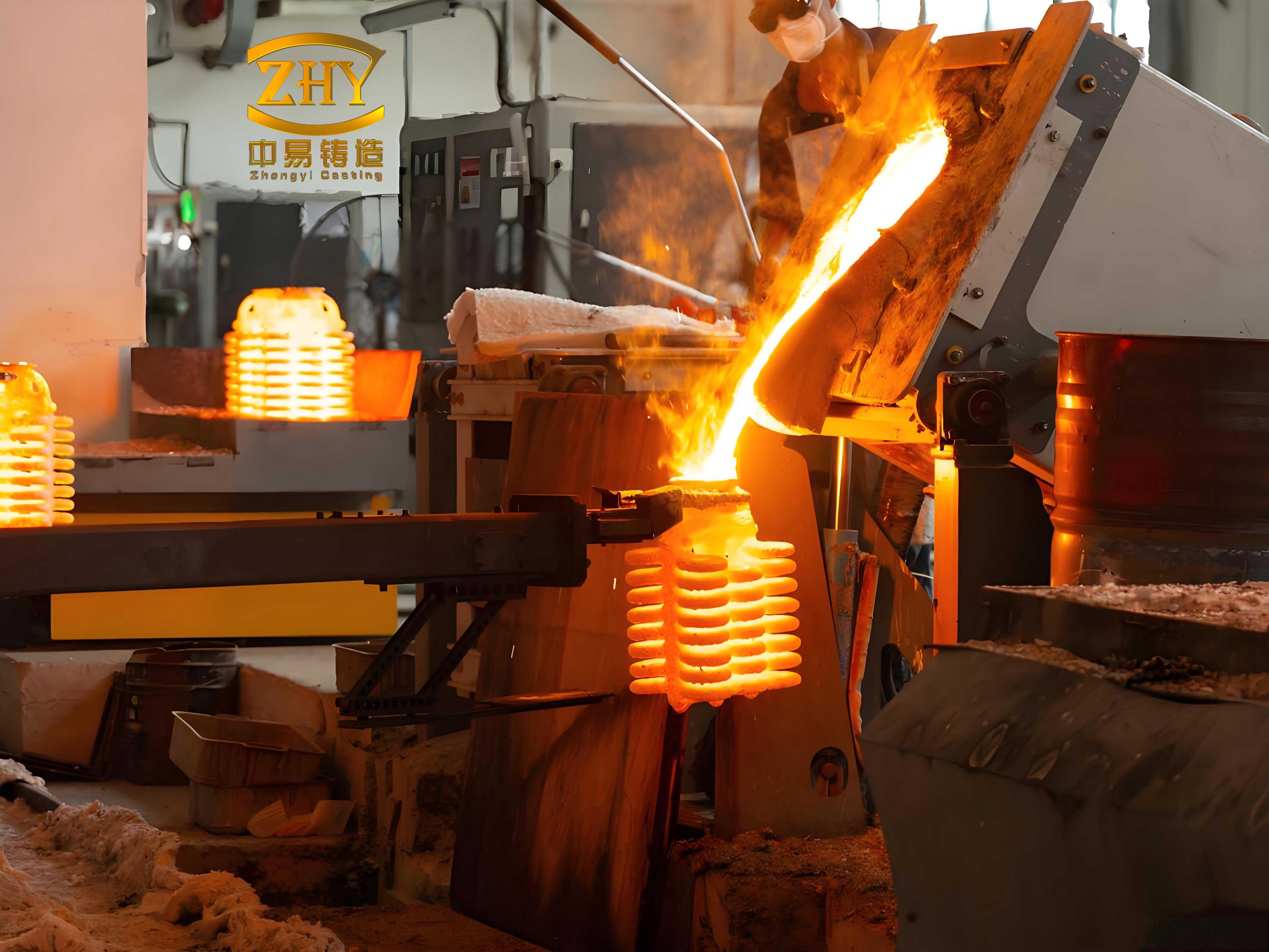
The core challenge in lost wax investment casting of steels lies in managing the intricate interplay of fluid flow, heat transfer, and solidification within a complex ceramic shell. The goal of CAE simulation is to mathematically model these physical phenomena to predict the final outcome of the casting process. The governing equations are solved over a discretized computational domain (the mold and cavity) to provide insights that are impossible to obtain experimentally.
The fundamental physics is described by a set of partial differential equations. The flow of molten metal during mold filling is governed by the Navier-Stokes equations, incorporating the effects of turbulence, surface tension (at the metal-air interface), and the tracking of the evolving free surface. A common approach is the Volume of Fluid (VOF) method. The energy equation, coupled with the flow, governs heat transfer:
$$ \rho C_p \left( \frac{\partial T}{\partial t} + \mathbf{u} \cdot \nabla T \right) = \nabla \cdot (k \nabla T) + Q_{latent} $$
where $ \rho $ is density, $ C_p $ is specific heat, $ T $ is temperature, $ t $ is time, $ \mathbf{u} is the velocity vector, $ k $ is thermal conductivity, and $ Q_{latent} $ is the latent heat source term released during phase change. The solidification process is critical for predicting shrinkage and porosity. This is often modeled using a fraction of solid ($f_s$) approach, where the evolution of $f_s$ with temperature is described by the alloy’s specific solidification path, often derived from thermodynamic databases or simplified as a linear function between the liquidus ($T_L$) and solidus ($T_S$) temperatures:
$$ f_s = \frac{T_L – T}{T_L – T_S} \quad \text{(for a linear approximation)} $$
The prediction of shrinkage porosity and microporosity is frequently based on the well-known Niyama criterion, which is a local thermal parameter that correlates with the ease of feeding during the final stages of solidification:
$$ Niyama = G / \sqrt{\dot{T}} $$
where $ G $ is the temperature gradient and $ \dot{T} $ is the cooling rate. Regions with a Niyama value below a critical threshold are prone to shrinkage porosity. Similarly, gas entrapment defects are predicted by tracking the movement and potential trapping of air/atmosphere within the mold cavity during filling.
For the lost wax investment casting process, accurate thermal property data for both the alloy and the ceramic shell material is paramount. The following table summarizes typical thermophysical properties used in such simulations:
| Material | Thermal Conductivity (W/m·K) | Specific Heat (J/kg·K) | Density (kg/m³) | Liquidus Temp., $T_L$ (°C) | Solidus Temp., $T_S$ (°C) |
|---|---|---|---|---|---|
| Steel (Q345B) | 37.2 | 553 | 7790 | ~1500 | ~1480 |
| Ceramic Shell (ZrO₂-based) | 1.2 | 1230 | 1450 | N/A | N/A |
The successful application of this methodology is best illustrated through a detailed case study involving a steel “shank” component for an automotive engine. The initial production using conventional lost wax investment casting techniques yielded an unacceptably high scrap rate of approximately 30%, primarily due to gas porosity defects located in the upper sections of the casting.
Step 1: Geometric Modeling and Meshing
The first step involved creating a precise 3D CAD model of the part, including the initial gating system (typically a simple pour cup and down-sprue). The geometry was then imported into the CAE software (e.g., AnyCasting, ProCAST, MAGMASOFT) for meshing. A high-quality finite element or finite volume mesh is crucial. For this complex part, an adaptive mesh with local refinement in thin sections and critical areas was employed. The final mesh contained over 750,000 elements and 1.5 million nodes, ensuring a balance between computational accuracy and efficiency.
Step 2: Initial Process Simulation & Defect Diagnosis
The initial simulation replicated the existing factory process parameters. The boundary conditions were set as follows:
| Process Parameter | Value |
|---|---|
| Pouring Temperature | 1580 °C |
| Shell Preheat Temperature | 1000 °C |
| Filling Time / Velocity | ~2.5 seconds (simulated) |
The filling and solidification simulation revealed the root cause of the defects. The visualization of the metal front progression showed turbulent, splashy flow during the filling of the top region of the casting. This turbulent flow entrapped air from the mold cavity into the molten metal. The subsequent solidification analysis, visualized through defect prediction modules, quantified this risk. The software generated a probabilistic map for gas entrapment, clearly highlighting the top region of the shank as the highest-risk zone, with a predicted defect probability index exceeding 0.8. The simulated defect location matched the physical defect location exactly, validating the model’s accuracy.
Step 3: Iterative Process Optimization via Simulation
Armed with this diagnosis, the virtual optimization began. The goal was to achieve a laminar, progressive filling pattern that minimizes turbulence and air entrainment, followed by a directional solidification pattern that promotes feeding from the gating system.
Strategy 1: Gating System Redesign. The original single-ingate system was replaced with a multi-gate configuration. The new design featured a central downsprue feeding into three distributed horizontal runners, which then fed the casting cavity at multiple, strategically chosen lower points. This design change fundamentally altered the filling dynamics. The mathematical impact can be understood by examining the Bernoulli equation and the concept of preventing free-fall of the metal stream:
$$ P + \frac{1}{2} \rho v^2 + \rho g h = \text{constant} $$
By using multiple gates with larger cross-sectional areas, the metal velocity ($v$) at the ingates is reduced, decreasing the kinetic energy term ($\frac{1}{2} \rho v^2$) and thereby reducing turbulence and splashing.
Strategy 2: Active Thermal Management. To further control solidification and mitigate any residual risk of microporosity, active cooling was introduced virtually. Cooling channels were modeled in the simulation at strategic locations in the investment shell surrounding the identified hot spot (the top of the casting). In the simulation, these channels were assigned a convective heat transfer boundary condition:
$$ q = h (T_{shell} – T_{coolant}) $$
where $ q $ is the heat flux, $ h $ is the heat transfer coefficient, $ T_{shell} $ is the local shell temperature, and $ T_{coolant} $ is the coolant temperature. This actively extracted heat, increasing the local temperature gradient ($G$) and cooling rate ($\dot{T}$), which improved the local Niyama value and promoted directional solidification towards the feeders.
Step 4: Validation of the Optimized Design
The simulation with the redesigned gating system and active cooling was run. The results were strikingly different:
| Performance Metric | Initial Design (Simulated) | Optimized Design (Simulated) |
|---|---|---|
| Filling Pattern | Turbulent, splashy in top region | Laminar, progressive bottom-up fill |
| Gas Entrapment Probability | High (>0.8 in defect zone) | Negligible (~0.0) |
| Solidification Sequence | Isolated hot spot at top | Directional, last point to solidify in feeder |
| Predicted Shrinkage | High risk in casting body | Confined to feeder heads |
The virtual prototype confirmed that the proposed changes would eliminate the gas porosity defect. The thermal analysis showed a smooth, progressive solidification front moving from the extremities of the casting back toward the newly designed feeder heads.
Step 5: Industrial Implementation and Verification
The optimized process design, fully validated in silico, was implemented on the actual lost wax investment casting production line. The ceramic shells were manufactured with the new gating geometry, and the cooling protocol was established for the relevant shell clusters. A production batch was run under the new parameters. The results were directly comparable to the simulation predictions. The physical castings were free from the gas porosity defects that had plagued the previous process. Dimensional inspection and radiographic testing confirmed high integrity. The scrap rate for this defect mode plummeted from 30% to nearly zero, contributing to an overall casting yield exceeding 98% for the production batch. This successful implementation translated into substantial cost savings, reduced lead time, and guaranteed delivery of high-quality components.
The integration of CAE simulation into the lost wax investment casting workflow represents a paradigm shift from art-based to science-based manufacturing. This case study exemplifies a systematic, four-pillar methodology for permanent process improvement:
1. Accurate Virtual Prototyping: Creating a high-fidelity digital twin of the entire process—geometry, materials, and physics—is non-negotiable. The accuracy of predictions hinges on the quality of input data and mesh.
2. Defect Root-Cause Analysis: Simulation is not just about predicting a yes/no outcome; it is a diagnostic tool that visually and quantitatively explains *why* and *where* a defect forms, whether due to turbulent filling, poor thermal gradients, or inadequate feeding.
3. Iterative, Risk-Free Optimization: The virtual environment allows for rapid exploration of dozens of design alternatives—changing gate sizes, locations, feeder designs, chill placements, shell preheat temperatures, and pouring parameters—at almost no cost. Each iteration provides immediate feedback on filling and solidification behavior.
4. Quantitative Process Window Definition: Beyond finding a single workable solution, simulation can be used to define robust process windows. For example, running multiple simulations with varying pouring temperatures (e.g., 1560°C, 1580°C, 1600°C) can identify the range within which sound castings are produced, providing valuable guidance for foundry floor operations.
The future of lost wax investment casting is inextricably linked to the advancement of CAE tools. Emerging trends include the integration of microstructure and mechanical property prediction (e.g., grain size, secondary dendrite arm spacing, tensile strength) based on the simulated thermal history. Furthermore, coupling casting simulation with subsequent heat treatment and machining simulations will enable a true digital thread for the component’s entire lifecycle. For any enterprise engaged in producing high-integrity, complex steel castings, the adoption of a rigorous CAE-based simulation and optimization strategy is no longer a luxury but a fundamental requirement for achieving competitiveness through superior quality, reduced costs, and accelerated innovation.