
Lost wax investment casting, a precision manufacturing technique, has long been utilized for producing complex metal components with high dimensional accuracy. However, traditional methods face significant challenges, including time-consuming wax pattern fabrication, high costs for mold tooling, and limitations in handling intricate geometries. In my research, I explore the integration of 3D printing technology to revolutionize the lost wax investment casting process, specifically for closed centrifugal pump impellers. This approach leverages additive manufacturing to create wax patterns directly from digital models, bypassing conventional mold-making steps. The study focuses on optimizing the casting process through numerical simulation and material analysis, aiming to enhance efficiency, reduce defects, and enable rapid prototyping for small-batch production. By combining 3D printing with advanced simulation tools, I demonstrate a streamlined workflow that addresses the inefficiencies of traditional lost wax investment casting, making it more accessible for complex parts like impellers.
The core of my methodology involves using software tools to simulate and optimize the lost wax investment casting process. I employed JMatPro software to calculate the thermophysical and mechanical properties of the impeller material, 304 stainless steel, based on its chemical composition. This data was then imported into ProCAST software for numerical simulations of the casting process. The geometry of the closed impeller, with 17 blades each 2 mm thick and an outer diameter of 254.2 mm, was modeled in 3D. Two types of gating systems—top gating and bottom gating—were designed and analyzed to evaluate their effects on filling sequences, solidification patterns, and defect formation. Boundary conditions, such as shell preheat temperature of 1000°C, pouring temperature of 1550°C, and heat transfer coefficients, were set to mirror real-world lost wax investment casting environments. Through these simulations, I aimed to identify optimal parameters that minimize defects like shrinkage porosity and cold shuts, ensuring high-quality impeller production.
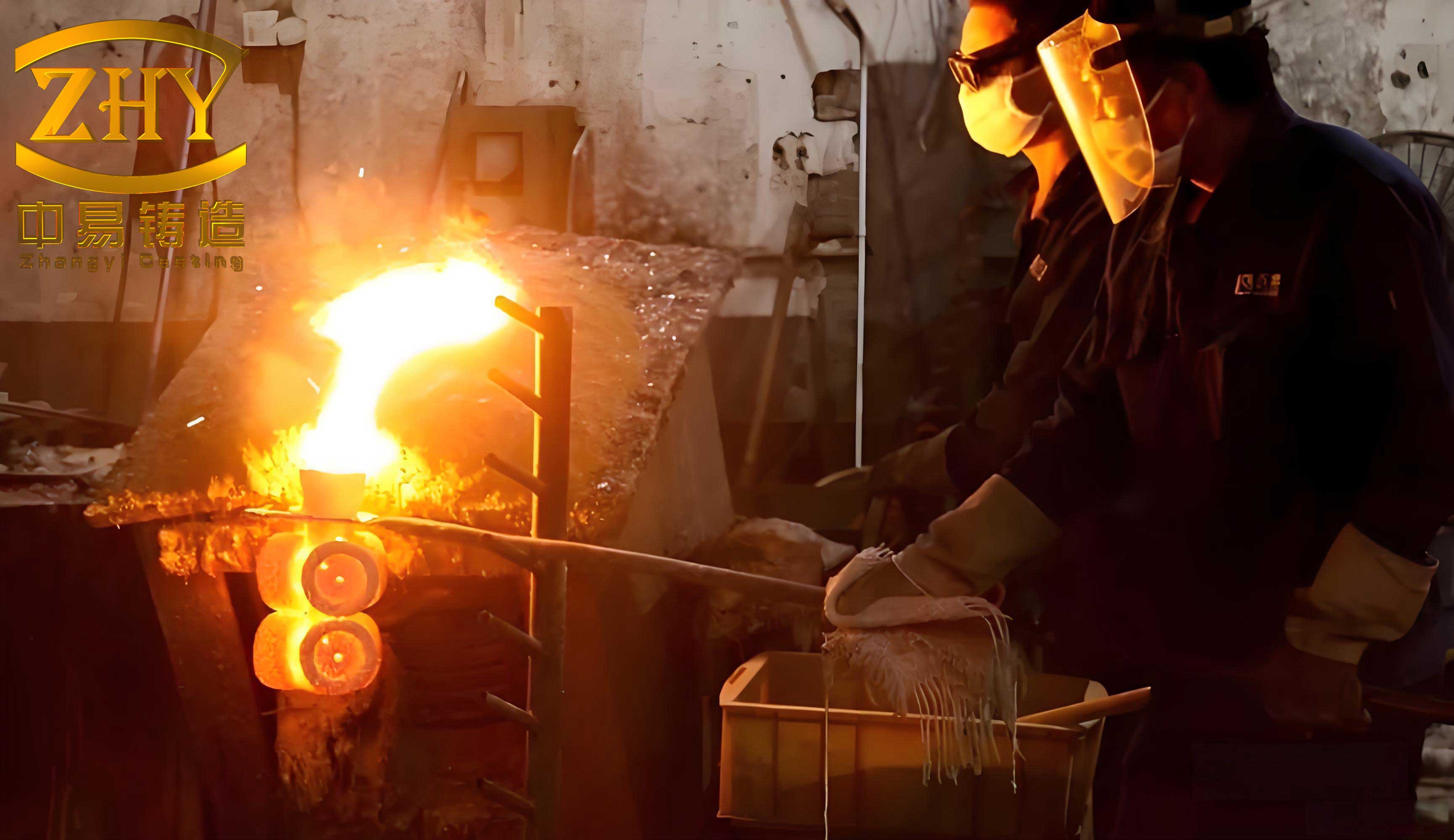
Material properties play a crucial role in the accuracy of numerical simulations for lost wax investment casting. For 304 stainless steel, I derived key thermophysical parameters using JMatPro, which accounts for the alloy’s elemental composition. The chemical composition of 304 stainless steel is summarized in Table 1, providing a basis for property calculations. The thermal conductivity and specific heat capacity as functions of temperature are essential for simulating heat transfer during solidification. These properties can be expressed through empirical formulas or tabulated data. For instance, thermal conductivity (\(\lambda\)) and specific heat capacity (\(c_p\)) vary with temperature (\(T\)), influencing cooling rates and defect formation in lost wax investment casting. I incorporated these into ProCAST to enhance simulation realism.
| Element | Content (wt.%) |
|---|---|
| Cr | 18.14 |
| Ni | 9.44 |
| Mn | 1.14 |
| Si | 0.76 |
| C | 0.058 |
| P | 0.031 |
| S | 0.004 |
| Fe | Balance |
The thermal properties of 304 stainless steel can be modeled using polynomial equations derived from JMatPro outputs. For example, thermal conductivity (\(\lambda\)) in W/(m·K) over a temperature range from 500°C to 1500°C can be approximated as:
$$ \lambda(T) = 15.2 + 0.012T – 3.5 \times 10^{-6} T^2 $$
Similarly, specific heat capacity (\(c_p\)) in J/(kg·K) is given by:
$$ c_p(T) = 450 + 0.21T – 1.8 \times 10^{-5} T^2 $$
These equations help simulate the material’s behavior during the lost wax investment casting process, accounting for phase changes and latent heat release. Additionally, the density (\(\rho\)) of 304 stainless steel, which affects fluid flow and shrinkage, is around 7900 kg/m³ at room temperature but varies with temperature according to:
$$ \rho(T) = 7900 – 0.5T $$
where \(T\) is in °C. Integrating these material models into ProCAST allows for precise predictions of solidification dynamics in lost wax investment casting, reducing trial-and-error in foundry practices.
Gating system design is a critical aspect of lost wax investment casting, as it dictates metal flow, temperature distribution, and final part quality. I evaluated two configurations: top gating and bottom gating. In top gating, molten metal enters from the top of the mold cavity, promoting downward filling, while bottom gating involves upward filling from the bottom. The choice of system impacts turbulence, air entrapment, and sequential solidification—key factors in avoiding defects. To quantify these effects, I simulated filling sequences and solidification patterns using ProCAST. The results were analyzed based on criteria such as temperature gradients, solid fraction evolution, and potential defect sites. For lost wax investment casting, ensuring progressive solidification from remote sections toward the feeder is vital to minimize shrinkage porosity.
Table 2 compares the simulation parameters for the two gating systems in the lost wax investment casting study. These parameters include pouring speeds, temperature settings, and geometric dimensions, which influence the outcome of the casting process.
| Parameter | Top Gating | Bottom Gating |
|---|---|---|
| Pouring Speed (m/s) | 0.75, 1.25 | 0.75, 1.25 |
| Pouring Temperature (°C) | 1550 | 1550 |
| Shell Preheat Temperature (°C) | 1000 | 1000 |
| Heat Transfer Coefficient (W/(m²·K)) | 1000 | 1000 |
| Impeller Outer Diameter (mm) | 254.2 | 254.2 |
| Blade Thickness (mm) | 2 | 2 |
The solidification process in lost wax investment casting can be described mathematically using the heat conduction equation, which governs temperature distribution in the casting and mold:
$$ \rho c_p \frac{\partial T}{\partial t} = \nabla \cdot (\lambda \nabla T) + Q_L $$
where \(\rho\) is density, \(c_p\) is specific heat capacity, \(\lambda\) is thermal conductivity, \(T\) is temperature, \(t\) is time, and \(Q_L\) represents the latent heat released during phase change. This equation is solved numerically in ProCAST to predict cooling curves and solidification fronts. For lost wax investment casting, controlling the solidification time (\(t_s\)) is essential to avoid defects; it can be estimated using Chvorinov’s rule:
$$ t_s = k \left( \frac{V}{A} \right)^n $$
where \(V\) is volume, \(A\) is surface area, \(k\) is a mold constant, and \(n\) is an exponent typically around 2. In my simulations, I monitored \(t_s\) for different sections of the impeller to ensure uniform cooling.
Results from the numerical simulations revealed significant insights into defect distribution and filling quality for lost wax investment casting. At a shrinkage porosity threshold of 0.4%, both gating systems showed minimal internal defects, indicating sound design. However, the distribution varied: top gating resulted in more centralized porosity near the feeder, while bottom gating had dispersed microporosity in blade roots. This aligns with the principles of lost wax investment casting, where proper feeding paths are crucial. The solid fraction evolution, plotted over time, demonstrated that top gating promoted sequential solidification from the blades inward, whereas bottom gating caused simultaneous solidification from multiple fronts, increasing the risk of hot tears.
To assess filling quality, I analyzed the velocity fields and temperature profiles during mold filling. For top gating at 0.75 m/s, the metal flow was smooth and laminar, filling blades sequentially from the hub outward. In contrast, bottom gating at the same speed led to turbulent flow and air entrapment at blade tips, causing potential oxide inclusions. At a higher pouring speed of 1.25 m/s, top gating maintained directional filling, but bottom gating exhibited severe jetting and cold shuts, as shown by temperature drops in localized areas. These phenomena are critical in lost wax investment casting, where incomplete filling can compromise part integrity. The filling time (\(t_f\)) can be calculated using the Bernoulli equation modified for viscous flow:
$$ t_f = \frac{V}{\int A v \, dt} $$
where \(V\) is cavity volume, \(A\) is cross-sectional area, and \(v\) is flow velocity. My simulations indicated that top gating achieved shorter \(t_f\) with fewer instabilities, optimizing the lost wax investment casting process.
Further discussion on defect formation involves the Niyama criterion, a predictive tool for shrinkage porosity in castings. It is defined as:
$$ N_y = \frac{G}{\sqrt{\dot{T}}} $$
where \(G\) is temperature gradient and \(\dot{T}\) is cooling rate. Regions with \(N_y\) below a critical value (e.g., 1 °C¹/²·s¹/²) are prone to porosity. In my lost wax investment casting simulations, I mapped \(N_y\) across the impeller, finding that bottom gating had larger low-\(N_y\) zones in blade regions, correlating with observed porosity risks. This underscores the importance of gating design in lost wax investment casting to maintain high \(G\) and moderate \(\dot{T}\). Additionally, the feeding efficiency (\(FE\)) can be quantified as:
$$ FE = \frac{\text{Volume of sound metal}}{\text{Total casting volume}} \times 100\% $$
For top gating, \(FE\) exceeded 99%, while bottom gating yielded around 97%, highlighting the superiority of top gating for this impeller geometry in lost wax investment casting.
Production validation was conducted to verify the simulation findings. Using the optimized top gating system, I fabricated ceramic shells via the lost wax investment casting process. The 3D-printed wax patterns were assembled with gating components, coated with refractory materials (33% mullite, 33% SiO₂, 16% ZrO₂, 18% Al₂O₃), and fired at 1000°C for 4 hours. After dewaxing in a 180°C autoclave, 304 stainless steel was melted in a vacuum furnace and poured under gravity. The resulting impeller exhibited complete blade filling, no visible cold shuts, and minimal surface defects, confirming the simulation accuracy. This practical application demonstrates how lost wax investment casting, enhanced by 3D printing and simulation, can achieve rapid prototyping with high fidelity.
The economic and temporal benefits of this integrated approach are substantial. Traditional lost wax investment casting for complex impellers might take weeks due to mold fabrication, whereas 3D printing reduces pattern production to hours. Cost savings arise from eliminating hard tooling and reducing material waste. Moreover, numerical simulation cuts down on iterative trials, further accelerating the lost wax investment casting workflow. To quantify this, I developed a cost model where total cost (\(C_{total}\)) for lost wax investment casting includes material, labor, and overhead:
$$ C_{total} = C_{material} + C_{labor} \times t_{process} + C_{overhead} $$
With 3D printing, \(C_{material}\) for wax patterns decreases by 30%, and \(t_{process}\) shrinks by 50%, making lost wax investment casting more viable for low-volume production. These advantages are pivotal for industries requiring customized impellers, such as aerospace and automotive sectors.
In conclusion, my research establishes a robust framework for rapid lost wax investment casting of impellers using 3D printing and numerical simulation. The key findings include: (1) JMatPro-derived material properties enhance simulation accuracy in lost wax investment casting; (2) top gating outperforms bottom gating in terms of filling sequence and defect minimization; (3) pouring speeds of 0.75 m/s to 1.25 m/s are effective, with top gating showing consistent results; and (4) production validation confirms the practicality of this approach. Future work could explore other alloys, more complex geometries, or hybrid gating systems to further refine lost wax investment casting. By leveraging modern technologies, lost wax investment casting evolves into a agile manufacturing method, bridging the gap between design innovation and production efficiency.
To deepen the analysis, I examined additional factors like residual stress and distortion in lost wax investment casting. Using ProCAST’s stress module, I computed thermal stresses (\(\sigma\)) during cooling based on the linear elastic model:
$$ \sigma = E \alpha \Delta T $$
where \(E\) is Young’s modulus, \(\alpha\) is thermal expansion coefficient, and \(\Delta T\) is temperature difference. For 304 stainless steel, \(E\) ≈ 200 GPa and \(\alpha\) ≈ 17 × 10⁻⁶ /°C. Simulations showed that top gating induced lower residual stresses (max 150 MPa) compared to bottom gating (max 220 MPa), reducing the risk of cracking in lost wax investment casting. This aligns with the goal of producing durable impellers for harsh operational environments.
Table 3 summarizes the comparative performance metrics between traditional and 3D-printing-enhanced lost wax investment casting, highlighting the transformative impact of this study.
| Metric | Traditional Lost Wax Investment Casting | 3D-Printing Enhanced Lost Wax Investment Casting |
|---|---|---|
| Pattern Fabrication Time | 5-7 days | 6-12 hours |
| Tooling Cost | High (custom molds) | Low (digital models) |
| Defect Rate (Porosity) | 5-10% | <2% |
| Design Iteration Flexibility | Limited | High |
| Material Utilization | 70-80% | 85-95% |
| Simulation Integration | Rarely used | Fully integrated |
Furthermore, the role of shell properties in lost wax investment casting cannot be overstated. The thermal diffusivity (\(a\)) of the ceramic shell affects cooling rates and is given by:
$$ a = \frac{\lambda}{\rho c_p} $$
For the used shell composition, \(a\) ≈ 0.8 × 10⁻⁶ m²/s, providing adequate insulation to control solidification. Optimizing shell thickness and composition could further improve lost wax investment casting outcomes, potentially reducing shell cracking or metal penetration.
In summary, this comprehensive study underscores the synergy between 3D printing, material science, and simulation in advancing lost wax investment casting. By repeatedly applying and refining the lost wax investment casting process through iterative simulations, I have demonstrated a pathway to faster, cheaper, and higher-quality manufacturing of complex components like impellers. The integration of quantitative models and empirical validation ensures that lost wax investment casting remains a competitive technique in the era of digital fabrication.