
In my extensive experience with the production of critical components, few challenges have been as persistent and technically nuanced as the elimination of gas porosity in high-integrity castings. One particularly demanding case involved the manufacture of stainless steel wire rope clampers, or shackles, using the precision investment casting process. The component, fabricated from type 1Cr18Ni9 (AISI 304 equivalent) stainless steel, demanded a flawless surface finish and absolute internal soundness to meet stringent export quality standards. Despite the known advantages of precision investment casting for achieving complex geometries and excellent surface finish, we encountered a reject rate of approximately 17% due to subsurface porosity located at the thermal center of the junction between the casting and its ingate. This narrative details my first-hand investigation into the root causes of this gas entrapment and the systematic engineering solutions developed to eradicate it, thereby perfecting the precision investment casting process for this application.
The defect manifested as a spherical, smooth-walled cavity roughly 1 mm in diameter, discernible only after the sprue was separated from the casting. Initial hypotheses pointed towards shrinkage porosity, given the location at a thermal hotspot. However, meticulous sectioning, grinding, and microscopic examination revealed a key differentiator: the cavity wall was perfectly smooth, unlike the rough, dendritic morphology characteristic of a shrinkage void. Furthermore, adjacent areas sometimes exhibited finely dispersed microporosity. This was unequivocally a gas hole defect. This finding was initially surprising for an 18-8 stainless steel alloy. Conventional wisdom, supported by metallurgical texts, suggests that the simultaneous presence of hydrogen and nitrogen in austenitic steels can reduce the tendency for hydrogen pickup and pore formation. Yet, our practical reality defied this general principle, highlighting the critical influence of specific process variables in precision investment casting.
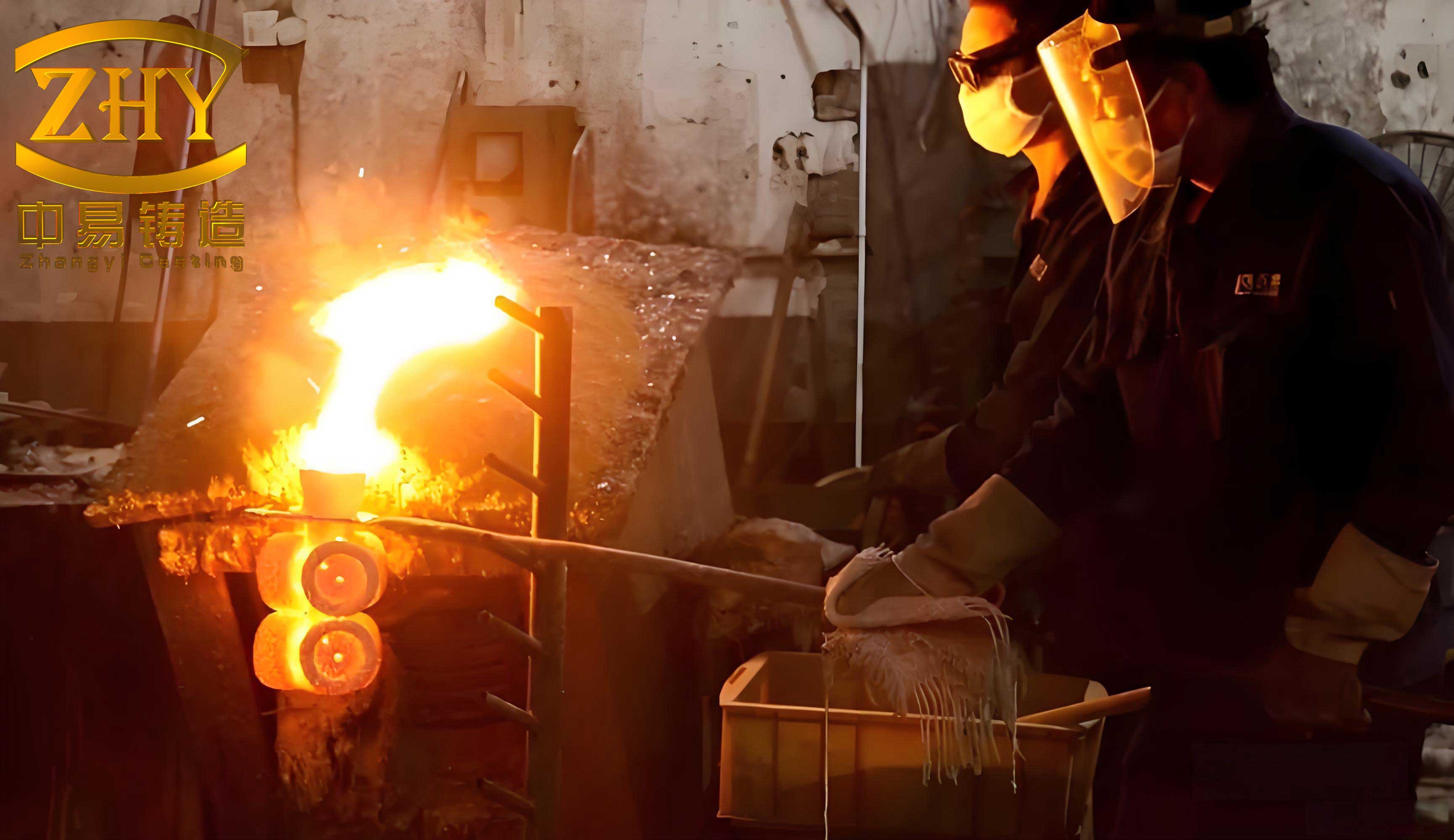
The pursuit of a solution began with a fundamental interrogation: what was the source of the gas? In precision investment casting, the metallurgical quality of the molten metal is paramount. Our charge makeup consisted primarily of recycled scrap (a mix of ferritic and austenitic grades), returns, and a minor fraction of virgin material. This scrap, often sourced from machining operations, was invariably contaminated with cutting oils, coolants, grease, and atmospheric oxides that had adsorbed moisture. Upon introduction to the intense heat of the induction furnace, these organic compounds undergo rapid pyrolysis and oxidation, releasing voluminous amounts of hydrogen and hydrocarbon gases. The oxide scales, especially when hydrated, release water vapor. While much of this gas escapes to the atmosphere, a significant fraction dissolves into the molten steel. The solubility of gases like hydrogen in stainless steel is not constant; it is a strong function of temperature, alloy phase, and local pressure. The dissolution process can be described by Sieverts’ Law, which states that the solubility of a diatomic gas in a metal is proportional to the square root of its partial pressure:
$$
S = k \sqrt{P}
$$
where \( S \) is the solubility, \( k \) is the Sieverts’ constant (temperature and alloy dependent), and \( P \) is the partial pressure of the gas. At the high tapping temperatures (~1650°C), the solubility \( k_{H,1650°C} \) is high, allowing the melt to become super-saturated with hydrogen if the gas generation from contaminants is excessive.
The journey of the gas from dissolution to defect formation is a race against time and solidification. Upon pouring into the ceramic shell, the metal begins to cool. As the temperature drops, the solubility of gas in the liquid metal decreases dramatically according to an Arrhenius-type relationship:
$$
k = k_0 \exp\left(-\frac{Q}{RT}\right)
$$
where \( Q \) is the heat of solution, \( R \) is the gas constant, and \( T \) is the absolute temperature. The now super-saturated gas must nucleate bubbles and escape. However, several factors conspired to trap it in our wire rope clamper. Firstly, the geometry was adversarial. The original ingate design featured a narrow cross-sectional area relative to the casting body and the main sprue. This created a pronounced thermal hotspot—the last region to solidify. Crucially, this narrow ingate would solidify first, acting as a plug that severed the only escape path for gas bubbles trying to float back up into the sprue. The gas, seeking the path of least resistance and highest temperature, accumulated at this blocked junction, forming a macroscopic pore.
Secondly, the inherent physical properties of molten stainless steel exacerbated the problem. The alloy has high viscosity and poor fluidity compared to, say, aluminum or cast iron. This high viscosity, quantified by a damping coefficient in the Navier-Stokes equations governing fluid flow, impedes the buoyant rise of small gas bubbles (Stokes’ Law velocity):
$$
v = \frac{2}{9} \frac{(\rho_m – \rho_g) g r^2}{\eta}
$$
where \( v \) is the terminal velocity, \( \rho_m \) and \( \rho_g \) are the density of metal and gas, \( g \) is gravity, \( r \) is the bubble radius, and \( \eta \) is the dynamic viscosity of the metal. A high \( \eta \) results in a low \( v \), meaning bubbles move sluggishly and are easily captured by the advancing solidification front.
Thirdly, our existing practice of transferring metal from the furnace to a ladle for pouring introduced two detrimental effects: temperature loss and turbulence. The temperature drop of about 100°C significantly increased the melt’s viscosity, further hampering gas逸出. The pouring action itself could entrain atmospheric air into the stream. Furthermore, if the ceramic shell was not sufficiently preheated, the “chill” effect would accelerate solidification at the metal-shell interface, forming a solid skin that encapsulated the still-liquid, gas-rich interior before degassing was complete.
The remediation strategy was multi-pronged, targeting each identified weakness in the process chain. The first and most logical step was source elimination. We instituted a rigorous pre-cleaning protocol for all scrap material to sever the primary gas source. The chemical cleaning bath formulation and process parameters we optimized are detailed below:
| Solution Component | Concentration (g/L) | Bath Temperature (°C) | Process Sequence |
|---|---|---|---|
| Sodium Hydroxide (NaOH) | 60 – 80 | 80 – 90 | 1. Immerse and agitate scrap for 5-15 min. 2. Transfer to hot water rinse (50-60°C) for 5-10 min. 3. Final rinse in flowing clean water. 4. Air dry thoroughly. |
| Sodium Carbonate (Na2CO3) | 20 – 60 | ||
| Trisodium Phosphate (Na3PO4·12H2O) | 15 – 30 | ||
| Sodium Silicate (Na2SiO3) | 5 – 10 |
This alkaline cleaning effectively saponified and removed oils, while the phosphates and silicates provided etching and rinsing benefits. This step alone dramatically reduced the initial gas load in the furnace, lowering the super-saturation ratio \( \alpha = C_{\text{actual}} / C_{\text{saturation}} \) at pouring temperature.
The second major intervention addressed thermal management. We abandoned the indirect ladle-pouring method. Instead, we implemented a direct-pour technique from the furnace to the shell. Shells were kept in a furnace vestibule at ~800°C until the moment of pour, minimizing thermal shock. This allowed us to pour at a higher, more consistent temperature (≈1650°C). The benefits were manifold: lower melt viscosity \( \eta \), prolonged fluidity time \( t_f \) (which scales inversely with cooling rate), and a greatly extended “window” for gas bubbles to coalesce and escape. Post-pour, we embedded the hot shells in an insulating sand bed to further slow cooling, promoting directional solidification that favored the sprue as the thermal and gaseous riser. The governing heat transfer equation during solidification is:
$$
\frac{\partial T}{\partial t} = \alpha \nabla^2 T – \frac{L}{C_p} \frac{\partial f_s}{\partial t}
$$
where \( \alpha \) is thermal diffusivity, \( L \) is latent heat, \( C_p \) is specific heat, and \( f_s \) is solid fraction. By insulating the shell, we reduced the term \( \alpha \nabla^2 T \) (the rate of heat conduction away), thereby increasing the local solidification time \( t_f \), which is critical for gas逸出.
The third pillar of our solution was a redesign of the gating geometry, specifically the ingate. The goal was to prevent it from being the first point of solidification and to provide a generous conduit for gas evacuation. The new design featured a significantly increased cross-sectional area at the junction with the casting, effectively eliminating the severe thermal constriction. This transformed the junction from a hot-spot into a controlled feeding and venting pathway. The design principle can be related to the modulus (Volume/Surface Area ratio, \( M = V/A_s \)). We ensured the modulus of the ingate junction was equal to or greater than that of the adjacent casting section to prevent premature sealing:
$$
M_{\text{ingate junction}} \geq M_{\text{casting hotspot}}
$$
This modification allowed gas bubbles, driven by buoyancy and solidification pressure, to migrate freely from the casting into the sprue, where they could vent to atmosphere or be trapped in the massive feeder head.
The synergy of these measures—source control, thermal optimization, and geometric redesign—produced transformative results. The reject rate due to gas porosity plummeted from 17% to near zero. The internal soundness of every casting was confirmed through non-destructive testing and random destructive sectioning. The success underscored a fundamental principle in precision investment casting: achieving defect-free components is not merely about executing a standard process, but about mastering the intricate interplay between metallurgy, thermodynamics, and fluid dynamics specific to each alloy and geometry.
In conclusion, the resolution of gas hole defects in stainless steel wire rope clampers was a testament to systematic process engineering within the precision investment casting framework. The key insights and actions were: 1) Identifying and eliminating the exogenous gas source through rigorous scrap decontamination, which controlled the initial super-saturation level \( \alpha \). 2) Revolutionizing the thermal regime by adopting direct high-temperature pouring onto hot shells and using post-pour insulation, thereby maximizing the gas逸出 time \( t_f \) by manipulating the solidification heat transfer equation. 3) Redesigning the gating system based on modulus principles to ensure the ingate remained open as a functional vent until after the casting section solidified. This holistic approach, treating the precision investment casting process as an integrated system rather than a series of isolated steps, is essential for reliably producing high-integrity, porosity-free stainless steel components. The lessons learned are universally applicable to other challenging alloys and geometries in the realm of advanced precision investment casting.