
In my extensive experience with stainless steel precision investment casting, shrinkage porosity stands out as the most persistent and critical defect encountered during production. This flaw not only compromises the structural integrity of castings but also leads to significant scrap rates, especially for components subjected to pressure or demanding operational environments. The fundamental cause of shrinkage porosity is inadequate liquid metal feeding during solidification. However, the path to resolution is not monolithic; it requires a nuanced, casting-specific approach. Through years of hands-on practice in precision investment casting, I have systematically analyzed and mitigated this issue by focusing on five primary influencing factors. This article delves into these factors, presenting actionable solutions, supported by analytical summaries and fundamental principles, to empower foundries in mastering shrinkage control.
The journey to a sound casting begins with understanding the root causes. In precision investment casting, shrinkage defects manifest in varying severities—from visible subsurface pores after shell removal to subtle “acid vomiting” after pickling, or even internal voids revealed only during subsequent machining. The core mechanism is always the same: the inability of molten steel to compensate for volumetric contraction as it solidifies. Our analysis consistently points to five interrelated factors: the design of ingates (number, size, location), the configuration of the pouring system (sprue or header), the inherent geometry of the casting (especially wall thickness variations), the pouring parameters (temperature and speed), and the thermal state of the ceramic shell. The first three are the dominant design-related culprits; once optimized through rigorous trial, they provide a permanent solution. The latter two are process variables with a lesser but still significant impact, often introducing sporadic defects due to operational inconsistencies if not strictly controlled.
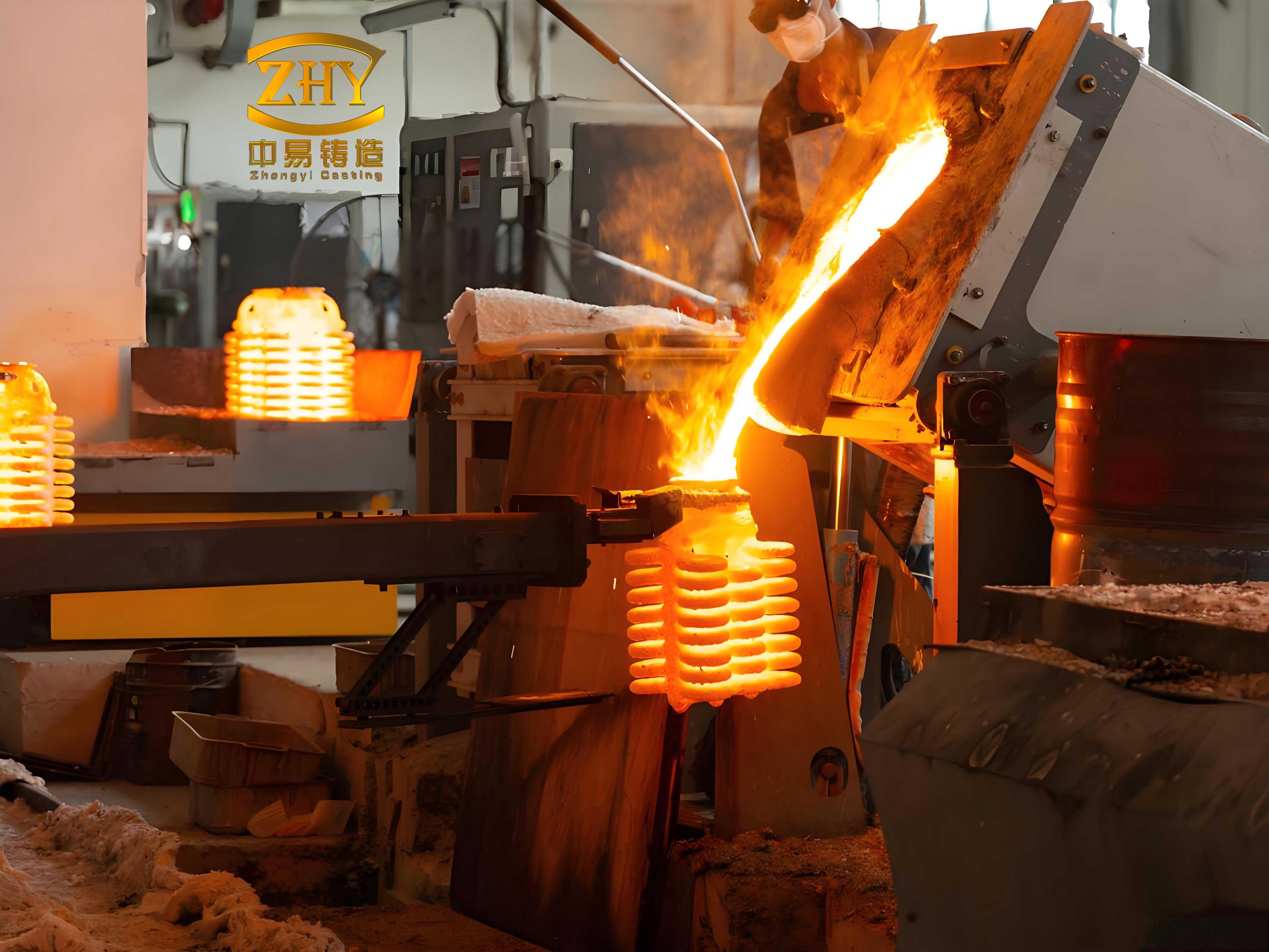
A primary lever for controlling feeding in precision investment casting is ingate strategy. The placement and dimensions of ingates directly govern the thermal and hydraulic pathways for liquid metal. A classic case involves a casting featuring two thick sections bridged by a thin web, with all three planes not co-planar. A single ingate on one thick section invariably leads to shrinkage at the junction between the thick and thin areas, as the thin section solidifies rapidly, isolating the thick section from the feed source. The solution is to employ two ingates, one on each thick section, thereby establishing direct feeding channels and increasing the volume of available feed metal. Mathematically, we can conceptualize the required feed metal volume $V_{feed}$ as a function of the casting’s hot spots:
$$ V_{feed} = \sum_{i=1}^{n} \beta \cdot V_i \cdot (T_{liquidus} – T_{solidus}) $$
where $\beta$ is the volumetric shrinkage coefficient of the steel, $V_i$ is the volume of each thermally isolated section (hot spot), and the temperature difference defines the solidification range. Using two ingates effectively increases the effective feeding range, reducing the isolated volume $V_i$. In one practical application, a non-sealing part with a 2mm annular groove between two 10mm thick walls saw scrap rates drop from 91% to 0% after switching from one to two ingates, perfectly illustrating this principle in precision investment casting.
The design of the pouring system, particularly the sprue or header, is equally critical in precision investment casting. It acts as a liquid metal reservoir. When the ingate cross-section is similar to the casting thickness and shrinkage occurs at the ingate root, the issue is often an insufficient thermal mass in the header. Upgrading to a larger cross-section header slows its solidification, extending the time available for feeding. This can be related to Chvorinov’s rule, where solidification time $t_s$ is proportional to the square of the volume-to-surface area ratio:
$$ t_s = k \left( \frac{V}{A} \right)^2 $$
For a sprue, a larger cross-section increases the $V/A$ ratio, thereby increasing $t_s$. This creates a favorable temperature gradient, ensuring the sprue remains liquid longer than the casting section it feeds. In a documented case within our precision investment casting operations, increasing the header cross-section from 30mm x 30mm to 40mm x 40mm reduced ingate-root shrinkage from 35% to a mere 2%, validating the effectiveness of this thermal mass approach.
Casting geometry often presents the most intractable challenges in precision investment casting. Complex shapes with abrupt wall thickness changes create isolated hot spots that are difficult to feed from standard ingate locations. When iterative gating and pouring system modifications fail, strategic design alterations become necessary. This involves collaborative communication with the client to implement process padding or structural modification. Process padding involves adding temporary material to a section of the casting to create a more favorable thermal mass for feeding, which is later removed by machining. For instance, adding material to ribs adjacent to a thick, shrink-prone hole bottom can successfully channel feed metal to the problem area. The underlying principle is to manipulate the solidification sequence, ensuring directional solidification toward the ingate. This can be guided by the concept of the modulus $M$, defined as volume divided by cooling surface area ($M = V/A$). Effective feeding requires a progressive increase in modulus from the casting extremity to the ingate: $M_{casting} < M_{ingate} < M_{sprue}$. Padding increases the local modulus, facilitating this gradient.
| Influencing Factor | Relative Impact | Primary Mitigation Strategy | Underlying Principle / Formula |
|---|---|---|---|
| Ingate Design (Number, Size, Position) | High | Use multiple ingates to directly feed isolated thick sections; optimize location at thermal centers. | Maximize feeding range: $F_{range} \propto \sqrt{n \cdot A_{gate}}$, where $n$ is number of gates, $A_{gate}$ is gate area. |
| Pouring System (Header/Sprue) | High | Use a larger cross-section header to act as a hotter, longer-lasting liquid reservoir. | Extend feeding time via Chvorinov’s Rule: $t_{s,header} > t_{s,casting}$. |
| Casting Structure & Wall Thickness | High | Implement process padding or redesign to minimize abrupt thickness changes and promote directional solidification. | Maintain a positive modulus gradient: $\nabla M > 0$ from casting to sprue. |
| Pouring Temperature | Medium | Increase temperature moderately for complex, varying sections; use lower temperature for uniform, simple shapes. | Enhance fluidity and delay solidification: $\eta_{feed} \propto (T_{pour} – T_{liquidus})$ within optimal range. |
| Pouring Speed | Medium | Employ slower pouring where possible to minimize turbulence and maximize thermal gradient. | Reduce thermal shock and promote sequential filling: $v_{pour} < v_{critical}$ for laminar flow. |
| Shell Thermal State | Low-Medium | Allow shell to cool to a dark or even room temperature state after firing before pouring. | Maximize mold-to-metal temperature difference: $\Delta T_{mold-metal} = T_{metal} – T_{mold}$. |
Another geometric solution in precision investment casting is the permanent modification of the part design to achieve more uniform wall thickness. For example, a thick base with a central thin-bottomed hole prone to shrinkage can be redesigned with a flanged structure, making the wall thickness more uniform and eliminating the isolated hot spot. This directly addresses the root cause by removing the severe modulus differential that drives isolated shrinkage.
Process parameters, while secondary to design, offer fine-tuning control in precision investment casting. Pouring temperature is a powerful tool. For castings with moderate wall thickness variations showing minor shrinkage, a strategically increased pouring temperature can improve feeding. The rationale is that a higher superheat extends the fluid life of the metal, allowing it to remain liquid longer to feed shrinking areas. However, this must be balanced against risks like increased gas solubility and mold-metal reaction. We can model the effective feeding time $t_{eff}$ as:
$$ t_{eff} \approx \frac{L \cdot \Delta T_{superheat}}{\alpha \cdot G} $$
where $L$ is the latent heat, $\Delta T_{superheat}$ is the pouring temperature minus the liquidus temperature, $\alpha$ is the thermal diffusivity, and $G$ is the temperature gradient. A higher $\Delta T_{superheat}$ increases $t_{eff}$. Conversely, for simple, uniform wall thickness castings, a lower pouring temperature is sufficient and often beneficial for grain refinement. Pouring speed complements temperature control; a slower pour minimizes turbulence and allows the first metal entering the mold to begin cooling, establishing a steeper thermal gradient favorable for directional solidification. This practice is paramount in precision investment casting for complex components.
The thermal state of the ceramic shell is a frequently overlooked but valuable parameter in precision investment casting. Pouring into a shell that has been fired and then allowed to cool to a dark or even ambient temperature state can significantly reduce minor shrinkage, especially in larger, intricate castings. This technique, known as cold-shell pouring, works by maximizing the initial temperature difference between the molten metal and the mold $\Delta T_{mold-metal}$. A larger $\Delta T$ accelerates the initial chill on the metal at the mold wall, promoting a faster establishment of a strong, directional solidification front from the casting surface inward toward the feeder. The heat extraction rate $q$ at the interface can be approximated by:
$$ q = h \cdot (T_{metal} – T_{mold}) $$
where $h$ is the heat transfer coefficient. A lower $T_{mold}$ increases $q$, leading to faster skin formation and better feeding conditions. Additionally, cold-shell pouring often yields a superior surface finish, a welcome secondary benefit in precision investment casting.
In synthesizing these strategies for precision investment casting, the unifying theme is the deliberate manipulation of thermal gradients and solidification sequences to enhance liquid metal feeding. Every tactic—from adding ingates and enlarging sprues to adding padding, adjusting temperatures, and cooling shells—aims to create a scenario where the feed metal remains liquid longer than the section it is intended to feed. This establishes a controlled, directional solidification pattern. The success in precision investment casting hinges on a holistic view that integrates part design, gating methodology, and process control. Foundries must treat the mold assembly, from sprue to casting, as a single thermal system. Advanced simulation software can now model these phenomena, but the empirical principles outlined here remain the foundational bedrock for process engineers. By meticulously applying these lessons, the incidence of shrinkage porosity in stainless steel precision investment casting can be reduced to negligible levels, ensuring high-integrity components for the most demanding applications. Continuous refinement and documentation of these experiences are what drive excellence in the field of precision investment casting.
To further quantify the interaction between these factors in precision investment casting, we can consider a simplified efficiency model for the feeding system. The overall feeding efficiency $\eta_{total}$ can be expressed as a product of contributions from each controlled factor:
$$ \eta_{total} = \eta_{gate} \cdot \eta_{sprue} \cdot \eta_{geometry} \cdot \eta_{temp} \cdot \eta_{shell} $$
Where each $\eta$ factor ranges from 0 (no feeding) to 1 (perfect feeding). For instance, $\eta_{gate}$ could be a function of the number of gates and their proximity to hot spots, while $\eta_{temp}$ relates to the pouring superheat. Optimizing the precision investment casting process involves maximizing this composite efficiency. Furthermore, the critical feeding pressure required to overcome shrinkage $P_{feed}$ can be related to the geometry of the mushy zone via the Darcy-based equation:
$$ P_{feed} = \frac{\mu \cdot L_f \cdot \dot{V}}{K \cdot A} $$
where $\mu$ is the viscosity of the interdendritic liquid, $L_f$ is the length of the feeding path through the mushy zone, $\dot{V}$ is the volumetric shrinkage rate, $K$ is the permeability of the dendritic network, and $A$ is the cross-sectional area of the feeding path. Strategies in precision investment casting that reduce $L_f$ (e.g., placing ingates closer) or increase $A$ (e.g., larger gates or padding) directly reduce the required $P_{feed}$, making the process more robust against shrinkage formation. This mathematical framework underscores why the empirical solutions discussed are effective and provides a scientific basis for continuous improvement in precision investment casting.