
As a researcher deeply involved in advanced manufacturing technologies, I have witnessed the transformative role of precision casting, particularly investment casting, in the aerospace sector. This process enables the production of complex, high-integrity components with exceptional dimensional accuracy and material properties. The aerospace industry’s relentless pursuit of lightweight, high-performance, and cost-effective solutions has made investment casting an indispensable manufacturing method. In this article, I will explore the current state and emerging trends of investment casting for critical aerospace materials, including superalloys, titanium alloys, aluminum alloys, and magnesium alloys. Furthermore, I will compare investment casting with emerging technologies like additive manufacturing, semi-solid forming, and metal injection molding, and outline future research priorities.
The fundamental process of investment casting involves creating a wax or polymer pattern, coating it with a ceramic shell, removing the pattern, and pouring molten metal into the cavity. This method allows for the production of components with intricate geometries, thin walls, and excellent surface finish. The aerospace industry leverages these advantages to manufacture parts such as turbine blades, structural frames, and engine casings, where precision and reliability are paramount. The following sections delve into the application of investment casting for various alloy systems, highlighting key advancements and challenges.
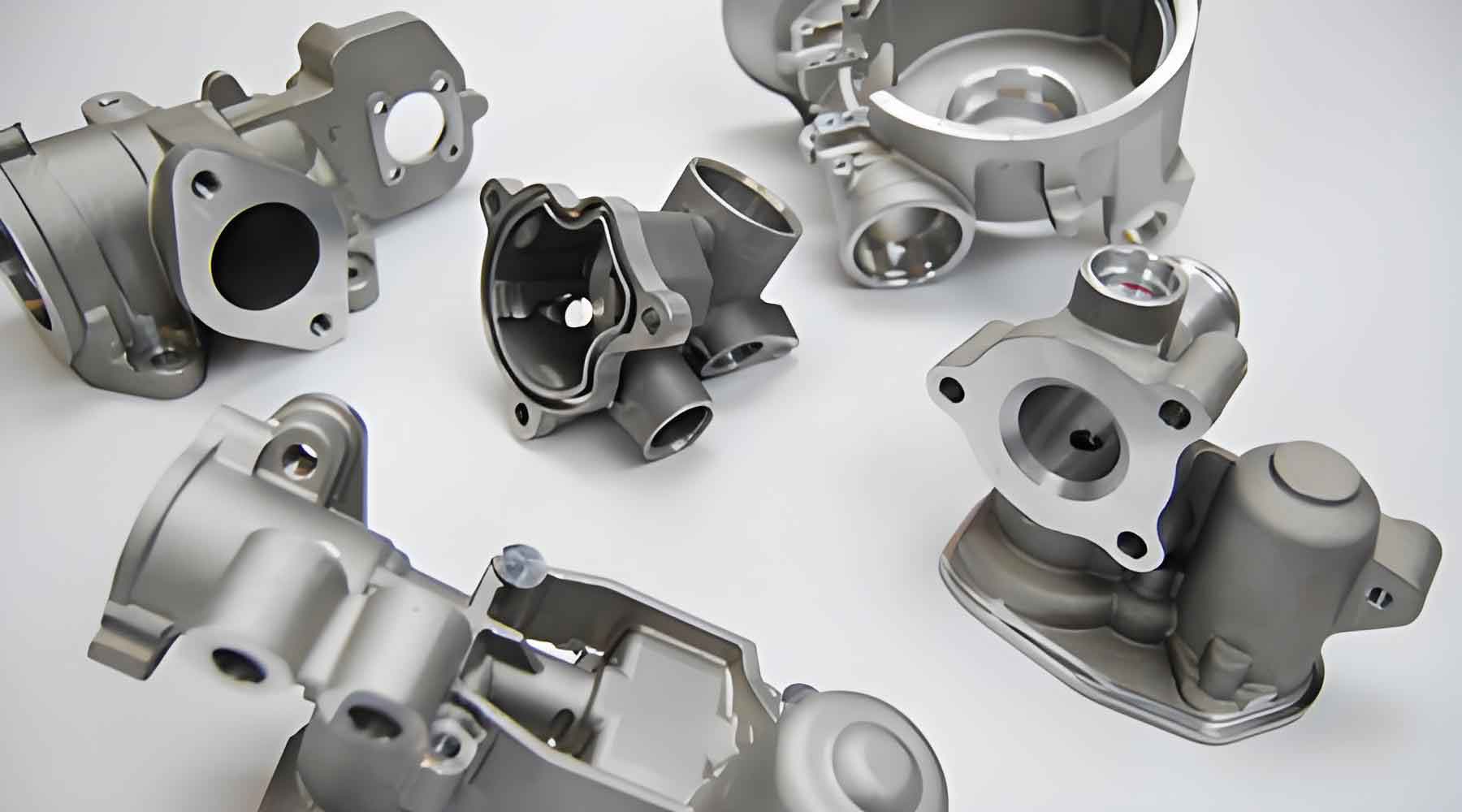
Superalloys in Investment Casting
Superalloys, including nickel-based, iron-based, and cobalt-based systems, are critical for high-temperature applications in aerospace, such as turbine blades and vanes. These materials retain their strength and corrosion resistance at temperatures exceeding 600°C. Investment casting is the preferred method for manufacturing superalloy components due to its ability to produce complex internal cooling channels and fine microstructures. For instance, directional solidification and single-crystal growth techniques in investment casting have revolutionized turbine blade performance by eliminating grain boundaries and enhancing creep resistance.
The core of superalloy investment casting lies in the development of advanced ceramic molds and cores. These must withstand extreme temperatures and chemical interactions with the molten metal. The high-temperature strength of the mold can be described by the following relation for stress under thermal load:
$$ \sigma = E \alpha \Delta T $$
where \( \sigma \) is the thermal stress, \( E \) is the Young’s modulus, \( \alpha \) is the coefficient of thermal expansion, and \( \Delta T \) is the temperature gradient. Optimizing these parameters is crucial to prevent mold cracking during pouring and solidification.
Recent advancements include the use of nano-sized additives in ceramic formulations to improve mold strength and thermal stability. For example, alumina-silica-based shells with nano-scale mullite reinforcements can operate at 1550–1600°C for extended periods. Additionally, soluble cores enable the creation of double-walled structures in single-crystal blades, enhancing cooling efficiency. The table below summarizes key properties of investment-cast superalloys used in aerospace.
| Alloy Type | High-Temperature Strength (MPa) | Creep Resistance | Primary Applications |
|---|---|---|---|
| Nickel-Based (e.g., Inconel 718) | 800–1000 at 700°C | Excellent | Turbine blades, disks |
| Cobalt-Based (e.g., Mar-M 509) | 600–800 at 900°C | Superior | Guide vanes, combustors |
| Iron-Based (e.g., A286) | 500–700 at 650°C | Good | Structural supports |
In my research, I have focused on optimizing the “temperature–organization–stress” theory to control grain size and minimize defects in superalloy castings. For instance, fine-grain overall impellers with grain sizes of ASTM 2–5 can be achieved through controlled cooling rates, significantly extending service life. The integration of computational modeling has been pivotal in predicting microstructure evolution during solidification, as described by the equation for grain growth:
$$ G = k \cdot t^n $$
where \( G \) is the grain size, \( k \) is a material constant, \( t \) is time, and \( n \) is the growth exponent. Such models aid in refining process parameters for superior mechanical properties.
Titanium Alloys in Precision Casting
Titanium alloys are prized in aerospace for their high strength-to-weight ratio, corrosion resistance, and compatibility with extreme environments. Investment casting of titanium alloys presents unique challenges due to their high reactivity with oxygen and nitrogen at elevated temperatures. This necessitates the use of inert or vacuum environments during melting and pouring. The most common titanium alloy for investment casting is Ti-6Al-4V, which offers a balanced combination of strength and ductility.
The selection of mold materials is critical to avoid contamination. Oxide-based ceramics such as yttria (Y₂O₃) and zirconia (ZrO₂) are preferred for face coats due to their chemical stability. The reaction kinetics between molten titanium and mold materials can be modeled using the Arrhenius equation:
$$ k = A e^{-E_a / RT} $$
where \( k \) is the rate constant, \( A \) is the pre-exponential factor, \( E_a \) is the activation energy, \( R \) is the gas constant, and \( T \) is the temperature. This helps in designing molds that minimize interfacial reactions.
Centrifugal investment casting has emerged as a key technique for thin-walled titanium components, improving fillability and reducing defects. For example, large engine casings with diameters up to 1300 mm and wall thicknesses as low as 1.0 mm have been successfully produced. The table below compares properties of investment-cast titanium alloys.
| Alloy | Yield Strength (MPa) | Density (g/cm³) | Notable Applications |
|---|---|---|---|
| Ti-6Al-4V | 830–900 | 4.43 | Engine mounts, airframe components |
| TiAl-based (e.g., Ti-48Al-2Nb-2Cr) | 324–480 | 3.8–4.2 | Low-pressure turbine blades |
| Ti-5Al-2.5Sn | 760–790 | 4.48 | Cryogenic tanks, structural parts |
Intermetallic titanium aluminides (TiAl) represent a significant advancement, offering reduced density and enhanced high-temperature capabilities. Investment casting of TiAl alloys requires precise control over cooling rates to avoid brittle phase formation. In my work, I have utilized vacuum induction melting with centrifugal assistance to produce TiAl components for missile systems, achieving thicknesses below 0.5 mm. The integration of additive manufacturing for pattern-making has further accelerated the development cycle for these complex castings.
Aluminum and Magnesium Alloys in Investment Casting
Aluminum and magnesium alloys are essential for lightweight aerospace structures. Investment casting of these alloys enables the production of thin-walled, complex parts with high dimensional accuracy. Aluminum alloys such as A356 and A357 are commonly used for structural components, offering mechanical properties comparable to wrought alloys, with yield strengths of 200–300 MPa. Magnesium alloys, with densities as low as 1.74 g/cm³, provide exceptional weight savings but require careful handling due to their flammability.
For aluminum investment casting, ceramic shell molds are standard, while石膏型 (plaster mold) processes are employed for high-precision applications. The solidification behavior of aluminum alloys can be described by the Chvorinov’s rule for solidification time:
$$ t_s = B \left( \frac{V}{A} \right)^2 $$
where \( t_s \) is the solidification time, \( B \) is the mold constant, \( V \) is the volume, and \( A \) is the surface area. This principle guides the design of gating systems to ensure uniform cooling.
Magnesium investment casting often uses dry sand or plaster molds to accommodate high shrinkage rates and prevent combustion. The development of flame-retardant coatings and protective atmospheres has been crucial. The table below outlines typical properties of investment-cast aluminum and magnesium alloys.
| Alloy | Density (g/cm³) | Tensile Strength (MPa) | Applications |
|---|---|---|---|
| A356 Aluminum | 2.68 | 230–280 | Engine housings, instrument panels |
| AZ91 Magnesium | 1.81 | 200–250 | Gearbox casings, electronic enclosures |
| ZE41 Magnesium | 1.83 | 220–270 | Missile components, satellite frames |
In my experience, composite mold systems—combining investment casting with resin sand or metal molds—have proven effective for producing functional-integrated components like electronic housings with intricate cooling fins. For instance, I have successfully cast aluminum impellers with blade thicknesses of 1.2 mm using such hybrid approaches. The key challenge for magnesium alloys lies in developing mold materials that resist reaction while maintaining dimensional stability, which I have addressed through tailored binder formulations.
Comparison with Emerging Manufacturing Technologies
Investment casting faces competition from newer processes like additive manufacturing, semi-solid forming, and metal injection molding. However, each technology has distinct advantages and limitations. Additive manufacturing, including selective laser melting (SLM) and electron beam melting (EBM), offers unparalleled design freedom and rapid prototyping but struggles with surface finish and internal defects for large components. In contrast, investment casting provides superior surface quality and material properties for high-volume production.
Semi-solid forming (SSF) involves shaping metal in a partially solid state, resulting in fine, spherical microstructures. The viscosity of semi-solid slurries can be modeled as:
$$ \eta = \eta_0 \dot{\gamma}^{n-1} $$
where \( \eta \) is the apparent viscosity, \( \eta_0 \) is the reference viscosity, \( \dot{\gamma} \) is the shear rate, and \( n \) is the power-law index. While SSF yields excellent mechanical properties, it is less suited for complex internal geometries compared to investment casting.
Metal injection molding (MIM) combines powder metallurgy with plastic injection molding, ideal for small, intricate parts. The debinding and sintering stages in MIM can be described by diffusion-based models:
$$ \frac{\partial C}{\partial t} = D \nabla^2 C $$
where \( C \) is the concentration, \( D \) is the diffusion coefficient, and \( t \) is time. MIM offers cost benefits for mass production but is limited by part size and material options. Investment casting remains dominant for large, high-performance aerospace components due to its versatility and maturity.
The integration of additive manufacturing with investment casting has created synergies, such as 3D-printed patterns or ceramic shells, reducing lead times by over 80% in some cases. For example, I have used stereolithography (SLA) to produce resin patterns for complex turbine blades, significantly accelerating development cycles. This hybrid approach leverages the strengths of both technologies, enabling rapid iteration without compromising quality.
Future Trends in Investment Casting
The future of investment casting in aerospace will be shaped by advancements in materials, process control, and digitalization. Based on my research, I identify five key areas for development:
First, enhancing the reliability of material systems is paramount. This includes developing novel alloy compositions, ceramic molds, and binders through computational thermodynamics and material genomics. For instance, high-entropy alloys and oxide-dispersion-strengthened materials could push the boundaries of temperature capability. Second, achieving simultaneous control over geometry and microstructure (“forming-property integration”) requires multi-physics modeling of solidification, accounting for thermal, fluid flow, and stress fields. The governing equation for heat transfer during solidification is:
$$ \rho c_p \frac{\partial T}{\partial t} = \nabla \cdot (k \nabla T) + L \frac{\partial f_s}{\partial t} $$
where \( \rho \) is density, \( c_p \) is specific heat, \( k \) is thermal conductivity, \( L \) is latent heat, and \( f_s \) is solid fraction. Coupling this with mechanical models enables prediction of residual stresses and distortion.
Third, computer simulation of solidification, microstructure, and stress will become more sophisticated, incorporating machine learning for real-time process optimization. Fourth, functional-structure integrated manufacturing will demand tailored materials and molds for multi-functional components, such as self-cooling blades or embedded sensors. Finally, digital twin technology will enable full-lifecycle management, from design to retirement, by creating virtual replicas of casting processes and components.
In conclusion, investment casting remains a cornerstone of aerospace manufacturing, continually evolving through innovation. The ongoing integration with digital tools and emerging processes will ensure its relevance in producing next-generation aircraft and spacecraft. As I continue my work in this field, I am committed to advancing the science and application of precision casting to meet the ever-growing demands of the aerospace industry.