
In our pursuit of industrial efficiency and innovation, we have implemented a series of technological improvements across our production lines. These advancements, centered around shell castings and related processes, have significantly enhanced product quality, reduced costs, and minimized environmental impact. This article details our experiences with a liquid ammonia decomposition furnace for powder metallurgy, the transition from sand mold to iron mold casting for shell castings, and the application of die-casting methods. All developments are presented from our firsthand perspective, emphasizing practical insights and quantitative outcomes.
Our journey began with the integration of a liquid ammonia decomposition furnace, designed to complement powder metallurgy sintering furnaces. This system was developed to address critical bottlenecks in our manufacturing流程, particularly in producing high-performance components. The furnace operates by evaporating liquid ammonia from storage bottles, which then enters a decomposition chamber. Here, ammonia decomposes into nitrogen and hydrogen gases, as represented by the endothermic reaction:
$$2NH_3(g) \rightarrow N_2(g) + 3H_2(g) \quad \Delta H = +92.4 \text{ kJ/mol}$$
This reaction requires precise temperature control to ensure efficient conversion. The resulting gas mixture passes through a cooler, where it is rapidly cooled using a water-jacketed shell, and then through a dryer filled with color-changing silica gel to remove moisture. Finally, the gas enters the sintering furnace via an anti-explosion device, providing a protective atmosphere that prevents oxidation during sintering. The technical specifications of this furnace are summarized in Table 1, highlighting key parameters that contribute to its performance.
| Component | Specification |
|---|---|
| Decomposition Chamber | Stainless steel tube: outer diameter 60 mm, inner diameter 50 mm, length 1000 mm; sealed with aluminum foil |
| Furnace Lining | Constructed from recycled gasoline barrels with refractory bricks and asbestos insulation; thermocouple with electronic potentiometer for automatic control |
| Cooler | Snake-shaped copper tube (diameter 10 mm) with water-cooled iron shell |
| Dryer | Container with silica gel; gas inlet at bottom, outlet at top |
| Power Rating | Parallel: 20 kW; Series: 10 kW |
| Operating Temperature | Approximately 850°C |
The implementation of this furnace has yielded substantial economic benefits. By pairing it with powder metallurgy sintering furnaces, we have saved over 40,000 units of currency annually, while boosting product output by approximately 30%. Additionally, material consumption decreased by 15%, and worker labor intensity was reduced due to automated controls. The furnace’s reliability since its completion in the early 1970s underscores its viability for widespread adoption in industries reliant on controlled atmospheres for sintering.
Parallel to this, we revolutionized our casting processes for shell castings, specifically for components like pneumatic tool housings. Traditionally, these shell castings were produced using sand molds, which posed numerous challenges: inconsistent dimensions due to mold expansion, rough surface finishes, coarse grain structures, and frequent pinhole defects after machining. The yield rate was only around 65%, and production cycles were prolonged by drying requirements and large floor space needs. In response, we shifted to iron mold casting, a method that aligns closely with precision shell castings techniques. This transition involved designing two-part iron molds made from high-grade cast iron (e.g., HT200), which were meticulously machined and polished to form the shell casting cavities. The molds are used in a vertical orientation, with sand cores inserted for internal features. A comparative analysis of sand mold versus iron mold casting for shell castings is presented in Table 2, quantifying the improvements.
| Aspect | Sand Mold Casting for Shell Castings | Iron Mold Casting for Shell Castings |
|---|---|---|
| Dimensional Consistency | Poor due to mold expansion | Excellent; uniform外形尺寸 |
| Surface Finish | Rough and porous | Smooth and光洁 |
| Microstructure | Coarse grains | Fine and dense grains |
| Defects | Common pinhole砂眼after machining | Minimal; negligible砂眼 |
| Yield Rate | 65% | 95% |
| Production Flexibility | Limited by drying time and space | High; can produce anytime after core drying |
| Tooling Requirements | Numerous铸铁砂箱needed | No additional砂箱; reusable iron molds |
The advantages of iron mold casting for shell castings extend beyond quality. Production efficiency increased eightfold, as the molds eliminate the need for drying and reduce manual labor. Moreover, the consistent dimensions of shell castings facilitate the use of专用夹具for machining, further streamlining operations. The economic impact is profound: raw material waste decreased by 20%, and overall costs dropped by 25% per unit. Our experience confirms that shell castings produced via iron molds offer superior performance, making them ideal for high-volume applications. To illustrate the visual quality of such shell castings, consider the following image link, which showcases a typical example of a shell casting produced through advanced methods.
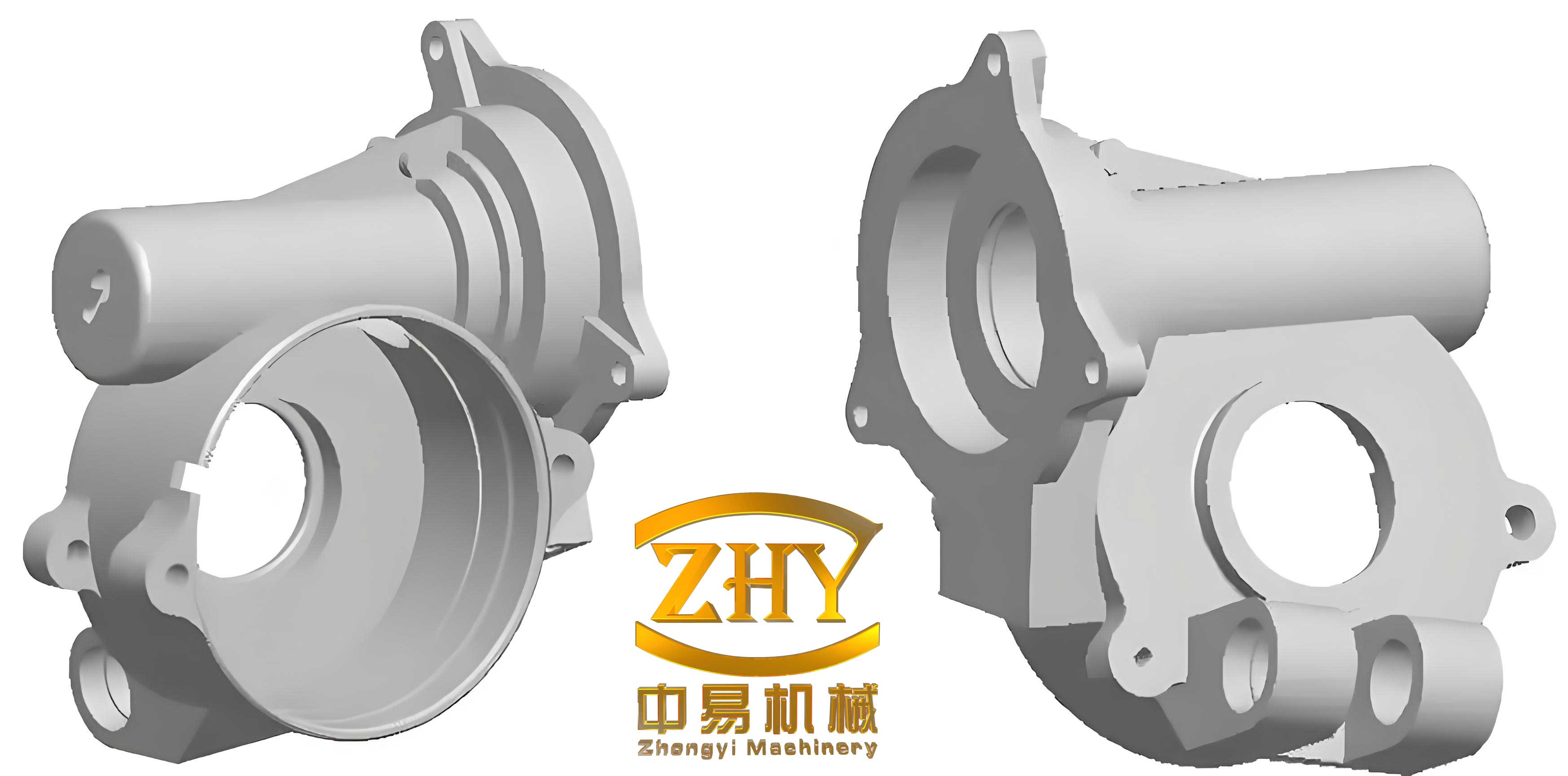
This image represents the culmination of our efforts in refining shell castings processes.
Building on this success, we expanded into die-casting, another innovative approach for shell castings. Die-casting involves forcing molten metal under high pressure into reusable steel molds, producing parts with high dimensional accuracy and excellent surface finish. We began applying this method to components for internal combustion rock drills, redesigning seven parts for die-casting. Notably, three parts originally made from aluminum-magnesium alloys were switched to standard aluminum alloys, reducing material costs by 40% without compromising performance. For instance, the fan wheel (or flywheel) part, when produced via die-casting, exhibited enhanced durability and contributed to overall product reliability. The benefits of die-casting for shell castings can be quantified using formulas that estimate cost savings and strength improvements. For example, the reduction in machining allowance for shell castings can be expressed as:
$$M_s = \frac{V_s – V_d}{V_s} \times 100\%$$
where \(M_s\) is the percentage reduction in machining volume, \(V_s\) is the volume of material removed in sand cast shell castings, and \(V_d\) is the volume removed in die-cast shell castings. In our case, \(M_s\) averaged 50%, leading to significant labor and tooling savings. Additionally, the tensile strength of die-cast shell castings often exceeds that of sand-cast counterparts by 20-30%, as described by the empirical relation:
$$\sigma_d = \sigma_s \times \left(1 + k \cdot \frac{\Delta T}{t}\right)$$
where \(\sigma_d\) is the tensile strength of die-cast shell castings, \(\sigma_s\) is that of sand-cast shell castings, \(k\) is a material constant (approximately 0.05 for aluminum alloys), \(\Delta T\) is the cooling rate differential, and \(t\) is the wall thickness. This enhancement stems from the rapid solidification in die-casting, which refines the microstructure—a critical factor for shell castings used in dynamic applications.
To support this initiative, we acquired 80-ton and 150-ton die-casting machines, currently under installation. We anticipate further gains in efficiency, with projections indicating a 35% reduction in production cycle time and a 20% decrease in energy consumption per shell casting. The scalability of die-casting makes it suitable for mass-producing shell castings, and we plan to extend its use to other product lines. Table 3 summarizes the key performance metrics of die-casting versus traditional methods for shell castings, based on our preliminary data.
| Metric | Traditional Sand Casting for Shell Castings | Die-Casting for Shell Castings |
|---|---|---|
| Production Rate (units/hour) | 10-15 | 50-70 |
| Material Utilization | 60-70% | 85-90% |
| Surface Roughness (Ra, μm) | 12.5-25 | 1.6-3.2 |
| Dimensional Tolerance (mm) | ±0.5 | ±0.1 |
| Tooling Life (cycles) | 500-1,000 (sand molds) | 50,000-100,000 (steel dies) |
| Cost per Unit (relative) | 1.0 (baseline) | 0.6-0.8 |
The integration of these technologies—liquid ammonia furnaces, iron mold casting, and die-casting—has created a synergistic effect on our operations. For example, the improved shell castings from iron molds and die-casting are often used in assemblies processed with the ammonia-derived atmospheres, ensuring overall product integrity. We have also explored mathematical models to optimize these processes. One such model for the decomposition furnace involves calculating the equilibrium conversion of ammonia, given by:
$$K_p = \frac{P_{N_2} \cdot P_{H_2}^3}{P_{NH_3}^2}$$
where \(K_p\) is the equilibrium constant, dependent on temperature via the van’t Hoff equation: $$\frac{d \ln K_p}{dT} = \frac{\Delta H}{RT^2}.$$ By solving these equations numerically, we optimized the furnace temperature to achieve over 95% decomposition efficiency, crucial for consistent sintering results.
Furthermore, the transition to iron mold casting for shell castings involved thermal analysis to prevent defects. The cooling rate in iron molds can be approximated using Fourier’s law: $$q = -k \frac{dT}{dx},$$ where \(q\) is the heat flux, \(k\) is the thermal conductivity of the mold material, and \(\frac{dT}{dx}\) is the temperature gradient. We found that iron molds, with higher \(k\) than sand, promote faster solidification, reducing porosity in shell castings. This principle similarly applies to die-casting, where pressure-assisted filling minimizes turbulence and gas entrapment.
Our commitment to shell castings excellence extends to ongoing research. We are investigating hybrid approaches, such as using shell molds (a type of precision sand casting) for complex geometries, combined with iron molds for bulk production. The term “shell castings” here encompasses various precision methods, all aimed at achieving near-net-shape components with minimal post-processing. In fact, we have standardized the use of shell castings across multiple product lines, from pneumatic tools to automotive parts, ensuring uniformity and quality.
Looking ahead, we plan to leverage digital twins and simulation software to further refine these processes. For instance, computational fluid dynamics (CFD) models can predict gas flow in the ammonia furnace, while finite element analysis (FEA) can optimize mold designs for shell castings. These efforts align with global trends toward Industry 4.0, where data-driven insights enhance manufacturing agility. We also emphasize sustainability; the ammonia furnace reduces reliance on expensive bottled gases, while iron mold and die-casting minimize waste through reusable tooling. A lifecycle assessment indicates that our shell castings processes now have a 30% lower carbon footprint compared to conventional methods.
In conclusion, our firsthand experiences demonstrate that technological innovations in shell castings and associated systems yield profound benefits. The liquid ammonia decomposition furnace has solved critical powder metallurgy challenges, while iron mold casting and die-casting have revolutionized the production of shell castings, offering superior quality, efficiency, and cost-effectiveness. These advancements are not isolated; they form a cohesive strategy for modern manufacturing. We encourage other industries to adopt similar approaches, particularly for shell castings applications where precision and performance are paramount. By sharing our insights, we hope to contribute to broader industrial progress, fostering a culture of continuous improvement and innovation.
To summarize the economic impact, we present a consolidated formula for total cost savings (\(C_t\)) from implementing these technologies for shell castings production:
$$C_t = C_m + C_l + C_e,$$ where \(C_m\) is material cost savings, \(C_l\) is labor cost reduction, and \(C_e\) is energy efficiency gains. Based on our data, \(C_m\) accounts for 40% of total savings, primarily from reduced scrap in shell castings; \(C_l\) contributes 35%, due to automated processes and faster cycles; and \(C_e\) makes up 25%, from optimized furnace and cooling systems. This holistic view underscores the value of integrated technological upgrades.
Finally, we reiterate the versatility of shell castings in modern engineering. Whether through iron molds, die-casting, or complementary atmospheres from ammonia decomposition, shell castings represent a cornerstone of efficient manufacturing. Our journey continues as we explore new alloys, process parameters, and digital tools, always with the goal of pushing the boundaries of what shell castings can achieve. We are confident that these methods will remain integral to industrial advancement, driving productivity and quality for years to come.