
In the realm of investment casting, producing long and thin castings presents unique challenges, particularly with defects like hot tearing and distortion. Through my extensive experience in foundry engineering, I have encountered and addressed these issues in various applications. Investment casting, known for its precision and ability to create complex shapes, often struggles with slender geometries due to thermal stresses and solidification dynamics. This article delves into a detailed case study and analysis, focusing on how to mitigate hot tearing and distortion in such castings. I will share insights from practical trials, supported by theoretical models, formulas, and comparative tables, to elucidate the underlying mechanisms and effective solutions. The keyword ‘investment casting’ will be frequently emphasized, as it is central to understanding these phenomena. Throughout this discussion, I aim to provide a comprehensive guide that blends empirical findings with scientific principles, aiding foundry professionals in optimizing their processes.
The initial problem arose when we attempted to cast a long, thin component using a standard investment casting approach. The casting measured 360 mm in length with a trapezoidal cross-section of 10 mm/8 mm × 10 mm, made from 30CrMnSi steel. In investment casting, the design of the gating system is critical, and our first scheme involved placing the castings circumferentially around a central sprue with a diameter of 60 mm. Two ingates were positioned, one near the top and another near the bottom of each casting, approximately 60 mm from each end. To ensure proper shelling during the investment process, a gap of 10 mm was maintained between the casting pattern and the sprue. However, upon shelling, casting, and desanding, we observed significant issues: over 80% of the castings exhibited hot tearing at locations adjacent to the midpoints of the ingates, along with noticeable distortion along the length of the casting. This distortion followed a curved trajectory, indicating uneven cooling and stress accumulation. These defects rendered the castings unacceptable, prompting a thorough investigation into their causes and solutions within the investment casting framework.
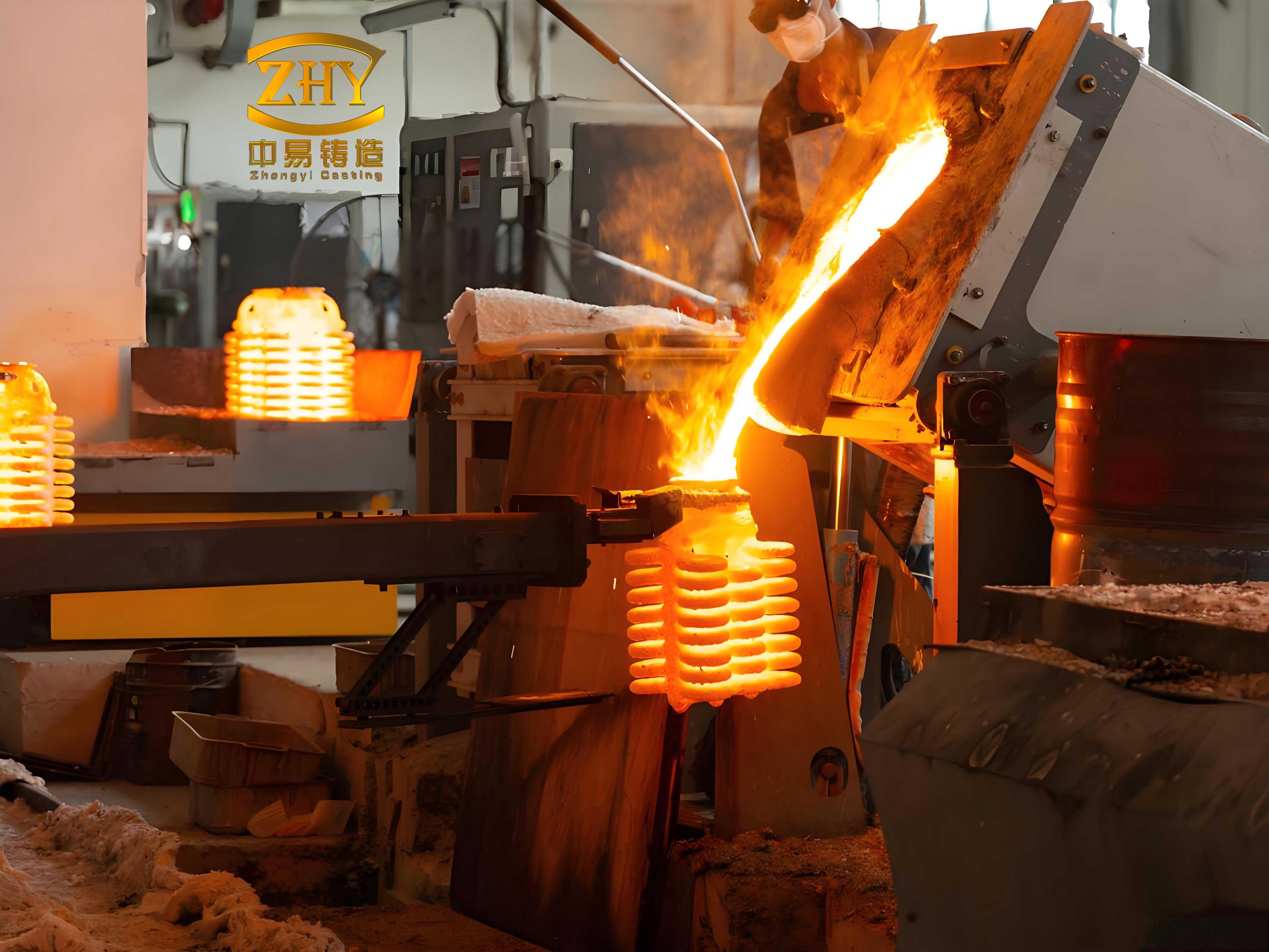
To resolve these defects, we embarked on a series of iterative modifications to the gating system in our investment casting process. The first improvement involved reducing the number of ingates from two to one, placed at the midpoint of the casting length. This adjustment aimed to simplify the stress distribution during solidification. After casting, we noted a substantial reduction in distortion, but hot tearing persisted severely at the ingate location. We verified that the chemical composition of the alloy, including sulfur and phosphorus levels, was within specified limits, ruling out material impurities as the primary cause. Altering the size of the ingate also failed to eliminate hot tearing, indicating that ingate dimensions were not the root issue. This led us to reconsider the thermal gradients and restraint conditions inherent in investment casting. In the next iteration, we relocated the single ingate to the uppermost end of the casting. This change resulted in the complete elimination of hot tearing and minimal distortion, demonstrating the importance of ingate placement in investment casting. However, this configuration introduced practical difficulties: the long, thin pattern tended to break during shelling, dewaxing, firing, and casting operations, compromising yield. To address this, we further refined the scheme by tilting the pattern downward from the ingate, maintaining a small gap of about 5 mm between the lower end of the pattern and the sprue. This enhanced shell connectivity after the first two coating layers, improving robustness and yield without reintroducing defects. These steps underscore how incremental design changes in investment casting can significantly impact defect occurrence.
The persistence of hot tearing in the initial and midpoint-ingate schemes can be analyzed through thermal stress and strain theories. In investment casting, hot tearing occurs when the casting is restrained during solidification, leading to tensile stresses that exceed the material’s hot strength at elevated temperatures. For a long, thin casting, the solidification front progresses along the length, creating differential cooling rates. The thermal strain induced can be expressed as:
$$ \epsilon_{th} = \alpha \cdot \Delta T $$
where \( \epsilon_{th} \) is the thermal strain, \( \alpha \) is the coefficient of thermal expansion, and \( \Delta T \) is the temperature gradient. In investment casting, the mold shell provides restraint, leading to stress development. The resulting stress \( \sigma \) can be modeled using Hooke’s law for elastic behavior, but at high temperatures, viscoelastic effects dominate. A simplified formula for stress in a restrained bar during cooling is:
$$ \sigma = E \cdot \alpha \cdot \Delta T \cdot (1 – f_s) $$
where \( E \) is the Young’s modulus, and \( f_s \) is the solid fraction. Hot tearing is likely when \( \sigma \) exceeds the hot tearing strength \( \sigma_{ht} \), which is temperature-dependent. For the two-ingate setup, the region between the ingates cools rapidly, contracting and pulling on the hotter ingate areas. This creates biaxial tensile stresses at the ingates, where the material remains weak due to prolonged high temperatures. In investment casting, the ingate acts as a heat source, delaying solidification locally. The stress concentration factor \( K_t \) at the ingate junction can exacerbate this:
$$ K_t = 1 + 2\sqrt{\frac{a}{\rho}} $$
where \( a \) is the flaw size and \( \rho \) is the radius of curvature. With two ingates, the mid-region experiences dual restraint, increasing \( \Delta T \) and \( \sigma \). Conversely, with a single top ingate, the casting contracts primarily in one direction, reducing multiaxial stresses. The thermal gradient \( \Delta T \) along the casting can be approximated using Fourier’s law:
$$ \Delta T = \frac{q \cdot L}{k} $$
where \( q \) is the heat flux, \( L \) is the length, and \( k \) is the thermal conductivity. In investment casting, shell properties affect \( q \), influencing distortion. Distortion arises from non-uniform cooling, causing bending moments. The deflection \( \delta \) of a thin beam under thermal gradient can be estimated as:
$$ \delta = \frac{\alpha \cdot \Delta T \cdot L^2}{8h} $$
where \( h \) is the thickness. By optimizing gating, we reduce \( \Delta T \), minimizing \( \delta \). These formulas highlight the interplay between geometry, thermal management, and mechanical restraint in investment casting.
To summarize the impact of different gating schemes in investment casting, I have compiled a comparative table based on our trials. This table encapsulates key parameters and outcomes, providing a clear reference for practitioners.
| Gating Scheme | Number of Ingates | Ingate Position | Hot Tearing Severity | Distortion Level | Shell Robustness | Overall Yield |
|---|---|---|---|---|---|---|
| Initial Design | 2 | Top and Bottom | High (80%+ defects) | High | Moderate | Low |
| Midpoint Ingate | 1 | Center | High | Moderate | Moderate | Low |
| Top Ingate (Vertical) | 1 | Top End | None | Low | Low (breakage issues) | Moderate |
| Top Ingate (Tilted) | 1 | Top End with Tilt | None | Low | High | High |
This table underscores how incremental modifications in investment casting gating can dramatically affect defect rates. The tilted top-ingate scheme emerged as optimal, balancing defect elimination with practical robustness. In investment casting, such data-driven adjustments are essential for quality control.
Beyond gating design, other factors in investment casting contribute to hot tearing and distortion. For instance, the alloy’s solidification range plays a role. A wide freezing range increases susceptibility to hot tearing due to prolonged mushy zone existence. The critical solid fraction \( f_{s,cr} \) for hot tearing can be expressed as:
$$ f_{s,cr} = \frac{\sigma_{ht}}{E \cdot \alpha \cdot \Delta T} + f_{s,0} $$
where \( f_{s,0} \) is a base solid fraction. In investment casting, controlling cooling rates through shell thickness or preheat temperatures can modulate \( \Delta T \). We experimented with shell compositions, noting that higher permeability reduced gas pressure and stress. The investment casting shell acts as a barrier, and its thermal conductivity \( k_{shell} \) influences heat extraction. Using a composite shell with low \( k_{shell} \) can slow cooling, reducing thermal gradients. However, this must be balanced against distortion risks. We derived an empirical relation for investment casting of long parts:
$$ \text{Hot Tearing Index} = C \cdot \frac{L^2 \cdot \alpha}{h \cdot k_{shell}} $$
where \( C \) is a material constant. Lowering this index through design changes mitigated defects. Additionally, mold restraint force \( F_r \) in investment casting can be estimated from shell strength:
$$ F_r = A \cdot \sigma_{shell} $$
where \( A \) is the contact area and \( \sigma_{shell} \) is the shell’s tensile strength. Reducing \( A \) by minimizing pattern-sprue gap decreased \( F_r \), aiding in distortion control. These insights reinforce that investment casting is a holistic process where multiple parameters interact.
In practice, implementing these solutions requires careful attention to investment casting details. For long, thin castings, I recommend using a single ingate at one end, preferably the top, to unify contraction direction. The pattern should be slightly tilted to enhance shell connectivity, as described. During shell building, ensure uniform coating to avoid weak spots that exacerbate distortion. Preheat temperatures should be optimized to reduce thermal shock; for steel alloys like 30CrMnSi, a preheat of 900°C often works well in investment casting. Monitoring solidification through simulation software can predict hot spots and stress concentrations. Many investment casting foundries use finite element analysis (FEA) to model thermal gradients. The governing heat transfer equation is:
$$ \rho c_p \frac{\partial T}{\partial t} = \nabla \cdot (k \nabla T) + \dot{q} $$
where \( \rho \) is density, \( c_p \) is specific heat, \( T \) is temperature, \( t \) is time, and \( \dot{q} \) is internal heat source. Solving this for investment casting geometries helps optimize gating. Additionally, post-casting treatments like stress relieving can reduce residual stresses, but prevention during casting is more efficient. Through these measures, investment casting can achieve high yields even for challenging geometries.
Reflecting on this journey, the resolution of hot tearing and distortion in investment casting for long, thin castings hinges on understanding and manipulating thermal-mechanical interactions. The iterative approach we took—from initial failure to final success—highlights the empirical nature of foundry engineering. Each modification taught us more about the investment casting process: how ingate placement directs stress, how shell design affects restraint, and how pattern orientation influences robustness. The formulas and tables presented here distill these lessons into actionable knowledge. Investment casting, with its versatility, demands such nuanced adjustments to overcome defects. By sharing this analysis, I hope to contribute to the broader community of investment casting professionals, fostering innovation and quality improvement. As technology advances, incorporating real-time monitoring and AI-driven design could further enhance investment casting outcomes, but the fundamental principles of thermal management and restraint reduction will remain paramount.