
As a researcher deeply involved in the advancement of precision manufacturing, I have always been fascinated by the potential of process enhancements in investment casting. This process, known for its ability to produce complex, near-net-shape components with excellent surface finish, still faces persistent challenges related to internal soundness, such as shrinkage porosity and hot tearing. In my pursuit of improving the metallurgical quality of investment castings, I turned my attention to vibration-assisted solidification. The principle is compelling: applying external mechanical energy during the critical phase change of a metal can fundamentally alter its solidification structure. This article details my comprehensive experimental study on the effects of vibration during the pouring and solidification stages of investment casting. My goal was to systematically evaluate how key vibration parameters—namely, the timing of vibration initiation, the duration of vibration, and the frequency of vibration—impact the final casting quality, specifically the reduction of shrinkage defects and the prevention of cracks.
The core mechanism behind vibration solidification in investment casting lies in the dynamic interaction between the oscillating mold and the solidifying metal. When mechanical vibration is applied, it induces forced convection within the molten pool. This convection increases the kinetic energy of the liquid metal, enhances heat and mass transfer, and most importantly, can fragment dendritic arms. These fragmented dendrites then act as additional nucleation sites, effectively refining the grain structure. The process can be conceptually described by considering the forces on a growing dendrite. The shear stress ($\tau$) induced by fluid flow around a dendrite tip can be related to the viscosity ($\eta$) and velocity gradient. When this stress exceeds the mechanical strength of the dendrite arm, fragmentation occurs. A simplified relation can be expressed as:
$$ \tau \propto \eta \cdot \frac{du}{dy} $$
where $du/dy$ is the velocity gradient near the solid-liquid interface. The vibration directly influences this gradient. Furthermore, the increased undercooling ($\Delta T$) due to enhanced heat extraction can be modeled. The total undercooling is a sum of several components: thermal ($\Delta T_t$), constitutional ($\Delta T_c$), and curvature ($\Delta T_r$) undercooling. Vibration primarily affects the thermal profile, potentially increasing $\Delta T_t$:
$$ \Delta T = \Delta T_t + \Delta T_c + \Delta T_r $$
The increased undercooling and dendrite fragmentation collectively promote a finer, more equiaxed grain structure, which inherently has better feeding characteristics and reduced susceptibility to concentrated shrinkage. This theoretical foundation formed the basis for my experimental design in investment casting.
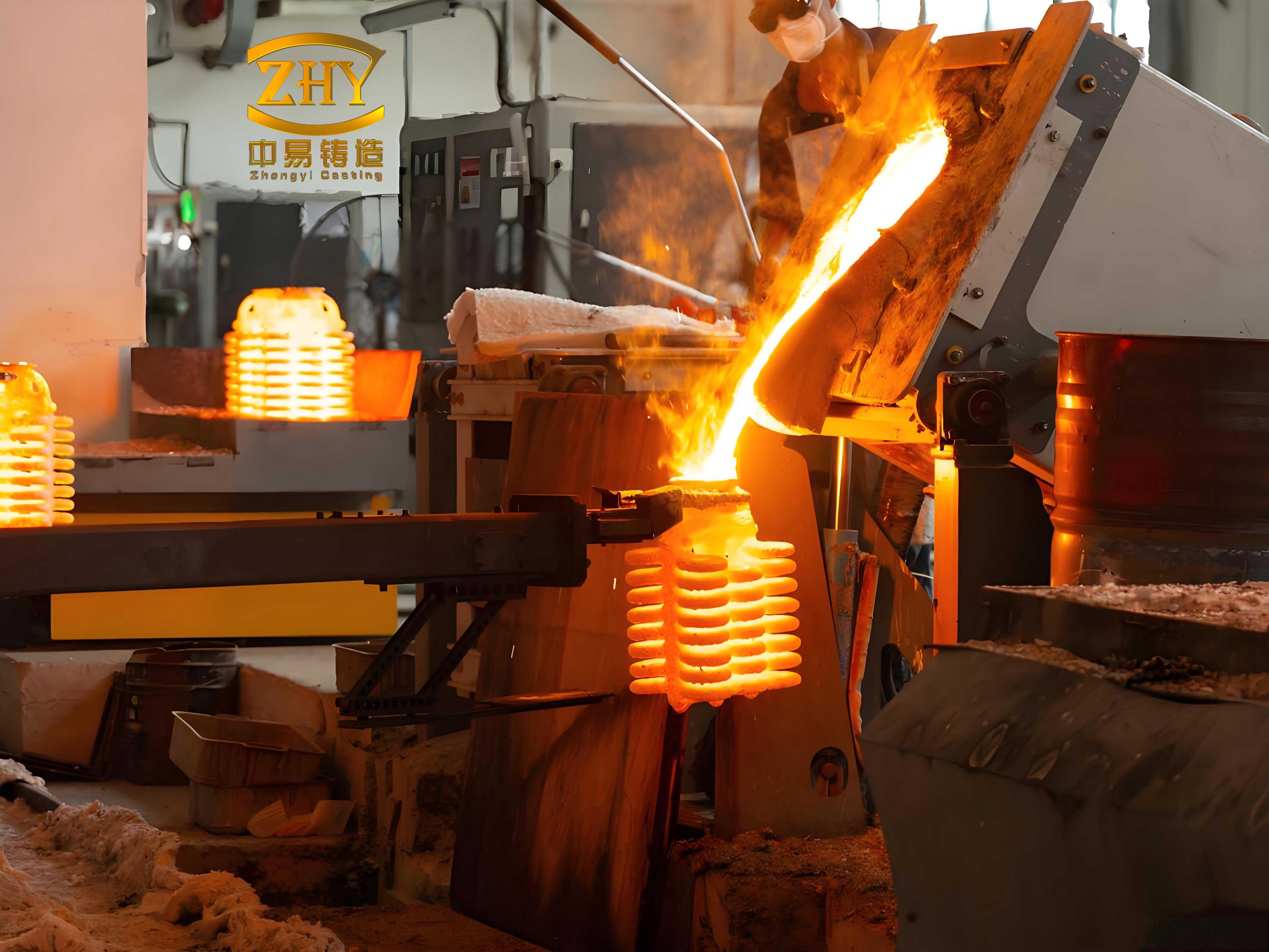
To investigate this, I designed a series of controlled experiments focusing on the investment casting process. The base material selected for all trials was a standard cast steel, ZG310-570, with its nominal chemical composition detailed in the table below. This material is commonly used in investment casting for engineering components, making the findings broadly applicable.
| Element | C | Si | Mn | P | S | Fe |
|---|---|---|---|---|---|---|
| Content | 0.45 | 0.29 | 0.62 | ≤0.03 | ≤0.02 | Bal. |
The investment casting shells were procured from a professional foundry, utilizing two common ceramic system identifiers (e.g., Type A and Type B for generalization, corresponding to the original 9560 and Q10 designations). All shells were subjected to standard dewaxing and high-temperature firing cycles prior to pouring. The experimental setup centered on a one-dimensional mechanical vibration platform. The fired ceramic shell was securely embedded in a sand-filled flask, which was then mounted onto this platform. A variable-frequency drive system allowed precise control over vibration frequency and duration. The molten ZG310-570 steel was prepared in an induction furnace and poured at a consistent superheat temperature for all experiments to isolate the vibration effects.
The first experimental variable was the timing of vibration initiation. I tested three distinct pouring methodologies within the investment casting process:
- Static Pouring (Control): The shell was poured without any applied vibration.
- Vibration After Pouring: The molten metal was poured into a stationary shell, and mechanical vibration commenced immediately after the pour was complete.
- Vibration During Pouring: The vibration platform was activated first. After a steady-state vibration was achieved (approximately 60 seconds), the metal was poured into the oscillating shell, and vibration continued throughout the initial solidification period.
For these initial comparisons, the vibration frequency was fixed at 50 Hz, and the total active vibration time was maintained at approximately 4 minutes. The response was evaluated qualitatively by examining the sink depth in the pouring cup (for thinner-walled Type A castings) and quantitatively through X-ray radiographic inspection for internal porosity in both casting types.
The results were striking and immediately highlighted the benefit of integrating vibration into the investment casting sequence. For the Type A (thinner-walled) investment castings, the sink depth in the pouring cup, a direct indicator of volumetric shrinkage and feeding efficiency, was most pronounced for the castings subjected to vibration during pouring. The static pour showed minimal sink, suggesting poorer internal feeding. Radiographic analysis of the thicker Type B investment castings provided conclusive evidence. The casting from the “Vibration During Pouring” batch exhibited the fewest and smallest shrinkage pores. The “Vibration After Pouring” casting showed improvement over the static castings but had more and larger pores compared to the first. This clearly established that initiating vibration before the metal enters the mold cavity yields superior results in investment casting. The forced convection established prior to metal arrival seems to prime the mold environment, enhancing fluidity and feeding from the very onset of solidification.
The second parameter I scrutinized was the duration of applied vibration. While vibration is beneficial, the energy input must be optimized. Using the “Vibration During Pouring” method at 50 Hz, I produced investment castings with two different vibration hold times: a shorter cycle of ~105 seconds and a longer cycle of ~246 seconds (approximately 4 minutes). Post-processing and inspection revealed a critical trade-off. While both vibrated castings showed improved soundness over non-vibrated ones, the casting subjected to the longer 246-second vibration cycle displayed incipient crack propagation from stress concentration points. This suggests that excessive vibration duration can induce detrimental tensile stresses in the partially solidified casting, leading to hot tearing. The relationship between vibration time ($t_v$), accumulated strain energy ($E_s$), and the material’s solid fraction ($f_s$) during the vulnerable coalescence stage is crucial. An empirical risk function ($R_{crack}$) for cracking could be conceptualized as:
$$ R_{crack} \propto \int_{t_{coherence}}^{t_{solid}} \sigma(t_v, f_s) \cdot \dot{\epsilon}(t_v) \, dt $$
where $\sigma$ is the thermal stress and $\dot{\epsilon}$ is the strain rate induced by vibration. Prolonged $t_v$ increases the integral value, raising the cracking risk. Therefore, in investment casting, vibration time must be sufficient to affect the main feeding zone but not so long as to damage the coherent solid network.
The third and perhaps most nuanced variable was the frequency of vibration. Mechanical vibration systems operate across a spectrum, and finding the resonant or most effective frequency for a given investment casting system is key. I conducted a series of pours using the “Vibration During Pouring” method with a fixed, moderate vibration time. The frequencies tested were 25 Hz, 35 Hz, and 45 Hz. The assessment was again based on pouring cup sink depth and X-ray analysis of the feeder sections.
| Vibration Frequency (Hz) | Relative Sink Depth* | Radiographic Soundness (Feeder Area) | Qualitative Rating |
|---|---|---|---|
| 25 | Shallow / Minimal | Some scattered porosity | Fair |
| 35 | Deepest | Most dense, minimal porosity | Excellent |
| 45 | Moderate | Dense, but minor micro-porosity | Good |
*Sink depth is a relative measure indicating the efficiency of volumetric contraction compensation.
The results indicated a clear optimum near 35 Hz for this specific investment casting setup with ZG310-570 steel. At 25 Hz, the energy input and induced fluid velocities were likely insufficient to create significant dendritic fragmentation or enhance feeding effectively. At 45 Hz, while effective, the higher frequency might lead to wave attenuation within the viscous melt or induce a less favorable flow pattern. The optimal frequency likely relates to the natural frequency of the molten metal pool within the specific ceramic shell geometry, maximizing energy transfer. This can be loosely analogized to a damped harmonic oscillator, where the system’s response amplitude $A$ is a function of the driving frequency $\omega$ and its natural frequency $\omega_n$:
$$ A(\omega) \propto \frac{1}{\sqrt{(\omega_n^2 – \omega^2)^2 + (2\zeta\omega_n\omega)^2}} $$
where $\zeta$ is the damping ratio. The maximum response (and thus maximum convective intensity) occurs near $\omega_n$. My experimental finding of 35 Hz suggests this is near the resonant condition for my investment casting test configuration, leading to the most effective grain refinement and feeding.
Delving deeper into the discussion, the synergy of these parameters defines the success of vibration in investment casting. The superior performance of “Vibration During Pouring” can be explained by the pre-establishment of a dynamic flow field. When vibration starts before pouring, the air within the shell cavity is agitated, potentially reducing back pressure. More importantly, as the first stream of metal enters, it encounters an already oscillating environment, promoting immediate droplet breakup and finer stream flow, which enhances heat distribution and reduces local superheat gradients. This early-stage uniformity sets the stage for a more homogeneous solidification front. The vibration energy also helps to keep the feeding channels open longer by constantly disturbing the forming dendrite mesh at the roots of feeders, effectively increasing the feeding range. This can be modeled by extending Darcy’s law for flow through a porous medium (the mushy zone) with an added vibration-induced pressure term ($P_{vib}$):
$$ v = -\frac{K}{\mu \cdot g_l} (\nabla P + \rho g + \nabla P_{vib}) $$
where $v$ is the interdendritic flow velocity, $K$ is the permeability, $\mu$ is viscosity, $g_l$ is the liquid fraction, $P$ is the metallostatic pressure, $\rho g$ is the gravitational head, and $\nabla P_{vib}$ is the vibrational pressure gradient. A positive $\nabla P_{vib}$ significantly augments $v$, improving feeding.
The frequency optimization underscores the importance of system matching. Every investment casting system—defined by alloy properties (density, viscosity, solidification range), shell properties (damping, stiffness), and part geometry—will have a characteristic frequency response. My results with ZG310-570 steel suggest that for similar medium-carbon steel investment castings, a frequency in the range of 30-40 Hz is a promising starting point for process development. Frequencies that are too low lack the necessary acceleration ($a = \omega^2 A$, where $A$ is amplitude) to overcome the melt’s yield strength or inertia, while very high frequencies may be damped out by the ceramic shell or cause cavitation rather than beneficial bulk flow.
Regarding vibration time, my findings call for a precision approach. The goal is to apply vibration through the critical period of primary dendrite formation and inter dendritic feeding, which is typically when the temperature is between the liquidus and a solid fraction of about 0.6-0.7. Continuing vibration beyond this point, into the solid cohesion stage, wastes energy and introduces risk. Therefore, for investment casting applications, a time-limited vibration protocol synchronized with the thermal history of the casting is ideal. This could potentially be automated by linking the vibration controller to a temperature feedback signal from the mold.
In conclusion, my experimental investigation robustly demonstrates that mechanical vibration is a powerful and practical tool for enhancing the quality of investment cast components. The key takeaways for implementing vibration in investment casting are: First, the timing of vibration initiation is critical; applying vibration before and during the pour yields significantly better results than applying it after the pour is complete. This sequence maximizes the benefits of forced convection on mold filling, thermal uniformity, and early grain refinement. Second, vibration duration must be carefully optimized. While sufficient time is needed to influence the solidifying microstructure, excessive vibration can lead to crack initiation due to induced thermal stresses in the partially solid casting. Third, an optimal vibration frequency exists for a given investment casting system. For ZG310-570 steel, a frequency around 35 Hz proved most effective in promoting dense, sound castings by likely coupling efficiently with the natural frequency of the melt-shell system. The integration of vibration technology into investment casting is not merely an additive operation but a transformative one that modulates the very physics of solidification. By judiciously selecting the parameters of timing, duration, and frequency, foundries can leverage this method to consistently produce investment castings with reduced shrinkage porosity, refined grains, and potentially enhanced mechanical properties, pushing the boundaries of what is achievable with this versatile precision casting process.