
In the pursuit of domestic production for critical components in high-speed trains, I have embarked on a comprehensive study focusing on the sand casting process of steel casting brake discs. These discs are paramount for safety, functioning to absorb kinetic energy during braking and dissipate it as heat. The material, structure, and performance must remain intact under extreme conditions. With advancements in steel casting technology, cast steel brake discs have seen enhanced performance and widespread application in high-speed trains globally. However, domestic trial production revealed significant challenges, including uneven hardness on friction surfaces, cracks, shrinkage porosity, and inclusions. This research aims to address these issues through meticulous process design and optimization, leveraging modern simulation tools and innovative manufacturing techniques.
The brake disc in question is a low-alloy wear-resistant steel casting, with dimensions of approximately Φ655 mm × 124 mm. It features two friction working surfaces connected by multiple cooling ribs, presenting a structure with dispersed hot spots and wall thicknesses ranging from 17 mm to 50 mm. The inherent complexity of this steel casting necessitates a robust casting process to ensure homogeneity and integrity. Initial trials yielded components with defects that compromised performance, prompting a detailed analysis and redesign.
My investigation began with a comparative quality assessment between imported brake discs and domestically trial-produced ones. Non-destructive testing methods, including magnetic particle inspection and X-ray radiography, were employed. The imported steel casting exhibited no surface defects, uniform internal quality, and consistent Brinell hardness across both working surfaces, ranging from HB 350 to HB 403. In contrast, the domestic trial piece showed linear and point defects on the surface, internal shrinkage cavities, porosity, cracks, slag inclusions, and highly variable hardness (HB 192–327) with poor symmetry between surfaces. This disparity underscored the need for process refinement.
| Quality Parameter | Imported Steel Casting | Domestic Trial Steel Casting |
|---|---|---|
| Surface Defects (Magnetic Particle) | None | Linear and point defects near gates |
| Internal Defects (X-ray) | None | Shrinkage cavities, porosity, cracks, slag |
| Hardness Range (Brinell) | HB 350–403 (both surfaces) | HB 192–327 (high variability) |
| Hardness Uniformity | Excellent symmetry and consistency | Poor symmetry and high dispersion |
Analysis of the original casting process revealed several shortcomings. The gating system introduced molten metal at concentrated points in thin sections, leading to localized overheating and subsequent cracking due to uneven contraction during solidification. The feeding system employed oversized top risers on one side and chills on the opposite side, creating asymmetric cooling conditions that resulted in hardness disparities. Additionally, the use of high returns in the charge likely contributed to impurity inclusion. The riser design, while seemingly ample, failed to effectively feed the dispersed hot spots between the ribs, leading to shrinkage defects. These insights guided the redesign of the steel casting process.
I developed three improved casting process schemes, designated A, B, and C, each with distinct gating and feeding systems. All schemes utilized furan resin sand molds, with ceramic filters placed at the ingate junctions and refractory brick tubes for runners. The pouring temperature was set at 1,570–1,590°C, and the casting shrinkage allowance was 2.0%. The key variations lie in the placement and number of risers and the avoidance of chills on the friction surfaces. The design principles were informed by both traditional casting manuals and contemporary research on feeding distances for steel castings.
For riser design, traditional rules suggest a feeding distance based on section thickness. However, recent studies, such as those by the American Steel Founders’ Society, provide more refined data. For a plate-like steel casting with a width-to-thickness ratio (W/T) of approximately 21, the lateral feeding distance (LFD) can be estimated. The relationship is often expressed as: $$ \text{LFD} = k \cdot T $$ where \( T \) is the thickness and \( k \) is a factor dependent on geometry and alloy. For low-alloy steel in sand molds, with W/T ≈ 21, data suggests \( k \approx 7 \), giving: $$ \text{LFD} = 7 \times 30 \, \text{mm} = 210 \, \text{mm} $$ This informed the riser spacing in Scheme C, aiming for more effective feeding without excessive riser volume.
| Scheme | Riser Configuration | Chill Usage | Gating System | Calculated Pouring Weight | Theoretical Yield |
|---|---|---|---|---|---|
| A | Multiple top risers on one surface, reduced size from original | None | Dispersed ingates | 308 kg | 55% |
| B | Risers on both sides, attempting symmetry | None | Dispersed ingates | 432 kg | 39% |
| C | Risers only on peripheral ribs, not on friction surfaces | None on friction surfaces | Bottom gating with multiple ingates | 354 kg | 48% |
The gating system was designed based on empirical formulas. The choke area was calculated, and the area ratios for the ingate, runner, and sprue were set as: $$ A_{\text{ingate}} : A_{\text{runner}} : A_{\text{sprue}} = 1.0 : (0.8–0.9) : (1.1–1.2) $$ This ensures a controlled fill to minimize turbulence and slag entrapment in the steel casting.
To optimize the process, I employed ProCAST software for numerical simulation of mold filling and solidification. The material was set as 28CrMoV5 steel, the mold as furan resin sand, and initial conditions included a pouring temperature of 1,580°C and mold temperature of 20°C. The heat transfer coefficient at the metal-mold interface was defined as 500 W/(m²·K). For shrinkage porosity prediction, the Niyama criterion was used, expressed as: $$ G / \sqrt{\dot{T}} \leq C $$ where \( G \) is the temperature gradient (K/mm), \( \dot{T} \) is the cooling rate (K/s), and \( C \) is a critical value. Based on literature, the critical value was set as: $$ C = 0.1 \, \text{K}^{0.5} \cdot \text{s}^{0.5} \cdot \text{mm}^{-1} $$ Simulations provided insights into fill patterns, solidification times, and potential defect locations.
The simulation results for each scheme were telling. Scheme A showed multiple shrinkage porosity defects at junctions between ribs and the main body, attributed to inadequate feeding. Scheme B exhibited improved internal soundness but still had variations in cooling conditions between the two working surfaces. Scheme C demonstrated no predicted shrinkage defects and the most symmetric cooling curves for corresponding points on the two friction surfaces. The temperature evolution at key points, as shown in the simulation, confirmed that Scheme C provided nearly identical thermal histories for both surfaces, crucial for achieving uniform hardness in the steel casting. Based on these outcomes—defect prediction, thermal symmetry, and yield—Scheme C was selected for production trials.
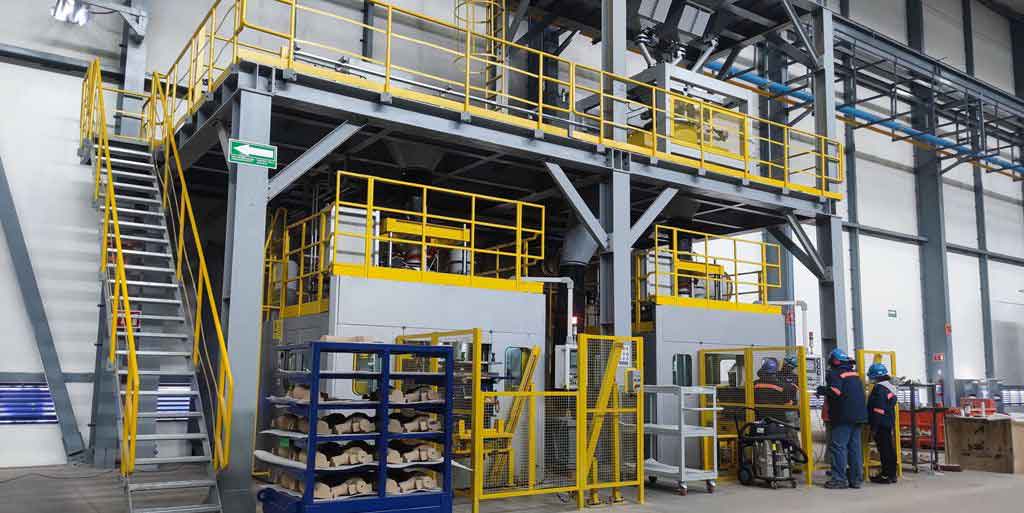
The implementation of Scheme C involved several advanced manufacturing steps. Three-dimensional casting process drawings were created using Solid Edge software, and cores were partitioned for 3D ink-jet printing. The furan resin sand cores were printed, coated with zirconium-based paint, and dried. Core assembly was meticulous, ensuring proper placement of ceramic filters and refractory tubes. For melting, high-purity raw materials—industrial pure iron, ferrosilicon, metallic manganese, and chromium—were used in an acid medium-frequency induction furnace to enhance the cleanliness of the steel casting. The melt was deoxidized with aluminum in the ladle before pouring. Two castings were produced with a recorded pouring temperature of 1,596°C and a pouring time of 21–24 seconds.
Post-casting, the components were cleaned, and rigorous inspection followed. Dimensional checks confirmed compliance with tolerances. Surface magnetic particle inspection revealed no defects. Ultrasonic testing also indicated sound internal structure. X-ray radiography showed only minor, dispersed gas pores well within acceptable limits per the technical specification. Hardness testing on the as-cast friction surfaces yielded promising results: for casting 1, the gate-side hardness ranged from HB 356 to 417, and the riser-side from HB 343 to 441; for casting 2, the ranges were HB 316–356 and HB 325–401, respectively. While some variability persisted, the hardness levels and symmetry were markedly improved and comparable to the imported steel casting. All results met the requirements of the technical specification for brake disc castings.
| Casting ID | Surface Side | Brinell Hardness Range (HB) | Maximum Difference (HB) | Comparative Note |
|---|---|---|---|---|
| 1 | Gate-side | 356–417 | 61 | Approaching imported disc uniformity |
| 1 | Riser-side | 343–441 | 98 | Slightly higher dispersion |
| 2 | Gate-side | 316–356 | 40 | Good uniformity |
| 2 | Riser-side | 325–401 | 76 | Acceptable symmetry |
This research underscores several critical findings for producing high-quality steel casting brake discs. Firstly, avoiding risers, gates, vents, or chills directly on the friction working surfaces is essential to create symmetric and uniform cooling conditions, thereby promoting consistent hardness across both surfaces. Secondly, employing high-purity charge materials, bottom gating systems, refractory conduits, and ceramic filters significantly reduces inclusions and slag defects in the steel casting. Thirdly, modern tools like CAD/CAE and 3D printing enable precise process design and validation, reducing trial-and-error. The integration of numerical simulation, using criteria like the Niyama function, allows for predictive defect analysis and optimization.
The success of this steel casting process hinged on a holistic approach. From material selection to mold design, every step was scrutinized. The use of simulation provided a virtual prototyping environment, saving time and resources. The 3D printing of cores ensured dimensional accuracy and repeatability. Moreover, the melting practice focused on cleanliness, which is paramount for high-integrity steel castings. The final components demonstrated that domestic production can achieve parity with imported ones, meeting the stringent demands of high-speed rail applications.
In conclusion, through systematic process redesign and advanced manufacturing techniques, I have developed a reliable sand casting process for steel casting brake discs. The optimized scheme eliminates major defects and ensures uniform hardness, fulfilling technical specifications. This work contributes to the localization of critical rail components and highlights the importance of integrated design and simulation in modern steel casting. Future work may explore further refinements in alloy composition or heat treatment to enhance performance, but the casting process itself now provides a robust foundation for quality production.