
The evolution of national policies promoting the integration of informatization and industrialization, coupled with the global momentum of Industry 4.0, has significantly elevated the performance requirements for foundry equipment. Within this landscape, V法 casting (Vacuum Molding Process) stands out as one of the most environmentally friendly casting methods and has experienced rapid development domestically. However, its unique process characteristics make the achievement of industrial automation particularly crucial. Our company has been dedicated to the research, development, and manufacturing of V法 casting process equipment. As early as 2014, we began actively exploring solutions to integrate industrial automated production with automated management. To date, we have successfully engineered and delivered over fifteen production lines incorporating robotic systems.
The core of V法 casting automation lies in achieving a fully automated management objective for the entire production workflow. This encompasses raw material handling, production planning, equipment operation, process recipe application, and finished product inventory management, all orchestrated by a superior-level Management Execution System (MES) or Enterprise Resource Planning (ERP) system. A foundational innovation enabling this is the design of readable identification codes (e.g., QR codes or RFID tags) on both castings and casting flasks. This design facilitates online, real-time tracking and control of production data and ensures full lifecycle traceability of the finished product. The integrated system delivers critical functionalities including raw material inventory alerts, optimized production scheduling, enhanced production efficiency, precise quality issue tracing, and real-time visual inventory management.
This article details the principles and implementations of integrating automated production with intelligent management in V法 casting processes, with a specific focus on the production of steel casting components. We will explore the technical architecture, key modules, and the tangible benefits realized through this integration.
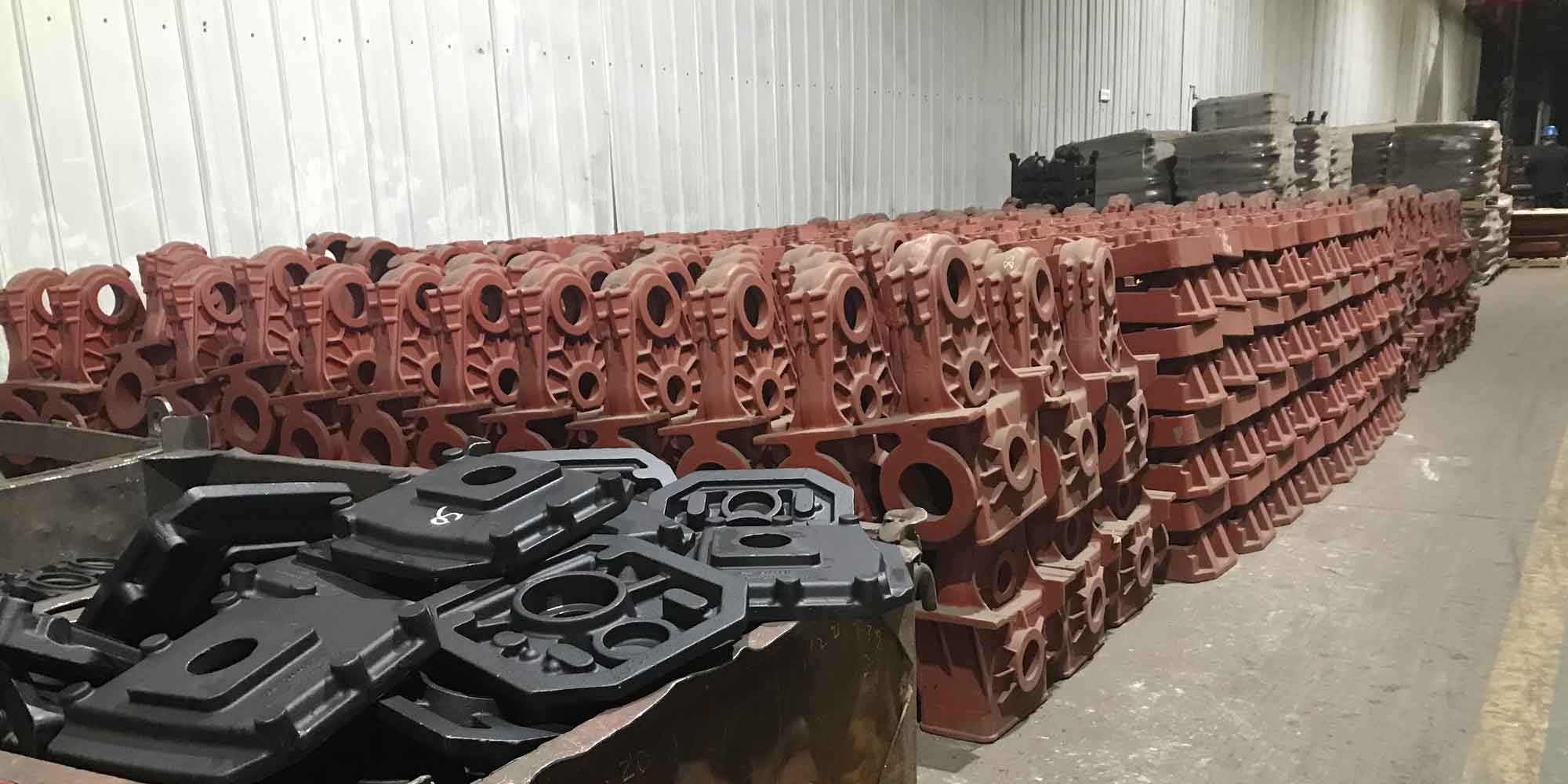
Architecture of an Automated V法 Casting Production Line for Steel Castings
A fully integrated automated V法 line for steel casting is a symphony of coordinated stations. The primary goal is to automate the core sequence: molding, pouring, cooling, transfer, shakeout, and casting extraction. The line’s design is governed by a production纲领 (production program) which defines key parameters.
| Parameter Category | Specification |
|---|---|
| Production Focus | High Manganese Steel & Alloy Steel Steel Castings (e.g., crusher hammers, jaw plates) |
| Annual Output | 8,000 – 10,000 metric tons |
| Melting Capacity | 3-ton Medium Frequency Furnace (One Power Supply for Two Furnaces) |
| Work Shift | Single Shift |
| Molding Line Efficiency | 4 – 6 Complete Molds per Hour |
| Sand Handling Capacity | 20 metric tons per hour |
| Vacuum System Capacity | 3 Vacuum Pumps @ 74 m³/min each |
| Flask Internal Dimensions | 2000 mm (L) × 1600 mm (W) × 400/300 mm (H) |
The automation and data flow hinge on several interconnected modules, each contributing to the seamless production of steel casting components.
1. Melting Department Automation
The journey of a steel casting begins with precise molten metal preparation. Automation here is vital for quality and consistency.
$$ \text{Metal Charge Precision} = f(\text{Automated Weighing}, \text{ERP Schedule}) $$
An automated charging system dispenses raw materials based on the precise weight required for each heat, as dictated by the production schedule from the ERP. Furthermore, a Melting Control Robot performs critical tasks:
- Slag removal (Rabbling)
- Assisting in composition sampling and analysis
- Adding deoxidizers and alloys
- Temperature measurement
This robotic intervention minimizes human-induced variability in the molten steel casting alloy, reduces labor intensity, and provides reliable, auditable data for quality assurance.
2. Molding Department Automation
This is the heart of the V法 process, where automation most directly replaces manual, labor-intensive steps. An automated molding station typically integrates:
- Bridge-Type Film Applicator: For consistent EVA film heating and draping over the pattern.
- Spraying Robot: Applies the refractory coating uniformly and efficiently.
- Independent Coating Drying Unit: Ensures proper coating cure before sand filling.
- Mobile Vibration Table: Transports the pattern/flask and provides compaction energy.
- Automatic Sand Filling & Compaction System.
- Back Film Application & Sealing Mechanism.
- Robotic Systems: For placing empty cope flasks (“coping”) and for roll-over/drag closing operations.
Control is managed by an integrated EMA (Equipment Management Automation) system. Both patterns and flasks carry scannable barcodes. Multiple automatic identification stations throughout the molding sequence read these codes, automatically pair the correct drag and cope, and record every action into a central database. This creates the digital foundation for traceability of each individual steel casting.
3. Pouring, Cooling, and Shakeout Automation
After molding, the automated flask handling continues.
- Pouring: A vacuum-transfer car moves the assembled mold to the pouring station. A system of mobile and stationary vacuum rails ensures the mold remains under vacuum during transfer. An automatic pouring machine, which may include a holding/ladling furnace for temperature stability, identifies the specific mold to be poured based on the ERP task list and executes the pour.
- Cooling: Molds are transferred to controlled cooling zones. The control system, via flask identification, can automatically route and sequence molds based on the steel casting alloy and its required solidification and cooling time $t_{cool}$. This optimizes cooling lane logistics.
$$ t_{cool} \propto \frac{(V_{casting})^2}{A_{casting}} \cdot C_{material} $$
Where $V_{casting}$ is volume, $A_{casting}$ is surface area, and $C_{material}$ is a cooling coefficient specific to the steel casting grade. - Shakeout: Upon completion of cooling, the mold is transported to the shakeout station. A robotic shakeout unit grips the flask, separating it from the casting and the sand mass. The empty flask is returned to the molding loop via a conveyor. Another robot then extracts the steel casting and places it onto a slow-cooling or processing line, while a separate mechanism cleans the pouring base plate for reuse.
The Intelligent Management System: Data as the Backbone
The physical automation described above generates vast amounts of data. The true power is unlocked when this data is integrated into a higher-level management system (ERP/MES). The core concept is bidirectional data flow.
| Direction | Process | Outcome |
|---|---|---|
| ERP → Production Control | ERP issues detailed production orders (what to cast, alloy, quantity, priority). | Tasks are dispatched automatically to melting, molding, and pouring subsystems. |
| Production Control → ERP | Each station captures real-time data: mold ID, pouring temp $T_{pour}$, times, weights, operator/robot ID. | ERP database updates with as-built records for each steel casting lot. Enables real-time tracking and historical analysis. |
The data acquisition cycle is continuous. A simplified workflow can be represented as a closed-loop system:
- Order Release: ERP system releases a production order for a specific steel casting part.
- Task Dispatch: Production Control System (PCS) breaks down the order into tasks for Melting, Pattern Retrieval, Molding, and Pouring.
- Execution & Data Capture: Each automated station executes its task while scanning component IDs and logging process parameters (e.g., $T_{pour}$, vacuum pressure $P_{vac}$).
- Data Aggregation & Feedback: All captured data is fed back to the ERP/MES, enriching the digital record of the production run.
- Analysis & Optimization: The system uses historical data for predictive analytics, preventive maintenance scheduling, and dynamic optimization of future production plans.
This integration allows for functions like dynamic scheduling that minimizes changeover time, or quality traceability where a defect in a finished steel casting can be traced back to the specific heat, mold, and process parameters from which it originated.
Application-Specific Adaptations for Steel Castings
The principles of automation are consistent, but their application must adapt to the specific demands of different steel casting products. We have implemented these systems in two distinct application domains.
Case Application 1: Wear-Resistant Mining Components
For high-manganese steel and alloy steel crusher hammers and plates, the primary focus was on achieving high-volume, consistent molding and handling of heavy, relatively flat molds. The automation sequence as described in the architecture section ensures minimal human intervention from film draping to casting extraction. The management system tracks each hammer’s production history, essential for quality certification in this demanding application. The key was robust hardware for handling large flasks and a data system capable of managing high throughput.
Case Application 2: Steel Casting Axle Housings
Producing more complex, core-heavy components like steel casting axles introduces additional challenges. The automation system was adapted with specific considerations:
- Core Setting: A robotic system was employed for precise and repeatable placement of complex sand cores, eliminating variability inherent in manual setting.
- Vacuum Pressure Control During Pouring & Solidification: For certain steel casting geometries, the vacuum level $P_{vac}$ needs careful modulation during the pour and pressure-holding phase to prevent penetration or other defects.
$$ P_{vac}(t) = P_{base} – \Delta P_{pour} + f(t)_{solidification} $$
Where $P_{base}$ is the standard molding vacuum, $\Delta P_{pour}$ is a controlled reduction during pouring, and $f(t)_{solidification}$ is a time-dependent function for the holding phase. Automating this profile ensures consistent, optimal pressure conditions, removing a critical source of human-dependent quality fluctuation. - Extended Cooling Management: The system’s ability to track and schedule based on extended, alloy-specific cooling times is fully utilized to ensure proper metallurgical properties in the final steel casting axle.
In both cases, extending the automation philosophy to equipment management—via a digitalized preventive maintenance and point-inspection system—further enhances overall equipment effectiveness (OEE) and line reliability.
Conclusion and Forward Perspective
The integration of industrial automation with intelligent management systems in V法 casting represents a transformative leap for the production of steel casting components. It moves the process from a series of discrete, skill-dependent operations to a continuous, data-driven manufacturing flow. The benefits are quantifiable: enhanced consistency in steel casting quality, full product traceability, significant reduction in manual labor and associated variability, optimized asset utilization, and actionable insights from production data.
The evolution is ongoing. Future developments will see deeper integration of Artificial Intelligence (AI) and Machine Learning (ML) algorithms for predictive quality control, self-optimizing process parameters in real-time, and even more sophisticated digital twins of the entire production line. For foundries specializing in steel casting, adopting this integrated automation and management approach is no longer merely an option for efficiency gains; it is becoming a strategic imperative for ensuring competitiveness, meeting stringent quality demands, and achieving sustainable manufacturing in the era of Industry 4.0. As a technology-driven equipment provider, our mission is to pioneer and deliver these advanced, tailored solutions, guiding foundries on the path most suitable for their specific production goals and market demands.