
In the pursuit of higher operational speeds for high-speed trains, such as those reaching 400 km/h, the braking system faces unprecedented thermal challenges. The kinetic energy conversion during braking generates immense heat, which must be efficiently dissipated to prevent failures like thermal cracking and fatigue. Traditional brake discs, often made from steel casting, have been widely used due to their mechanical strength and durability. However, at extreme speeds, steel casting brake discs may encounter temperature peaks exceeding their material limits, leading to safety concerns. This study investigates the thermal dissipation performances of two brake disc types: carbon-ceramic composites and conventional steel casting discs, under emergency braking conditions at 400 km/h. Using a fluid-solid-thermal coupling simulation approach, we analyze temperature variations and their impact on the surrounding air domain, validated through bench tests. The focus is on comparing the thermal behaviors, with an emphasis on the limitations and advantages of steel casting in high-speed applications.
The braking process in high-speed trains involves the conversion of kinetic energy into thermal energy via friction between the brake disc and pads. For steel casting brake discs, this can lead to rapid temperature rises, potentially causing thermal stresses and cracks. The heat dissipation performance is critical, as it affects not only the disc’s integrity but also the thermal environment in the bogie area. We develop complex models of a high-speed train front end, incorporating both carbon-ceramic and steel casting brake discs. An air domain is established around the model to simulate real-world conditions, allowing for an analysis of convective heat transfer without predefined coefficients. This method provides a more accurate representation compared to traditional thermal-solid coupling simulations, which often rely on fixed convective values. The study aims to predict thermal behaviors for future CR400 trains, ensuring safety and reliability.
To model the thermal dissipation, we employ computational fluid dynamics (CFD) coupled with thermal analysis. The train front model is simplified to reduce computational cost while retaining essential features like the bogie and brake disc assembly. The steel casting brake disc and carbon-ceramic brake disc are modeled based on actual dimensions, with careful attention to geometric details such as cooling fins. For steel casting, the fins are cylindrical, whereas carbon-ceramic discs feature radial fin structures. The material properties are temperature-dependent, as summarized in tables below. The simulation assumes isotropic materials, neglecting radiation effects, and considers forced convection during braking and natural convection post-braking. The braking scenario involves a two-stage deceleration: from 400 km/h to 200 km/h at 0.98 m/s², and from 200 km/h to stop at 1.25 m/s², totaling 101 seconds, with an extended simulation time of 130 seconds to observe post-braking effects.
The governing equations for heat transfer include conduction and convection. The heat conduction equation in three dimensions is given by:
$$ \rho_m C \frac{\partial T}{\partial t} = \frac{\partial}{\partial x} \left( k \frac{\partial T}{\partial x} \right) + \frac{\partial}{\partial y} \left( k \frac{\partial T}{\partial y} \right) + \frac{\partial}{\partial z} \left( k \frac{\partial T}{\partial z} \right) $$
where \( \rho_m \) is density, \( C \) is specific heat capacity, \( T \) is temperature, \( t \) is time, and \( k \) is thermal conductivity, all varying with temperature. For convective heat transfer, the heat flux is expressed as:
$$ q = -h_c \Delta T $$
with \( h_c \) as the convective heat transfer coefficient and \( \Delta T \) the temperature difference between the solid surface and fluid. The boundary conditions at the fluid-solid interface ensure continuity:
$$ T_{W1} = T_{W2} $$
$$ q_{W1} = q_{W2} $$
$$ -\lambda \frac{\partial T}{\partial n} = h(T_W – T_f) $$
where \( \lambda \) is thermal conductivity, \( n \) is the normal direction, \( T_W \) is wall temperature, and \( T_f \) is fluid temperature. The fluid flow is modeled using the k-ε turbulence model, with the air domain having a blockage ratio below 5% to minimize boundary effects. The equivalent friction heat method is applied to simulate heat generation on the disc surface, avoiding direct contact modeling for computational efficiency.
The material parameters for carbon-ceramic and steel casting brake discs are critical in determining thermal responses. Below are tables summarizing these properties at various temperatures, highlighting the differences that influence dissipation. For instance, steel casting has a higher density but lower specific heat capacity compared to carbon-ceramic, affecting how heat is stored and transferred.
| Parameter | Temperature (K) | Value for Carbon-Ceramic |
|---|---|---|
| Density (kg/m³) | – | 2300 |
| Specific Heat Capacity (J/(kg·K)) | 373.15 | 800 |
| 573.15 | 1300 | |
| 773.15 | 1550 | |
| 973.15 | 1700 | |
| 1173.15 | 1600 | |
| Thermal Conductivity (W/(m·K)) | 373.15 | 66.0 |
| 573.15 | 55.6 | |
| 773.15 | 51.8 | |
| 973.15 | 50.6 | |
| 1173.15 | 47.0 |
| Parameter | Temperature (K) | Value for Steel Casting |
|---|---|---|
| Density (kg/m³) | – | 7980 |
| Specific Heat Capacity (J/(kg·K)) | 373.15 | 487 |
| 573.15 | 565 | |
| 773.15 | 667 | |
| 973.15 | 805 | |
| 1173.15 | 805 | |
| Thermal Conductivity (W/(m·K)) | 373.15 | 45.9 |
| 573.15 | 41.2 | |
| 773.15 | 37.6 | |
| 973.15 | 32.8 | |
| 1173.15 | 26.0 |
The braking conditions are defined with initial speeds of 300 km/h and 400 km/h, using deceleration values as per standard emergency protocols. The air properties are temperature-dependent, with density varying, specific heat capacity at 1006.43 J/(kg·K), thermal conductivity at 0.0242 W/(m·K), and viscosity at 1.7894 × 10⁻⁵ kg/(m·s). The simulation mesh is unstructured, refined near the brake discs for accuracy, and validated through grid independence tests. The manufacturing of steel casting brake discs involves processes like melting and molding, which can influence material homogeneity and thermal performance.
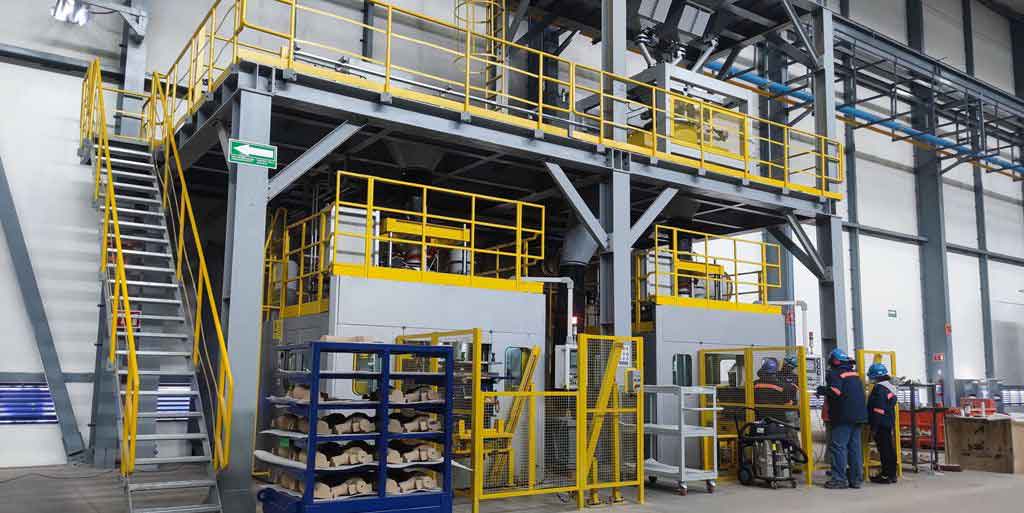
This equipment is essential for producing high-quality steel casting components, ensuring they meet the rigorous demands of high-speed train applications. In contrast, carbon-ceramic discs are fabricated via chemical vapor infiltration and other advanced methods, resulting in lighter weight and better thermal stability.
From the simulation results, the temperature evolution on the friction surfaces reveals distinct behaviors. For carbon-ceramic brake discs at 400 km/h initial speed, the peak temperature occurs at approximately 86.3 seconds, reaching 1098.56 K. The temperature rise follows a curve described by the heat input-output balance, with an initial rapid increase due to high friction heat generation. The rate changes around 60 seconds due to deceleration variation, modeled by a piecewise function. Mathematically, the temperature trend can be approximated by integrating the heat equation with time-varying boundary conditions. For steel casting brake discs under the same conditions, the peak temperature is lower at 1019.26 K but occurs earlier at 73 seconds. This indicates faster heat accumulation in steel casting, potentially leading to higher thermal gradients. The temperature distribution across the disc surface is more uniform in carbon-ceramic discs, thanks to their superior thermal conductivity and fin design, whereas steel casting discs show radial temperature increases with larger gradients.
To quantify the differences, we compare key metrics in a table below. The data underscores the advantages of carbon-ceramic in delaying peak temperature and reducing gradients, which is crucial for preventing thermal cracks. However, steel casting discs, despite their limitations, remain cost-effective for lower-speed applications.
| Brake Disc Type | Initial Speed (km/h) | Peak Temperature (K) | Time to Peak (s) | Average Surface Temperature at End (K) |
|---|---|---|---|---|
| Carbon-Ceramic | 400 | 1098.56 | 86.3 | ~850 |
| Steel Casting | 400 | 1019.26 | 73.0 | ~700 |
| Carbon-Ceramic | 300 | ~1050 | ~80 | ~800 |
| Steel Casting | 300 | ~950 | ~65 | ~650 |
The temperature distribution on the friction surface can be modeled using a radial function. For a disc with radius \( r \), the temperature \( T(r, t) \) satisfies the heat equation in cylindrical coordinates. Under simplifying assumptions, a steady-state approximation yields:
$$ T(r) = T_0 + \frac{q_g}{4k} (R^2 – r^2) $$
where \( T_0 \) is the center temperature, \( q_g \) is heat generation per unit volume, \( k \) is thermal conductivity, and \( R \) is outer radius. For steel casting, lower \( k \) values result in steeper gradients, as observed in simulations. The convective cooling on the surface adds complexity, with the heat transfer coefficient \( h_c \) varying with air velocity \( v \), approximated by empirical correlations like \( h_c \propto v^{0.8} \) for turbulent flow. During braking, \( v \) decreases linearly with time, affecting dissipation rates.
The impact on the surrounding air domain is significant, especially for carbon-ceramic discs. The fluid-solid-thermal coupling simulation shows that carbon-ceramic brake discs cause more pronounced temperature rises in the air, with hotspots forming in vortices near the disc. The maximum temperature difference in the air domain between carbon-ceramic and steel casting discs can reach 210 K, particularly above the disc. This poses thermal safety risks in the bogie area, as elevated air temperatures may affect nearby components. The air temperature evolution follows the energy equation for fluid flow:
$$ \rho_f C_f \left( \frac{\partial T_f}{\partial t} + \mathbf{u} \cdot \nabla T_f \right) = \nabla \cdot (k_f \nabla T_f) + S $$
where \( \rho_f \) is air density, \( C_f \) is specific heat, \( \mathbf{u} \) is velocity vector, \( k_f \) is thermal conductivity, and \( S \) is source term from disc heating. The simulation captures this coupled behavior, revealing that steel casting discs, while generating lower air temperatures, still contribute to localized heating. The manufacturing process for steel casting involves careful control of cooling rates to avoid defects that could exacerbate thermal issues during braking.
Bench tests were conducted to validate the simulation results. For steel casting brake discs, a 1:1 inertia test bench measured temperatures using embedded thermocouples. At 300 km/h emergency braking, the average surface temperature reached 779.90 K, closely matching simulation predictions. The temperature data over time \( t \) can be fitted to an exponential rise function:
$$ T(t) = T_{\infty} – (T_{\infty} – T_0) e^{-\alpha t} $$
where \( T_{\infty} \) is steady-state temperature, \( T_0 \) is initial temperature, and \( \alpha \) is a decay constant dependent on material properties and cooling conditions. For steel casting, \( \alpha \) is higher due to faster heat conduction, leading to quicker temperature drops post-braking. The carbon-ceramic disc tests at 400 km/h common braking conditions showed a peak temperature of 1094.7 K, aligning with simulation trends. The validation confirms the accuracy of the fluid-solid-thermal coupling model, enabling reliable predictions for future designs.
In discussion, the superior thermal performance of carbon-ceramic brake discs is attributed to their material composition and structural design. The high thermal conductivity and specific heat capacity allow for efficient heat distribution, minimizing thermal stresses. In contrast, steel casting brake discs, while robust, suffer from lower thermal conductivity, causing localized hotspots and potential crack initiation. The heat dissipation rate \( \dot{Q} \) can be expressed as:
$$ \dot{Q} = h_c A \Delta T + \frac{k A \Delta T}{L} $$
for combined convection and conduction, where \( A \) is surface area and \( L \) is characteristic length. For steel casting, the conduction term is smaller due to lower \( k \), relying more on convection, which diminishes at lower speeds. This makes steel casting less suitable for extreme braking scenarios. However, steel casting remains prevalent in many industries due to its cost-effectiveness and ease of fabrication. The thermal fatigue life of brake discs can be estimated using Coffin-Manson relation:
$$ N_f = C (\Delta \epsilon_p)^{-m} $$
where \( N_f \) is cycles to failure, \( \Delta \epsilon_p \) is plastic strain range, and \( C, m \) are material constants. For steel casting, thermal cycling during braking induces strains that reduce \( N_f \), whereas carbon-ceramic’s resilience extends service life.
The implications for high-speed train design are profound. Using carbon-ceramic brake discs can enhance safety by reducing thermal gradients and peak temperatures, but it requires careful consideration of the surrounding thermal environment. Steel casting brake discs, if used, must be optimized through material enhancements, such as alloying or improved fin geometries, to withstand higher speeds. Future research could integrate direct frictional contact modeling for even greater accuracy. In conclusion, this study demonstrates that carbon-ceramic brake discs offer better thermal dissipation performance compared to steel casting discs under 400 km/h braking conditions, though they impose greater thermal loads on the air domain. The fluid-solid-thermal coupling approach provides a robust tool for evaluating brake disc designs, ensuring the safety and efficiency of next-generation high-speed trains.
To further elaborate, the thermal management in braking systems involves complex interactions. For steel casting brake discs, the heat flux during braking can be calculated from the frictional power:
$$ q_f = \mu p v $$
where \( \mu \) is friction coefficient, \( p \) is pressure, and \( v \) is sliding velocity. This heat flux is applied as a boundary condition in simulations. Over time, the temperature rise \( \Delta T \) in the disc volume \( V \) is given by:
$$ \Delta T = \frac{1}{\rho_m C V} \int q_f \, dt $$
For steel casting, with lower \( C \), \( \Delta T \) rises faster, explaining the earlier peak. The cooling fins enhance convection; their effectiveness \( \eta_f \) can be modeled using fin theory:
$$ \eta_f = \frac{\tanh(m L_f)}{m L_f} $$
where \( m = \sqrt{h_c P / (k A_c)} \), \( P \) is perimeter, \( A_c \) is cross-sectional area, and \( L_f \) is fin length. Steel casting fins, being cylindrical, have different \( \eta_f \) compared to carbon-ceramic’s radial fins, affecting overall dissipation. The manufacturing of steel casting components often involves processes like sand casting or investment casting, which can introduce microstructural variations impacting thermal properties. Therefore, quality control in steel casting is essential for consistent performance.
In summary, this comprehensive analysis highlights the trade-offs between carbon-ceramic and steel casting brake discs. While carbon-ceramic excels in thermal uniformity and peak temperature delay, steel casting offers economic advantages but requires design modifications for high-speed applications. The integration of advanced simulation methods and bench testing ensures reliable predictions, paving the way for safer and more efficient high-speed rail systems.