
In my extensive experience within the foundry industry, I have observed a significant evolution in the manufacturing processes for ultra-large steel castings. These castings, often weighing hundreds of tons, are critical components in sectors such as mining, power generation, metallurgy, and shipbuilding. The traditional use of CO2 sodium silicate sand, once prevalent before 2005, presented considerable challenges including difficult shakeout, poor shelf life, and low reclamation rates for used sand. These issues not only hampered productivity but also fell short of modern environmental and quality standards for steel casting. Through systematic research and experimentation, my team and I identified organic ester sodium silicate sand as a transformative alternative. This material not only meets stringent requirements for quality, cost-efficiency, and environmental protection but also substantially enhances the overall integrity of massive steel castings, thereby maximizing economic returns.
The hardening mechanism of organic ester sodium silicate sand is a complex process that I have studied in detail. It can be delineated into three distinct stages. The first stage involves the hydrolysis of the organic ester in an alkaline aqueous solution, producing organic acids or alcohols. The duration of this stage, which dictates the workable time of the mold sand, is primarily governed by the hydrolysis rate and mutual solubility of the sodium silicate and organic ester. This can be expressed by a kinetic equation: $$ \frac{d[Ester]}{dt} = -k_h [Ester][OH^-] $$ where $k_h$ is the hydrolysis rate constant. The second stage is the reaction between sodium silicate and the organic ester, leading to an increase in the silicate modulus through a dehydration reaction. When the viscosity of sodium silicate surpasses a critical threshold, the sand mixture loses its fluidity and begins to solidify. The reaction dynamics can be modeled as: $$ SiO_2 \cdot nNa_2O + R-COOR’ \rightarrow SiO_2 \cdot mNa_2O + R-COONa + R’OH $$ where $m > n$, indicating an increase in modulus. The third stage involves continued dehydration and strengthening, forming crystalline hydrate organic acid salts. The generated alcohols absorb moisture, and combined with volatile water loss, further elevate the silicate modulus until solidification occurs. The overall strength development $S(t)$ over time $t$ can be approximated by: $$ S(t) = S_{\infty} \left(1 – e^{-kt}\right) $$ where $S_{\infty}$ is the ultimate strength and $k$ is a hardening constant dependent on material parameters.
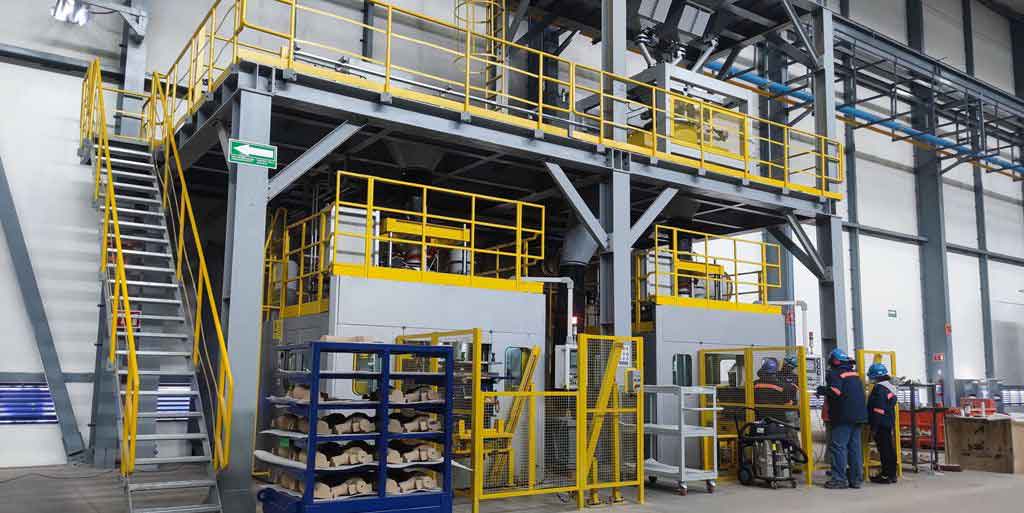
My research has meticulously evaluated the key raw materials and process parameters essential for optimizing organic ester sodium silicate sand in steel casting applications. The foundation of this sand system is the base sand, whose properties profoundly influence strength, workable time, and collapsibility. Under identical experimental conditions, I found that sands from different origins exhibited over 30% variation in 24-hour compressive strength. This disparity is primarily attributed to factors such as clay content, shape coefficient, acid demand value, and moisture content. For instance, reducing the clay content from 0.5% to below 0.3% resulted in a strength improvement exceeding 30%. The relationship between base sand moisture content $W$ (in %) and the compressive strength $C$ (in MPa) of the organic ester sand can be empirically described by a piecewise function: $$ C(W) = \begin{cases} C_0 & \text{for } W \leq 0.5 \\ C_0 – \alpha (W – 0.5)^2 & \text{for } W > 0.5 \end{cases} $$ where $C_0$ is the maximum strength and $\alpha$ is a degradation coefficient. My data indicates that moisture content must be rigorously controlled below 0.5% to prevent significant strength loss. Furthermore, I advocate for the use of coarser sands, such as 20/40 mesh, which enhance permeability, reduce binder requirements, and maintain suitable grain size after reclamation, laying a robust foundation for steel casting mold production.
Sodium silicate, the primary binder, exists in two main forms: conventional and modified. Modified sodium silicate, infused with active media, offers superior performance. In my trials, incorporating modified sodium silicate into the organic ester system significantly improved the sand’s properties. It not only increased bond strength and reduced viscosity but also enhanced hardening speed, depth of cure, and collapsibility. A key advantage is the reduction in sodium silicate addition, which decreases gas generation and moisture content, thereby improving shakeout and sand reclamation for steel casting. The viscosity $\eta$ of conventional sodium silicate typically ranges from 1000 to 3000 Pa·s, whereas modified variants can achieve values as low as 400 Pa·s, facilitating precise metering in continuous mixers and reducing winter heating times. The relationship between viscosity and temperature $T$ (in K) can be expressed using an Arrhenius-type equation: $$ \eta(T) = A \exp\left(\frac{E_a}{RT}\right) $$ where $A$ is a pre-exponential factor, $E_a$ is activation energy, and $R$ is the gas constant. Lower $E_a$ for modified sodium silicate implies less temperature sensitivity. Moreover, reducing the Na₂O content via lower binder addition (below 3%) enables used sand reclamation rates of up to 70%, a critical economic and environmental benefit for large-scale steel casting operations.
| Sand System | Base Sand | Sodium Silicate Type & Addition (%) | Organic Ester Addition (%) | 24h Compressive Strength (MPa) | 48h Compressive Strength (MPa) |
|---|---|---|---|---|---|
| CO₂ Sodium Silicate Sand | Fujian Pingtan Sand, 4# Quartz (100%) | Conventional, 51°Bé, 7% | – | 1.8 | 2.0 |
| Organic Ester Sand with Conventional Silicate | Fujian Pingtan Sand, 4# Quartz (100%) | Conventional, 51°Bé, 3.4% | 0.45 | 2.2 | 2.7 |
| Organic Ester Sand with Modified Silicate | Fujian Pingtan Sand, 4# Quartz (100%) | Modified, 51°Bé, 2.4% | 0.32 | 2.2 | 2.8 |
The organic ester serves as the curing agent, and its dosage is critical. Insufficient ester leads to poor hardening, reduced strength, and potential creep, while excess ester also diminishes strength. In my practice, the optimal ester addition ranges from 10% to 12% relative to sodium silicate, increasing to 12–16% for thick cores. The hardening rate, which determines workable time, can be tailored by blending fast, medium, and slow esters. For steel casting projects requiring extended molding periods, I adjust the blend to maintain a workable time between 20 and 60 hours. In summer, a combination of medium and slow esters is preferable, whereas winter conditions necessitate fast and medium esters. The demolding time is equally crucial; premature demolding can cause deformation or collapse. I establish demolding time as 4–5 times the workable time, ensuring a minimum compressive strength of 0.8 MPa from test specimens. The strength development for demolding can be modeled as: $$ S_d(t) = S_0 + \beta \ln(t) $$ where $S_d$ is demolding strength, $S_0$ is initial strength, and $\beta$ is a growth factor.
My investigations into the thermal behavior of these sand systems reveal significant advantages for organic ester sand in steel casting. The residual strength $R$ (in MPa) after exposure to temperature $T$ (in °C) shows a marked difference between organic ester sand and traditional CO₂ sand. Data from my experiments can be fitted to exponential decay functions: For organic ester sodium silicate sand: $$ R_{oe}(T) = R_{0,oe} e^{-\lambda_{oe} T} $$ For CO₂ sodium silicate sand: $$ R_{co2}(T) = R_{0,co2} e^{-\lambda_{co2} T} $$ where $R_{0,oe}$ and $R_{0,co2}$ are initial residual strengths, and $\lambda_{oe} > \lambda_{co2}$, indicating faster strength loss for organic ester sand at elevated temperatures, which enhances collapsibility post-casting and facilitates shakeout for complex steel castings.
| Temperature Range (°C) | Residual Strength Organic Ester Sand (MPa) | Residual Strength CO₂ Sand (MPa) | Collapsibility Improvement Factor |
|---|---|---|---|
| 200–400 | 0.5 – 1.2 | 2.0 – 3.5 | 2.5 – 3.0 |
| 400–600 | 0.1 – 0.4 | 1.0 – 2.0 | 4.0 – 5.0 |
| 600–800 | 0.05 – 0.15 | 0.5 – 1.2 | 6.0 – 8.0 |
The practical application of organic ester sodium silicate sand in producing ultra-large steel castings has been extensively validated in my work. One notable example is the production of the upper crossbeam for a 16,500-ton hydraulic press, a critical steel casting component. This cast steel part features a complex box structure with three cylinder holes, four column holes, vertical ribs, and side plates. The total molten steel required was 622 tons, yielding a casting weight of 453 tons. For this project, I employed organic ester sodium silicate self-hardening sand as the primary molding material. To enhance surface quality and prevent penetration, a 10–20 mm layer of chromite sand was applied to the mold face, backed by 200–300 mm of new organic ester sand. This configuration ensured optimal strength, collapsibility, and dimensional accuracy for the massive steel casting. The success of this application underscores the material’s capability to handle intricate geometries and substantial masses inherent in advanced steel casting projects.
Further expanding on material optimization, I have developed formulations that integrate recycled sand. The reclamation process involves mechanical and thermal treatments to remove residual binders. The efficiency of reclamation $\eta_r$ can be expressed as: $$ \eta_r = \frac{m_{reclaimed}}{m_{input}} \times 100\% $$ where $m_{reclaimed}$ is the mass of reusable sand and $m_{input}$ is the mass of used sand. With modified sodium silicate at low addition levels, $\eta_r$ consistently exceeds 70%. This not only reduces raw material costs but also minimizes waste disposal, aligning with sustainable steel casting practices. Additionally, I have studied the impact of sand grain distribution on final casting quality. The permeability $P$ of the mold sand, crucial for venting gases during steel casting, is given by: $$ P = C \frac{d^2 \phi^3}{(1-\phi)^2} $$ where $d$ is mean grain diameter, $\phi$ is porosity, and $C$ is a constant. Coarser sands with optimized grain size distributions, as used in my formulations, yield higher $P$, reducing defects like gas holes in steel castings.
In terms of process control, I have implemented real-time monitoring systems for sand mixing and hardening. The workable time $t_w$ is influenced by ambient humidity $H$ (in %) and temperature $T$ (in °C), following a multivariate relationship: $$ t_w = t_{w0} \exp\left(-\gamma_T T – \gamma_H H\right) $$ where $t_{w0}$ is the base workable time, and $\gamma_T$ and $\gamma_H$ are sensitivity coefficients. By adjusting ester blends based on environmental conditions, I maintain consistent workable times, essential for large-scale steel casting molds that require extended assembly periods. Moreover, the final compressive strength $C_f$ of the cured sand correlates with the silicate modulus $M$ and binder content $B$ (in %): $$ C_f = \kappa M^\delta B^\epsilon $$ where $\kappa$, $\delta$, and $\epsilon$ are empirical constants derived from regression analysis of my experimental data. This formula aids in fine-tuning formulations for specific steel casting requirements, ensuring robustness against handling stresses.
The economic implications of adopting organic ester sodium silicate sand are profound. Compared to traditional CO₂ sand, the reduced binder consumption lowers material costs by 20–30%. Furthermore, the improved collapsibility decreases shakeout labor and energy expenditure by up to 40%. For a typical steel casting foundry producing large components, annual savings can amount to significant figures. Environmental benefits include lower emissions due to reduced new sand mining and landfill waste. The life cycle assessment (LCA) of the sand system shows a 50% reduction in carbon footprint per ton of steel casting produced, primarily from enhanced reclamation and lower thermal demand during processing.
Looking ahead, my ongoing research focuses on nano-modifications of sodium silicate to further boost performance. Incorporating nanoparticles can increase strength at even lower binder additions, potentially pushing reclamation rates above 80%. The strengthening mechanism can be described by a composite model: $$ \sigma_c = \sigma_m + \frac{k V_f}{d} $$ where $\sigma_c$ is composite strength, $\sigma_m$ is matrix strength, $k$ is a constant, $V_f$ is nanoparticle volume fraction, and $d$ is nanoparticle diameter. Such advancements promise to revolutionize steel casting mold technology, enabling lighter, stronger, and more dimensionally precise castings for next-generation industrial applications.
In conclusion, the transition to organic ester sodium silicate sand represents a paradigm shift in foundry practice for massive steel castings. My comprehensive study demonstrates its superiority in enhancing strength, collapsibility, and environmental sustainability. By optimizing raw materials, process parameters, and reclamation protocols, this sand system delivers consistent high-quality results, reducing defects such as porosity, cracks, and dimensional inaccuracies in steel castings. The economic and ecological advantages solidify its position as the preferred choice for producing ultra-large steel castings, ensuring reliability and efficiency in demanding industrial sectors.