
The global pursuit of sustainable and low-carbon energy sources has positioned nuclear power as a critical component of the future energy mix. Over the past six decades, nuclear technology has evolved through several generations, culminating in advanced designs like pressurized water reactors (PWRs), which prioritize both efficiency and inherent safety. As a nation committed to energy security and environmental goals such as carbon neutrality, China has witnessed a remarkable acceleration in its nuclear power program. This rapid expansion has necessitated a parallel and intensive effort in the domestic manufacturing of critical nuclear island components. Among these, steel casting plays a pivotal role, as it is the preferred and often only feasible manufacturing method for large, complex-shaped components that must withstand the extreme operating conditions within the reactor coolant system. The journey towards the localization of Nuclear Class 1 steel castings—components whose failure could directly lead to a radiological release—represents a significant chapter in China’s advanced manufacturing history.
The nuclear island of a PWR is its heart, housing the reactor vessel and the primary coolant system. The integrity of this system is paramount. Components here are subject to high pressure, high temperature, corrosive coolant, and intense neutron irradiation over decades of operation. Consequently, the steel casting for these applications must meet phenomenally stringent quality standards, far exceeding those for conventional industrial castings. These standards, historically based on foreign codes like France’s RCC-M or the American ASME BPVC, dictate rigorous material specifications, non-destructive examination (NDE) requirements, and performance criteria. The primary challenge stems from the material of choice: austenitic or austenitic-ferritic stainless steels. While offering excellent corrosion resistance and toughness, these alloys possess a wide solidification range, leading to a “mushy” or pasty mode of solidification. This characteristic makes them highly prone to formation of shrinkage porosity and hot tears, presenting formidable obstacles for producing sound, heavy-section steel casting. For years, this technological barrier meant reliance on imports, creating supply chain vulnerabilities. This article, from my perspective as an engineer involved in this field, details the research, development, and eventual industrialization of these critical steel casting components in China.
The Pantheon of Nuclear Class 1 Steel Castings
The primary coolant system relies on several key cast components. Each represents a unique set of material and geometrical challenges.
| Component | Primary Function | Key Technical Challenge | Applicable Standards (Historically) |
|---|---|---|---|
| Primary Coolant Pipe (Piping & Elbows) | Circulates pressurized, heated coolant between reactor, steam generator, and pumps. | Long, thick-walled centrifugal casting; shrinkage in heavy-section sand cast elbows. | RCC-M |
| Primary Coolant Pump Casing | Houses the pump impeller; contains the pressurized primary coolant. | Extremely heavy sections (>400mm); volumetric soundness under 100% NDE. | RCC-M, ASME |
| Squib Valve Body | Provides passive safety function; houses explosive charge to open flow path during accidents. | Zero-repair policy; soundness in complex, thick sections. | ASME |
| Pump Guide Vane & Impeller | Directs flow and imparts kinetic energy to the coolant. | Complex aerofoil shapes; dimensional accuracy; crack prevention in martensitic stainless. | RCC-M |
| Fuel Assembly Nozzles (Upper/Lower) | Supports and positions fuel rods within the reactor core. | Precision investment casting of complex lattice structures; thin sections. | RCC-M |
Material Science Foundation: The Stainless Steel Conundrum
The performance of a steel casting begins with its chemistry. Nuclear-grade stainless steels are meticulously engineered. For primary circuit components, the base is often a low-carbon 18-8 type stainless (e.g., 304L), but modified to include a controlled ferrite content. This dual-phase austenitic-ferritic (duplex) microstructure is crucial. The ferrite phase, typically specified between 8-20% depending on the standard, enhances yield strength and improves resistance to stress corrosion cracking. Perhaps most importantly for fabrication, it improves weldability, often eliminating the need for post-weld heat treatment—a significant advantage for onsite construction and repair.
The fundamental challenge in casting these alloys can be understood through solidification theory. Unlike plain carbon steels that solidify over a narrow temperature range, stainless steels have a broad solidification interval, $\Delta T_f = T_l – T_s$, where $T_l$ is the liquidus and $T_s$ is the solidus temperature. During cooling, a large mushy zone exists where solid and liquid coexist. Feeding of shrinkage through this tortuous, dendritic network becomes extremely difficult, leading to internal microporosity. The susceptibility to shrinkage, $S$, can be conceptually related to the alloy’s characteristics:
$$ S \propto \frac{\Delta T_f \cdot \beta_v}{K_{mushy}} $$
where $\beta_v$ is the volumetric shrinkage coefficient and $K_{mushy}$ is the permeability of the mushy zone, which is itself a complex function of dendrite arm spacing. This explains why achieving radiographically sound steel casting in sections exceeding 200mm is a monumental task in process design.
| Component (Typical Material) | C (max) | Cr | Ni | Mo | Other | Key Feature |
|---|---|---|---|---|---|---|
| Primary Pipe (Z3CN20-09M) | 0.040 | 19.0-21.0 | 8.0-11.0 | – | Co ≤0.20 | Controlled ferrite (~15-18%) |
| AP1000 Pump Casing (CF8A) | 0.08 | 18.0-21.0 | 8.0-11.0 | ≤0.5 | Co ≤0.05 | Low Cobalt for activation control |
| Squib Valve Body (CF8M variant) | 0.03 | 17.0-21.0 | 9.0-13.0 | 2.0-3.0 | Co ≤0.20 | Added Mo for pitting resistance |
| Pump Impeller (CA6NM type) | ~0.06 | ~13.0 | ~4.0 | ~0.5 | Martensitic structure | High strength, requires PWHT |
The Development Saga of Critical Components
1. Primary Coolant Pipe: The Aortic Arch
The casting of primary pipe loops for second-generation PWRs (like CPR1000/CNP1000) was a landmark achievement. Each loop consists of hot leg, cold leg, and crossover leg segments, fabricated by welding centrifugal-cast straight pipes to statically-cast elbows.
The Straight Pipe: Centrifugal Mastery. Producing a ~7-meter long, ~120mm thick stainless pipe via horizontal centrifugal casting is a feat of process control. The key is to balance forces to avoid defects like banding or segregation while ensuring directional solidification from the outer diameter inwards. Critical parameters form a complex interdependence:
$$ G \cdot v = \text{Constant} $$
where $G$ is the thermal gradient and $v$ is the growth velocity, which is controlled by mold rotation speed $\omega$, superheat $\Delta T_{sup}$, and mold coating properties. The rotation speed must generate a centrifugal acceleration ($g$-level) sufficient for soundness but avoid turbulence. Domestic manufacturers developed proprietary models for this, often expressed as:
$$ \omega = k \cdot \sqrt{\frac{g}{R}} $$
where $R$ is the internal radius of the pipe and $k$ is an empirical factor accounting for metal fluidity and section thickness. The resulting microstructure shows a fine, equiaxed outer zone transitioning to a columnar structure, free of the gross shrinkage that would plague a static steel casting of similar proportions.
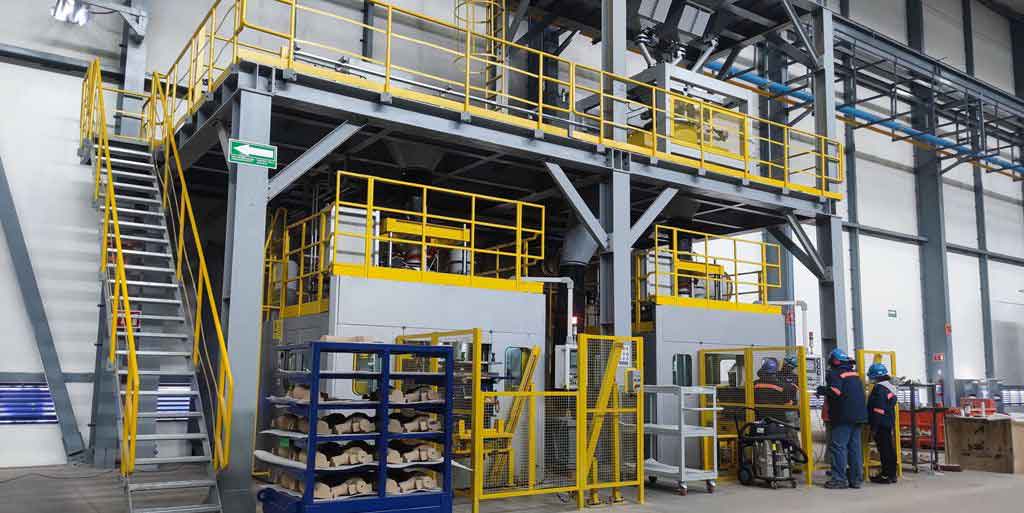
The 90° Elbow: The Shrinkage Battle. The static casting of a 5-ton, 31-inch diameter elbow with sections over 140mm thick was the true crucible of skill. Here, the art and science of feeding design is paramount. The goal is to establish a strong thermal gradient toward the feeder (riser). The efficacy of a riser, according to the Chvorinov rule, is governed by its modulus, $M = V/A$ (Volume/Surface Area), which must exceed that of the casting section it feeds. For complex geometries like an elbow, this is achieved through strategic placement of multiple risers—top risers on the outer curve and often extensive use of internal chills or cooling fins on the thick inner curve to promote directional solidification. The choice of sand binder system (furan resin vs. sodium silicate) also became a point of competitive differentiation, affecting collapsibility, surface finish, and ultimately, the amount of post-casting weld repair needed.
2. Primary Coolant Pump Casing: The Heart’s Chamber
As the pressure boundary housing the rotating assembly, the pump casing is arguably the most demanding large steel casting in the nuclear island. Its shape is a complex pressure vessel with numerous nozzles and a massive sectional thickness exceeding 400mm at the suction and discharge volutes.
The core problem remains the mitigation of centerline shrinkage in these ultra-heavy sections. Beyond modulus calculations, advanced simulation software became indispensable for predicting hot spots and optimizing feeder placement. However, simulation alone is not enough. The practical solution involves a combination of:
- Massive Feeder Networks: Using multiple large top risers and neck-down side risers to create dominant thermal sinks.
- Exothermic Riser Liners: To prolong feeding capability by keeping the riser metal liquid longer than predicted by sand alone.
- Controlled Cooling: Managing the cooling curve through the solidification range to minimize thermal stress and hot tearing, often approximated by controlling the cooling rate parameter:
$$ \frac{dT}{dt} \approx \frac{T_p – T_s}{t_{solid}} $$
where $T_p$ is the pouring temperature and $t_{solid}$ is the total solidification time.
A persistent challenge that emerged during industrialization was surface pinhole defects, likely due to mold-metal interface reactions with the resin binder. Solving this required meticulous control of sand moisture, binder ratios, and mold coating formulations—a testament to the holistic systems approach needed for nuclear-grade steel casting.
3. Squib Valve Body: Zero-Defect Mandate
Introduced with the AP1000 design, the squib valve body presents a unique challenge: it must be produced to ASME B&PV Code Section III, Class 1 standards with a “no repair” policy for critical areas. This means the as-cast quality must be essentially perfect. The component, though smaller (3-4 tons), has intersecting bores creating isolated hot spots up to 380mm thick.
The development strategy here pushed foundries to the极限 of process control. It involved:
- Ultra-Rigorous Gating and Feeding: Using computer simulation iteratively to design a system that guarantees sequential solidification from the casting extremities back to the massive feeders.
- Premium Molding Practices: Employing high-purity silica sand, controlled resin chemistry, and specialized refractory coatings to minimize surface defects at source.
- Process Stability: Every variable—from charge makeup and melt oxidation (controlled by the Al activity) to pouring temperature and time—was locked down into a strict process qualification protocol.
$$ [O]_{melt} + [Al] \rightleftharpoons (Al_2O_3) $$
Maintaining a low oxygen potential was critical to minimize oxide inclusions that could serve as nucleation sites for porosity.
The successful serial production of these valves demonstrated that zero-repair steel casting for nuclear service was achievable with extreme discipline.
4. Other Critical Castings: Precision and Specialization
The pump impeller and guide vanes, typically cast in martensitic stainless steel (e.g., CA6NM), present different challenges. High strength is achieved through a quench-and-temper heat treatment after casting. The risk here is casting cracks due to the high hardenability and transformation stresses. This necessitates careful design of filleting, use of compliant core materials, and controlled cooling in the mold. The advent of 3D sand printing technology has been transformative for these parts, allowing for the precise, integral fabrication of complex internal flow passages that were previously impossible or prohibitively expensive with conventional core-making.
The development of investment-cast fuel assembly nozzles to replace machined forgings is a compelling case of value engineering. The investment casting process allows the near-net-shape production of the intricate lattice structure, saving enormous amounts of material and machining time. The challenge shifts to dimensional consistency, thin-wall integrity, and ensuring the fine surface finish required for hydraulic performance. Process control focuses on precise shell building, controlled pouring, and minimizing metal-ceramic interactions.
Industrialization and Future Outlook
The collective R&D efforts of domestic enterprises have culminated in a robust, industrialized supply chain for Nuclear Class 1 steel casting. Multiple Chinese foundries now hold the necessary regulatory certifications (N-stamp from the National Nuclear Safety Administration) and have supplied components for virtually all domestic PWR projects, from CPR1000 to Hualong One. This represents a monumental shift from complete import dependency to self-reliance.
However, the journey is not complete. Several reflective points emerge:
- The Market-Driven Innovation Model: The sheer scale of China’s nuclear new-build program provided the demand that justified the massive private investment in R&D. This underscores the critical link between national energy policy and advanced manufacturing capability.
- The “Tacit Knowledge” Gap: The core of successful steel casting for these components lies in proprietary, experience-based “tacit knowledge”—the nuanced understanding of gating design, slag control, or sand conditioning. This knowledge resides almost exclusively within the manufacturing enterprises, with limited dissemination to academia. Establishing more structured industry-university collaborative R&D centers could accelerate future innovation cycles.
- From Localization to Standardization: True technological leadership requires moving beyond manufacturing to foreign designs and standards. The next frontier is the development of indigenous material databases, lifetime performance models, and ultimately, China’s own comprehensive nuclear component design and manufacturing codes. This requires deep, fundamental research into the long-term behavior of these steel casting materials under irradiation, thermal aging, and cyclic loading.
- Advanced Process Integration: The future lies in tighter integration of technologies like real-time solidification monitoring (e.g., thermal analysis), AI-driven process optimization, and additive manufacturing for cores and molds. This will push the quality and consistency of nuclear steel casting to even higher levels.
In conclusion, the story of Nuclear Class 1 steel casting development in China is a testament to focused engineering perseverance. It transformed a critical bottleneck into a domain of national strength. The massive, sound pump casings, the intricate valve bodies, and the precisely shaped internals now produced domestically are more than just components; they are symbols of a mature, high-technology industrial base capable of supporting the safe and reliable expansion of nuclear power—a key tool in addressing the dual challenges of energy security and climate change.