
The production of large-scale steel castings, a cornerstone of heavy industry, inherently generates a significant volume of process surplus material. During the foundry process, elements such as feeders (risers), gating systems, and overflows are designed to ensure sound casting integrity. Once their purpose is served, these sections are removed, creating what is commonly termed ‘returns’ or ‘process scrap.’ For high-alloy grades like duplex stainless steels, martensitic and austenitic stainless steels, heat-resistant steels, and nickel-base alloys, these returns represent not just metallic scrap but a concentrated reservoir of valuable and often costly alloying elements—chromium, nickel, molybdenum, tungsten, cobalt, and vanadium. Disposing of this material as waste constitutes a profound economic loss and contradicts sustainable manufacturing principles. Therefore, the systematic classification, rigorous management, and scientifically optimized reintegration of these high-alloy returns into the melting process are critical levers for reducing production costs, conserving strategic resources, and minimizing the environmental footprint of a steel casting foundry.
My experience in managing melting operations has shown that the financial and operational benefits of a robust returns management system are substantial. However, the complexity is high. The improper handling or indiscriminate use of these materials can lead to catastrophic quality issues, such as off-specification chemistry, inclusion formation, or excessive trace element content, resulting in scrapped castings and multiplied costs. This article, from my perspective, delves into the comprehensive strategy for handling these materials, encompassing logistical frameworks, metallurgical guidelines for usage, and the underlying principles that dictate recovery efficiency.
Classification of High-Alloy Steel Casting Returns
The first and most crucial step is precise classification. Returns are not a monolithic category; their characteristics and suitable applications vary dramatically. We categorize them primarily by the alloy family of the original casting and secondarily by their physical form and generation process.
1. By Alloy Family:
- Duplex Stainless Steel Returns: Characterized by high Cr, Ni, and Mo, with a specific phase balance.
- Martensitic Stainless Steel Returns: High in Cr, with moderate Ni and Mo, capable of being hardened by heat treatment.
- Austenitic Stainless Steel Returns: Very high in Cr and Ni, with possible Mo addition, retaining an austenitic structure at room temperature.
- Heat-Resistant Steel Returns: Typically 9-12% Cr steels. We further subdivide:
- 9Cr types (high Cr, Mo, V)
- 9Cr-W types (adds Tungsten)
- 9Cr-Co types (adds Cobalt)
- Nickel-Base Alloy Returns: Exceptionally high in Ni and Cr, often containing Mo, Nb, and other elements.
2. By Physical Form & Generation Process:
- High-Alloy Return Material (Clean Cast Returns): This is the bulk (often >90%) of the surplus, comprising cut-off feeders, gates, and runners. They are relatively clean, dense sections of the original casting.
- High-Alloy Arc Gouging Slag (Type I & II): The oxidized slag produced during thermal cutting (arc gouging). Type I comes from duplex, martensitic, austenitic, and nickel-base alloys. Type II comes specifically from heat-resistant steels. This material is highly oxidized but rich in metallic oxides (Cr2O3, FeO, etc.) and alloy elements.
- High-Alloy Arc Gouging Chips (Type I & II): The metallic chips or spatter generated during arc gouging. The same Type I/II classification applies. They are contaminated with copper from the gouging electrode coating.
- High-Alloy Steel Machining Chips: Swarf generated during final machining of the steel casting. These are finely divided, have a high surface-area-to-volume ratio, and can be contaminated with cutting fluids or other machining debris.
Accurate identification at the point of generation—tagged with the original cast identification number which links to its material specification—is non-negotiable. Visual sorting is unreliable; a formalized material traceability system is required.
The Recovery Management System
A disciplined, process-driven system is essential to prevent cross-contamination and ensure material integrity. The flow, as we have implemented it, is a closed-loop with clear ownership and verification points.
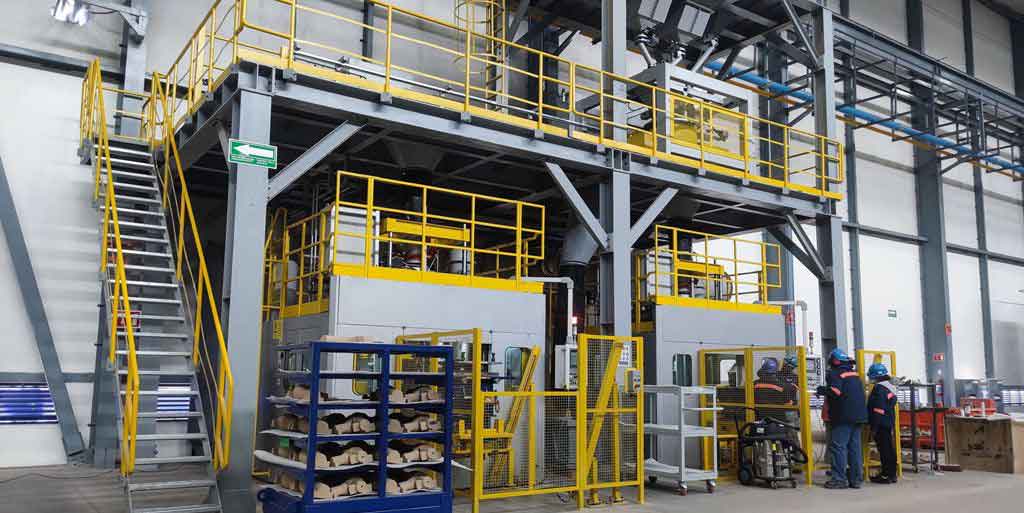
The process begins at the fetting station where surplus material is cut from the steel casting. Immediately, it is placed into designated containers (hoppers, bins) labeled with the cast number. Transportation to the melt shop is segregated. Upon receipt, the melt shop verifies the material against the production record for that cast number, confirming its alloy grade. It is then transferred to a designated storage zone—bulk piles for common grades, dedicated bins for less frequent or “exotic” alloys (e.g., non-magnetic austenitics). Crucially, all non-metallics like refractory brick, ceramic filter tubes, or sand must be removed beforehand. Contaminated returns lead to increased slag volume, refractory wear, and potential inclusion defects in the subsequent steel casting.
Metallurgical Principles for the Utilization of Returns
Simply throwing returns into a furnace is a recipe for inconsistency. Their use must be governed by the chemistry of the target heat and the selected melting practice. The two primary melting routes in steel casting foundries are:
- Oxidation Practice (EAF → Ladle Furnace (LF) → often VOD/VD): Involves an intentional oxidation phase to remove impurities (P, C, gases). Returns are typically added during the reducing phase in the LF or are pre-melted.
- Return (Remelt) Practice: Primarily used in Electric Arc Furnace (EAF) or Induction Furnace melting for similar-grade production. No intentional oxidation occurs, so element recovery is high, but impurity levels (P, trace elements) can only be diluted, not removed.
The recovery yield of an alloy element from a return charge depends on its oxidation affinity, the process atmosphere, and the melting stage of addition. Elements like Nickel (Ni) and Molybdenum (Mo) are relatively noble and have high recovery even under oxidizing conditions. Chromium (Cr) has a strong affinity for oxygen; its recovery plummets if added under an oxidizing slag. The recovery yield $R_{element}$ can be conceptually modeled as a function of process parameters:
$$ R_{M} = k_{M} \cdot f(O_{slag}, T, [C], t) $$
where $R_{M}$ is the recovery rate of element M, $k_{M}$ is a base recovery constant for that element, and the function $f$ accounts for the influence of slag oxidation potential $O_{slag}$, bath temperature $T$, bath carbon content [C], and reaction time $t$. For example, in a reducing ladle furnace slag with high basicity and low FeO, Cr recovery from oxidized slag or returns can be remarkably high via reduction reactions like:
$$ 3(FeO) + 2[Cr] \leftrightarrow (Cr_2O_3) + 3[Fe] \quad \text{(Oxidation of Cr from melt)} $$
$$ (Cr_2O_3) + 3[C] \rightarrow 2[Cr] + 3CO(g) \quad \text{(Reduction of Cr2O3 under reducing conditions)} $$
This principle allows for the strategic use of even oxidized materials.
Application Guidelines and Strategic Usage
The following matrix and discussion outline the strategic use of various return types. The core rule is to match the chemistry of the return to the target steel casting specification, while vigilantly avoiding the introduction of detrimental or超标 elements (e.g., V in non-heat-resistant grades, Cu from gouging chips).
| Return Material Type | Recommended Melting Practice & Use | Key Considerations & Prohibitions | Typical Element Recovery Range* |
|---|---|---|---|
| Duplex Stainless Returns | Primary use in same-grade production. Can be added in LF reducing stage or pre-melted in induction furnace for highest yield. Limited use in other austenitic/martensitic grades with careful Mo calculation. | Prohibit in heat-resistant steel casting. Risk of Mo/Ni carryover. | Cr, Ni, Mo: 95-98% (under reduction) |
| Martensitic Stainless Returns | Suitable for return practice in EAF/Induction for same grade. Can be used in oxidation practice for similar grades with LF addition. | Watch for P build-up in return practice. Prohibit in heat-resistant steel casting (Ni carryover). | Cr, Ni, Mo: 80-90% (return practice); Up to 98% (LF reduction) |
| Austenitic Stainless Returns | Excellent for return practice in same-grade or duplex production. Use with caution in martensitic grades (Ni control). | Prohibit in heat-resistant steel casting (Ni超标). | Cr, Ni, Mo: 95-98% (return/LF reduction) |
| Nickel-Base Returns | Best added under strong reduction (LF) or pre-melted to act as a high-grade Ni/Cr/Mo alloy addition. | Prohibit in heat-resistant steel casting (Ni超标). Invaluable for adjusting chemistry in high-alloy steel casting. | Ni, Cr: 95-98% (under reduction) |
| Heat-Resistant (9Cr, etc.) Returns | Use in return or oxidation practice for same-grade casting. LF addition under reduction for best W/Co/V recovery. | Prohibit in duplex/austenitic/martensitic/nickel-base steel casting (V and W/Co carryover). | Cr, Mo: 80-90% (return); W,Co,V: >95% (LF reduction) |
| Arc Gouging Slag & Chips (Type I) | Can be charged to the EAF during oxidation practice for duplex/austenitic/martensitic grades. Limited quantity. | Control Cu input from chips (<5-10% of charge). Prohibit in heat-resistant/nickel-base grades. | Metallic Yield: 50-70%. Element recovery varies. |
| Arc Gouging Slag & Chips (Type II) | Can be charged to the EAF during oxidation practice for heat-resistant steel grades only. | Prohibit in all other steel casting grades to prevent V contamination. | Metallic Yield: 50-70%. |
| Machining Chips | Best used in small percentages (≤5%) in return practice for similar grades. Add to furnace basket bottom/top. | Prohibit in carbon steel casting (alloy contamination). Must be clean/dry. | Element recovery similar to clean returns if properly melted. |
* Recovery is highly dependent on specific process conditions.
Furnace Charging Strategy
Even within a correct material choice, the physical charging of returns into an EAF impacts efficiency, electrode breakage, and melt-down time. Our standard protocol is:
– Dense, large feeder sections (which are slow to melt) are placed directly under the electrodes in the high-temperature zone.
– Very heavy blocks are placed on the furnace bottom to protect the refractory from dropping charges.
– Smaller runners and lighter returns are placed around the furnace periphery.
– Chips or loose materials are placed on the top of the charge to facilitate early arc stabilization and prevent them from being blown into the offtake system.
– Any material coated with sand or slag is kept away from the electrode arcs to avoid slag splashing and unstable arcs.
Quantifying the Benefit: A Cost-Saving Model
The economic driver for this entire system is the substitution of virgin ferroalloys with recovered elements. The value of a return charge can be approximated by modeling it as an alloy addition. Consider a charge of 10,000 kg of Austenitic Stainless Steel (Type 304) returns being used in a return-practice melt for the same grade. Typical composition: 18% Cr, 8% Ni.
If the recovery rates are $R_{Cr} = 0.96$ and $R_{Ni} = 0.98$, the recoverable mass of each alloy is:
$$ m_{Cr, recovered} = 10,000\,kg \times 0.18 \times 0.96 = 1,728\,kg $$
$$ m_{Ni, recovered} = 10,000\,kg \times 0.08 \times 0.98 = 784\,kg $$
If the market price for High-Carbon Ferrochrome (HC FeCr, ~60% Cr) is $P_{FeCr}$ per kg Cr-unit, and for Nickel is $P_{Ni}$ per kg, the cost saving $S$ from avoided virgin alloy purchase is:
$$ S = (m_{Cr, recovered} \times P_{FeCr}) + (m_{Ni, recovered} \times P_{Ni}) $$
This calculation, while simplified, ignores the intrinsic iron value and processing cost but starkly illustrates the order-of-magnitude savings, especially for Ni, Co, and Mo-bearing returns. For a large steel casting foundry, annual savings can run into millions of dollars.
Conclusion
The production surplus from high-alloy steel casting is a strategic asset, not a liability. Its effective management is a multidimensional challenge requiring tight integration of logistics, metallurgical science, and production planning. From my operational vantage point, the following pillars are non-negotiable for success:
- Uncompromising Classification and Traceability: From the moment the steel casting is separated from its feeding system, material identity must be preserved.
- Process-Disciplined Recovery Workflow: A clear, accountable system for handling, transporting, and storing returns prevents the costly error of material mixing.
- Metallurgically-Guided Utilization: Every addition must be justified by the target chemistry and the selected melting route. Knowledge of elemental recovery mechanisms is key to unlocking value from even oxidized by-products.
- Economic and Environmental Optimization: The system’s ultimate goal is to minimize the consumption of primary, energy-intensive ferroalloys, thereby lowering the cost and carbon footprint of each tonne of liquid steel produced for casting.
By implementing such a holistic approach, a steel casting foundry transforms its waste stream into a primary resource, achieving significant competitive advantage through cost reduction, resource conservation, and enhanced operational sustainability. The discipline required pays for itself many times over, ensuring that every kilogram of alloy poured into a mold yields its maximum potential value.