
In the field of metallurgical engineering, the development of advanced materials for hot rolling rolls is a critical area of study. As a researcher focused on steel castings, I have extensively investigated the potential of alloyed spheroidal graphite cast steel, a unique engineering material that combines the characteristics of high-carbon steel and spheroidal graphite cast iron. This material is particularly promising for hot rolling applications due to its superior mechanical properties, wear resistance, and thermal fatigue performance. In this article, I will delve into the composition, microstructure, properties, and applications of this specialized steel castings, emphasizing its relevance in industrial settings. Throughout this discussion, the term ‘steel castings’ will be frequently referenced to highlight its broad applicability and significance in manufacturing processes.
Hot rolling rolls operate under extreme conditions, directly contacting red-hot steel at temperatures ranging from 1000°C to 1100°C. They are subjected to cyclical mechanical loads, severe wear, and rapid thermal fluctuations, leading to significant thermal fatigue. Therefore, materials for these rolls must exhibit high strength, excellent wear resistance, and robust thermal fatigue resistance. Traditional materials like chilled cast iron, high-chromium cast iron, alloy steel, tool steel, and high-speed steel have been used, but each has limitations such as brittleness, poor machinability, or inadequate adhesion resistance. Semi-steel rolls, popular in the 1970s, offered a balance but suffered from complex production processes and high costs. In contrast, spheroidal graphite cast steel, a type of advanced steel castings, overcomes these drawbacks by integrating the benefits of both steel and cast iron, making it an ideal candidate for hot rolling rolls.
Spheroidal graphite cast steel is essentially an over-eutectoid steel with a carbon content typically between 1.1% and 1.8%, where the microstructure includes spherical graphite particles dispersed in a steel matrix. This is achieved through specific melt treatment during solidification, promoting direct precipitation of graphite spheroids. The resulting steel castings exhibit a hybrid structure: the matrix provides strength and toughness similar to steel, while the graphite particles impart lubrication and anti-galling properties akin to cast iron. This combination allows for tailored properties through alloying and heat treatment, catering to diverse operational demands. The manufacturing process of such steel castings involves careful control of cooling rates and inoculation to ensure uniform graphite distribution, which is crucial for consistent performance.
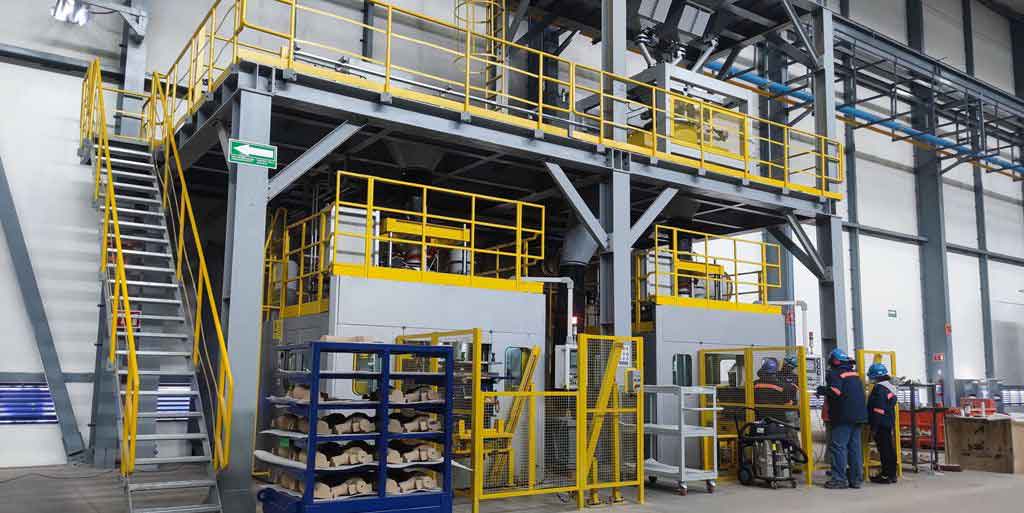
The chemical composition of spheroidal graphite cast steel is fundamental to its properties. Like other steel castings, it primarily consists of Fe, C, Si, and Mn, with S and P considered impurities. Alloying elements such as Cr, Mo, Ni, Cu, V, Ti, and W are added to enhance specific characteristics. Carbon plays a dual role: partially dissolving in the matrix to form carbides and precipitating as graphite spheres. The carbon content directly influences the volume fractions of graphite and carbides, which can be expressed using the following relationship for steel castings: $$V_g + V_c = f(C, T_c)$$ where \(V_g\) is the graphite volume fraction, \(V_c\) is the carbide volume fraction, \(C\) is the carbon content, and \(T_c\) is the cooling rate. Silicon promotes graphite formation by reducing the affinity between iron and carbon, but excessive silicon can embrittle the matrix. Manganese enhances carbide formation, increasing hardness but potentially causing segregation. Chromium strengthens the matrix and boosts carbide content, improving wear resistance, while molybdenum refines grains and enhances thermal stability. Nickel aids graphite uniformity and improves toughness. The synergistic effects of these elements are often leveraged in multi-alloy systems like Cr-Mo or Cr-Mo-Ni to optimize performance. Table 1 summarizes the typical composition ranges for alloyed spheroidal graphite cast steel, highlighting its role as advanced steel castings.
| Element | Range (wt%) | Primary Function |
|---|---|---|
| C | 1.1–1.8 | Forms graphite and carbides for hardness and lubrication |
| Si | 1.0–1.8 | Promotes graphite formation, strengthens matrix |
| Mn | 0.2–1.0 | Enhances carbide formation, increases hardness |
| Cr | 0.3–1.5 | Strengthens matrix, increases carbide content |
| Mo | 0.1–0.3 | Refines grains, improves thermal stability |
| Ni | 0–1.0 | Promotes graphite uniformity, enhances toughness |
| Cu | 0–1.5 | Strengthens matrix, improves wear resistance |
| V, Ti, W | 0–0.5 | Form hard carbides, increase wear resistance |
| S | ≤0.020 | Harmful impurity, kept low |
| P | ≤0.030 | Harmful impurity, kept low |
The microstructure of spheroidal graphite cast steel is critical to its performance. In the as-cast state, it consists of pearlite or sorbitte, carbides, spherical graphite, and a small amount of ferrite surrounding the graphite particles in a “bull’s-eye” pattern. After heat treatment, such as normalizing, the ferrite diminishes, resulting in a matrix of pearlite, graphite, and carbides. The graphite volume fraction is generally less than 2–3%, while carbides range from 1.0% to 2.0%. Carbides exist as particles or blocks, and their distribution must be controlled to avoid网状 networks that degrade toughness. Forging can spheroidize carbides, producing a granular pearlite structure. The stability of carbides at elevated temperatures is vital for thermal fatigue resistance; studies show that even after heating at 500–700°C for several hours, the carbide volume fraction changes minimally, as indicated in Table 2. This stability is a key advantage of these steel castings in hot working environments.
| Heating Temperature (°C) | 2 h | 3 h | 4 h | 5 h | 6 h |
|---|---|---|---|---|---|
| 500 | 1.26% | 1.38% | 1.16% | 0.98% | 1.24% |
| 600 | 1.13% | 1.24% | 1.10% | 1.03% | 1.12% |
| 700 | 1.13% | 1.35% | 1.19% | 1.07% | 1.19% |
Mechanical properties of spheroidal graphite cast steel bridge those of cast steel and cast iron. As-cast or annealed states yield tensile strengths of 550–750 MPa, elongation of 1–6%, and hardness of HB200–390. Alloying and normalizing can enhance these properties; for instance, chromium-alloyed versions achieve tensile strengths up to 850 MPa after normalizing, and with added Mo, Cu, and Ni, strengths reach 900–1000 MPa with impact energy of 15–25 J and hardness of HB300–450. Austempering further improves toughness, with impact energy peaking at 25 J for steels with 3.0% Si treated at 347°C. The relationship between composition and mechanical properties can be modeled for steel castings using empirical formulas: $$\sigma_b = A + B \cdot C + C \cdot Cr + D \cdot Mo$$ where \(\sigma_b\) is tensile strength, and A, B, C, D are constants derived from experimental data. These properties make spheroidal graphite cast steel a versatile material among steel castings for load-bearing applications.
Friction and wear performance are paramount for hot rolling rolls. Spheroidal graphite cast steel exhibits excellent wear resistance due to its unique microstructure: hard carbides act as a supportive skeleton, while graphite particles provide lubrication and anti-adhesion. In rolling operations, graphite smears onto surfaces, reducing sticking between the roll and workpiece. Comparative studies show that rolls made of this material last 2.42 times longer than quenched 65MnMo forged steel rolls, as seen in Table 3. The wear resistance correlates with carbide and graphite volume fractions, as illustrated by the equations: $$W^{-1} = k_1 V_c + k_2 V_g$$ where \(W^{-1}\) is inversely proportional to wear rate, \(V_c\) and \(V_g\) are volume fractions of carbides and graphite, and \(k_1\), \(k_2\) are coefficients. Increasing these fractions boosts wear resistance, but excessive amounts may compromise strength and ductility. Alloying with Cr, Si, and Cu strengthens the matrix, while V, Ti, and W form additional hard carbides. However, balance is crucial to maintain overall toughness in steel castings.
| Material | Roll 1 | Roll 2 | Roll 3 | Roll 4 | Roll 5 | Roll 6 | Roll 7 | Roll 8 | Roll 9 | Roll 10 | Average |
|---|---|---|---|---|---|---|---|---|---|---|---|
| Spheroidal Graphite Cast Steel | 7542 | 7205 | 7334 | 6958 | 7845 | 7634 | 6896 | 7006 | 7437 | 7128 | 7299 |
| Quenched 65MnMo Forged Steel | 3021 | 2896 | 2964 | 3128 | 3135 | 2967 | 3156 | 2790 | 2921 | 3185 | 3016 |
Thermal fatigue resistance is another critical aspect for hot rolling rolls, which undergo cyclic heating and cooling. Spheroidal graphite cast steel outperforms traditional steels like 40CrMo and 70Mn in thermal fatigue tests, with first microcracks appearing after more cycles, as shown in Table 4. The thermal stress developed during cycling can be described by: $$\Delta \sigma = -E \alpha \Delta t$$ where \(\Delta \sigma\) is the thermal stress change, \(E\) is Young’s modulus, \(\alpha\) is the coefficient of thermal expansion, and \(\Delta t\) is the temperature gradient. Graphite particles lower \(E\) and \(\alpha\), while enhancing thermal conductivity, thereby reducing \(\Delta \sigma\). Although graphite can initiate cracks due to interfacial weaknesses, it also blunts crack propagation by dispersing stress at graphite/matrix boundaries. Carbide stability is essential; unstable carbides may decompose into graphite, causing volumetric expansion and increased stress. Alloying elements like C, Si, and Cu improve thermal fatigue resistance by promoting graphite, whereas Cr and Mo enhance carbide stability. Optimal compositions must balance these effects for durable steel castings.
| Material | 800°C to Room Temperature Water Quench | 900°C to Room Temperature Water Quench |
|---|---|---|
| Spheroidal Graphite Cast Steel (Type 1) | 24 | 8 |
| Spheroidal Graphite Cast Steel (Type 2) | 26 | 14 |
| 40CrMo Steel | 11 | 6 |
| 70Mn Steel | 9 | 5 |
Applications of spheroidal graphite cast steel in hot rolling rolls demonstrate its practical benefits. For example, rolls with composition 1.40%C, 1.50%Si, 0.70%Mn, 0.80%Cr, 0.30%Mo achieve tensile strengths of 989 MPa after normalizing. In rolling carbon steel, these steel castings last 5.45 times longer than ZU70Mn steel rolls; for silicon steel, the factor is 2.39 times, as per Table 5. Another case involves wheel rolling rolls, where alloyed spheroidal graphite cast steel replaced 65MnMo forged steel, eliminating frequent breakage and adhesion issues. Guide shoes made from this material outlast quenched 45 steel by 14–20 times, showcasing its versatility. Additionally, these steel castings offer uniform microstructure with minimal hardness variation between surface and core, and shallow crack depths allow for easy refurbishment, extending service life further.
| Roll Material | Rolled Material | Rolling Volume (104 tons) | Roll Consumption (kg/ton billet) |
|---|---|---|---|
| ZU70Mn Steel | Carbon Steel | 1.2 | 0.6432 |
| Spheroidal Graphite Cast Steel | Carbon Steel | 9.0 | 0.1148 |
| ZU70Mn Steel | Silicon Steel | 7.4 | 0.0506 |
| Spheroidal Graphite Cast Steel | Silicon Steel | 15.0 | 0.0213 |
To quantify the performance of steel castings like spheroidal graphite cast steel, various mathematical models can be applied. For wear resistance, the Archard equation is often adapted: $$V = K \frac{F_n L}{H}$$ where \(V\) is wear volume, \(K\) is wear coefficient, \(F_n\) is normal load, \(L\) is sliding distance, and \(H\) is hardness. In this context, \(H\) is influenced by carbide content, and \(K\) is reduced by graphite lubrication. For thermal fatigue, the Coffin-Manson relation is relevant: $$\Delta \epsilon_p = C (N_f)^{-b}$$ where \(\Delta \epsilon_p\) is plastic strain range, \(N_f\) is cycles to failure, and \(C\) and \(b\) are material constants. For spheroidal graphite cast steel, \(\Delta \epsilon_p\) is lowered due to graphite’s stress-relief effect, increasing \(N_f\). These models help optimize the design of steel castings for specific applications.
The future of spheroidal graphite cast steel in hot rolling rolls looks promising. While much research focuses on high-speed steel rolls, this material offers a cost-effective alternative with balanced properties. Its ability to withstand temperatures up to 700°C with stable carbides makes it suitable for demanding environments. Further advancements in alloy design and processing techniques could enhance its performance. For instance, computational methods like CALPHAD can predict phase equilibria, aiding in composition optimization. Additionally, additive manufacturing may enable complex geometries for steel castings, expanding their use. As industries seek durable and efficient materials, spheroidal graphite cast steel stands out as a robust solution among steel castings.
In summary, alloyed spheroidal graphite cast steel represents a significant innovation in the realm of steel castings. Its unique microstructure, combining a steel matrix with spherical graphite and carbides, delivers exceptional mechanical strength, wear resistance, and thermal fatigue resistance. Through careful control of composition and heat treatment, properties can be tailored for hot rolling applications, outperforming traditional materials. The integration of mathematical models and empirical data supports its development and application. As a researcher, I believe that continued exploration of this material will yield even greater benefits for industrial processes, solidifying its role as a key advanced steel castings in metallurgy.