
In my extensive work within the foundry industry, I have dedicated significant effort to exploring and optimizing the V-process casting method for the production of medium and small steel castings used in railway applications. The V-process, or vacuum sealed molding process, is a physical molding technique that utilizes dry sand without any binders. The sand is filled into a flask with a vacuum chamber, compacted via micro-vibration, sealed with a plastic film, and then vacuum is applied. The pressure difference between the inside and outside of the flask imparts strength to the mold, allowing for pattern removal, mold assembly, and pouring while maintaining the vacuum state. This method has gained traction in China for various applications, including large steel castings like railway side frames, couplers, and crossings. However, its application for medium and small steel castings—typically defined as those weighing less than 100 kg—has been limited due to challenges in production efficiency. Through practical experimentation and batch production strategies, I have demonstrated that V-process casting can be economically and environmentally viable for manufacturing high-quality railway steel castings, meeting stringent rail industry standards.
The core advantage of V-process casting lies in its ability to produce steel castings with excellent surface finish, dimensional accuracy, and reduced defects. For railway components, such as bearing adapters, center plates, and other small parts, these qualities are crucial for safety and performance. My focus has been on adapting the V-process for batch production of multiple steel castings per mold, thereby overcoming the inefficiencies associated with single-piece molding. This approach not only enhances productivity but also maintains the inherent benefits of the V-method, such as minimal sand waste and low environmental impact. In this article, I will delve into the detailed process design, parameter optimization, and defect mitigation strategies based on my firsthand experiences, emphasizing the repeated application of this technique for steel castings in the rail sector.
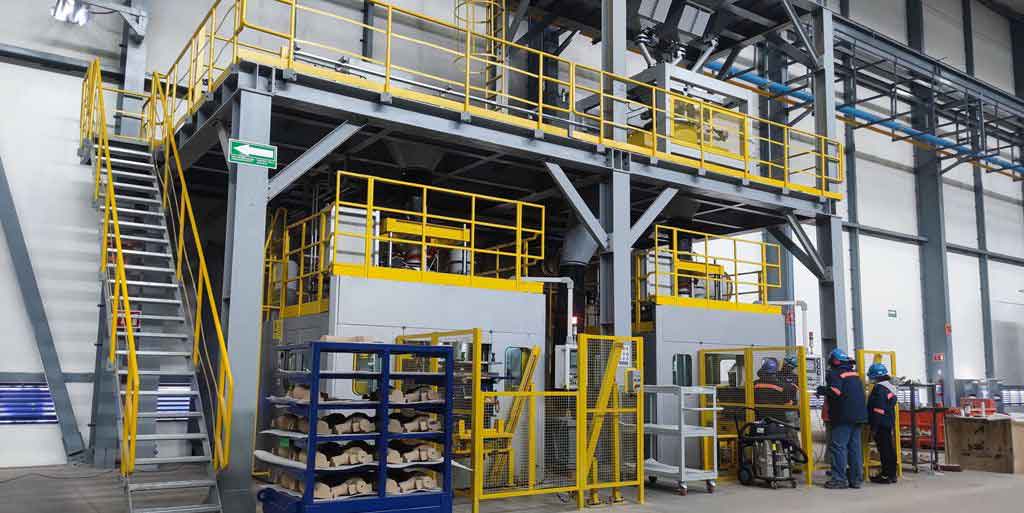
To successfully implement V-process casting for railway steel castings, a comprehensive process design is essential. This encompasses the gating system, pouring techniques, venting arrangements, riser design, sand selection, coating application, and pouring parameters. Each element must be tailored to the unique characteristics of steel castings, which have high melting temperatures and specific solidification behaviors. Below, I outline the key aspects of this design, supported by tables and formulas to summarize critical data.
Firstly, the gating system for V-process steel castings must ensure smooth metal flow, minimize turbulence and oxidation, and facilitate rapid mold filling. I typically employ a bottom-gating system with ceramic sprue tubes. For medium and small steel castings produced in multi-cavity molds, the gating can be designed as open or semi-open systems. The cross-sectional area ratios are crucial: for an open system, the ratio is $$ F_{\text{sprue}} : F_{\text{runner}} : F_{\text{ingate}} = 1 : (1.2 \text{ to } 2) : (1.2 \text{ to } 2) $$, while for a semi-open system, it is $$ F_{\text{sprue}} : F_{\text{runner}} : F_{\text{ingate}} = 1 : (1.2 \text{ to } 1.8) : (1.2 \text{ to } 1.5) $$. These ratios help maintain a filled runner, preventing air entrapment and oxidation in the steel castings. The pouring cup can be integrated using a ceramic cup placed on the sprue and secured with water glass sand or V-process dry sand, followed by film covering. Alternatively, a pre-made cup can be attached after mold stripping, with seals to prevent leakage. The choice depends on the height difference between the ladle and the cup.
For batch production of steel castings, I often utilize “series pouring” and “tilted pouring” techniques. Series pouring involves connecting multiple steel castings in a mold through extended gating channels, where the end of one casting’s gating serves as the ingate for the next. This is feasible due to the light weight and fast filling of small steel castings, and it enhances productivity without compromising quality. Tilted pouring involves elevating one end of the mold after assembly, creating an inclination angle typically between $8^\circ$ and $15^\circ$. This promotes slag and sand removal during pouring, especially for plate-like steel castings, reducing defects like slag inclusions and sand holes. The inclination angle $\theta$ can be calculated based on mold dimensions and riser height: $$ \theta = \tan^{-1}\left(\frac{h}{L}\right) $$ where $h$ is the height difference and $L$ is the mold length. Proper venting is critical in V-process casting, as the sealed mold can trap gases. The total vent cross-sectional area should be 2 to 3 times the ingate area, i.e., $$ A_{\text{vent}} = (2 \text{ to } 3) \times A_{\text{ingate}} $$. Vents are placed at the highest points using open risers, vent risers, or dedicated vent holes.
Riser design in V-process steel castings requires careful attention to ensure feeding and minimize defects. Risers can be attached by film bonding or integrated via one-time film covering. For insulating risers, which are common for steel castings, I recommend increasing their size to account for potential gas and shrinkage defects at the junction. Open risers serve dual purposes of venting and feeding; after pouring, they must be covered with insulating materials and dry sand, then sealed with a back film to maintain vacuum and enhance feeding efficiency. The use of exothermic insulating risers can improve yield but requires precautions: avoid coating the riser film, ensure top sealing for open risers, and delay ignition until steel reaches the riser top. The feeding efficiency can be estimated using Chvorinov’s rule for solidification time: $$ t = k \left( \frac{V}{A} \right)^2 $$ where $t$ is solidification time, $V$ is volume, $A$ is surface area, and $k$ is a constant dependent on mold material. V-process molds have higher $k$ values due to better insulation, leading to slower cooling and improved feeding for steel castings.
The selection of molding sand is pivotal for V-process steel castings. I prefer high-purity quartz sand with SiO$_2$ content above 98% and refractoriness between 1600°C and 1700°C. The sand must have good flowability and uniform grain distribution to achieve high compaction density. The properties of typical sand used for steel castings are summarized in Table 1.
| Parameter | Specification |
|---|---|
| SiO$_2$ Content | > 98% |
| Refractoriness | 1600–1700°C |
| Grain Size Distribution | |
| Bulk Density | 1.5–1.6 g/cm³ |
Coatings play a vital role in V-process casting for steel castings, as they maintain the pressure differential, provide refractoriness, and ease stripping. Based on my trials, I have developed coating specifications tailored for medium and small steel castings. The performance requirements and application checks are detailed in Table 2 and Table 3, respectively.
| Property | Target Value |
|---|---|
| Refractoriness | ≥ 1650°C |
| Spray Density | 1.70–1.95 g/cm³ |
| Suspension Rate (after 1h stirring) | ≥ 95% |
| Gas Evolution (at 1000°C) | ≤ 20 ml/g |
| Resin Content | ≤ 2.2% |
| Check Point | Criteria |
|---|---|
| Dryness | No wet feel, non-sticky, no deformation upon touch |
| Crack Resistance | No delamination or cracking after air drying |
| Peelability | Coating peels off in chunks after shakeout |
| Density | Uniform, no runs or buildup; no visible film under light |
| Coating Thickness | 0.5–1.5 mm |
| Fast-Drying Property | 1 mm layer dries in ≤ 3 min at 45°C with weak wind |
Pouring speed and temperature are critical parameters for V-process steel castings. Due to the vacuum-assisted flow, pouring can be faster than in conventional sand casting, and temperatures can be slightly lower. For batch production of steel castings with complex gating, I recommend a starting pouring temperature of 1575–1585°C to ensure complete mold filling. The pouring time $T$ can be estimated using the formula: $$ T = S \sqrt{M} $$ where $M$ is the total poured mass in kg, and $S$ is a coefficient ranging from 1.1 to 1.45, depending on wall thickness and casting complexity. For a typical mold with 250–350 kg of steel, the pouring time should be controlled within 35 seconds, often slightly longer than calculated to account for multi-cavity layouts. The pouring sequence should follow a “slow-fast-slow-teeming” pattern to minimize turbulence. The heat transfer during pouring can be modeled using the Reynolds number for fluid flow: $$ Re = \frac{\rho v D}{\mu} $$ where $\rho$ is steel density, $v$ is velocity, $D$ is characteristic diameter, and $\mu$ is viscosity. Maintaining laminar flow ($Re < 2300$) helps reduce oxidation in steel castings.
Defect prevention is paramount for producing high-integrity steel castings via the V-process. I have identified common issues such as “oxidation cutting,” gas holes, and sand sticking, and developed targeted countermeasures based on practical observations.
The “oxidation cutting” phenomenon occurs when mold film rupture or parting line leakage allows air ingress, leading to oxidation and erosion of casting edges. To prevent this in steel castings, I emphasize sealing integrity. At parting lines, I use sealing clay strips or design interlocking mold features to block airflow. For riser interfaces, ensure tight film bonding or one-time covering, and after pouring, immediately cover open risers with sand and a back film. The vacuum pressure differential $\Delta P$ must be maintained above a critical value: $$ \Delta P = P_{\text{atm}} – P_{\text{vacuum}} > 0.05 \text{ MPa} $$ to prevent collapse and leakage. Regular checks of vacuum system integrity are essential.
Gas hole defects in V-process steel castings arise from trapped gases due to film combustion, coating reactions, or inadequate venting. My strategies include: designing generous venting systems, ensuring core vents connect to atmosphere, employing controlled pouring speeds, performing proper ladle deoxidation, and optimizing coating resin content. The gas generation volume $V_g$ from coatings can be approximated: $$ V_g = m_c \times g_e $$ where $m_c$ is coating mass and $g_e$ is gas evolution per gram. Keeping $g_e$ low through resin control is crucial. Additionally, coating must be thoroughly dried to below 1% moisture content. For complex steel castings, I incorporate vent channels using ceramic filters or perforated cores.
Sand sticking or burn-on defects in steel castings are mitigated by lowering pouring temperatures, using high-refractoriness coatings, ensuring uniform coating application, and shortening mold shakeout times. The risk of sand penetration can be assessed via the permeability of the sand mold, given by Darcy’s law: $$ v = \frac{K}{\mu} \nabla P $$ where $v$ is velocity, $K$ is permeability, and $\nabla P$ is pressure gradient. Using fine, well-compacted sand reduces $K$, minimizing metal penetration. Coating thickness $\delta$ also plays a role; I aim for $\delta \geq 0.5$ mm to act as a barrier. Post-pouring, I delay shakeout until steel castings solidify below 800°C to avoid thermal cracking.
To validate these process designs for steel castings, I conducted production trials on railway components like bearing adapters and center plates. The results showed consistent quality, with smooth surfaces and clear markings. Statistical analysis of defect rates before and after optimization revealed significant improvements. For instance, gas hole incidence dropped from 5% to below 1% after enhancing venting and coating control. The mechanical properties of these steel castings, such as tensile strength and impact toughness, met ASTM A216 Grade WCB standards, confirming the suitability of V-process for critical rail applications.
In conclusion, my exploration confirms that V-process casting is a robust method for manufacturing medium and small steel castings for railways. By optimizing gating, venting, risering, and defect prevention, high-quality steel castings can be produced efficiently and sustainably. The batch production approach via multi-cavity molds addresses productivity concerns, making it viable for mass production of railway steel castings. Future work could focus on automating film handling and integrating simulation software for further refinement. As the demand for durable and precise steel castings in rail transport grows, V-process casting offers a promising pathway, combining economic and environmental benefits with superior product quality.
Throughout this article, I have emphasized the repeated application of V-process techniques for steel castings, highlighting its versatility and effectiveness. The tables and formulas provided serve as practical guides for foundries aiming to adopt this method. With continued innovation, V-process casting can expand its role in producing a wider range of steel castings, reinforcing its value in modern manufacturing.