
In the construction industry, the performance of fasteners is critical for ensuring structural stability, safety, and long-term reliability. As demands for higher durability and resistance increase, conventional fasteners often fall short in meeting requirements for high wear and corrosion resistance. This study focuses on improving the properties of steel castings used in building fasteners by investigating the casting process of a new ZG25CrV steel alloy. We explore the effects of pouring temperature and pouring time on wear resistance and corrosion resistance, aiming to optimize these parameters for superior performance. Steel castings, such as these fasteners, play a pivotal role in infrastructure, and enhancing their quality through precise casting control is essential. Throughout this article, the term ‘steel castings’ will be emphasized to highlight the broader applicability of our findings in the casting industry.
The background of this research stems from previous studies on fastener performance, including analyses of fracture causes, stiffness variations, defect recognition, and fatigue testing. However, there is a gap in understanding how casting parameters directly influence the mechanical and chemical properties of steel castings. By alloying ZG230-450 (ZG25) cast steel with chromium and vanadium, we develop ZG25CrV steel castings with potential for enhanced耐磨性和耐蚀性. This work provides a reference for modifying casting processes to achieve better-performing steel castings in various applications.
Materials and Experimental Methods
The steel castings used in this study are ZG25CrV building fasteners, produced via a manual green sand molding process. The melting was conducted using induction melting, followed by the addition of alloying elements Cr and V to the base ZG25 steel. The chemical composition of the ZG25CrV steel castings is detailed in Table 1, which ensures consistency in material properties across trials.
| C | Mn | Si | P | S | Cr | V | Fe |
|---|---|---|---|---|---|---|---|
| ≤0.3 | ≤1.2 | ≤0.5 | ≤0.04 | ≤0.04 | 0.8-1.2 | 0.6-1.0 | Balance |
The casting process involves several steps: melting, composition verification, slag removal, inoculation, pouring, shakeout, and cleaning. The fasteners have specific dimensions, such as a small end inner diameter of 30 mm and a large end outer diameter of 50 mm. To study the impact of casting parameters, we varied the pouring temperature and pouring time as outlined in Table 2. These parameters are crucial for determining the microstructure and defect formation in steel castings.
| Sample No. | Pouring Temperature (°C) | Pouring Time (min) |
|---|---|---|
| 1 | 1475 | 3 |
| 2 | 1500 | 3 |
| 3 | 1525 | 3 |
| 4 | 1550 | 3 |
| 5 | 1575 | 3 |
| 6 | 1550 | 1 |
| 7 | 1550 | 5 |
| 8 | 1550 | 7 |
| 9 | 1550 | 9 |
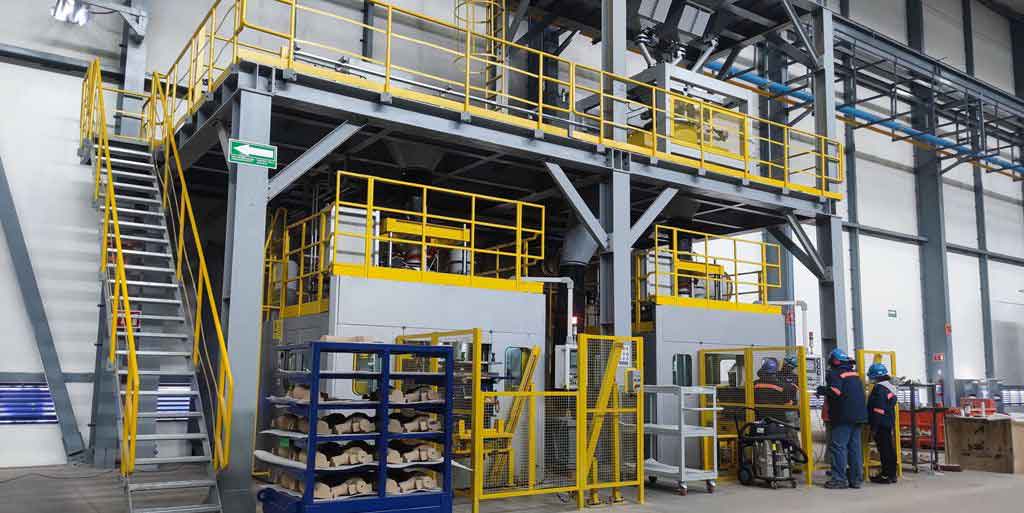
The equipment used for casting, as shown in the image, includes induction furnaces and molding setups that are standard in producing high-quality steel castings. This infrastructure ensures precise control over temperature and time, which are key variables in optimizing steel castings.
For wear resistance testing, we cut disc-shaped samples (25 mm diameter, 5 mm thickness) from the steel castings. Using an MG1000 wear testing machine, tests were conducted at room temperature with a wheel speed of 2000 rpm, load of 100 N, and duration of 10 min. Wear volume was recorded, and surface morphology was examined via a PG18 metallographic microscope. The wear volume \( V_w \) is calculated based on mass loss and density, but for consistency, we report it directly. To model the wear behavior, we propose a relationship between wear volume and pouring temperature \( T \), which can be expressed as a quadratic function: $$ V_w = a T^2 + b T + c $$ where \( a \), \( b \), and \( c \) are constants derived from experimental data. This formula helps in predicting the optimal temperature for steel castings.
Corrosion resistance was evaluated using electrochemical methods. Samples (20 mm diameter, 5 mm thickness) were tested in a 5 mol/L NaCl solution at room temperature with a three-electrode system on an RST5200 electrochemical workstation. Corrosion potential \( E_{corr} \) was measured, and surface morphology was observed using a JSM6510 scanning electron microscope. The corrosion potential can be related to pouring time \( t \) through an empirical equation: $$ E_{corr} = \alpha \ln(t) + \beta $$ where \( \alpha \) and \( \beta \) are parameters that reflect the influence of casting time on the electrochemical properties of steel castings. Such formulas are essential for understanding how processing conditions affect the longevity of steel castings in corrosive environments.
Results and Discussion on Wear Resistance
The wear resistance of ZG25CrV steel castings was significantly influenced by pouring temperature. As shown in Figure 3 (represented here as data), the wear volume decreased initially with increasing temperature before rising again. At a constant pouring time of 3 min, the wear volume was highest at 1475°C and lowest at 1550°C. Specifically, at 1550°C, the wear volume was \( 10.5 \times 10^{-3} \, \text{mm}^3 \), which is 57.7% lower than at 1475°C. This trend indicates that an optimal pouring temperature exists for minimizing wear in steel castings. The quadratic model mentioned earlier can be fitted to the data: for example, using values from Table 3, we derive coefficients to predict wear volume. Table 3 summarizes the wear volume data for different pouring temperatures.
| Pouring Temperature (°C) | Wear Volume (×10⁻³ mm³) | Reduction Compared to 1475°C (%) |
|---|---|---|
| 1475 | 24.8 | 0 |
| 1500 | 18.2 | 26.6 |
| 1525 | 12.7 | 48.8 |
| 1550 | 10.5 | 57.7 |
| 1575 | 15.3 | 38.3 |
The surface morphology after wear testing revealed wider grooves and more debris at lower temperatures, while at 1550°C, the surface showed finer grooves and minimal damage. This improvement is attributed to better microstructure formation, such as refined grains and reduced defects like porosity, which are common issues in steel castings. The relationship between wear volume and temperature can be further analyzed using the Arrhenius-type equation for wear rate: $$ V_w = V_0 \exp\left(-\frac{Q}{RT}\right) $$ where \( Q \) is the activation energy for wear, \( R \) is the gas constant, and \( T \) is the absolute temperature. This emphasizes the thermal sensitivity of wear mechanisms in steel castings.
Similarly, pouring time affected wear resistance. At a constant pouring temperature of 1550°C, the wear volume varied with pouring time, as shown in Figure 5. The minimum wear volume of \( 10.5 \times 10^{-3} \, \text{mm}^3 \) occurred at 3 min, which is 51.6% lower than at 9 min. This suggests that both too short and too long pouring times detrimentally impact steel castings. A short time may lead to incomplete filling and segregation, while a long time can cause excessive heating and defect formation. Table 4 presents the wear volume data for different pouring times.
| Pouring Time (min) | Wear Volume (×10⁻³ mm³) | Reduction Compared to 9 min (%) |
|---|---|---|
| 1 | 22.1 | 0 (reference for comparison) |
| 3 | 10.5 | 51.6 |
| 5 | 13.8 | 37.6 |
| 7 | 17.2 | 22.2 |
| 9 | 21.7 | 0 |
To quantify the effect, we can use a power-law model: $$ V_w = k t^n $$ where \( k \) and \( n \) are constants. For steel castings, optimal pouring time ensures uniform solidification and minimal internal stresses, enhancing wear resistance. The interplay between temperature and time can be expressed via a combined parameter, such as the thermal modulus \( \Theta = T \cdot t \), which might correlate with wear volume: $$ V_w = f(\Theta) = A \Theta^2 + B \Theta + C $$ This holistic approach is valuable for process optimization in producing durable steel castings.
Results and Discussion on Corrosion Resistance
The corrosion resistance of ZG25CrV steel castings was evaluated through corrosion potential measurements. At a constant pouring time of 3 min, the corrosion potential shifted positively with increasing pouring temperature up to 1550°C, then negatively at higher temperatures. The most positive potential of -0.689 V was observed at 1550°C, which is 135 mV higher than at 1475°C (-0.824 V). This indicates improved corrosion resistance at optimal temperatures. The data are summarized in Table 5.
| Pouring Temperature (°C) | Corrosion Potential (V) | Shift Compared to 1475°C (mV) |
|---|---|---|
| 1475 | -0.824 | 0 |
| 1500 | -0.765 | +59 |
| 1525 | -0.721 | +103 |
| 1550 | -0.689 | +135 |
| 1575 | -0.758 | +66 |
The corrosion potential relates to the thermodynamic tendency for corrosion; a more positive potential suggests better stability. The effect can be modeled using the Nernst equation for electrode potentials, considering the influence of microstructure on anodic and cathodic reactions in steel castings: $$ E_{corr} = E^0 + \frac{RT}{nF} \ln\left(\frac{a_{\text{oxidized}}}{a_{\text{reduced}}}\right) $$ where \( E^0 \) is the standard potential, \( n \) is the number of electrons, and \( a \) denotes activities. Changes in pouring temperature alter the microstructure, affecting these activities and thus the corrosion behavior of steel castings.
Pouring time also played a role. At 1550°C, the corrosion potential was most positive at 3 min (-0.689 V), shifting negatively to -0.818 V at 9 min—a difference of 129 mV. This shows that prolonged pouring times reduce corrosion resistance, likely due to increased oxide formation or segregation. Table 6 details these results.
| Pouring Time (min) | Corrosion Potential (V) | Shift Compared to 9 min (mV) |
|---|---|---|
| 1 | -0.702 | +116 |
| 3 | -0.689 | +129 |
| 5 | -0.735 | +83 |
| 7 | -0.791 | +27 |
| 9 | -0.818 | 0 |
The relationship between corrosion potential and pouring time can be described by a logarithmic decay function, as previously mentioned: $$ E_{corr} = \alpha \ln(t) + \beta $$ Fitting this to the data allows for predicting optimal times for corrosion-resistant steel castings. Additionally, the polarization resistance \( R_p \), which inversely correlates with corrosion rate, can be estimated from potential data: $$ R_p = \frac{B}{i_{corr}} $$ where \( B \) is a constant and \( i_{corr} \) is the corrosion current. This highlights the importance of casting parameters in controlling electrochemical properties of steel castings.
Microstructural analysis via SEM revealed that samples cast at optimal parameters had fewer defects like pores and inclusions, leading to smoother surfaces and better passive film formation. This aligns with the improved corrosion resistance. The synergy between wear and corrosion resistance is crucial for steel castings in harsh environments; thus, optimizing both parameters is key.
Comprehensive Analysis and Modeling
To integrate the effects of pouring temperature and time, we can develop a multi-variable model for the properties of steel castings. Let \( P \) represent a performance metric, such as wear volume or corrosion potential. A general equation might be: $$ P = c_0 + c_1 T + c_2 t + c_3 T^2 + c_4 t^2 + c_5 T t $$ where \( c_i \) are coefficients determined by regression analysis. For wear volume, using data from Tables 3 and 4, we can solve for these coefficients to predict outcomes for any combination of \( T \) and \( t \). This approach is valuable for industrial applications where steel castings are produced under varying conditions.
Moreover, the solidification rate \( R \), which depends on \( T \) and \( t \), influences microstructure. A faster rate (from lower temperatures or shorter times) can refine grains but may cause cracks, while a slower rate can lead to coarse structures and segregation. The relationship can be expressed as: $$ R = \frac{T – T_m}{t \cdot \rho C_p} $$ where \( T_m \) is the melting point, \( \rho \) is density, and \( C_p \) is heat capacity. Optimizing \( R \) ensures balanced properties in steel castings.
The addition of Cr and V enhances hardenability and corrosion resistance through carbide formation and solid solution strengthening. The volume fraction of carbides \( f_c \) can be estimated using: $$ f_c = \frac{w_{Cr} + w_{V}}{k} $$ where \( w \) are weight percentages and \( k \) is a constant. This fraction affects wear resistance, as higher \( f_c \) reduces abrasive wear. For steel castings, controlling alloy composition alongside casting parameters is essential.
Statistical analysis, such as ANOVA, can quantify the significance of each parameter. For example, the F-test can determine whether pouring temperature or time has a greater impact on wear volume. This helps in prioritizing control measures in the production of steel castings.
Conclusions and Recommendations
This study demonstrates that pouring temperature and pouring time critically influence the wear and corrosion resistance of ZG25CrV steel castings. An optimal pouring temperature of 1550°C and pouring time of 3 min were identified, resulting in a wear volume of \( 10.5 \times 10^{-3} \, \text{mm}^3 \) and a corrosion potential of -0.689 V. These values represent improvements of 57.7% in wear resistance and 135 mV in corrosion potential compared to suboptimal conditions. The findings underscore the importance of precise parameter control in casting processes for high-performance steel castings.
Future work could explore other alloying elements or advanced casting techniques, such as vacuum casting, to further enhance properties. Additionally, real-time monitoring of temperature and time during production could ensure consistency in steel castings. By applying these insights, manufacturers can produce steel castings that meet the demanding requirements of modern construction and other industries.
In summary, steel castings are vital components whose performance can be significantly upgraded through optimized casting parameters. This research provides a framework for achieving such optimization, contributing to the advancement of steel casting technology.