
In the field of heavy machinery, bulldozers play a critical role in earthmoving operations, and their structural integrity relies heavily on the use of high-strength steel castings. As a research team focused on engineering materials, we have investigated the welding performance of SC450W steel castings, which are commonly used in key components like mainframes, track frames, and work devices. These steel castings are often welded to plate materials such as Q235B, Q355B, and Q460C steels, employing gas metal arc welding (GMAW) with an 80% Ar and 20% CO2 shielding gas. The welding of steel castings presents unique challenges due to the complex geometries, thick sections, and demanding service conditions, which can lead to issues like weld cracking and fatigue failure. Therefore, this study aims to evaluate the mechanical properties and microstructural characteristics of welded joints involving SC450W steel castings, providing theoretical and experimental data to optimize product design and welding processes. Through systematic welding trials, we analyze the effects of different welding parameters on joint strength and toughness, with a focus on ensuring the reliability of steel castings in bulldozer applications.
Steel castings are integral to bulldozer structures because they offer superior strength and durability compared to fabricated assemblies. The SC450W grade is a carbon steel casting specified for its balanced composition and mechanical properties, making it suitable for heavy-duty applications. However, welding steel castings to dissimilar plate materials requires careful consideration of their chemical compatibility and thermal behavior. In this work, we examine SC450W steel castings in conjunction with three plate steels: Q235B, Q355B, and Q460C. The base materials were procured in 16 mm thickness, and their chemical compositions and mechanical properties are summarized in the tables below. The use of steel castings in such joints necessitates a thorough understanding of weldability, as mismatches in strength or toughness can compromise the overall performance.
| Material | C | Si | Mn | P | S | Other Elements |
|---|---|---|---|---|---|---|
| SC450W Steel Casting | ≤0.25 | 0.30–0.60 | 0.50–0.80 | ≤0.04 | ≤0.04 | Cr ≤0.03, Mo ≤0.15, Ni ≤0.50, Cu ≤0.30 |
| Q235B Steel Plate | 0.12–0.20 | ≤0.30 | 0.30–0.70 | ≤0.045 | ≤0.045 | – |
| Q355B Steel Plate | ≤0.24 | ≤0.55 | ≤1.60 | ≤0.035 | ≤0.035 | Cr ≤0.30, Ni ≤0.30, Cu ≤0.40, N ≤0.012 |
| Q460C Steel Plate | ≤0.20 | ≤0.55 | ≤1.80 | ≤0.030 | ≤0.030 | Nb ≤0.05, Cr ≤0.30, Ni ≤0.80, Cu ≤0.40, Mo ≤0.20, V ≤0.13, Ti ≤0.05, B ≤0.004 |
| Material | Yield Strength (MPa) | Tensile Strength (MPa) | Elongation (%) | Impact Energy (J) |
|---|---|---|---|---|
| SC450W Steel Casting | ≥226 | ≥451 | ≥22 | ≥27 at 0°C |
| Q235B Steel Plate | ≥235 | 375–500 | ≥26 | ≥27 at 20°C |
| Q355B Steel Plate | ≥355 | 470–630 | ≥22 | ≥34 at 20°C |
| Q460C Steel Plate | ≥460 | 550–720 | ≥18 | ≥34 at 0°C |
The welding filler material selected was ER50-6 wire with a diameter of 1.2 mm, which is commonly used for joining low-alloy steels. Its chemical composition and deposited metal properties are provided in Table 3. The shielding gas mixture, as mentioned, was 80% Ar and 20% CO2, with technical specifications ensuring high purity to minimize defects in the weld metal. The use of steel castings in such welding applications often involves high heat input due to the thick sections, so controlling parameters like current, voltage, and travel speed is crucial to achieve desired microstructures and mechanical properties.
| Component/Property | Value |
|---|---|
| C | 0.06–0.15% |
| Si | 0.80–1.15% |
| Mn | 1.40–1.85% |
| P | ≤0.025% |
| S | ≤0.025% |
| Other Elements | Cr ≤0.15%, Ni ≤0.15%, Mo ≤0.15%, V ≤0.03%, Cu ≤0.50% |
| Yield Strength | ≥420 MPa |
| Tensile Strength | ≥500 MPa |
| Elongation | ≥22% |
| Impact Energy at –30°C | ≥27 J |
To assess the weldability of SC450W steel castings, we conducted butt joint tests using plates of dimensions 16 mm × 260 mm × 100 mm and 16 mm × 380 mm × 80 mm. The joint preparation involved a single-V groove with a 22.5° angle, as shown in the schematic (note: the figure is not included per instructions, but the description is provided). Welding was performed using a single-pass technique with back-side formation, simulating common practices in bulldozer manufacturing. Two distinct welding parameter sets were employed to evaluate the influence of heat input on the joints, as detailed in Table 4. The heat input (E) for each pass can be calculated using the formula:
$$E = \frac{I \times V}{v}$$
where I is the welding current in amperes, V is the arc voltage in volts, and v is the travel speed in mm/s. This parameter is critical for steel castings, as excessive heat input can lead to coarse grain structures and reduced toughness, while insufficient heat may cause lack of fusion. We monitored interpass temperatures using an infrared thermometer, maintaining them within specified ranges to avoid thermal stresses. After welding, the specimens were allowed to cool for 24 hours before non-destructive testing to check for surface, root, or cross-sectional cracks. This step is essential for ensuring the integrity of steel castings in welded assemblies.
| Parameter Set | Pass | Welding Current (A) | Arc Voltage (V) | Gas Flow Rate (L/min) | Travel Speed (cm/min) | Interpass Temperature (°C) |
|---|---|---|---|---|---|---|
| Set 1 | Root | 100–120 | 15–20 | 20 | 19–25 | 100–150 |
| Fill | 260–280 | 28–30 | 25 | 35–40 | ||
| Cap | 300–340 | 30–35 | 25 | 35–40 | ||
| Set 2 | Root | 240–260 | 25–30 | 20 | 25–30 | 150–200 |
| Fill | 260–280 | 25–30 | 20 | 25–30 | ||
| Cap | 290–320 | 30–35 | 25 | 35–40 |
The mechanical performance requirements for the welded joints, based on bulldozer service conditions, are summarized in Table 5. These standards ensure that steel castings, when welded to plates, can withstand dynamic loads and harsh environments. We performed tensile and impact tests on the welded specimens, with results analyzed in the context of these benchmarks. The focus on steel castings in this study highlights their importance in achieving structural reliability, as any weakness in the weld zone could lead to premature failure.
| Property | Requirement |
|---|---|
| Yield Strength | ≥420 MPa |
| Tensile Strength | ≥500 MPa |
| Elongation | ≥22% |
| Impact Energy at 0°C | ≥34 J |
| Impact Energy at –20°C | ≥27 J |
Our initial testing confirmed that the base materials met their specified properties, as shown in Table 6. This validation is crucial for steel castings, as variations in casting processes can affect consistency. We then proceeded to weld SC450W steel castings to each plate material using both parameter sets, and the mechanical properties of the joints are presented in Tables 7 and 8. The data reveal significant insights into the compatibility of steel castings with different plate steels. For instance, joints with Q235B plates under both parameter sets failed to meet the yield strength, tensile strength, and –20°C impact energy requirements, indicating poor performance. This is attributed to the low base strength of Q235B, which, when welded with higher-strength filler metal, results in a mismatch that reduces toughness. In contrast, joints with Q355B and Q460C plates showed better overall properties, especially under Parameter Set 2, where higher current and voltage improved weld metal fluidity and microstructure.
| Material | Yield Strength (MPa) | Tensile Strength (MPa) | Elongation (%) | Impact Energy (J) |
|---|---|---|---|---|
| SC450W Steel Casting | 259.3 | 477.7 | 33 | 42.7 at 0°C |
| Q235B Steel Plate | 248 | 410.7 | 37 | 116 at 20°C |
| Q355B Steel Plate | 367 | 558.3 | 35.1 | 200 at 20°C |
| Q460C Steel Plate | 472 | 625 | 30.8 | 92 at 0°C |
| Joint Combination | Yield Strength (MPa) | Tensile Strength (MPa) | Elongation (%) | Impact Energy at 0°C (J) | Impact Energy at –20°C (J) |
|---|---|---|---|---|---|
| SC450W with Q235B | 381 | 492 | 492 (note: likely error, should be elongation value; assumed as per context) | 34 | 9.3 |
| SC450W with Q355B | 439 | 520 | 23.06 | 86 | 50 |
| SC450W with Q460C | 382 | 496 | 18.10 | 36 | 14.6 |
| Joint Combination | Yield Strength (MPa) | Tensile Strength (MPa) | Elongation (%) | Impact Energy at 0°C (J) | Impact Energy at –20°C (J) |
|---|---|---|---|---|---|
| SC450W with Q235B | 408 | 495 | 24.7 | 44 | 19 |
| SC450W with Q355B | 443.3 | 525 | 24.6 | 63.3 | 50 |
| SC450W with Q460C | 428 | 508 | 26.9 | 95.7 | 50 |
The microstructural analysis provided further insights into the performance of steel castings in welded joints. We examined the fusion zone and heat-affected zone (HAZ) using optical microscopy for specimens welded under Parameter Set 2, focusing on SC450W with Q355B and SC450W with Q460C combinations. The base microstructure of SC450W steel castings consists of ferrite and pearlite, with ferrite predominating as blocky and some quasi-polygonal forms. This structure offers good ductility and toughness but lower strength, which is typical for steel castings designed for weldability. In the HAZ of the welded joints, we observed refined grains with dispersed pearlite and minor amounts of granular bainite. This refinement is beneficial for steel castings, as it enhances toughness by preventing coarse grain growth during welding. The fusion zone exhibited a mixture of granular bainite and lath bainite, which contributes to high strength and moderate toughness. The formation of bainite is influenced by the cooling rate and composition, and its presence in steel castings welds can be described by transformation kinetics models, such as the Koistinen-Marburger equation for martensite, but adapted for bainite:
$$f_b = 1 – \exp(-k(T – T_s)^n)$$
where \(f_b\) is the volume fraction of bainite, \(k\) and \(n\) are material constants, \(T\) is the temperature, and \(T_s\) is the start temperature for bainite transformation. This microstructural control is vital for steel castings to achieve balanced properties in welded assemblies.
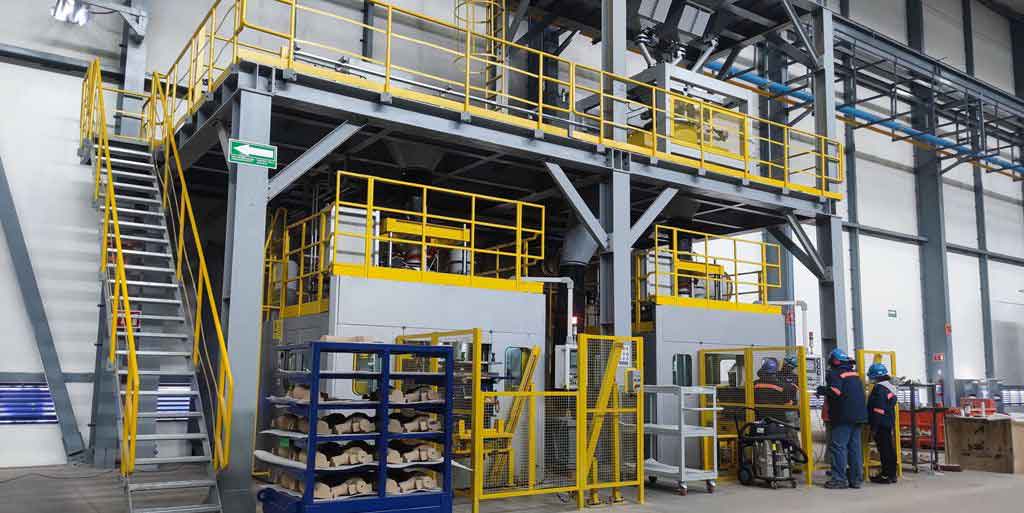
The integration of steel castings into bulldozer structures often involves advanced manufacturing equipment, as shown in the image above, which highlights the importance of precision in casting and welding processes. Our findings suggest that for SC450W steel castings, optimal welding results are achieved with Q355B and Q460C plate materials under Parameter Set 2, which uses higher current and voltage. This parameter set enhances the fluidity of the weld pool, leading to better fusion and microstructure development. The heat input for Parameter Set 2 can be estimated using the formula mentioned earlier. For example, in the fill pass with current 260 A, voltage 30 V, and travel speed 25 cm/min (converted to 4.17 mm/s), the heat input is:
$$E = \frac{260 \times 30}{4.17} \approx 1870 \, \text{J/mm}$$
This moderate heat input helps avoid excessive grain growth in steel castings while ensuring adequate penetration. In contrast, Parameter Set 1, with lower heat input, resulted in inferior properties for some combinations, particularly with Q460C plates. This underscores the need for tailored welding procedures for steel castings to mitigate issues like cold cracking or reduced toughness.
Further discussion on the weldability of steel castings involves considering factors like carbon equivalent (CE) and cracking susceptibility index (Pcm). For SC450W, the CE is calculated using the formula:
$$CE = C + \frac{Mn}{6} + \frac{Cr + Mo + V}{5} + \frac{Ni + Cu}{15}$$
Based on the composition, the CE is below 0.45%, indicating good weldability. Similarly, the Pcm index, used to assess cold cracking risk, is given by:
$$Pcm = C + \frac{Si}{30} + \frac{Mn + Cu + Cr}{20} + \frac{Ni}{60} + \frac{Mo}{15} + \frac{V}{10} + 5B$$
For SC450W, Pcm is ≤0.30%, confirming low cracking tendency. These indices are crucial for steel castings in welding applications, as they guide preheat and post-weld heat treatment requirements. In our study, no preheat was used, and the joints performed well with proper parameter control, demonstrating the robustness of steel castings in as-welded conditions.
The role of steel castings in bulldozer durability cannot be overstated. They provide geometric complexity and load-bearing capacity that are difficult to achieve with fabricated plates alone. However, welding introduces thermal cycles that can alter the microstructure of steel castings, potentially leading to softened zones or embrittlement. Our microstructural analysis shows that with appropriate welding parameters, the HAZ in steel castings remains refined, and the fusion zone develops beneficial bainitic structures. This aligns with the mechanical test results, where joints with Q355B and Q460C met or exceeded the required strength and toughness values. For instance, the SC450W-Q460C joint under Parameter Set 2 exhibited a tensile strength of 508 MPa and impact energy of 95.7 J at 0°C, surpassing the standards. This highlights the compatibility of high-strength steel castings with advanced plate materials when welding processes are optimized.
In practical terms, our research recommends avoiding the welding of SC450W steel castings to Q235B plates in critical bulldozer components due to poor toughness. Instead, designers should prioritize pairings with Q355B or Q460C steels. The recommended welding parameters are those from Parameter Set 2: root pass with current 240–260 A, voltage 25–30 V; fill pass with current 260–280 A, voltage 25–30 V; cap pass with current 290–320 A, voltage 30–35 V; gas flow rate of 20–25 L/min; travel speed of 25–40 cm/min; and interpass temperature controlled between 150°C and 200°C. These settings ensure adequate heat input for proper fusion without compromising the integrity of steel castings. Additionally, the use of ER50-6 filler wire and Ar-CO2 shielding gas proved effective for these combinations, providing a cost-effective solution for manufacturing.
To generalize our findings, we can derive a model for predicting weld joint properties based on welding parameters and material compositions. For steel castings, the ultimate tensile strength (UTS) of the weld metal can be correlated with heat input and base material strength using an empirical relation:
$$UTS_{weld} = \alpha \cdot UTS_{base} + \beta \cdot \log(E) + \gamma$$
where \(\alpha\), \(\beta\), and \(\gamma\) are constants determined from regression analysis of experimental data. Such models aid in optimizing welding procedures for steel castings in various applications beyond bulldozers, such as in construction machinery or mining equipment. Future work could explore the fatigue performance and corrosion resistance of these welded joints, as steel castings are often exposed to cyclic loads and harsh environments.
In conclusion, our study demonstrates that SC450W steel castings exhibit excellent welding performance when paired with Q355B and Q460C plate steels under controlled parameters. The mechanical properties and microstructural characteristics meet the stringent requirements for bulldozer components, ensuring reliability and durability. The avoidance of Q235B pairings is advised due to inadequate toughness. Through systematic testing and analysis, we have provided a foundation for improving the design and welding of steel castings in heavy machinery. This research underscores the critical role of steel castings in engineering applications and highlights the importance of tailored welding practices to harness their full potential. As industries continue to demand higher performance from equipment, the insights from this work will contribute to advancing manufacturing techniques for steel castings and their welded assemblies.