
In the evolving landscape of manufacturing, additive manufacturing, particularly 3D printing, has emerged as a transformative technology for the foundry industry. My research focuses on addressing the unique challenges posed by 3D printed sand molds and cores, especially for steel castings, where surface quality and dimensional accuracy are paramount. These molds and cores, produced through binder jetting or similar processes, exhibit inherent porosity, complex geometries, and stair-step artifacts on surfaces due to the layer-by-layer deposition. These artifacts can lead to poor surface finish on steel castings if not properly mitigated. Consequently, conventional coatings often fail, resulting in issues like heavy flow marks, sagging, and uneven coverage. To overcome this, I embarked on developing a specialized water-based flow coating tailored for 3D printed sand molds and cores used in steel castings production. This coating must exhibit excellent rheological properties—specifically low yield value and thixotropy—to ensure smooth application and uniform coverage, thereby enhancing the surface quality of steel castings.
The core objective of this work is to formulate a coating that not only provides adequate refractoriness for high-temperature steel castings but also flows seamlessly over intricate mold surfaces. Through systematic experimentation, I investigated the effects of various suspending agents and binders on rheology, optimized the配方, and validated the coating in实际 casting trials. The findings highlight the critical role of rheological control in achieving defect-free steel castings from 3D printed molds.
Materials and Methods
In this study, I adopted a first-person perspective to detail the experimental approach. The selection of materials was guided by the demanding requirements of steel castings, which involve pouring temperatures often exceeding 1500°C. Refractory fillers must withstand these conditions without degrading.
Experimental Materials
The primary refractory materials chosen were zircon flour and white alumina powder, known for their high melting points and stability under thermal stress. For the binder system, I utilized polyvinyl alcohol (PVA) and silica sol, which offer a balance of green strength and high-temperature integrity. Suspending agents included modified magnesium aluminum silicate and lithium-based bentonite, while additives such as wetting agents (KT-70), defoamers (DZ-200), and preservatives (YN-) were incorporated to enhance coating performance. The solvent was deionized water.
Experimental Procedures
The methodology involved preparing coatings with varying compositions, measuring their rheological properties, and testing their application on 3D printed sand samples. Rheology was assessed using a rotational viscometer to determine parameters like thixotropic index and yield value. Coating application was performed via flow coating, simulating industrial conditions. The optimized coating was then subjected to drying temperature studies to evaluate its impact on mold strength, followed by actual casting trials for steel castings.
Coating Formulation Design
I designed multiple formulation schemes to isolate the effects of individual components. The base composition included zircon flour and white alumina powder in a fixed ratio, with variable amounts of suspending agents and binders. Below is a summary of the initial formulation matrix.
| Component | Range (wt.%) |
|---|---|
| Zircon Flour | 70 |
| White Alumina Powder | 30 |
| Lithium-Based Bentonite | 0–2.5 |
| Modified Magnesium Aluminum Silicate | 0–2.5 |
| Polyvinyl Alcohol (PVA) | 0–2 |
| Silica Sol | 0–1 |
| Wetting Agent (KT-70) | 0.2–0.5 |
| Defoamer (DZ-200) | 0.3–0.6 |
| Preservative (YN-) | 0.2–0.5 |
| Water (Solvent) | Adjust to desired viscosity |
By adjusting these components, I aimed to achieve a coating with optimal flowability and leveling for 3D printed sand molds used in steel castings.
Results and Discussion
The development process involved extensive testing to understand how each component influences the coating’s behavior. Rheology is a critical aspect, as it dictates how the coating spreads and settles on complex mold surfaces.
Influence of Suspending Agents on Rheology
Suspending agents play a pivotal role in maintaining particle dispersion and controlling flow. I tested various combinations of lithium-based bentonite and modified magnesium aluminum silicate. Lithium-based bentonite offers good suspension and fluidity but poor thixotropy, leading to inadequate leveling after flow coating. Modified magnesium aluminum silicate provides excellent thixotropy and suspension but can impede流动性. Through trials, I found that a复合 system yielded the best results. The table below details specific formulations and their observed effects.
| Formulation # | Lithium Bentonite (wt.%) | Modified MgAl Silicate (wt.%) | Observations (Flow Coating) |
|---|---|---|---|
| 1 | 0 | 2.0 | Thick coating, poor leveling,堆积 evident |
| 2 | 0.5 | 1.5 | Moderate improvement |
| 3 | 1.0 | 1.0 | Balanced flow |
| 4 | 1.5 | 0.5 | Optimal: uniform coating, no sagging |
| 5 | 2.0 | 0 | Excessive flow, thin coverage |
Formulation 4, with 1.5% lithium bentonite and 0.5% modified magnesium aluminum silicate, provided the right equilibrium, ensuring the coating could flow easily yet recover quickly to minimize流痕. This is crucial for steel castings, where surface smoothness directly impacts the final product quality.
Influence of Binders on Rheology and Strength
Binders contribute to both green strength and high-temperature performance. I evaluated combinations of PVA and silica sol. PVA enhances toughness, while silica sol improves thermal resistance. However, increasing silica sol content raised viscosity, affecting flowability. The table summarizes formulations with varying binder ratios.
| Formulation # | PVA (wt.%) | Silica Sol (wt.%) | Viscosity (Φ6 cup, seconds) | Leveling Performance |
|---|---|---|---|---|
| A | 1.2 | 0 | 7.2 | Good flow,但 high-temp strength may be lacking |
| B | 0.9 | 0.3 | 7.8 | Optimal: smooth flow, adequate strength |
| C | 0.6 | 0.6 | 8.5 | Slightly viscous, minor流痕 |
| D | 0.3 | 0.9 | 9.2 | Poor leveling, evident streaks |
| E | 0 | 1.2 | 10.0 | Unsuitable for flow coating |
Formulation B, with a PVA-to-silica sol ratio of 3:1, emerged as the best compromise, offering sufficient高温 strength for steel castings without compromising rheology. This balance is vital to prevent mold erosion during the pouring of molten steel.
Optimized Coating Formulation
Based on the above analyses, I derived an optimized formulation that integrates the最佳 components. This配方 is designed specifically for 3D printed sand molds and cores in steel castings production.
| Component | Weight Percentage (wt.%) |
|---|---|
| Zircon Flour | 70 |
| White Alumina Powder | 30 |
| Lithium-Based Bentonite | 1.5 |
| Modified Magnesium Aluminum Silicate | 0.5 |
| Polyvinyl Alcohol (PVA) | 0.9 |
| Silica Sol | 0.3 |
| Wetting Agent (KT-70) | 0.3 |
| Defoamer (DZ-200) | 0.4 |
| Preservative (YN-) | 0.3 |
| Water | Adjust to achieve target density |
The key performance indicators for this optimized coating are outlined below, ensuring it meets the rigorous demands of steel castings.
| Parameter | Target Range |
|---|---|
| Viscosity (Φ6 flow cup) | 7.5–8.0 seconds |
| Density | 1.85–1.90 g/cm³ |
| Baumé Degree | 65–70 °Bé |
| Suspension Stability (2 hours) | 100% |
| Suspension Stability (24 hours) | ≥98% |
| Thixotropic Index | 10–15 Pa·s⁻¹ |
| Yield Value | 5–10 Pa |
Rheological Analysis and Mathematical Modeling
Rheology is the cornerstone of this coating’s performance. Using a rotational viscometer, I measured the apparent viscosity at different shear rates to construct flow curves. The coating exhibits假塑性 behavior, characterized by a decrease in viscosity with increasing shear rate—a desirable trait for flow coatings. The thixotropic index, which quantifies the time-dependent recovery of viscosity, is calculated from the area between the shear-thinning and recovery curves. The formula for thixotropic index (S) is:
$$ S = \pi^2 \left[ 0.08 (\eta_6 – \eta’_6) + 0.64 (\eta_{12} – \eta’_{12}) + 3.2 (\eta_{30} – \eta’_{30}) \right] $$
where \(\eta\) represents the viscosity during shear thinning and \(\eta’\) during recovery, with subscripts indicating shear rates (e.g., 6 s⁻¹). For the optimized coating, the calculated thixotropic index was approximately 13 Pa·s⁻¹, falling within the target range. This low value ensures quick leveling after application, reducing defects on steel castings.
The yield value (\(\tau_y\)), the stress required to initiate flow, is equally important. It is derived from viscosity measurements using the formula:
$$ \tau_y = \frac{4\pi (\eta_6 – \eta’_6)}{9} $$
For this coating, the yield value was around 6 Pa, indicating minimal resistance to flow under low stress, which prevents sagging on vertical surfaces of 3D printed molds. These rheological parameters collectively enable the coating to form uniform layers on complex geometries, essential for high-quality steel castings.
The flow curve data can be summarized by the Herschel-Bulkley model, often used for non-Newtonian fluids:
$$ \tau = \tau_y + K \dot{\gamma}^n $$
where \(\tau\) is shear stress, \(\dot{\gamma}\) is shear rate, \(K\) is consistency index, and \(n\) is flow behavior index. For this coating, \(n < 1\) indicates shear-thinning behavior. Experimental data拟合 yielded values of \(\tau_y \approx 6 \, \text{Pa}\), \(K \approx 0.5 \, \text{Pa} \cdot \text{s}^n\), and \(n \approx 0.7\), confirming its假塑性 nature tailored for steel castings molds.
Effect of Drying Temperature on Mold Strength
3D printed sand molds are inherently porous, allowing coating moisture to penetrate deeply. Improper drying can weaken the mold or cause焦化 at thin sections. I conducted experiments using coated 3D printed specimens to determine the optimal drying temperature. The relationship between drying temperature and transverse strength is expressed empirically. The data showed that strength decreases with increasing temperature due to potential binder degradation. The following equation models the strength loss:
$$ \sigma(T) = \sigma_0 e^{-k(T – T_0)} $$
where \(\sigma(T)\) is strength at temperature \(T\), \(\sigma_0\) is initial strength at reference temperature \(T_0\), and \(k\) is a degradation constant. Based on tests, I recommend a two-stage drying process: start at 105°C to gradually remove moisture, then raise to 150°C for final curing. Higher temperatures, like 180°C, caused significant strength reduction and焦化, unsuitable for delicate steel castings molds. The table below illustrates the trend.
| Drying Temperature (°C) | Transverse Strength (MPa) | Observations |
|---|---|---|
| 105 | 2.8 | Good strength, no焦化 |
| 120 | 2.5 | Acceptable |
| 150 | 2.2 | Optimal for balance |
| 180 | 1.8 | Reduced strength, slight焦化 |
| 200 | 1.5 | Excessive焦化, weak edges |
This drying protocol ensures that molds retain sufficient integrity to withstand the pressures of molten steel during casting, critical for producing defect-free steel castings.
Application Validation in Steel Castings Production
To validate the coating’s efficacy, I conducted full-scale casting trials on actual steel castings components. The test involved a steel casting weighing approximately 1.5 tons, made of ZG06Cr13Ni4Mo stainless steel—a common material for demanding applications. The 3D printed sand core was sizable, with a diameter of about 1400 mm and height of 550 mm, featuring internal spiral passages that exemplify the complexity achievable with additive manufacturing.
The coating was applied via flow coating, achieving a uniform thickness of around 0.5 mm. The process demonstrated excellent leveling: no sagging, dripping, or streaks were observed, and the coating covered the stair-step artifacts effectively. After drying per the optimized schedule, the mold was assembled and poured. The resulting steel casting exhibited a smooth surface finish, free from defects like sand adhesion, gas holes, or rough textures. This success underscores the coating’s ability to enhance surface quality in steel castings produced via 3D printed molds.
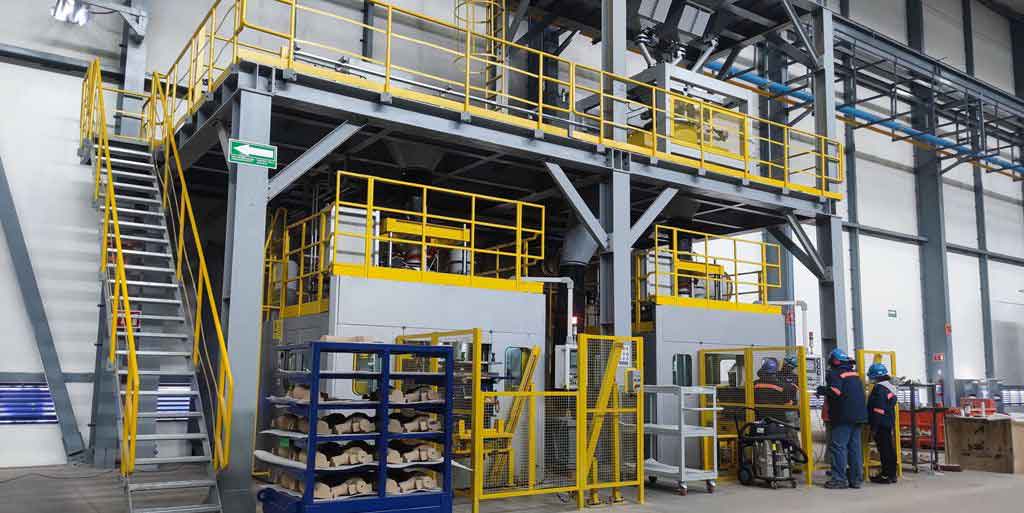
The image above illustrates typical equipment used in steel castings production, highlighting the context in which this coating operates. The integration of 3D printing with such foundry setups paves the way for more agile manufacturing of steel castings.
Further quantitative analysis confirmed the coating’s performance. The table below lists the adjusted coating properties as measured during the trial.
| Property | Measured Value |
|---|---|
| Viscosity (Φ6 flow cup) | 7.8 seconds |
| Density | 1.89 g/cm³ |
| Baumé Degree | 68 °Bé |
| Suspension Stability (2 hours) | 100% |
| Suspension Stability (24 hours) | 99.6% |
| Thixotropic Index | 13 Pa·s⁻¹ |
| Yield Value | 6 Pa |
These values align closely with the targets, ensuring reproducible results for steel castings applications. The coating’s consistency across batches is vital for industrial adoption, where reliability is key to producing high-integrity steel castings.
Conclusion
Through this research, I have developed and validated a water-based flow coating specifically designed for 3D printed sand molds and cores used in steel castings production. The key findings are multifaceted. Firstly, the rheological properties are critical: the coating must exhibit low yield value (5–10 Pa) and low thixotropic index (10–15 Pa·s⁻¹) to achieve excellent flowability and leveling on complex mold surfaces. This is achieved through a复合 suspending agent system of lithium-based bentonite and modified magnesium aluminum silicate, along with a balanced binder combination of PVA and silica sol. Secondly, drying temperature significantly affects mold strength; a two-stage process starting at 105°C and finishing at 150°C optimal prevents degradation while ensuring proper curing. Thirdly, the optimized formulation, with a Baume degree of 65–70 °Bé and high suspension stability, provides consistent coverage and refractory performance for high-temperature steel castings.
The application trials demonstrated that this coating enables uniform, smooth layers on 3D printed molds, directly improving the surface finish of steel castings. This advancement not only addresses the challenges posed by additive manufacturing in foundries but also supports the broader adoption of 3D printing for complex steel castings, reducing lead times and enhancing dimensional accuracy. Future work could explore further refinements, such as incorporating nano-additives for improved thermal shock resistance or developing coatings for other alloy systems. Nonetheless, this study establishes a robust foundation for next-generation coatings in the rapidly evolving field of steel castings production via 3D printing.