
In the manufacturing of railway freight cars, large steel castings such as bolsters and side frames are critical components that require extensive fettling operations after casting. Traditional methods involve manual labor in open, multi-process environments, leading to significant challenges in environmental pollution, worker safety, and operational efficiency. We have developed an intelligent fettling solution that integrates advanced technologies like 3D vision, robotics, and automated logistics to address these issues. This article presents a comprehensive overview of our approach, focusing on the design and implementation of an intelligent cutting and grinding production line for steel castings. The goal is to enhance quality, reduce labor intensity, and improve the working environment, making the process economically viable and sustainable.
The fettling of steel castings typically involves several steps: shakeout, removal of fins and gating systems, shot blasting, carbon arc gouging, surface grinding, defect welding, and inspection. Each step generates pollutants like dust, smoke, noise, and arc light, posing health risks and environmental concerns. Moreover, the heavy and bulky nature of steel castings necessitates frequent crane handling, increasing safety hazards. Our solution aims to transform this process through automation and smart systems, leveraging modern engineering principles to create a streamlined, eco-friendly production line.
To provide context, let’s examine the current fettling process for steel castings. The table below summarizes the key operations, their durations, and associated pollutants, based on typical practices in the industry.
| Operation | Description | Time per Piece | Pollutants |
|---|---|---|---|
| Mechanical Shakeout | Removal of mold sand from external surfaces | 15 min per box | Dust, Noise |
| Manual Core Removal | Clearing internal cavity sand using pneumatic tools | 90 min per piece | Dust, Noise |
| Gating System Cutting | Removal of fixed-position gates, risers, and vents | 15 min per piece | Smoke, Noise |
| Fin Cutting | Removal of variable-position fins and flash | 12 min per piece | Smoke, Noise |
| Shot Blasting | Surface cleaning to remove residual sand and scale | 3–5 min per piece | Dust |
| Carbon Arc Gouging | Elimination of high cutting remnants and defects | 12 min per piece | Smoke, Dust, Arc Light, Noise |
| Surface Grinding | Smoothing edges, removing burrs, and finishing key surfaces | 60 min per piece | Grinding Dust |
| Defect Welding | Repair of pores, shrinkage, cracks, etc. | 15 min per piece | Smoke, Arc Light, Noise |
| Inspection and Confirmation | Quality check, defect marking, and record-keeping | 15 min per piece | — |
| Workpiece Flipping | Handling and repositioning using cranes | 1 min per piece | — |
The total fettling time for each steel casting can exceed 3 hours, with significant variability due to manual interventions. This inefficiency motivated us to design an intelligent production line that reduces cycle times and mitigates pollutants. Our solution is built around a takt-based workflow, where each station performs specific tasks in a synchronized manner. The core idea is to replace labor-intensive steps with robotic systems, guided by 3D vision and controlled via programmable logic controllers (PLCs).
The overall scheme comprises several units: a preparation station, an intelligent cutting unit, a manual cutting unit, an intelligent grinding unit, a manual welding and grinding unit, an intelligent logistics system, a safety and environmental protection unit, and a gating collection system. These are integrated into a continuous production line for steel castings, ensuring seamless material flow and process control. The design emphasizes modularity, allowing for adaptation to different types of steel castings used in railway applications.
In terms of workstation design, we have optimized the layout based on process flow and time studies. The table below outlines the stations, their functions, and pollutants, aligning with our goal of minimizing environmental impact.
| Workstation | Function | Pollutants |
|---|---|---|
| Preparation Station | Loading from shot blasting, removal of fins and flash, preparation of clamping surfaces, and batch loading into the line | Smoke, Dust, Noise |
| Intelligent Cutting Unit | Robotic removal of fixed gating systems (gates, risers, vents) using flame cutting | Smoke, Dust, Noise |
| Manual Cutting Unit | Manual trimming of variable fins, adjustment of cutting remnants, and removal of slag | Smoke, Dust, Noise |
| Intelligent Grinding Unit | Robotic grinding of predefined surfaces on steel castings using servo-driven belt grinders | Grinding Dust |
| Manual Welding and Grinding Unit | Manual repair of defects (e.g., pores, cracks), final grinding, and inspection | Smoke, Dust, Arc Light, Noise |
The logistics design ensures efficient movement of steel castings between stations. We implemented a mixed flow strategy: batch flow for preparation and manual welding/grinding to accommodate furnace-based heat treatment requirements, and single-piece flow for automated units to reduce space needs. Key logistics equipment includes loading carts, gantry manipulators, transfer carts, monorail cranes, and unloading carts, all coordinated by a central control system. The takt time is set at 15 minutes per piece, balancing throughput with process capabilities.
To quantify performance, we can use mathematical models. For example, the cutting time in the intelligent cutting unit can be estimated using the formula:
$$ T_c = \frac{L}{v} + t_s $$
where \( T_c \) is the total cutting time, \( L \) is the total length of cuts per steel casting, \( v \) is the cutting speed (typically 0.5–1.0 m/min for flame cutting of thick sections), and \( t_s \) is the setup and positioning time. For a typical steel casting like a bolster, \( L \) might be 2–3 meters, leading to \( T_c \approx 5–10 \) minutes, which fits within the takt. Similarly, grinding efficiency can be expressed as:
$$ R_g = \frac{A}{\mu \cdot t_g} $$
where \( R_g \) is the grinding rate (area per time), \( A \) is the surface area to be ground, \( \mu \) is a material removal factor (dependent on grinding tool and pressure), and \( t_g \) is the grinding time. Our robotic grinders achieve \( R_g \approx 0.1 \, \text{m}^2/\text{min} \) for steel castings, reducing manual effort by over 50%.
The configuration of each unit is critical for success. Below, we detail the specifications and requirements, incorporating technical parameters to ensure reliability.
| Unit | Key Components | Specifications | Performance Metrics |
|---|---|---|---|
| Preparation Station | Cutting torches, pneumatic grinders, workbenches | Gas pressure: ≥0.3 MPa (fuel), ≥0.8 MPa (O₂); Air pressure: 0.5–0.6 MPa | Capacity: 16 pieces per batch; Operator count: 2 |
| Intelligent Cutting Unit | Robots (2 units), 3D vision system, positioner, cutting torch, scrap collector | Robot repeatability: ≤0.2 mm; Vision accuracy: ≤0.5 mm; Positioner load: ≥1 t | Cutting allowance: 2–5 mm; Efficiency gain: 45–100% vs. manual |
| Manual Cutting Unit | Rotary table, positioner, manual torch, slag conveyor | Table rotation: 180°; Positioning error: ≤0.2° | Flexibility for variable geometries; Safety via two-hand controls |
| Intelligent Grinding Unit | Robots, servo-driven belt grinders, tool changer, high-precision indexer | Grinding accuracy: ≤0.5 mm; Indexer precision: cam divider-based | Surface roughness: ≤Ra 12.5 μm; Coverage: 35–55% of manual workload |
| Manual Welding and Grinding Unit | Welding machines, grinders, monorail crane, inspection tools | Crane capacity: ≥2 t; Work area: 12 m × 8.5 m | Defect repair rate: 15 min per piece; Integrated inspection |
| Intelligent Logistics System | Gantry manipulator, loading/unloading carts, PLC control | Manipulator speed: 0–30 m/min (longitudinal); Load: ≥1 t | Takt compliance: 15 min per piece; Automated transfers |
| Safety and Environmental Unit | Enclosed cabins, dust collectors, sensors (noise, gas, dust), video monitoring | Noise reduction: ≥20 dB; Dust collection efficiency: ≥99% | Pollutant containment; Real-time monitoring |
| Gating Collection System | Scrap conveyors, bins, transport carts | Conveyor speed: adjustable; Capacity: match production rate | Recycling of cut-offs; Clean floor management |
The intelligent cutting unit relies on 3D vision to locate gating elements on steel castings. The vision system captures point clouds, processes them to extract cutting paths, and guides the robot. The positioning error \( \delta \) can be modeled as:
$$ \delta = \sqrt{\delta_v^2 + \delta_r^2} $$
where \( \delta_v \) is the vision system error (≤0.5 mm) and \( \delta_r \) is the robot repeatability error (≤0.2 mm), yielding \( \delta \approx 0.54 \) mm, sufficient for flame cutting tolerances. For grinding, the material removal rate \( MRR \) is given by:
$$ MRR = k \cdot F_n \cdot v_s $$
where \( k \) is a constant for steel castings, \( F_n \) is the normal force applied by the grinder, and \( v_s \) is the grinding speed. Our robotic system adjusts \( F_n \) dynamically based on surface scans, ensuring consistent finish.
Logistics coordination is managed by a central PLC that synchronizes all units. The flow of steel castings follows a predefined sequence, with sensors ensuring proper positioning. The gantry manipulator’s motion profile can be optimized using kinematic equations, such as for acceleration \( a \):
$$ a = \frac{v_f – v_i}{t} $$
where \( v_i \) and \( v_f \) are initial and final velocities, and \( t \) is time. This allows smooth transfers without jarring the heavy steel castings.
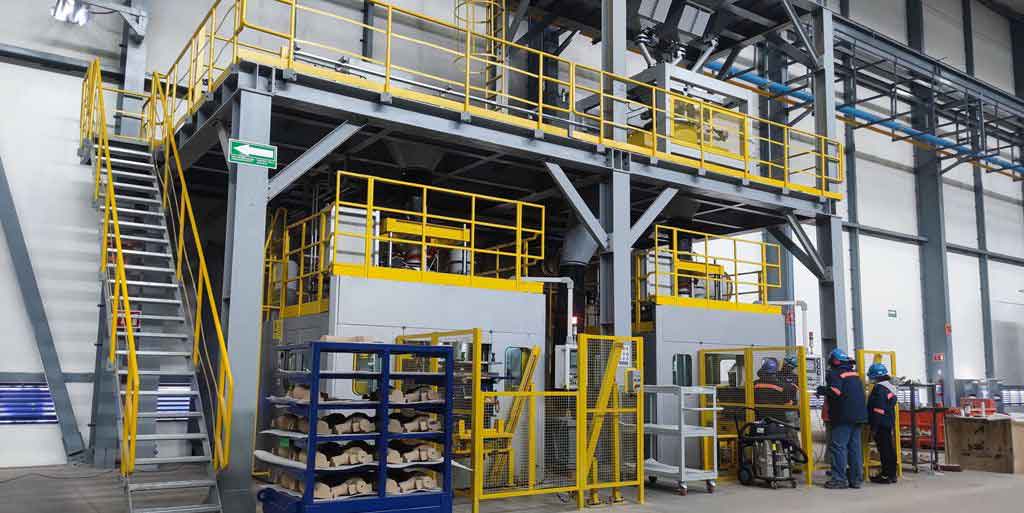
The integration of these units into a cohesive production line for steel castings has yielded significant benefits. In validation trials, the intelligent cutting unit achieved cutting allowances of 2–5 mm, with surface flatness improvements of over 30% compared to manual methods. The robotic grinding unit reduced the manual grinding workload by 35–55%, attaining surface roughness levels of Ra 12.5 μm or better, which meets quality standards for railway components. The logistics system operated flawlessly, maintaining the 15-minute takt with minimal downtime. Environmental metrics showed drastic reductions: dust emissions decreased by over 80%, noise levels dropped by 20 dB within enclosed units, and real-time monitoring prevented pollutant leaks.
Economically, the solution is viable due to labor savings and higher throughput. The initial investment in robotics and automation is offset by reduced operational costs and improved product consistency. For steel castings production, this intelligent fettling line represents a paradigm shift toward smart manufacturing. Future enhancements could include AI-based defect prediction and adaptive process control, further optimizing the fettling of steel castings.
In conclusion, our intelligent fettling solution for large steel castings in railway freight cars demonstrates how automation and digital technologies can transform traditional processes. By designing a takt-based, modular production line with integrated safety and environmental controls, we have addressed key challenges in quality, efficiency, and worker welfare. The successful implementation underscores the potential for scalable adoption across the casting industry, paving the way for greener and smarter manufacturing of steel castings.