
In the demanding world of mineral processing, the lifespan of grinding mill liners directly impacts operational efficiency and cost. Traditionally, the production of these critical components from high manganese steel presents significant challenges. The alloy’s substantial solidification shrinkage necessitates large, heavy risers for effective feeding. Its low thermal conductivity promotes columnar grain structures in the as-cast state, increasing susceptibility to hot tearing. Furthermore, the extreme hardness of the carbide network before heat treatment makes the removal of these massive risers via oxy-acetylene cutting exceptionally difficult and labor-intensive. This article details a first-hand account of developing and implementing a riserless casting process for high manganese steel liners using the expendable pattern casting (EPC) method under vacuum, a technique that has proven both viable and economically advantageous.
The liners in question are employed in large rotary grinding mills. These mills consist of a long, rotating cylindrical shell internally lined with these wear-resistant plates. The ore is fed into one end, lifted by the rotation of the shell, and then cascades down, fracturing under impact. This cyclical process gradually reduces the ore to a fine powder, which discharges from the opposite end. The liners themselves are subjected to a complex wear mechanism dominated by high-stress impact and gouging abrasion.
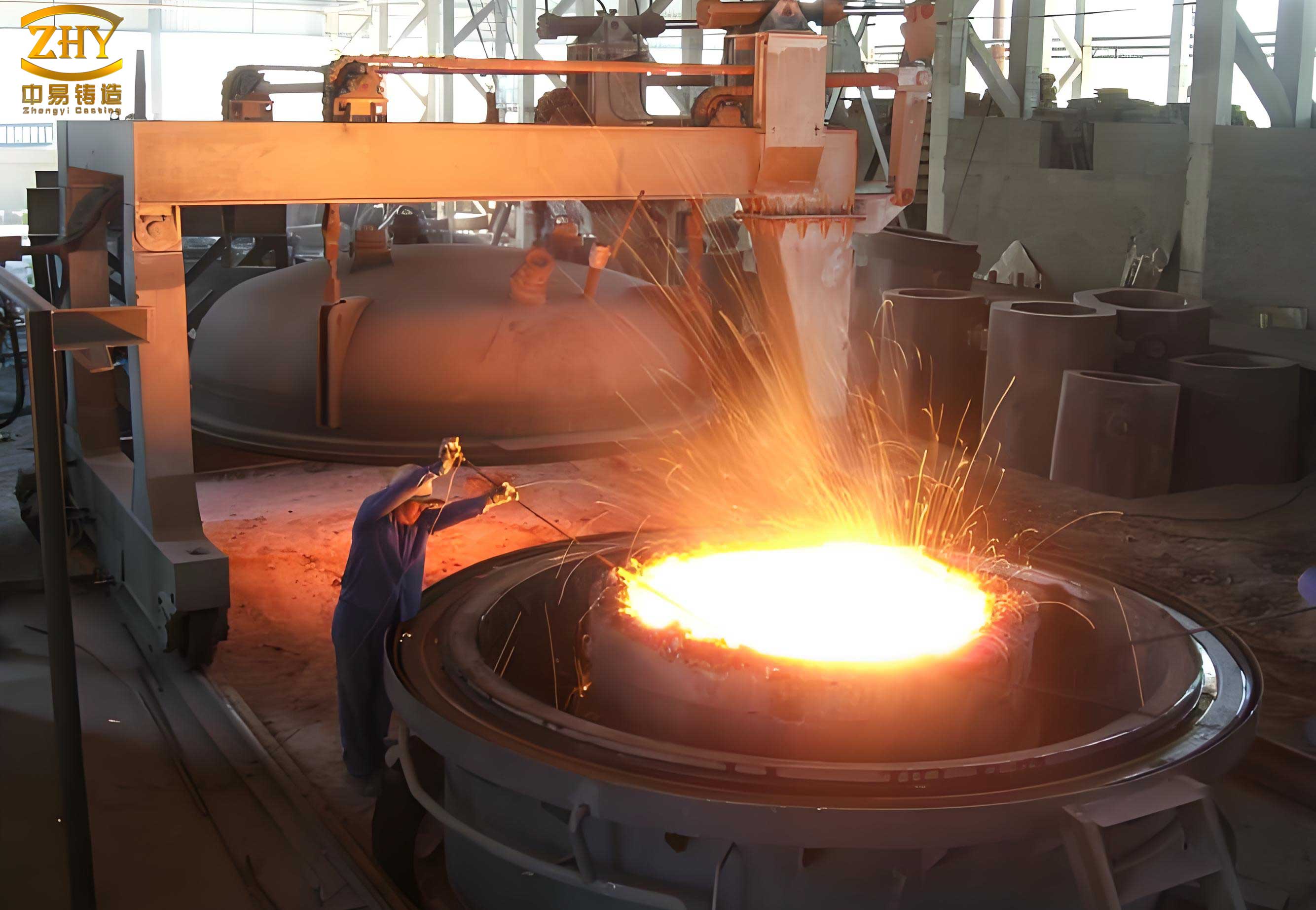
Motivated by the specific service conditions of these liners and the inherent properties of high manganese steel—namely its excellent fluidity even near its liquidus temperature (approximately 1340°C)—a project was initiated to eliminate risers. The core hypothesis was that by enforcing a truly simultaneous solidification regime through controlled cooling in dry sand under vacuum, the liquid metal contraction could be minimized and centralized in a non-detrimental location within the casting cross-section.
Feasibility Analysis for Riserless High Manganese Steel Casting
The justification for adopting a riserless approach rests on two interconnected pillars: solidification control and component functionality.
1. Solidification Control via the EPC Process: The expendable pattern casting process, when coupled with vacuum assistance, provides an unparalleled environment for achieving directional and simultaneous solidification. The vaporization of the foam pattern creates a slight delay at the metal-front, allowing the entire cavity to fill before significant heat loss occurs. The uniform thermal properties of the unbonded sand and the cooling effect of the vacuum draw promote heat extraction evenly from all surfaces of the casting. This is critical for achieving the desired solidification pattern. The foundation of riser design is Chvorinov’s Rule, which states that solidification time is proportional to the square of the volume-to-surface area ratio:
$$ t_f = B \left( \frac{V}{A} \right)^n $$
where \( t_f \) is the total solidification time, \( V \) is the casting volume, \( A \) is its surface area, \( B \) is a mold constant, and \( n \) is an exponent typically close to 2. In a conventional sand casting, variations in section thickness create significant differences in local \( V/A \) ratios, necessitating risers to feed heavier sections. The EPC-vacuum process, by promoting more uniform heat extraction, effectively minimizes these differences, allowing sections of moderate and relatively uniform thickness—like these liners—to solidify nearly simultaneously. In the complete absence of risers, the final liquid pool and the associated volumetric shrinkage from liquid to solid (typically 4-6% for high manganese steel) will be concentrated along the thermal centerline (or hot spot) of the casting. This manifests as a centralized zone of micro-porosity or axial looseness.
2. Functional Justification Based on Service Life: The second pillar addresses whether this inherent central unsoundness compromises the liner’s performance. Analysis of the wear mechanism is key. These liners fail primarily by gradual thickness reduction due to surface loss from impact and gouging. Their service life is defined by the time it takes for the wearing surface to recede to a minimum safe thickness. Crucially, the wear progression is a surface phenomenon. The postulated axial shrinkage zone remains embedded within the body of the material throughout most of the component’s life. The liner is typically replaced long before the wear depth approaches this internal zone. Therefore, the presence of this controlled internal porosity does not affect the active wear resistance or the structural integrity required for its mounting and service. This principle can be conceptually modeled: if the wear rate is \( W_r \) (mm per million tons processed) and the initial thickness is \( T_i \), the liner is replaced at a minimum thickness \( T_{min} \). The condition for the porosity zone at depth \( D_p \) to be irrelevant is:
$$ T_{min} > D_p $$
For well-designed, uniform-section liners, \( D_p \) is small relative to \( T_i – T_{min} \), validating the riserless approach.
The following table summarizes the core rationale for the riserless high manganese steel casting process:
| Aspect | Traditional Challenge | Riserless EPC-Vacuum Solution | Technical Basis |
|---|---|---|---|
| Feeding & Shrinkage | Large risers required; difficult removal. | Simultaneous solidification centralizes micro-porosity in non-critical area. | Chvorinov’s Rule applied under uniform cooling. Centralized shrinkage is functionally acceptable. |
| Thermal Stress | Low conductivity leads to hot tears, especially near risers. | Elimination of thermal hot spots from risers reduces stress concentration. | More uniform temperature gradient during solidification and cooling. |
| Process Yield | Low (typically 50-65%) due to large riser volume. | High (increased by >20%). Metal is used only for the casting. | Riser metal, often 30-40% of total poured weight, is eliminated. |
| Post-Casting Operation | Oxy-fuel cutting of risers is slow, costly, and hazardous. | Riser cutting operation is completely eliminated. | No secondary thermal process required before heat treatment. |
Core Process Essentials for Riserless High Manganese Steel Casting
The success of riserless high manganese steel casting hinges on meticulous control over every step, from pattern making to heat treatment. Deviation can lead to incomplete fills, penetration defects, or unacceptable levels of internal porosity.
1. Expandable Polystyrene (EPS) Pattern Requirements: The quality of the foam pattern is the first critical control point.
- Density: Patterns must be fabricated from EPS with a minimum density of 18 kg/m³. Lower density foam degrades too rapidly during metal pouring, producing excessive gaseous products that can lead to laps or folds in the casting.
- Dimensional Accuracy & Shrinkage Allowance: The pattern dimensions must incorporate a shrinkage allowance that accounts for both the foam’s behavior and the metal’s contraction. This allowance is empirically determined and varies based on pattern geometry and density. A typical allowance for high manganese steel in this process ranges from 2.3% to 2.6%.
- Drying: All patterns must undergo a thorough drying cycle after fabrication to eliminate any residual moisture from the molding process, which would otherwise contribute to gas defects.
2. Coating Formulation and Application: The refractory coating applied to the foam pattern serves multiple vital functions: it provides a barrier to prevent sand penetration, facilitates the escape of pyrolysis gases, and contributes to the cooling rate. A proprietary coating formulation was developed, with its composition detailed below:
| Component | Type | Function | Approximate % |
|---|---|---|---|
| Fused Magnesia Powder | Refractory Aggregate | Provides high-temperature stability and resistance to metal penetration. | Base Material (~100 parts by weight) |
| Polyvinyl Acetate (PVA) Emulsion | Binder | Green strength and adhesion to the EPS pattern. | 3-5% (of aggregate weight) |
| Sodium-based Bentonite | Suspension Agent | Prevents settling of heavy magnesia particles in the slurry. | 1-2% |
| Water-soluble Phenolic Resin | Binder | Enhances high-temperature strength and coating integrity. | 1-2% |
| Carboxymethyl Cellulose (CMC) | Thickener | Controls slurry viscosity for consistent coating thickness. | 0.1-0.3% |
| Sodium Hexametaphosphate | Dispersant | Improves particle dispersion and slurry fluidity. | 0.05-0.1% |
The coating must exhibit excellent rheology for dip application, forming a uniform layer without runs or drips. The target dry coating thickness is a minimum of 2.0 mm. Achieving this requires two consecutive dipping cycles.
3. Coating Drying and Pattern Assembly: Proper drying is non-negotiable. The first coat requires a minimum of 6 hours of forced air drying at 40-50°C. After the second coat, the drying time must extend to at least 8 hours. The pattern assembly, including the attached gating system (typically a bottom-filling design to ensure calm metal entry), must be completely dry to the touch before proceeding to molding. Any residual moisture will turn to steam upon metal contact, risking blowholes or even violent eruptions.
4. Molding and Compaction Procedure: The process uses a standard flask (1500mm x 1500mm x 1300mm) equipped for vacuum extraction on five sides. The molding medium is dry, washed silica sand. The procedure is strict:
- A base layer of sand is placed in the flask.
- The dried pattern cluster is positioned, and pouring cups/gates are carefully sealed with refractory paste to prevent sand ingress.
- Sand is added in stages, not exceeding 300 mm in depth per stage.
- After each sand addition, the flask is subjected to systematic, multi-axis vibration to achieve optimal and uniform compaction. The goal is a high, consistent bulk density without pattern distortion.
- Vibration is stopped before adding the next layer of sand. The process of “sand-fill then vibrate” is repeated until the flask is full. Simultaneous sand filling and vibration leads to uneven compaction and must be avoided.
- A plastic film is placed over the top of the flask and connected to the vacuum system.
Melting, Composition Control, and Pouring Practice
The metallurgical quality of the high manganese steel casting begins at the melt. A 5-ton electric arc furnace is used for primary melting to achieve the precise chemical composition required by standard ZGMn13-2 (similar to ASTM A128 Grade B4). The target composition is critical for achieving the final wear-resistant austenitic structure after heat treatment.
$$ \text{Target Composition (wt\%):} \quad C: 1.10-1.30,\quad Mn: 11.5-13.0,\quad Si: 0.40-0.80,\quad P \leq 0.070,\quad S \leq 0.035 $$
Lower phosphorus is particularly sought to minimize embrittlement. After tapping into an 8-ton pre-heated ladle, the steel is allowed to “quiet” or settle for a minimum of 6 minutes. This holding period is crucial for temperature homogenization, slag separation, and the flotation of non-metallic inclusions. Pouring temperature is the single most critical parameter for the riserless process. Excessive temperature increases total liquid contraction and can destabilize the simultaneous solidification front. The optimal range, as measured by a submerged quick-response thermocouple, is 1420–1430°C. A practical shop-floor check involves immersing a clean, dry mild steel rod into the ladle for several seconds; upon removal, the degree of metal adherence gives a reliable indication of the steel’s fluidity and approximate temperature.
Pouring Protocol under Vacuum: The vacuum pump must be activated at least 3 minutes before pouring to establish a stable, reduced pressure within the sand mass. The vacuum level is maintained between -0.45 MPa and -0.50 MPa (approx. 13.5-15 inHg). This negative pressure strengthens the mold, helps evacuate foam pyrolysis products through the coating, and enhances metal fluidity. The pour itself must be swift and continuous—once begun, the stream must not be interrupted until the pouring cup is full and visible metal is present. A break in the stream can allow air aspiration, leading to oxidation and cold shuts.
Heat Treatment: Achieving the Austenitic Structure
The as-cast high manganese steel casting contains a network of brittle carbides at the grain boundaries, rendering it hard and unusable. The water quenching (water toughening) process transforms this structure into a single-phase, ductile austenite with exceptional work-hardening capability. The cycle must be precisely controlled:
- Heating: Castings are loaded into a furnace at a low temperature. The heating rate to approximately 600°C is controlled to ≤100°C/hour to avoid thermal cracking from residual stresses and the volumetric changes during carbide dissolution.
- Soaking/Austenitization: The charge is held at a temperature between 1080°C and 1100°C. The holding time is a function of section thickness and furnace load; a rule of thumb is 1 hour per 25 mm of thickness, with a minimum of 4 hours for liner sections. This ensures complete dissolution of carbides into the austenite matrix. The equilibrium condition can be approximated by the solubility product:
$$ [\%C] \cdot [\%Mn] \approx K(T) $$
where \( K(T) \) increases with temperature, favoring carbide dissolution at the soaking temperature. - Quenching: This is the most critical step. Castings must be rapidly transferred from the furnace and immersed in the quench tank before their temperature falls below 960°C to prevent reprecipitation of carbides. The quench water must be agitated and its volume must be at least 10 times the weight of the quenched load. The initial water temperature should be below 35°C. The castings are held submerged for a minimum of 40 minutes to ensure cooling below approximately 200°C. After quenching, the microstructure is a uniform, tough austenite with a hardness of approximately 200 HB, which can work-harden in service to over 550 HB.
The key parameters for successful heat treatment of high manganese steel castings are summarized below:
| Process Stage | Key Parameter | Target Value / Range | Rationale |
|---|---|---|---|
| Heating | Heating Rate (to ~600°C) | ≤ 100 °C / hour | Prevents thermal shock and cracking during phase transformations. |
| Austenitizing | Temperature | 1080 – 1100 °C | Fully dissolves carbides into solid solution. |
| Austenitizing | Time at Temperature | 4 hours (minimum) | Ensures complete diffusion and homogenization. |
| Transfer & Quench | Delay (Furnace to Quench) | Minimize; Metal Temp ≥ 960°C | Prevents deleterious carbide precipitation on cooling. |
| Quenching | Water Temperature (Start) | < 35 °C | Ensures high cooling rate through critical temperature range. |
| Quenching | Water Volume / Charge Weight | > 10 : 1 | Limits water temperature rise to maintain quenching severity. |
| Quenching | Immersion Time | ≥ 40 minutes | Guarantees cooling below ~200°C throughout the section. |
Conclusion and Economic Impact
The implementation of the riserless high manganese steel casting process for grinding mill liners has demonstrated conclusive technical and commercial success. Multiple sets of liners produced for different mining operations have consistently exceeded 24 months of severe service without failure, validating the initial hypothesis regarding the acceptability of controlled internal porosity.
The benefits of this methodology for high manganese steel casting are substantial and multi-faceted:
1. Enhanced Quality and Consistency: By eliminating the thermal mass of risers, the process reduces thermal gradients, minimizing the risk of hot tears and promoting a more uniform metallurgical structure. The challenges associated with riser removal—such as potential damage from cutting or grinding—are completely avoided.
2. Dramatic Improvement in Yield: The process yield, defined as the weight of good castings divided by the total weight of metal poured, increased by over 20 percentage points. In practical terms, this means more liners can be produced from the same amount of liquid steel, representing a direct saving in raw material (ferroalloys, energy for melting) cost. The yield improvement \( \Delta Y \) can be expressed as:
$$ \Delta Y = Y_{\text{new}} – Y_{\text{old}} = \left( \frac{W_{\text{casting}}}{W_{\text{casting}} + W_{\text{gating}}} \right)_{\text{new}} – \left( \frac{W_{\text{casting}}}{W_{\text{casting}} + W_{\text{riser}} + W_{\text{gating}}} \right)_{\text{old}} $$
where \( W_{\text{riser}} \) in the old process was a significant fraction of the total pour weight.
3. Elimination of a Costly and Hazardous Operation: The oxy-fuel cutting of high manganese steel risers is a slow, energy-intensive, and skill-dependent process that generates fumes and consumes gases. Its complete removal streamlines production flow, reduces labor costs, and improves shop floor safety.
4. Reduction in Finishing Labor: Without large riser pads to grind flush, the post-heat-treatment finishing operation is significantly faster and less labor-intensive.
In summary, the riserless high manganese steel casting process via the EPC-vacuum method is not merely a theoretical alternative but a proven, robust manufacturing route for a specific class of wear parts. Its success is predicated on a deep understanding of the alloy’s solidification behavior, a rigorous application of process controls, and a clear-eyed assessment of the component’s functional requirements. For foundries producing uniform-section, high-volume wear castings like mill liners, this approach offers a compelling pathway to higher quality, reduced cost, and a stronger competitive position. The journey from conventional practice to this efficient method underscores the potential for innovation within the established domain of high manganese steel casting.