
In my extensive experience with metallurgical practices, the application of rare earth (RE) modification to high manganese steel castings has emerged as a pivotal technique for enhancing mechanical properties. However, the persistent challenge lies in achieving consistent quality. Variability in outcomes, sometimes leading to detrimental effects like metal “contamination,” underscores a fundamental gap in understanding the underlying mechanisms. Through years of research and practical application, I have come to recognize that stabilizing the quality of RE-modified high manganese steel castings hinges on a systematic approach. This approach is built on the principle that stable modification quality is predicated on stable modification processes; these processes are, in turn, ensured by fulfilling specific fundamental conditions in production; and these conditions are realized through targeted operational strategies. This article delves into this stability framework, exploring the core conditions, their mechanistic bases, and supportive methodologies, all while emphasizing the critical role of precise control in producing superior high manganese steel castings.
The cornerstone of quality begins with stringent control over the chemical composition of the high manganese steel casting. The standard grades, such as those akin to Hadfield steel, have theoretical compositions, but practical production demands tailored control compositions based on casting geometry and size. The interplay of manganese (Mn) and carbon (C) is paramount. A key relationship that governs both toughness and work-hardening capacity is the Mn/C ratio. My observations align with the principle that when $Mn/C \geq 10$, an optimal balance is achieved. Excessive carbon, particularly beyond 1.2%, promotes the formation of coarse primary carbides and a significant increase in carbide volume fraction, which embrittles the high manganese steel casting. The carbon content should be maintained at $C \leq 1.2\%$. While increased manganese content can slightly coarsen carbides, it more beneficially disrupts their continuity, preventing harmful continuous networks. This can be expressed by considering the carbide volume fraction $V_c$ as a function of composition:
$$ V_c \approx f(C, Mn, Si) $$
Where $f$ denotes a complex relationship. Silicon (Si) is another critical element; high Si levels, typically above 0.6%, accelerate carbide coarsening and foster the formation of those detrimental continuous networks. Therefore, silicon should be controlled at $Si \leq 0.6\%$. Other residuals like sulfur and phosphorus must be kept low to prevent hot tearing and embrittlement: $S \leq 0.06\%$ and $P \leq 0.07\%$. The following table summarizes the recommended composition ranges for a stable high manganese steel casting base prior to RE modification.
| Element | Symbol | Recommended Control Range (%) | Primary Effect |
|---|---|---|---|
| Carbon | C | ≤ 1.20 | Controls carbide formation and hardness |
| Manganese | Mn | 11.0 – 14.0 | Ensures austenite stability, influences Mn/C ratio |
| Silicon | Si | ≤ 0.60 | Minimizes carbide coarsening and networking |
| Sulfur | S | ≤ 0.06 | Reduces hot shortness and inclusions |
| Phosphorus | P | ≤ 0.07 | Mitigates cold brittleness |
Achieving a superior high manganese steel casting is not merely about composition; effective deoxidation is a non-negotiable prerequisite. High manganese steel melt contains substantial dissolved oxygen, primarily as MnO due to manganese’s high affinity for oxygen. MnO has significant solubility in the steel melt. If deoxidation is inadequate, introducing rare earth elements leads to their immediate oxidation, forming high-melting-point complex compounds like RE-oxides, RE-oxy-sulfides, etc. The reaction can be simplified as:
$$ [RE] + (MnO) \rightarrow (RE_xO_y) + [Mn] $$
Under the time constraints of typical modification treatment (reaction and holding periods), these fine, dispersed RE-containing compounds cannot adequately coalesce and float into the slag. Consequently, they remain as non-metallic inclusions within the melt. When the concentration of these inclusions exceeds the pre-treatment level, it results in the so-called “contamination” of the steel, severely undermining the refining and grain nucleation effects of the rare earths. This accelerates the fade or recession of the modification effect. Therefore, a thorough pre-deoxidation using elements like aluminum or calcium-silicon is essential to lower the active oxygen potential before RE addition, creating a cleaner melt matrix for effective RE modification of the high manganese steel casting.
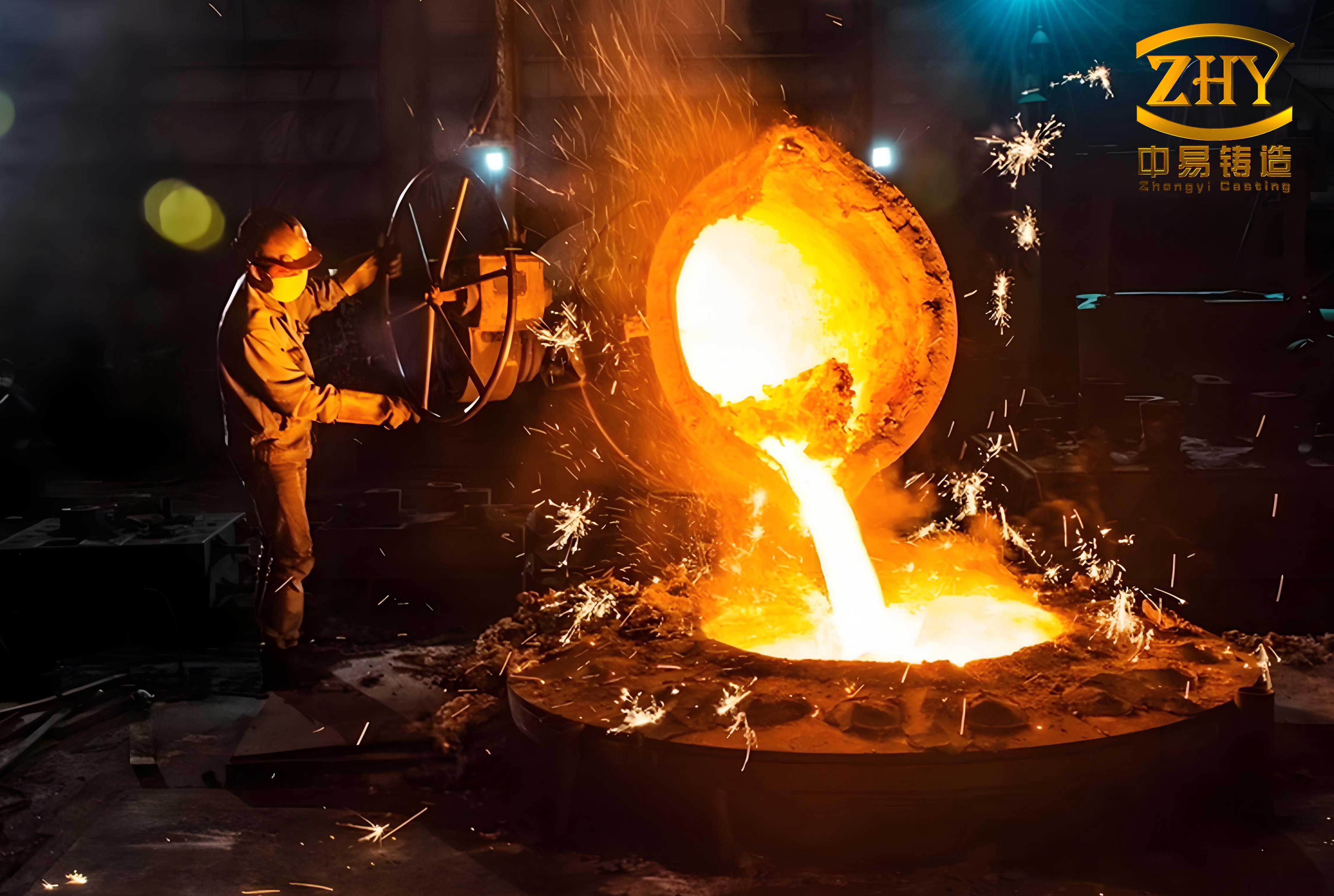
The temperature at which the RE modifier is introduced profoundly impacts the efficacy of the treatment for high manganese steel castings. Empirical data from production, akin to the referenced study, consistently shows superior impact toughness results from high-temperature modification compared to low-temperature addition. In my practice, high-temperature modification involves adding the RE alloy when the melt temperature is approximately 1550°C, whereas low-temperature modification occurs around 1400°C. The mechanistic explanation is rooted in solidification thermodynamics. Consider the vertical section of the Fe-Mn-C phase diagram for a ~13% Mn alloy. The liquidus temperature $T_L$ for a given carbon content can be approximated. For a standard high manganese steel casting composition, $T_L$ is typically above 1400°C. Adding RE at temperatures significantly above the liquidus (high-temperature modification) ensures the modifier is fully dissolved and uniformly distributed in a completely liquid melt, allowing sufficient time for interfacial reactions and heterogeneous nucleation site formation. Adding near or just above the liquidus (low-temperature modification) risks partial solidification or increased melt viscosity, hindering uniform dispersion and reaction kinetics. This can be conceptualized by the undercooling $\Delta T$ available for grain refinement:
$$ \Delta T_{effective} = T_{pour} – T_N $$
Where $T_N$ is the nucleation temperature enhanced by RE particles. High-temperature processing maximizes the time-integrated effect of these nuclei. The superiority is clear from toughness data, as illustrated in the following comparative table.
| Sample Set | High-Temp Modification (ak, J/cm²) | Low-Temp Modification (ak, J/cm²) | Improvement Factor |
|---|---|---|---|
| 1 | 224 | 113 | ~1.98 |
| 2 | 233 | 131 | ~1.78 |
| 3 | 228 | 141 | ~1.62 |
| 4 | 241 | 121 | ~1.99 |
| 5 | 237 | 133 | ~1.78 |
| Average | 232.6 | 127.8 | ~1.82 |
The selection of the RE modifier type, its addition amount, and the specific addition protocol are the final pillars of the stable process. Numerous RE alloys are available, primarily based on cerium (Ce)-rich mischmetal from the light rare earth group. The choice depends on the targeted residual RE content and cost-effectiveness. The optimal residual RE content in the final high manganese steel casting, from my work, lies between 0.020% and 0.030%. This range maximizes the grain refining and inclusion morphology control without causing excessive intermetallic formation. The addition amount $W_{RE}$ (in kg) can be calculated based on the melt weight $M$ (kg), target recovery rate $\eta$ (typically 20-40% for single addition), and desired residual content $[RE]_{res}$ (in wt%):
$$ W_{RE} = \frac{M \cdot [RE]_{res}}{\eta \cdot C_{RE}} $$
where $C_{RE}$ is the RE content in the master alloy. Regarding addition technique, while ladle (tap stream) addition is common, a two-step process—adding a portion into the furnace during final stages followed by a final adjustment in the ladle—often yields more consistent and recoveries. This two-step method aligns better with the modification mechanism by allowing initial reaction in a larger, more turbulent bath and final micro-adjustment, ensuring homogeneity for the high manganese steel casting.
The fundamental conditions form the core, but several auxiliary strategies significantly bolster the consistency and performance of RE-modified high manganese steel castings. First, adopting a rapid melting practice minimizes the melt’s exposure time at high temperature, thereby reducing gas pickup (hydrogen, nitrogen) and excessive oxidation. This results in a cleaner, healthier melt foundation. Second, meticulous preheating of all additions—fluxes, alloys, deoxidizers, modifiers, and even the ladle—to at least 200-300°C is crucial. This prevents thermal shock, moisture introduction (a source of hydrogen), and promotes faster dissolution. Coupled with strict control of mold and core moisture, it eliminates a major source of gas porosity and pinholes in the high manganese steel casting.
Third, applying a carbonaceous coating to the mold cavity or the casting surface prior to heat treatment is a valuable trick. During the solution heat treatment (water quenching or “water toughening”), the high manganese steel casting surface can suffer from decarburization, leading to a soft ferrite layer that impairs wear resistance. The carbonaceous coating creates a locally reducing atmosphere, mitigating carbon loss and preserving surface integrity. Fourth, the water quenching process itself demands attention. Merely immersing the casting is insufficient; vigorous agitation of the quenching medium is essential. As schematically represented, using pumps or mechanical stirgers to create a turbulent flow ensures rapid and uniform heat extraction across the entire casting section, preventing the formation of soft transformation products like pearlite and ensuring a fully austenitic microstructure with dispersed carbides.
Fifth, for castings that distort during quenching, corrective measures should be applied in the temperature range of 400-550°C. At this temperature, the high manganese steel casting retains sufficient ductility to allow for mechanical straightening without inducing cold cracking, which is a risk at room temperature due to the material’s high work-hardening rate. Finally, subjecting the finished high manganese steel casting to shot peening or blast cleaning is highly recommended. This process induces a compressive residual stress layer on the surface and provides a mild work-hardening effect, effectively increasing the initial surface hardness. This is particularly beneficial for wear applications, as it improves the in-service work-hardening response from the very start of the component’s life.
To deepen the understanding, let’s consider the solidification kinetics influenced by RE modification. The grain refinement mechanism can be modeled using the free growth model undercooling. The presence of RE-containing particles (e.g., RE2O3, RE2O2S) acts as potent heterogeneous nucleation sites for austenite grains. The critical radius $r^*$ for a nucleus on a substrate is given by:
$$ r^* = -\frac{2 \gamma_{SL}}{\Delta G_v} $$
Where $\gamma_{SL}$ is the solid-liquid interfacial energy and $\Delta G_v$ is the volume free energy change. RE particles lower the effective $\gamma_{SL}$ for austenite nucleation, reducing $r^*$ and increasing the nucleation rate $I$:
$$ I = I_0 \exp\left(-\frac{\Delta G^*}{kT}\right) $$
where $\Delta G^*$ is the activation energy barrier, reduced by the catalytic potency factor $f(\theta)$ of the substrate. This leads to a finer as-cast grain structure, which directly translates to improved toughness and more uniform properties in the final high manganese steel casting. Furthermore, the modification effect on inclusions alters the stress concentration factors. The aspect ratio of inclusions, a key parameter affecting ductility, is reduced as RE modifies elongated MnS and other sulfides into globular, less harmful oxy-sulfides. The stress concentration factor $K_t$ for an elliptical inclusion is related to its aspect ratio $a/b$:
$$ K_t \approx 1 + 2\sqrt{\frac{a}{b}} $$
RE modification promotes $a/b \rightarrow 1$, thus minimizing $K_t$ and enhancing the ductility and fatigue resistance of the high manganese steel casting.
The journey towards a flawless high manganese steel casting involves navigating complex interdependencies. While production facilities may vary in melting equipment (induction vs. arc furnace), molding methods (sand casting vs. investment), and heat treatment setups, the principles remain universal. By first securing the fundamental conditions—precise composition control, effective deoxidation, optimal modification temperature, and calculated modifier addition—the pathway to stable quality becomes clear. Subsequent implementation of tailored auxiliary strategies then locks in this stability. It is this holistic, system-oriented approach that transforms the art of RE modification into a reliable science. The outcome is not just a high manganese steel casting that meets specifications, but one that consistently delivers exceptional performance in the most demanding wear and impact applications, thereby validating the widespread adoption and continuous refinement of this valuable technology.
In conclusion, the quest for quality stability in RE-modified high manganese steel castings is a multifaceted endeavor grounded in metallurgical principles. Through deliberate control of chemical composition, melt cleanliness, processing temperatures, and addition methodologies, a robust foundation is established. Augmenting this with supportive practices like rapid melting, proper preheating, protective coatings, agitated quenching, hot correction, and surface peening creates a comprehensive quality assurance system. Each high manganese steel casting produced under this regime embodies the synergy of these elements, resulting in a product characterized by superior and consistent toughness, wear resistance, and overall reliability. As the industry continues to evolve, further research into the nano-scale interactions of rare earths with the steel matrix and advanced process monitoring techniques will undoubtedly push the boundaries of what is achievable, solidifying the position of RE-modified high manganese steel castings as a material of choice for critical engineering applications.