
In my extensive experience within the foundry industry, the production of high manganese steel casting components, particularly liners for large grinding mills, has always presented a significant technical challenge. The inherent properties of high manganese steel casting, such as its exceptional work-hardening capability and toughness, make it ideal for abrasive and impact-intensive environments. However, achieving consistent quality and extended service life requires meticulous control over every aspect of the manufacturing process. This article delves deeply into the comprehensive methodology I have developed and refined for producing superior high manganese steel casting parts, specifically focusing on the application of rare earth (RE) modification and integrated process optimization. The goal is to share a detailed, first-person perspective on the metallurgical and engineering principles that underpin successful high manganese steel casting production.
The foundation of any high-quality high manganese steel casting lies in its chemical composition. For grades like ZGMn13, the primary elements—carbon (C), manganese (Mn), and silicon (Si)—must be balanced precisely, while harmful elements like sulfur (S) and phosphorus (P) are minimized. In my practice, for large-diameter wet grinding mill liners operating in alkaline slurry conditions, I have optimized the composition to enhance both mechanical properties and corrosion resistance. The key relationship is the Mn/C ratio, which critically influences the stability of the austenitic matrix and the behavior of carbides. I control the carbon content between 1.0% and 1.2% and manganese between 11% and 14%, aiming for an Mn/C ratio of approximately 11. Additionally, chromium (Cr) is added in the range of 2.5% to 3.5% to improve corrosion resistance. The detailed compositional specifications I adhere to are summarized in Table 1.
| Element | Content (wt.%) |
|---|---|
| C | 1.0 – 1.2 |
| Si | 0.3 – 0.6 |
| Mn | 11 – 14 |
| Cr | 2.6 – 3.2 |
| S | ≤ 0.04 |
| P | ≤ 0.07 |
| RE (residual) | Trace |
| V, Ti | Trace |
The metallurgical quality of high manganese steel casting is paramount and is significantly enhanced through rare earth modification. The primary objectives in improving high manganese steel casting are threefold: to reduce the amount of carbide precipitation, to control the morphology of these carbides, and to refine and strengthen the austenitic matrix. This ensures that under service conditions, the material exhibits minimal deformation while rapidly developing a work-hardened surface. RE treatment, typically added at 0.1% in the ladle, fundamentally alters the solidification behavior. RE elements are potent surface-active agents that adsorb onto growing carbide interfaces, modifying their shape from continuous networks to more isolated, globular forms. This transformation can be conceptually described by considering the interfacial energy reduction. The change in Gibbs free energy for carbide formation with RE adsorption can be expressed as:
$$ \Delta G_{carbide}^{RE} = \Delta G_{carbide}^{0} – \Gamma_{RE} \cdot \sigma_{int} $$
where $\Delta G_{carbide}^{0}$ is the standard free energy change, $\Gamma_{RE}$ is the surface excess concentration of RE atoms, and $\sigma_{int}$ is the interfacial energy. The negative term promotes a change in precipitate morphology.
Furthermore, RE elements act as powerful deoxidizers and desulfurizers. They react with impurities like Al2O3, FeO, MnO, FeS, and MnS to form complex, low-density inclusions that float out into the slag. This purification effect drastically reduces the number of brittle, angular inclusions that typically weaken grain boundaries in conventional high manganese steel casting. The refinement of the austenite grain size is another critical benefit. RE addition increases the undercooling ($\Delta T$) during solidification, which in turn reduces the critical nucleus radius ($r^*$) according to classical nucleation theory:
$$ r^* = \frac{2 \gamma_{SL}}{\Delta G_v} \approx \frac{2 \gamma_{SL} T_m}{L_f \Delta T} $$
Here, $\gamma_{SL}$ is the solid-liquid interfacial energy, $\Delta G_v$ is the volumetric free energy change, $T_m$ is the melting point, and $L_f$ is the latent heat of fusion. A higher $\Delta T$ leads to a smaller $r^*$, resulting in a finer grain structure. The dramatic improvement in mechanical properties achieved through RE modification in high manganese steel casting is quantitatively demonstrated in Table 2.
| Material Grade | Tensile Strength, $\sigma_b$ (MPa) | Elongation, $\delta$ (%) | Impact Toughness, $\alpha_K$ (J/cm²) | Hardness (HBS) |
|---|---|---|---|---|
| Conventional ZGMn13 | 608 | 13 | 112 | 210 |
| RE-Modified High Manganese Steel | 916 | 34 | 187 | 224 |
A crucial in-process quality check I employ is the bend test performed on a sample cast directly from the furnace. The sample geometry, a critical factor for sensitivity, is designed with specific dimensions. I use a rectangular bar sample with a central reduced section. The sample is quenched in water at a temperature between 800°C and 900°C (visible as a yellow-red color). The resulting bend angle or the presence of cracks provides an immediate, qualitative assessment of the steel’s ductility and the effectiveness of the RE treatment before proceeding to full-scale casting of high manganese steel components. This simple test is a vital gatekeeper for冶金 quality.
The casting process itself for high manganese steel casting demands careful engineering to prevent defects and ensure soundness. For large liner castings, I use a CO2-hardened sodium silicate sand system for the mold. However, to address the issue of chemical burn-on caused by the reaction between MnO and acidic SiO2 in the sand—which is particularly severe in core areas—I employ furan resin sand for the complex core sections. This combination minimizes veining and improves surface finish. The mold coatings are equally critical; I apply a magnesite-based alcohol coating to the mold surfaces to create a refractory barrier. Furthermore, stress concentration points in the liner design are mitigated by incorporating generous fillets and radii in the pattern.
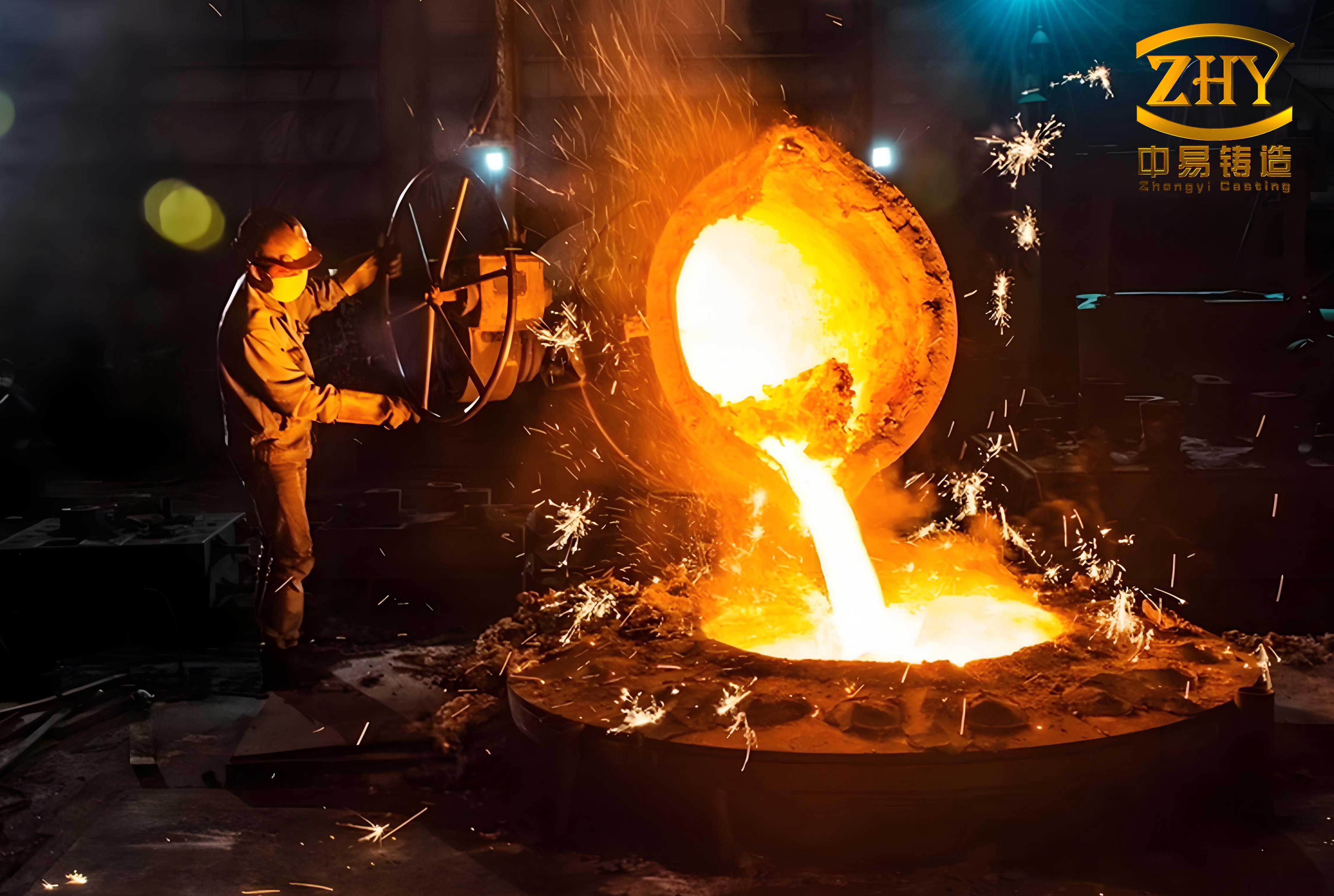
Pouring parameters are precisely defined. The tapping temperature from the furnace is maintained between 1480°C and 1520°C, followed by a brief holding period for slag removal and temperature homogenization. The pouring temperature is controlled within 1400°C to 1450°C. A controlled pouring sequence—slow initially to avoid turbulence, then fast to ensure complete filling, and slow again at the end to aid feeding—is executed, with the total pouring time for a large liner kept under 10 seconds. This regimen is essential for achieving optimal fluidity while minimizing oxidation and thermal gradients in this high manganese steel casting.
The heat treatment cycle is the final and most critical step in unlocking the properties of high manganese steel casting. The process is a solution heat treatment, commonly known as water toughening. The objective is to dissolve all carbides into the austenite matrix. The heating rate must be controlled, especially for thick-section castings, to prevent thermal cracking. I typically use a multi-stage heating profile with soaking periods at intermediate temperatures like 350°C and 650°C. The final solutionizing temperature is rigorously maintained at $1050 \pm 10$°C. The holding time ($t$) can be estimated based on the section thickness ($d$) using a diffusion-controlled model:
$$ t \propto \frac{d^2}{D} $$
where $D$ is the diffusion coefficient of carbon in austenite at the solution temperature. After sufficient soaking, the quench must be rapid and uniform. The castings are transferred from the furnace to the quench tank in less than 10 seconds to prevent any carbide reprecipitation during cooling. The quench water temperature is kept below 50°C using a circulation system to maintain a high cooling rate and ensure full supersaturation of carbon in austenite. The success of this high manganese steel casting heat treatment is evident in the fully austenitic, carbide-free microstructure that provides the remarkable work-hardening capability.
In modern foundry practice, the integration of computer simulation has revolutionized the design and optimization of processes for complex castings like high manganese steel casting components. While the aforementioned practices are applied to liner production, the principles extend to other geometries. For instance, in the production of an axle housing—another critical safety component—I leverage simulation software to virtually test and refine the gating and feeding system before any metal is poured. The process begins with creating a detailed 3D model of the casting, such as the one shown conceptually earlier. The simulation software solves the fundamental equations of fluid flow, heat transfer, and solidification. The Navier-Stokes equations for fluid flow and the energy equation for heat transfer are computed:
$$ \rho \left( \frac{\partial \mathbf{v}}{\partial t} + \mathbf{v} \cdot \nabla \mathbf{v} \right) = -\nabla p + \mu \nabla^2 \mathbf{v} + \rho \mathbf{g} $$
$$ \rho C_p \frac{\partial T}{\partial t} = \nabla \cdot (k \nabla T) + Q_{latent} $$
where $\rho$ is density, $\mathbf{v}$ is velocity, $p$ is pressure, $\mu$ is viscosity, $\mathbf{g}$ is gravity, $C_p$ is specific heat, $k$ is thermal conductivity, $T$ is temperature, and $Q_{latent}$ is the latent heat source term. By applying these simulations to the high manganese steel casting process, I can predict potential defects like shrinkage porosity, hot tears, and mistruns. An initial conservative gating design might place the casting horizontally with multiple risers. Simulation often reveals that this leads to unnecessary complexity or thermal hotspots. An optimized design, derived iteratively through simulation, might use a more efficient vertical gating system with chills to promote directional solidification. The quantitative comparison of two such designs for a hypothetical axle housing casting can be summarized in Table 3.
| Design Parameter | Conservative Design (Horizontal) | Optimized Design (Vertical with Chills) |
|---|---|---|
| Total Riser Volume (cm³) | 8500 | 5200 |
| Predicted Shrinkage Porosity Volume (cm³) | 45 | < 5 |
| Filling Time (s) | 8.5 | 6.2 |
| Maximum Temperature Gradient (°C/cm) | 15 | 28 |
| Yield (Casting Weight / Total Pour Weight) | 64% | 78% |
The table clearly shows the benefits of simulation-driven optimization for high manganese steel casting: reduced riser metal consumption, lower defect risk, faster filling, and a steeper thermal gradient conducive to sound feeding. This virtual trial-and-error process eliminates the cost and time associated with physical prototyping, ensuring that the first casting produced from the optimized pattern is of high quality. This methodology is perfectly applicable to the production of large, complex high manganese steel casting liners as well.
Expanding further on the science behind high manganese steel casting, the work-hardening mechanism itself is a fascinating area. The austenitic matrix of high manganese steel casting is metastable. Under impact or abrasion, deformation induces a strain-induced transformation to martensite (ε-martensite or α’-martensite) and creates a high density of dislocations. The flow stress ($\sigma_f$) increases with strain ($\epsilon$) according to a relationship that can be approximated by:
$$ \sigma_f = \sigma_0 + K \epsilon^n $$
where $\sigma_0$ is the initial yield strength, $K$ is the strength coefficient, and $n$ is the work-hardening exponent. In RE-modified high manganese steel casting, the finer grain size (according to the Hall-Petch relationship, $\sigma_y \propto d^{-1/2}$) and cleaner matrix provide more nucleation sites for this transformation and hinder dislocation motion, leading to a higher $n$ value and more rapid surface hardening. This is why the optimized high manganese steel casting liner lasts significantly longer in service.
In conclusion, the production of superior high manganese steel casting components is a multifaceted endeavor that integrates precise chemical control, advanced冶金 techniques like rare earth modification, meticulous process engineering, and state-of-the-art simulation tools. From the fundamental control of the Mn/C ratio and the transformative effects of RE on carbide morphology and grain refinement, to the precise orchestration of pouring and heat treatment parameters, every step is critical. The adoption of computer simulation allows for the pre-emptive optimization of feeding and gating systems, reducing development time and ensuring soundness. The continuous pursuit of excellence in high manganese steel casting technology not only enhances the performance and longevity of critical industrial components like mill liners and axle housings but also drives forward the entire field of abrasion-resistant material engineering. The synergy between traditional metallurgical wisdom and modern computational power represents the future of reliable and efficient high manganese steel casting production.