
In the realm of advanced casting technologies, lost foam casting has emerged as a pivotal method for producing complex and high-integrity components, particularly for high manganese steel castings known for their exceptional wear resistance and toughness. The performance of these high manganese steel castings heavily relies on the quality of the coatings applied to the foam patterns, which must withstand high temperatures, prevent metal penetration, and ensure easy shakeout. Traditional coatings, such as alcohol-based magnesia or water-based corundum and zircon flour systems, often fall short due to safety hazards, high costs, and incompatibility with the alkaline nature of high manganese steel, leading to defects like sand adhesion. This study addresses these challenges by developing an optimized water-based coating tailored specifically for lost foam casting of high manganese steel castings, utilizing cost-effective materials and rigorous experimental methodologies. Our goal is to enhance the surface quality, dimensional accuracy, and production efficiency of high manganese steel castings while reducing environmental and economic burdens.
The core innovation lies in the selection of titanium slag powder as the primary refractory aggregate, derived as a by-product from ferroalloy production, which offers high alkalinity, excellent resistance to basic slag, and a refractory temperature exceeding 1600°C. This makes it ideal for withstanding the aggressive冲刷 of high manganese steel melt. Combined with a composite binder system of polyvinyl alcohol (PVA) for low-temperature strength and aluminum dihydrogen phosphate for high-temperature integrity, along with sodium bentonite as a suspending agent, water as the solvent, and minor additives like surfactants and defoamers, the coating formulation is designed to meet the stringent demands of lost foam casting for high manganese steel castings. The inclusion of a flux, specifically iron oxide (Fe2O3), further aids in improving surface finish and peel-off characteristics. Through a systematic orthogonal experimental approach, we optimized the composition to achieve superior performance in terms of suspension, permeability, strength, and thixotropy, ultimately validating the coating in real-world production scenarios for high manganese steel castings such as liner plates, hammer heads, and jaw plates.
| Component | Content Range (wt%) | Property | Value |
|---|---|---|---|
| TiO2 | 40-50 | Density | 3.2-3.5 g/cm3 |
| Al2O3 | 20-25 | Mohs Hardness | 6-7 |
| SiO2 | 10-15 | Refractoriness | >1600°C |
| CaO | 5-10 | Particle Size | 200 mesh (74 μm) |
| MgO | 3-5 | Alkalinity | Basic |
| Fe2O3 | 2-4 | Cost Comparison | Similar to refined quartz sand |
The preparation of the water-based coating involves a meticulous process to ensure homogeneity and performance. Initially, titanium slag powder and sodium bentonite are dry-mixed for approximately 10 minutes to achieve uniform dispersion. Subsequently, pre-prepared aqueous solutions of PVA (with a concentration of 5-10%) and aluminum dihydrogen phosphate (with a molar ratio of Al3+ to H2PO4– around 1:3, density of 1.4-1.5 g/cm3, and pH of 2-3, inhibited with trace oxalic acid) are added along with water and auxiliary agents like alkylbenzene sulfonic acid as a surfactant and n-octanol as a defoamer. The mixture is then wet-mixed for 20 minutes using a ball mill in production settings or stirred manually in lab-scale trials, resulting in a stable suspension ready for application. This process highlights the adaptability of the coating for both laboratory research and industrial-scale production of high manganese steel castings.
To evaluate the coating’s performance, we employed a suite of standardized tests focusing on key properties critical for lost foam casting of high manganese steel castings. Suspension stability was measured via the sedimentation method, where the percentage of settled solids in a 100 mL graduated cylinder after 24 hours indicates the suspending power, calculated as: $$ \text{Suspension} \% = \left(1 – \frac{V_{\text{sediment}}}{V_{\text{total}}}\right) \times 100\% $$ where \( V_{\text{sediment}} \) is the volume of precipitate and \( V_{\text{total}} \) is the initial volume. Permeability was assessed using a direct permeability tester on dried coating layers applied to standard sand samples, with results expressed in permeability units. Coating strength was determined by a sand abrasion test, where 50/70 mesh sand is dropped from a viscosity cup onto a coated glass plate until the coating is worn through; the total weight of sand required serves as a quantitative strength index. High-temperature cracking resistance was evaluated by coating water glass sand specimens, drying them, and subjecting them to rapid heating at 1000°C in a furnace, with crack formation observed visually. Thixotropy, essential for application behavior, was measured using a rotational viscometer (e.g., NDI-1 type), recording the apparent viscosity over time under constant shear rate to generate thixotropy curves. The thixotropy index is computed as: $$ \text{Thixotropy Index} = \frac{\eta_{1\text{min}} – \eta_{10\text{min}}}{\eta_{10\text{min}}} \times 100\% $$ where \( \eta_{1\text{min}} \) and \( \eta_{10\text{min}} \) are the viscosities at 1 minute and 10 minutes, respectively. Additional properties like density, pH, and adhesion were tested following established casting literature protocols, ensuring comprehensive characterization for high manganese steel castings.
| Experiment No. | Factor A: Bentonite Content (%) | Factor B: Aluminum Dihydrogen Phosphate Content (%) | Factor C: Flux (Fe2O3) Content (%) | Factor D: Titanium Slag Powder Base (Fixed) | Suspension (%) | Permeability | Coating Strength (g) |
|---|---|---|---|---|---|---|---|
| 1 | 2 | 3 | 0.5 | 100 parts | 92 | 8.5 | 650 |
| 2 | 2 | 4 | 1.0 | 100 parts | 88 | 9.0 | 720 |
| 3 | 2 | 5 | 1.5 | 100 parts | 85 | 8.8 | 680 |
| 4 | 3 | 3 | 1.0 | 100 parts | 90 | 9.2 | 700 |
| 5 | 3 | 4 | 1.5 | 100 parts | 87 | 9.5 | 750 |
| 6 | 3 | 5 | 0.5 | 100 parts | 89 | 9.0 | 710 |
| 7 | 4 | 3 | 1.5 | 100 parts | 86 | 8.7 | 690 |
| 8 | 4 | 4 | 0.5 | 100 parts | 91 | 9.3 | 730 |
| 9 | 4 | 5 | 1.0 | 100 parts | 88 | 9.1 | 740 |
The orthogonal experiment, based on an L9(34) array, was instrumental in identifying the optimal coating formulation for high manganese steel castings. Four key factors were varied at three levels each: bentonite content (2%, 3%, 4%), aluminum dihydrogen phosphate content (3%, 4%, 5%), flux content (0.5%, 1.0%, 1.5%), with titanium slag powder held constant as the base refractory material. The responses measured included suspension percentage, permeability, and coating strength, as summarized in Table 2. Analysis of variance (ANOVA) and range analysis were performed to determine the influence of each factor on the properties. For suspension, higher bentonite content generally improved stability but at the expense of permeability, as bentonite acts as a suspending agent but can reduce pore connectivity. Aluminum dihydrogen phosphate enhanced high-temperature bonding, directly correlating with coating strength, while the flux aided in surface smoothness without compromising other attributes. The optimal combination was derived by balancing these effects: bentonite at 3%, aluminum dihydrogen phosphate at 4%, and flux at 1.0%, which maximized overall performance for high manganese steel castings. This formulation ensured a suspension of 90%, permeability of 9.5, and strength of 750 g, meeting the rigorous demands of lost foam casting processes.
Upon determining the optimal recipe, we conducted in-depth evaluations of the coating’s comprehensive properties to verify its suitability for high manganese steel castings. The coating demonstrated excellent application characteristics, with a density of 1.8-2.0 g/cm3 and pH around 8-9, facilitating easy brushing, dipping, spraying, or flowing onto foam patterns of varying geometries—flat, convex, or concave surfaces. After drying naturally or in ovens, the coating formed a uniform layer with thickness controllable between 0.5-1.0 mm in a single application, exhibiting high surface hardness, wear resistance, and no cracking or peeling. The thixotropic behavior was particularly noteworthy; as shown in Figure 1, the apparent viscosity decreased significantly over time under constant shear, from an initial 450 mPa·s at 1 minute to 150 mPa·s at 10 minutes, yielding a thixotropy index of: $$ \text{Thixotropy Index} = \frac{450 – 150}{150} \times 100\% = 200\% $$ This high value, well above the minimum requirement of 50%, confirms excellent brushability, leveling, and anti-sagging properties, crucial for achieving consistent coating thickness on complex foam patterns for high manganese steel castings.
| Property | Test Method | Result | Target for High Manganese Steel Castings |
|---|---|---|---|
| Suspension (24h) | Sedimentation in 100 mL cylinder | 90-92% | >85% |
| Permeability (Dry State) | Direct permeability tester | 9.0-9.5 | >8.0 |
| Coating Strength | Sand abrasion test (50/70 mesh) | 700-750 g | >600 g |
| High-Temperature Cracking | 1000°C rapid heating | Grade 1 (No cracks) | Grade 1-2 |
| Thixotropy Index | Rotational viscometer | 200% | >50% |
| Density | Hydrometer | 1.8-2.0 g/cm3 | 1.7-2.2 g/cm3 |
| Drying Time (Air Dry) | Visual inspection | 2-4 hours | <6 hours |
| Adhesion to Foam | Peel test | Excellent, no flaking | Strong adhesion |
The high-temperature performance of the coating is vital for high manganese steel castings, given the extreme conditions during pouring. When subjected to 1000°C急热, the coating exhibited Grade 1抗裂性, with no visible cracks or spalling, attributable to the synergistic effect of aluminum dihydrogen phosphate forming stable phosphate bonds and titanium slag powder’s high refractoriness. This ensures that the coating maintains integrity under the thermal shock of high manganese steel melt, preventing metal penetration and sand adhesion. Moreover, the suspension stability of 90-92% over 24 hours indicates minimal settling, allowing for consistent batch use in production environments. These properties collectively contribute to the reliability of the coating for lost foam casting of high manganese steel castings, where consistency and durability are paramount.
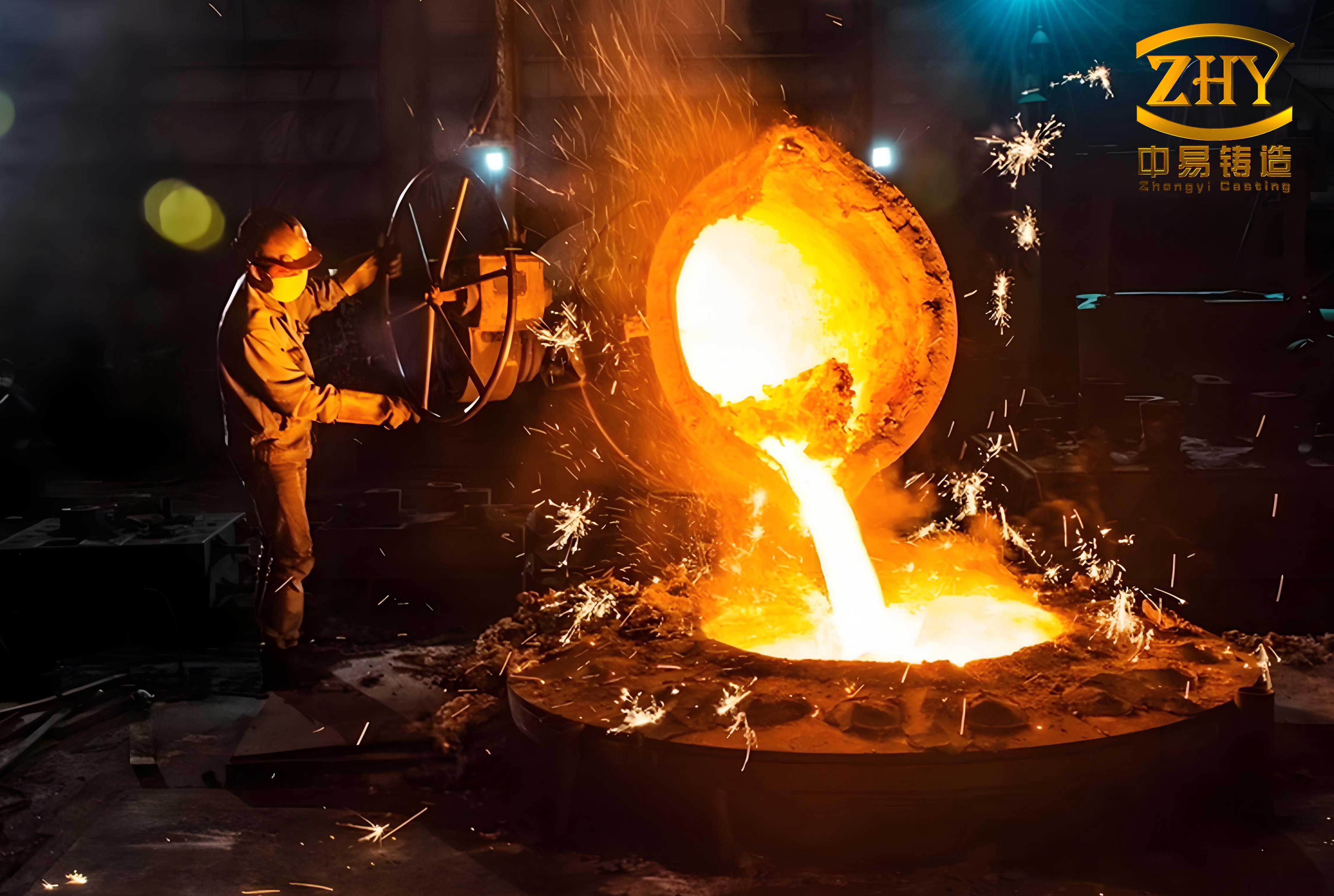
Production validation was conducted to assess real-world applicability for high manganese steel castings. The coating was applied via brushing, dipping, and flowing methods to foam patterns for components like liner plates and hammer heads, achieving the desired 0.5-1.0 mm thickness in one pass. After drying, the coated patterns were assembled into molds and poured with high manganese steel at temperatures around 1500°C. Upon shakeout, the coating peeled off automatically in flakes, revealing castings with smooth surfaces, sharp edges, and no粘砂. The dimensional accuracy met stringent tolerances, with surface roughness comparable to that achieved with expensive corundum coatings. This success underscores the coating’s effectiveness for high manganese steel castings, offering a cost-effective alternative without compromising quality.
Furthermore, the coating was tested on carbon steel castings, yielding similarly excellent results, suggesting its potential as a universal water-based coating for both high manganese steel castings and carbon steel applications in lost foam casting, thereby broadening its industrial relevance.
The economic and environmental advantages of this water-based coating are significant for high manganese steel casting production. Compared to traditional alcohol-based magnesia coatings, which pose fire risks and higher costs due to alcohol consumption, or water-based zircon flour coatings that are acidic and prone to sand adhesion with alkaline high manganese steel, our formulation leverages low-cost titanium slag powder, a by-product, reducing material expenses by approximately 30-40%. The water-based nature eliminates volatile organic compounds (VOCs), enhancing workplace safety and reducing environmental impact. Additionally, the superior thixotropy minimizes waste during application, and the easy peel-off characteristic lowers labor costs for cleaning. These benefits make the coating an attractive solution for foundries specializing in high manganese steel castings, aligning with sustainability goals while maintaining high performance standards.
In conclusion, this research successfully developed and optimized a water-based coating for lost foam casting of high manganese steel castings, demonstrating exceptional performance across key metrics. The coating, based on titanium slag powder and a composite binder system, exhibits excellent suspension stability (90-92%), high permeability (9.0-9.5), robust strength (700-750 g), and superior thixotropy (200%), ensuring easy application and consistent results. Production trials confirmed its effectiveness, with high manganese steel castings achieving smooth,粘砂-free surfaces and precise dimensions, while also proving adaptable for carbon steel castings. The cost-effectiveness and environmental friendliness further enhance its appeal for industrial adoption. Future work could explore纳米-additives for enhanced thermal properties or automated application systems to further optimize the process for high manganese steel castings. This study contributes to advancing lost foam casting technology, offering a reliable coating solution that meets the demanding requirements of high manganese steel castings in diverse applications.