
In the production of high manganese steel casting, when chemical composition, casting technology, and water toughening treatment are identical or similar, the melting process significantly influences the rejection rate and service life of castings. Through our practical experience, we have identified the melting process as a critical factor for enhancing metallurgical quality and improving inclusion ratings in high manganese steel casting. This article elaborates on the key aspects of the melting process that we have implemented to achieve these improvements. The focus is on optimizing operations to reduce inclusions, which are directly linked to defects such as cracks and ultimately affect mechanical properties. By refining our approach, we have successfully lowered scrap rates and extended the lifespan of high manganese steel casting components.
Our melting setup utilizes a 1-ton medium frequency coreless induction furnace with a basic lining. We opted for a basic lining because acidic linings lead to severe corrosion during the melting of high manganese steel casting. The process follows a non-oxidizing method, also known as the remelting method, which minimizes the melting loss of alloying elements and requires relatively lower operational skills. In medium frequency furnace melting, precipitation deoxidation is employed due to the low slag temperature and poor metallurgical reaction capacity. We typically use precipitation deoxidation rather than diffusion deoxidation or combined deoxidation (diffusion-precipitation) for high manganese steel casting, as it is simpler, cost-effective, and time-efficient. This approach suits the characteristics and needs of small to medium-sized enterprises while meeting the technical and operational requirements of high manganese steel casting.
A crucial aspect of our process is the emphasis on covering and protecting the molten steel, which directly impacts metallurgical quality and inclusion ratings. We avoid the tendency to prioritize chemical composition control over steel protection. During charging, we first place a layer of lime at the bottom of the furnace, with a weight approximately 1% of the total metal charge. As melting proceeds, the slag continuously covers the molten steel surface, protecting it from gas absorption and excessive oxidation, while also collecting inclusions and conserving energy. We supplement with lime as needed and add fluorite (commonly known as fluorspar) in a lime-to-fluorite weight ratio of 3:1 to lower the slag melting point and adjust viscosity, facilitating slag removal. This protective slag layer is essential for maintaining the integrity of high manganese steel casting.
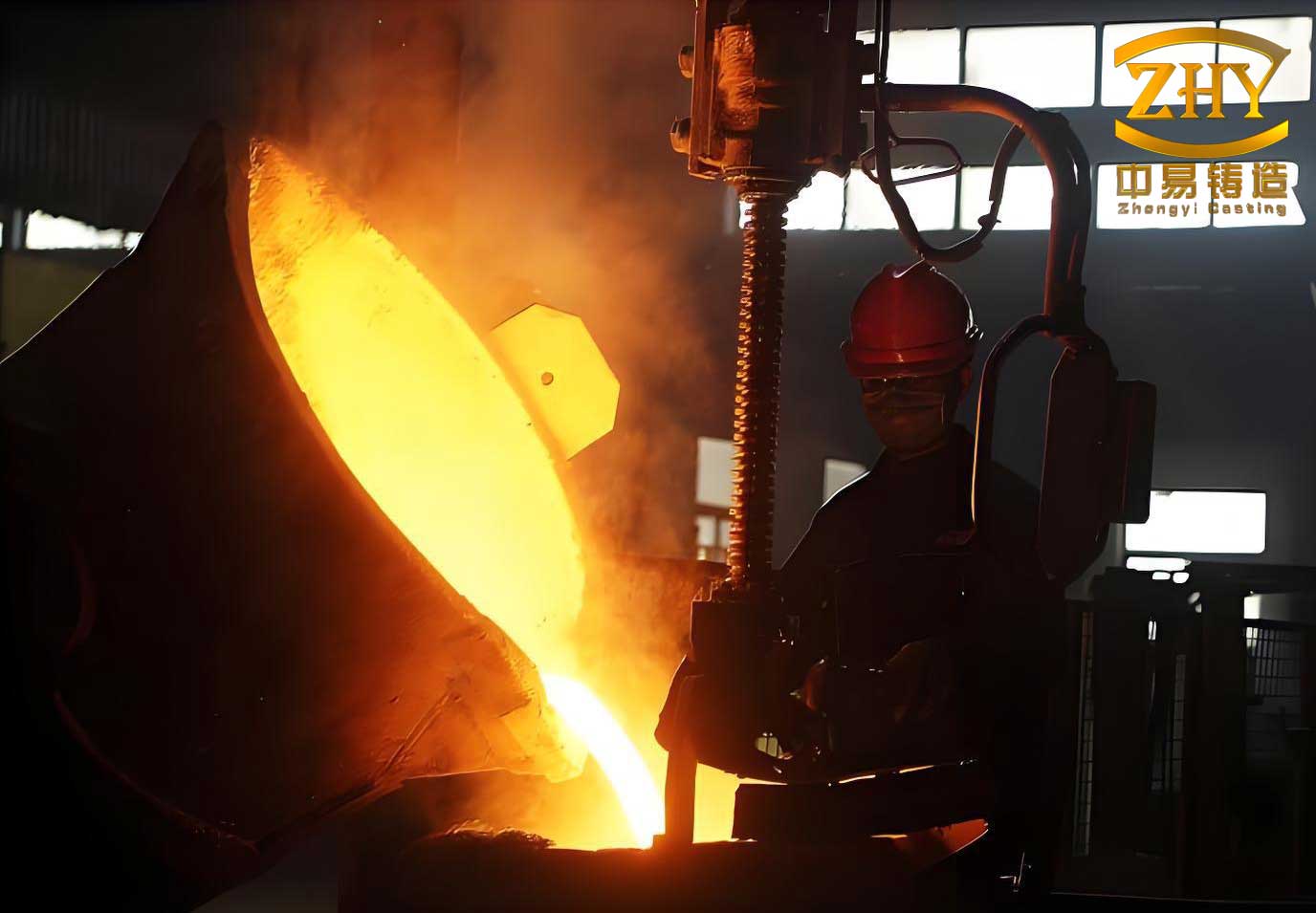
The sequence of adding alloying ferromanganese is a pivotal factor affecting inclusion ratings in high manganese steel casting. In the remelting method, we do not simply charge scrap steel, returns, and ferromanganese together. Instead, we add ferromanganese after pre-deoxidation. Thermodynamics of metallurgical reactions indicate that during the melting stage, when steel temperature is lower, manganese oxidizes extensively, leading to high manganese oxide content and increased inclusions. Production data show that when ferromanganese is charged initially, the recovery rate is about 75%, whereas when added after pre-deoxidation, it reaches approximately 90%. Therefore, the sequence significantly influences the quality of high manganese steel casting. Specifically, alloying ferromanganese should be added after pre-deoxidation, when the oxygen carriers and iron oxide content in the steel are reduced, minimizing the formation of manganese oxide inclusions even if temperature drops slightly.
We ensure that the alloying ferromanganese is fully preheated and baked above 600°C to prevent substantial cooling of the molten steel. The lump size is about 50–100 mm, depending on furnace temperature and total addition amount. We add it in batches while red-hot, stirring thoroughly after each batch to prevent “freezing” or settling, and wait until each batch is largely melted before adding the next. This controlled addition process is critical for maintaining homogeneity and reducing inclusions in high manganese steel casting.
Pre-deoxidation and final deoxidation are strategically managed to reduce oxygen content and inclusions. Pre-deoxidation rapidly removes most of the oxygen from the molten steel, reducing oxidation of subsequently added ferromanganese and easing the task of final deoxidation. We use high-carbon ferromanganese for pre-deoxidation, as it contains high carbon content, which acts as a strong deoxidizer. The carbon oxidation enhances pre-deoxidation, lowering the oxygen content (i.e., iron oxide) to a minimal level. High-carbon ferromanganese is added during the early reduction period, before alloying ferromanganese, at a steel temperature of about 1450–1500°C. The addition amount is about 0.5% of the steel weight, with a recovery rate of approximately 85%.
Final deoxidation is conducted after chemical composition adjustment, building upon pre-deoxidation to achieve thorough deoxygenation. Since residual oxygen is already low after pre-deoxidation, we use strong deoxidizers like aluminum. The addition is about 0.1% of the steel weight. Considering that precipitation deoxidation is slightly less thorough than diffusion deoxidation, we use approximately 0.12% of the steel weight. This step ensures minimal oxygen content, crucial for high-quality high manganese steel casting.
After tapping, the molten steel is allowed to stand for 2–5 minutes. This镇静 time promotes the flotation of gases and inclusions, improving inclusion ratings and metallurgical quality. The tapping temperature for high manganese steel casting is about 1480–1520°C, with a pouring temperature of 1380–1420°C. Proper temperature control and镇静 are vital for defect-free high manganese steel casting.
To summarize key parameters, we present the following table detailing the melting process conditions for high manganese steel casting:
| Process Parameter | Specification | Remarks |
|---|---|---|
| Furnace Type | 1-ton Medium Frequency Coreless Induction Furnace | Basic lining preferred |
| Melting Method | Non-oxidizing (Remelting) | Minimizes alloy loss |
| Deoxidation Method | Precipitation Deoxidation | Simple and cost-effective |
| Slag Covering | Lime (1% of charge) + Fluorite (Lime:Fluorite = 3:1) | Protects and collects inclusions |
| Ferromanganese Addition | After pre-deoxidation, preheated >600°C, batch-wise | Recovery rate ~90% |
| Pre-deoxidation Agent | High-carbon Ferromanganese (0.5% of steel weight) | Add at 1450–1500°C |
| Final Deoxidation Agent | Aluminum (0.12% of steel weight) | Strong deoxidizer |
| 镇静 Time | 2–5 minutes after tapping | Promotes inclusion flotation |
| Tapping Temperature | 1480–1520°C | For high manganese steel casting |
| Pouring Temperature | 1380–1420°C | Optimal for casting quality |
The metallurgical reactions involved in deoxidation can be expressed using chemical equations. For instance, the oxidation of manganese during melting is represented as:
$$ \text{Mn} + \text{O} \rightarrow \text{MnO} $$
This reaction is favorable at lower temperatures, leading to inclusion formation if manganese is added early. The deoxidation by carbon in high-carbon ferromanganese is:
$$ \text{C} + \text{O} \rightarrow \text{CO} \uparrow $$
This gas evolution enhances oxygen removal. The final deoxidation with aluminum is:
$$ 2\text{Al} + 3\text{O} \rightarrow \text{Al}_2\text{O}_3 $$
forming alumina inclusions that can float out during镇静. The efficiency of deoxidation can be quantified using the equilibrium constant. For aluminum deoxidation, the relationship is given by:
$$ K_{\text{Al}} = \frac{a_{\text{Al}_2\text{O}_3}}{[a_{\text{Al}}]^2 [a_{\text{O}}]^3} $$
where \(a\) denotes activity. In practice, we aim to minimize oxygen activity to reduce inclusions in high manganese steel casting.
Inclusion rating is assessed according to standards such as GB/T 13925-2010 for high manganese steel castings. The ratings are typically based on microscopic examination, with categories like oxide inclusions and sulfide inclusions. Our process adjustments have led to significant improvements. The inclusion levels in high manganese steel casting are now generally不大于 2.0 or 2.5, often ranging from 1.5 to 2.0 or 1.0 to 1.5, and sometimes as low as 0.5 to 1.0 or 1.0 to 1.5. This reduction has eliminated crack-type defects caused by inclusions in scrap castings. For example, in ball mill applications, the consumption rate of high manganese steel casting has improved from 1000 grams per ton of ore to 800 grams per ton, demonstrating enhanced durability.
To further illustrate the impact of process variables on inclusion formation, we can model the oxygen content reduction. Let \([\text{O}]_{\text{initial}}\) be the initial oxygen content, and \([\text{O}]_{\text{final}}\) after deoxidation. The removal efficiency \(\eta\) for pre-deoxidation with high-carbon ferromanganese can be approximated as:
$$ \eta = 1 – \frac{[\text{O}]_{\text{after pre-deox}}}{[\text{O}]_{\text{initial}}} $$
Empirical data suggest \(\eta \approx 0.7\) for our process. After final deoxidation with aluminum, the residual oxygen content is given by:
$$ [\text{O}]_{\text{final}} = \frac{K_{\text{Al}}^{1/3}}{[\text{Al}]^{2/3}} $$
assuming alumina activity is unity. By controlling aluminum addition, we achieve low \([\text{O}]_{\text{final}}\), directly benefiting high manganese steel casting quality.
Another critical aspect is the effect of slag composition on inclusion absorption. The basicity index \(B\) of the slag is defined as:
$$ B = \frac{\text{CaO}}{\text{SiO}_2} $$
We maintain \(B \approx 2.5\) to 3.0 by adjusting lime and fluorite additions. This basic slag favors the absorption of acidic inclusions like SiO₂ and Al₂O₃, thereby cleaning the molten steel for high manganese steel casting. The viscosity \(\mu\) of the slag also matters for inclusion removal; it can be estimated using empirical formulas based on composition and temperature.
We have also optimized the cooling curve during solidification of high manganese steel casting to minimize segregation and inclusion entrapment. The solidification time \(t_s\) for a casting section of thickness \(d\) is given by Chvorinov’s rule:
$$ t_s = k \left( \frac{V}{A} \right)^2 $$
where \(V\) is volume, \(A\) is surface area, and \(k\) is a constant dependent on mold material and pouring temperature. By controlling pouring temperature and mold design, we ensure directional solidification that pushes inclusions toward the feeding heads, improving the integrity of high manganese steel casting.
The following table summarizes the typical inclusion ratings achieved before and after process optimization for high manganese steel casting:
| Sample Batch | Oxide Inclusion Rating (max) | Sulfide Inclusion Rating (max) | Overall Quality |
|---|---|---|---|
| Before Optimization | 3.0–3.5 | 2.5–3.0 | High rejection due to cracks |
| After Optimization | 1.5–2.0 | 1.0–1.5 | Low rejection, improved lifespan |
Additionally, we monitor the chemical composition of high manganese steel casting to ensure consistency. The target composition typically includes: C 1.0–1.4%, Mn 11–14%, Si 0.3–0.8%, P ≤ 0.07%, S ≤ 0.05%. Minor adjustments are made based on the application. The relationship between manganese content and inclusion formation is particularly important; higher manganese can increase viscosity, affecting inclusion flotation. We use the following formula to estimate the effect of manganese on oxygen solubility:
$$ \log [\text{O}]_{\text{eq}} = -\frac{A}{T} + B + \sum C_i [\%i] $$
where \(T\) is temperature in Kelvin, and \(C_i\) are interaction parameters for elements like manganese. For high manganese steel casting, manganese reduces oxygen solubility, aiding deoxidation but also potentially forming MnO inclusions if not controlled.
The economic impact of our process improvements is significant. By reducing inclusions, we decrease the scrap rate of high manganese steel casting by approximately 15%, leading to cost savings and higher productivity. The extended service life of components in abrasive environments, such as mining and cement industries, further enhances the value proposition of high manganese steel casting. We estimate that the optimized melting process adds negligible cost while yielding substantial benefits, making it a viable approach for manufacturers of high manganese steel casting.
In conclusion, through meticulous control of the medium frequency furnace melting process, we have successfully reduced inclusions and elevated metallurgical quality in high manganese steel casting. Key measures include proper slag covering, sequenced addition of alloying ferromanganese, effective pre-deoxidation with high-carbon ferromanganese, thorough final deoxidation with aluminum, and adequate镇静 time. These steps have resulted in inclusion ratings consistently below 2.0, elimination of crack defects, and improved performance metrics such as reduced consumption in ball mills. The process is both technically sound and economically favorable, underscoring the importance of melting工艺 in the production of high-quality high manganese steel casting. Future work may involve further refinements, such as real-time monitoring of oxygen activity and advanced slag engineering, to push the boundaries of excellence in high manganese steel casting.