
In the production of wear plates for electric locomotives, the selection of high manganese steel as the material is critical due to its exceptional wear resistance and toughness. However, in our manufacturing process, we encountered persistent cracking issues in high manganese steel castings, which severely impacted assembly progress. These cracks occurred across various stages, including casting, heat treatment, machining, and welding. Through extensive research, we identified that the root cause was the excessive presence of carbides in the microstructure, exceeding standard limits. This led us to conduct a comprehensive study on the casting process, focusing on key parameters to mitigate defects. This article details our first-person perspective on the measures implemented to prevent cracks in high manganese steel castings, emphasizing practical improvements in foundry practices.
The high manganese steel casting process for wear plates involves several intricate steps, where deviations can lead to detrimental defects. Initially, our foundry utilized a manual green sand molding technique with sodium silicate-bonded sand, with one casting per mold and surface drying. Melting was carried out in a medium-frequency induction furnace. The wear plates are subjected to significant stresses, including vertical compressive loads from the car body and lateral forces during curve negotiation, necessitating defect-free high manganese steel castings. Our investigation revealed that the as-cast microstructure contained a high volume of carbides, primarily due to suboptimal casting parameters. The following sections outline our systematic approach to addressing these issues, with a focus on enhancing the integrity of high manganese steel castings.
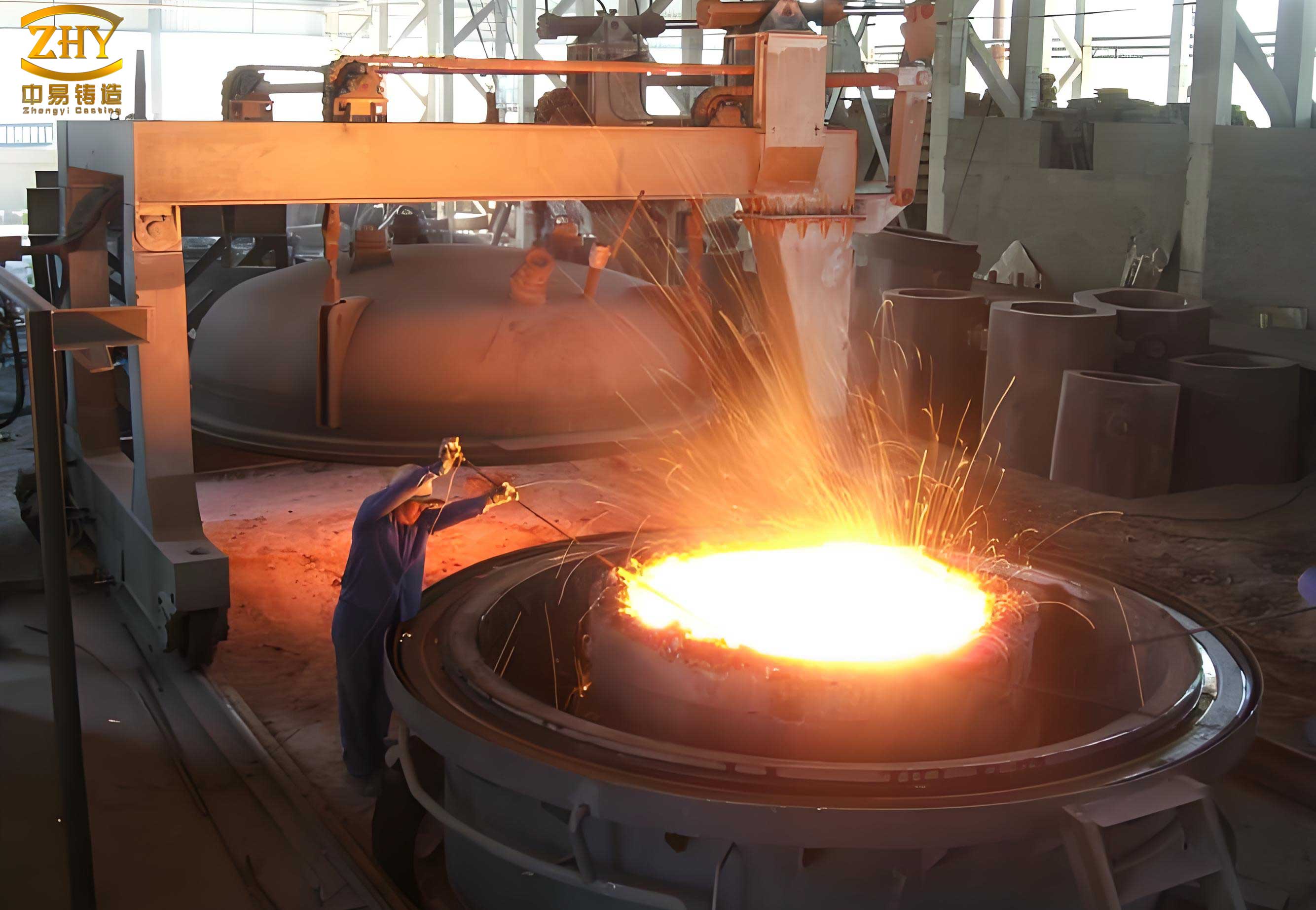
The formation of cracks in high manganese steel castings is often linked to thermal stresses and microstructural inhomogeneities. We analyzed the stress distribution using basic thermal stress models. For instance, the thermal stress ($\sigma$) generated during cooling can be expressed as:
$$\sigma = E \cdot \alpha \cdot \Delta T$$
where $E$ is the Young’s modulus of high manganese steel, $\alpha$ is the coefficient of thermal expansion, and $\Delta T$ is the temperature gradient. High manganese steel has a relatively low thermal conductivity, leading to larger $\Delta T$ and thus higher stress, which predisposes the casting to hot tearing and cold cracking. Additionally, the precipitation of carbides follows kinetic principles; we approximated the carbide volume fraction ($V_c$) using an empirical relation:
$$V_c = C_0 \cdot \left(1 – \exp\left(-k \cdot t^n\right)\right)$$
where $C_0$ is the initial carbon content, $k$ is a rate constant dependent on temperature, $t$ is time, and $n$ is an exponent. Excessive $V_c$ embrittles the matrix, reducing ductility and promoting crack initiation. Our goal was to optimize process variables to minimize $V_c$ and control $\sigma$.
To systematically address the cracking problem, we revised multiple aspects of the high manganese steel casting process. The improvements are summarized in Table 1, comparing original and modified practices.
| Process Parameter | Original Practice | Modified Practice | Impact on High Manganese Steel Casting Quality |
|---|---|---|---|
| Furnace Lining Material | Acidic (silica sand + sodium silicate) | Basic (magnesite + brine) | Reduced furnace breakthrough; extended lining life; improved melt purity. |
| Pouring Position | Horizontal, no riser | Vertical, with enlarged runner as riser | Eliminated shrinkage porosity and voids; enhanced feeding efficiency. |
| Pouring Temperature | Excessively high (above 1500°C) | Controlled (1420–1450°C) | Reduced coarse primary grains; minimized thermal stresses and cracks. |
| Mold Opening Time | At room temperature | At ~200°C (dark red heat) | Decreased restraint stress; less hot tearing and segregation. |
| Coating Material | Acidic silica-based | Basic magnesite powder | Prevented chemical burn-on and sand adhesion; smoother surface. |
| Gate Removal Method | Oxy-acetylene cutting at room temperature | Hot cutting at ~200°C or hammering | Avoided thermal shock and carbide precipitation; reduced cracking at gates. |
First, we addressed the furnace lining material. Initially, an acidic lining of silica sand and sodium silicate was used, but frequent furnace breakthroughs occurred, disrupting the high manganese steel casting sequence. We switched to a basic lining composed of magnesite (MgO) and brine (MgCl₂ solution). The particle size distribution of magnesite and the brine ratio were strictly controlled. The lining life increased dramatically, allowing continuous melting of over 100 furnaces without breakthrough, compared to every two furnaces previously. This change also reduced energy consumption and labor for repairs, aligning with sustainable high manganese steel casting practices.
Next, we redesigned the pouring position. Originally, a horizontal pouring setup without risers was employed (as depicted in a schematic, though not shown here). This led to pronounced shrinkage cavities and porosity due to the high carbon, manganese, and silicon content in high manganese steel, which lowers thermal conductivity and widens the solidification range. The modified design adopted vertical pouring with an enlarged runner serving as an open riser. The machining allowance was shifted to the side to reduce wall thickness variations. This modification ensured directional solidification and adequate feeding, effectively eliminating shrinkage defects in high manganese steel castings. The feeding efficiency can be estimated using Chvorinov’s rule:
$$t_s = B \cdot \left(\frac{V}{A}\right)^2$$
where $t_s$ is solidification time, $B$ is a mold constant, $V$ is volume, and $A$ is surface area. By optimizing the gating system, we increased the $V/A$ ratio in the riser region, prolonging $t_s$ and improving feeding.
Control of pouring temperature was crucial. High pouring temperatures promoted coarse primary crystallization, worsening mechanical properties and increasing crack susceptibility. We conducted trials at varying temperatures and found that a tapping temperature of 1480°C and a pouring temperature between 1420°C and 1450°C yielded crack-free as-cast structures with acceptable carbide levels. The relationship between pouring temperature ($T_p$) and crack incidence ($I_c$) can be modeled linearly for a range:
$$I_c = m \cdot T_p + b$$
where $m$ is a positive slope, indicating higher $I_c$ with increased $T_p$. Our data fitted this trend, justifying the temperature reduction. Table 2 presents experimental results from pouring temperature trials in high manganese steel casting.
| Pouring Temperature Range (°C) | As-Cast Crack Frequency (%) | Carbide Volume Fraction After Heat Treatment (%) | Observation on High Manganese Steel Casting Quality |
|---|---|---|---|
| 1500–1520 | High (≥30) | Exceeded standard (>10) | Severe hot tears and coarse grains; unacceptable. |
| 1450–1480 | Moderate (10–20) | Near standard (8–10) | Reduced cracks but some porosity; required improvement. |
| 1420–1450 | Low (≤5) | Within standard (≤8) | Minimal cracks; fine microstructure; optimal range. |
| Below 1420 | Very low (≤2) | Within standard (≤8) | Risk of cold shuts; not recommended. |
The selection of mold opening time significantly influenced hot tearing. High manganese steel has a high linear shrinkage rate and low high-temperature strength, making it prone to hot cracks under mold restraint. We observed the solidification pattern and opened the mold when the riser solidified and cooled to approximately 800°C (dark red heat). At this point, mold restraints were loosened, reducing stress. Full opening occurred at about 200°C (dark black heat), followed immediately by cleaning. This timing minimized segregation and carbide aggregation. The stress relief can be quantified by considering the strain rate during cooling:
$$\dot{\epsilon} = \frac{\Delta L}{L_0 \cdot \Delta t}$$
where $\dot{\epsilon}$ is strain rate, $\Delta L$ is length change, $L_0$ is initial length, and $\Delta t$ is time interval. By opening the mold early, we reduced $\dot{\epsilon}$, thereby lowering stress accumulation in high manganese steel castings.
To prevent chemical burn-on, we switched to a basic coating of magnesite powder. High manganese steel contains substantial manganese, which reacts with acidic silica sand to form low-melting-point compounds like manganese silicates, causing adherence. The alkaline coating provided a barrier, eliminating this issue and improving surface finish of high manganese steel castings.
The final critical step was gate removal. Cracks often initiated at gate sections due to thermal stress from cutting. We tested three methods: (1) reducing gate cross-section and hammering off cold, (2) local preheating to 200°C followed by oxy-acetylene cutting, and (3) hot cutting at 200°C immediately after mold opening. Method 1 caused deformation; method 2 was effective but added steps; method 3 proved best, eliminating cracks without extra heating. The thermal stress during cutting can be approximated using the same formula as earlier, with $\Delta T$ representing the temperature difference between the cut zone and the bulk. Method 3 minimized $\Delta T$, thus reducing stress. Table 3 compares these methods for high manganese steel casting cleanup.
| Method Description | Procedure Details | Crack Occurrence Rate (%) | Deformation Risk | Suitability for High Manganese Steel Casting |
|---|---|---|---|---|
| Method 1: Cold Hammering | Reduce gate area; hammer off at room temperature | Low (5) | High (significant distortion) | Poor due to distortion and labor intensity. |
| Method 2: Local Preheating and Cutting | Heat gate to 200°C, then oxy-acetylene cut | Very low (2) | Low (minimal) | Good but requires additional heating step. |
| Method 3: Hot Cutting | Cut gate at 200°C immediately after mold opening | Negligible (<1) | Very low (none) | Excellent; efficient and crack-free. |
Implementing these measures collectively transformed our high manganese steel casting operations. The yield rate for wear plates improved from 60% to over 95%, with substantial economic benefits. The basic furnace lining extended service life, saving energy and materials. The controlled pouring temperature and optimized gating reduced scrap rates. The hot cutting method streamlined post-casting processes. These improvements underscore the importance of holistic process control in high manganese steel casting.
In conclusion, preventing cracks in high manganese steel castings requires a multifaceted approach targeting microstructure and stress management. By selecting appropriate furnace linings, redesigning pouring systems, controlling temperatures, timing mold opening, using compatible coatings, and adopting careful cleanup techniques, we successfully mitigated cracking in wear plates. The experience gained provides valuable insights for future high manganese steel casting projects, emphasizing that meticulous attention to each process parameter is key to achieving defect-free components. The integration of these practices ensures reliable performance of high manganese steel castings in demanding applications like locomotive wear plates.
Further research could explore advanced simulation models for stress analysis in high manganese steel casting, or investigate alloy modifications to enhance inherent crack resistance. Nonetheless, our practical adjustments demonstrate that even traditional foundry methods can be optimized to overcome challenges in high manganese steel casting, contributing to more efficient and sustainable manufacturing.