
In my experience with heavy equipment manufacturing, the production of high manganese steel castings for electric shovels represents a significant technical challenge due to the material’s unique properties. High manganese steel, particularly the 7C grade, is renowned for its exceptional work-hardening ability, toughness, and wear resistance, making it ideal for components like front and rear idler pulleys that endure extreme abrasive and impact loads. However, its low thermal conductivity, high linear shrinkage, and tendency to form casting defects such as sand sticking, cracks, and shrinkage porosity necessitate a meticulously optimized process. Through extensive work in process design, steel melting, and heat treatment, we have developed a robust methodology for producing high-quality high manganese steel castings. This article elaborates on the comprehensive approach, incorporating detailed tables and formulas to summarize key aspects, aiming to provide an in-depth resource for foundry engineers. The keyword ‘high manganese steel casting’ will be frequently emphasized to underscore its centrality in this discussion.
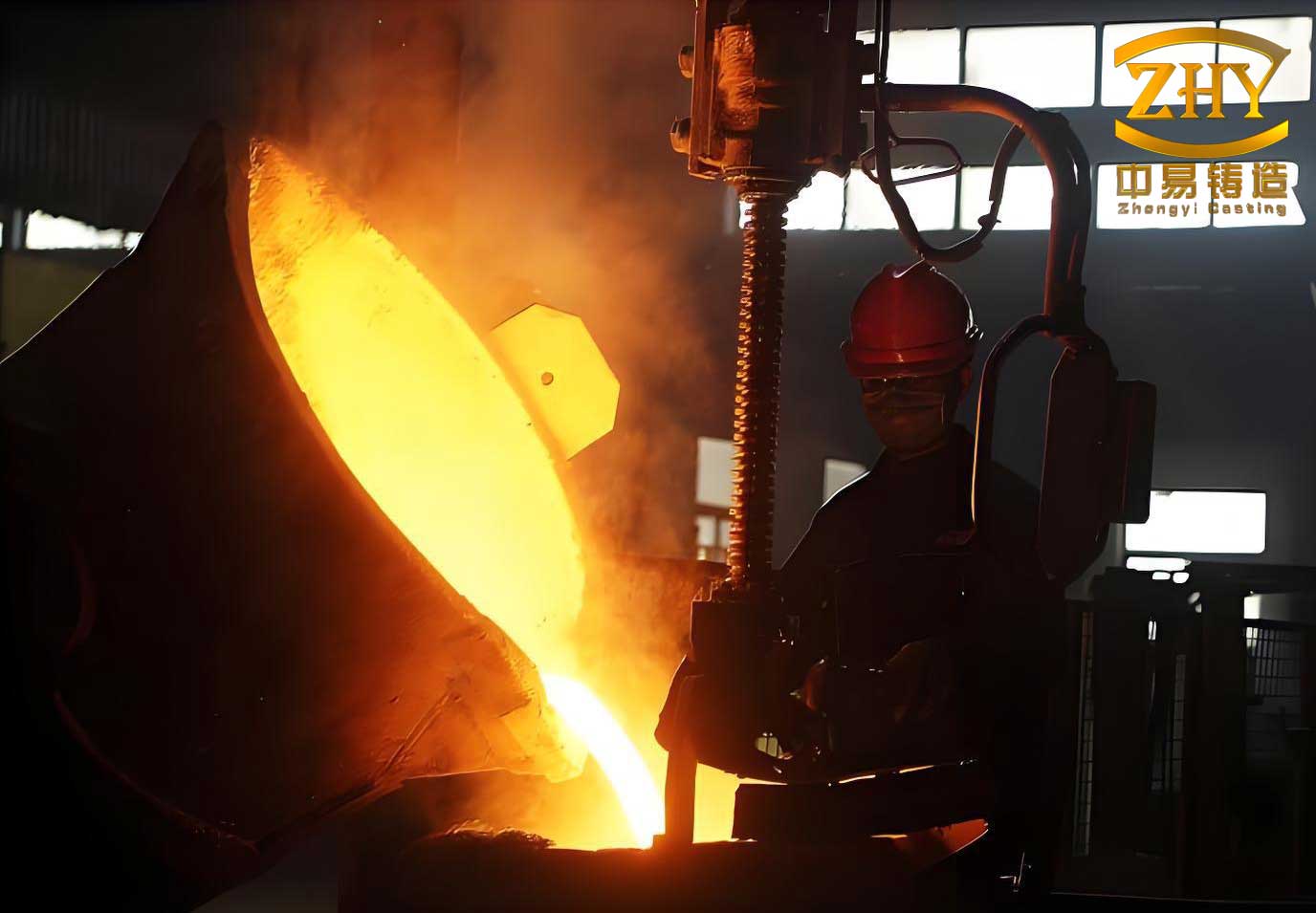
The success of any high manganese steel casting project hinges on understanding the material’s metallurgical behavior. The 7C high manganese steel has a specific chemical composition that dictates its performance. Below is a detailed table outlining the required composition.
| Element | Range | Role in High Manganese Steel Casting |
|---|---|---|
| Carbon (C) | 1.05–1.20 | Enhances hardness and wear resistance; critical for austenite stability. |
| Silicon (Si) | ≤0.80 | Deoxidizer; excessive Si can reduce toughness. |
| Manganese (Mn) | 12.00–14.00 | Key austenite stabilizer; provides work-hardening capability. |
| Phosphorus (P) | ≤0.06 | Impurity; must be minimized to prevent embrittlement. |
| Sulfur (S) | ≤0.03 | Impurity; low levels reduce hot tearing risk. |
| Chromium (Cr) | ≤0.07 | Trace element; can influence corrosion resistance. |
| Molybdenum (Mo) | 0.80–1.20 | Improves strength and hardenability; aids in refining microstructure. |
| Total Residuals | ≤1.00 | Ensures purity and consistency in high manganese steel casting. |
The casting performance of high manganese steel is influenced by its thermal properties. The linear shrinkage, a critical parameter, can be expressed as a percentage of the pattern dimension. For 7C high manganese steel, the linear shrinkage (ε) typically ranges from 2.5% to 2.8%, which must be accurately incorporated into pattern design to minimize machining allowances. This can be formulated as:
$$ \epsilon = \frac{L_{\text{pattern}} – L_{\text{casting}}}{L_{\text{pattern}}} \times 100\% $$
where \( L_{\text{pattern}} \) is the pattern dimension and \( L_{\text{casting}} \) is the final casting dimension after cooling. Precise control of this shrinkage is vital for dimensional accuracy in high manganese steel casting.
Determining the optimal process scheme for high manganese steel casting involves several strategic decisions. Based on the structural characteristics of the idler pulleys, we choose horizontal pouring orientation. This facilitates mold filling, simplifies riser design, and aligns with the molding position. The parting line is selected as a split type to ease manual molding operations using solid patterns. To address core-related issues, such as poor collapsibility and sand sticking, the core is designed with a hollow structure. This enhances yielding during solidification and improves heat dissipation, reducing the risk of defects. The pattern shrinkage scale is precisely set at 2.5–2.8%, as derived from the linear shrinkage formula, ensuring that the high manganese steel casting meets tight tolerances without excessive machining.
Casting process design for high manganese steel casting requires meticulous attention to riser and gating systems. Riser design is paramount to compensate for solidification shrinkage. For the front idler pulley, which features circumferential holes, a combination of a circular riser on the hub and side risers on the rim is employed. The riser dimensions are based on the hot spot diameters of the casting. The riser hot spot diameter (\( D_r \)) is related to the casting hot spot diameter (\( D_c \)) by a multiplier \( k \):
$$ D_r = k \cdot D_c $$
For the front idler pulley, the hub riser has \( k = 1.32 \) (i.e., \( D_c = 240 \, \text{mm} \), \( D_r = 316 \, \text{mm} \)), and the side risers have \( k = 1.53 \) (i.e., \( D_c = 130 \, \text{mm} \), \( D_r = 200 \, \text{mm} \)). For the rear idler pulley, a single round riser with \( k = 1.33 \) (i.e., \( D_c = 360 \, \text{mm} \), \( D_r = 480 \, \text{mm} \)) is used. The riser height is increased, and the fillet radius at the riser-casting junction is enlarged to facilitate hot cutting and minimize thermal cracking. The effectiveness of risers is also evaluated through continuity ratio, which for the front idler pulley is 100% for the circular riser and 36% for the side risers, and for the rear idler pulley is 45.4%. These calculations ensure adequate feeding for the high manganese steel casting.
The gating system is designed to promote directional solidification and enhance riser efficiency. A single-pour, single-ingate system with a ring-shaped runner and double-layer ingates is utilized. The ingates are introduced from both the casting body and the riser, raising the riser temperature for optimal补缩. The flow rate and filling time can be estimated using fluid dynamics principles. The volumetric flow rate (\( Q \)) through the gating system is given by:
$$ Q = A \cdot v $$
where \( A \) is the cross-sectional area of the ingate and \( v \) is the flow velocity, which depends on the pouring height and friction losses. For high manganese steel casting, a controlled filling velocity minimizes turbulence and oxide inclusion formation.
| Parameter | Front Idler Pulley | Rear Idler Pulley |
|---|---|---|
| Runner Type | Ring-shaped | Ring-shaped |
| Ingate Layers | Double | Double |
| Ingate Location | Casting & Riser | Casting & Riser |
| Pouring Temperature Range | 1430–1455°C | 1430–1455°C |
Molding material selection is critical to achieve the desired surface finish and internal quality in high manganese steel casting. Chromite resin sand is chosen for both mold and core sands due to its high refractoriness and low thermal expansion, which reduces veining and penetration defects. The coating applied is a premium FSK coating, which forms a protective barrier against metal-mold reactions, effectively minimizing sand sticking. The permeability of the mold sand (\( P \)) can be quantified to ensure proper gas escape during pouring:
$$ P = \frac{V \cdot L}{A \cdot t \cdot \Delta p} $$
where \( V \) is the volume of air passed, \( L \) is the sample length, \( A \) is the cross-sectional area, \( t \) is time, and \( \Delta p \) is the pressure difference. Optimizing this parameter is essential for defect-free high manganese steel casting.
Steel melting and pouring are pivotal stages in producing high-quality high manganese steel casting. To mitigate issues like chemical sand sticking, we transition from electric arc furnace melting to ladle refining. This reduces oxygen content and minimizes oxidation of alloying elements. The refined steel must meet the compositional specs in Table 1. The pouring temperature is tightly controlled between 1430°C and 1455°C to balance fluidity and shrinkage. Post-pouring, a combination of high-quality exothermic and insulating compounds is applied to the risers to prolong solidification and enhance feeding efficiency. The solidification time (\( t_s \)) for a high manganese steel casting can be approximated using Chvorinov’s rule:
$$ t_s = B \cdot \left( \frac{V}{A} \right)^n $$
where \( V \) is the casting volume, \( A \) is the surface area, \( B \) is a mold constant, and \( n \) is an exponent typically around 2. This helps in scheduling riser removal and heat treatment.
Cleaning and heat treatment procedures are carefully orchestrated to prevent defects in high manganese steel casting. After cooling to approximately 300°C, the molds are shaken out, and risers and gates are promptly hot-cut, with residuals kept under 200 mm. The castings are immediately transferred to a furnace for pre-heat treatment before water toughening (solution annealing). This rapid transition avoids thermal cracking from stress concentration. The water toughening process involves heating the high manganese steel casting to 1050–1100°C, holding to dissolve carbides, then quenching in water to retain a homogeneous austenitic microstructure. The kinetics of carbide dissolution can be described by the Arrhenius equation:
$$ k = A \exp\left(-\frac{E_a}{RT}\right) $$
where \( k \) is the rate constant, \( A \) is the pre-exponential factor, \( E_a \) is activation energy, \( R \) is gas constant, and \( T \) is temperature. Post-heat treatment, final cleaning is done without using torches to prevent micro-cracking, and residual riser roots are removed underwater.
| Stage | Temperature Range | Time | Purpose |
|---|---|---|---|
| Heating | Room Temp to 1050°C | 2–4 hours | Austenitization |
| Soaking | 1050–1100°C | 1–2 hours per 25 mm thickness | Carbide dissolution |
| Quenching | Water, 20–40°C | Rapid immersion | Austenite retention |
| Tempering (if needed) | 200–300°C | 1–2 hours | Stress relief |
The production outcomes for high manganese steel casting have been highly successful. This methodology has been applied to manufacture idler pulleys for 4100XPC, 2300XPC, and 2800XPC electric shovels. All castings passed stringent non-destructive testing, including ultrasonic and radiographic inspection, conforming to PH material 950A-D standards. The table below summarizes the key quality metrics achieved.
| Shovel Model | Casting Component | Ultrasonic Test Result | Radiographic Test Result | Surface Quality |
|---|---|---|---|---|
| 4100XPC | Front Idler Pulley | No indications | Acceptable per Level 2 | Smooth, minimal dressing |
| 4100XPC | Rear Idler Pulley | No indications | Acceptable per Level 2 | Smooth, minimal dressing |
| 2300XPC | Front Idler Pulley | Minor scattered indications | Acceptable per Level 2 | Good, slight roughness |
| 2300XPC | Rear Idler Pulley | No indications | Acceptable per Level 2 | Smooth, minimal dressing |
| 2800XPC | Front Idler Pulley | No indications | Acceptable per Level 2 | Excellent, as-cast finish |
| 2800XPC | Rear Idler Pulley | No indications | Acceptable per Level 2 | Excellent, as-cast finish |
In conclusion, the production of high manganese steel casting for electric shovels demands an integrated approach. Key learnings include the necessity of using ladle-refined steel to reduce oxides and improve fluidity, which directly enhances the surface and internal quality of high manganese steel casting. Lowering pouring temperatures within the 1430–1455°C range, coupled with premium FSK coatings, effectively combats sand sticking. Designing hollow cores improves collapsibility and prevents cracking in thick sections like hubs. Hot cutting risers at or below 300°C with immediate furnace transfer precludes thermal cracking. Moreover, rational riser and chill design ensures sound feeding and dense microstructure. These practices have proven reliable across multiple shovel models, underscoring the robustness of this high manganese steel casting process. Future advancements may involve computational simulation to optimize riser placement and predict solidification patterns, further elevating the consistency of high manganese steel casting production. The repeated emphasis on ‘high manganese steel casting’ throughout this discourse highlights its technical complexity and industrial significance.
To further elaborate on the metallurgy, the work-hardening behavior of high manganese steel casting is governed by the formation of martensite under deformation, which can be modeled using strain-hardening laws. The Hollomon equation is often applicable:
$$ \sigma = K \epsilon^n $$
where \( \sigma \) is true stress, \( \epsilon \) is true strain, \( K \) is strength coefficient, and \( n \) is strain-hardening exponent. For high manganese steel casting, \( n \) is typically high, contributing to its durability. Additionally, the impact toughness at low temperatures can be assessed using Charpy tests, with energies often exceeding 100 J at -40°C, ensuring performance in harsh environments. The corrosion resistance of high manganese steel casting in abrasive settings can be approximated by wear rate formulas, such as Archard’s equation:
$$ W = \frac{K \cdot L \cdot H}{H} $$
where \( W \) is wear volume, \( K \) is wear coefficient, \( L \) is load, and \( H \) is hardness. These theoretical insights complement the practical process details, providing a holistic view of high manganese steel casting engineering.
In summary, every aspect from alloy design to final inspection plays a crucial role in mastering high manganese steel casting. The integration of empirical data, as tabulated and formulated herein, with hands-on foundry expertise, ensures the delivery of reliable components that meet the rigorous demands of mining and construction machinery. The continuous refinement of these techniques will drive further innovations in high manganese steel casting technology.