
In the field of materials engineering, I have long been fascinated by the unique properties of high manganese steel casting, particularly its exceptional resistance to impact and abrasive wear. High manganese steel casting, often referred to as Hadfield steel, has been a cornerstone material in industries such as mining, construction, and machinery due to its remarkable ability to work-harden under high-stress conditions. This work-hardening characteristic is primarily achieved through a specific heat treatment process known as water toughening, which transforms the microstructure to enhance toughness and wear resistance. However, the practical application of high manganese steel casting involves components of varying thicknesses, and the optimization of water toughening parameters for different section sizes remains a critical challenge. In this study, we delve into the effects of water toughening on the microstructure, mechanical properties, and wear behavior of high manganese steel casting with different wall thicknesses, aiming to provide comprehensive insights for industrial production.
The historical context of high manganese steel casting dates back to the late 19th century, and it has since evolved as a premier material for applications subjected to severe impact and abrasion. Despite the emergence of alternative耐磨 materials like减摩铸铁 and low-alloy steels, high manganese steel casting retains dominance in high-impact scenarios due to its unparalleled work-hardening capability. This capability is inherently linked to the austenitic matrix that forms after water toughening, where carbon化物 dissolve to create a homogeneous structure. Prior research has often focused on specific thicknesses, limiting generalizability. Thus, our investigation targets a range of thicknesses—10 mm, 20 mm, and 30 mm—to simulate real-world casting variations. We hypothesize that wall thickness significantly influences the kinetics of carbide dissolution and grain growth during heat treatment, thereby affecting the final performance of high manganese steel casting.
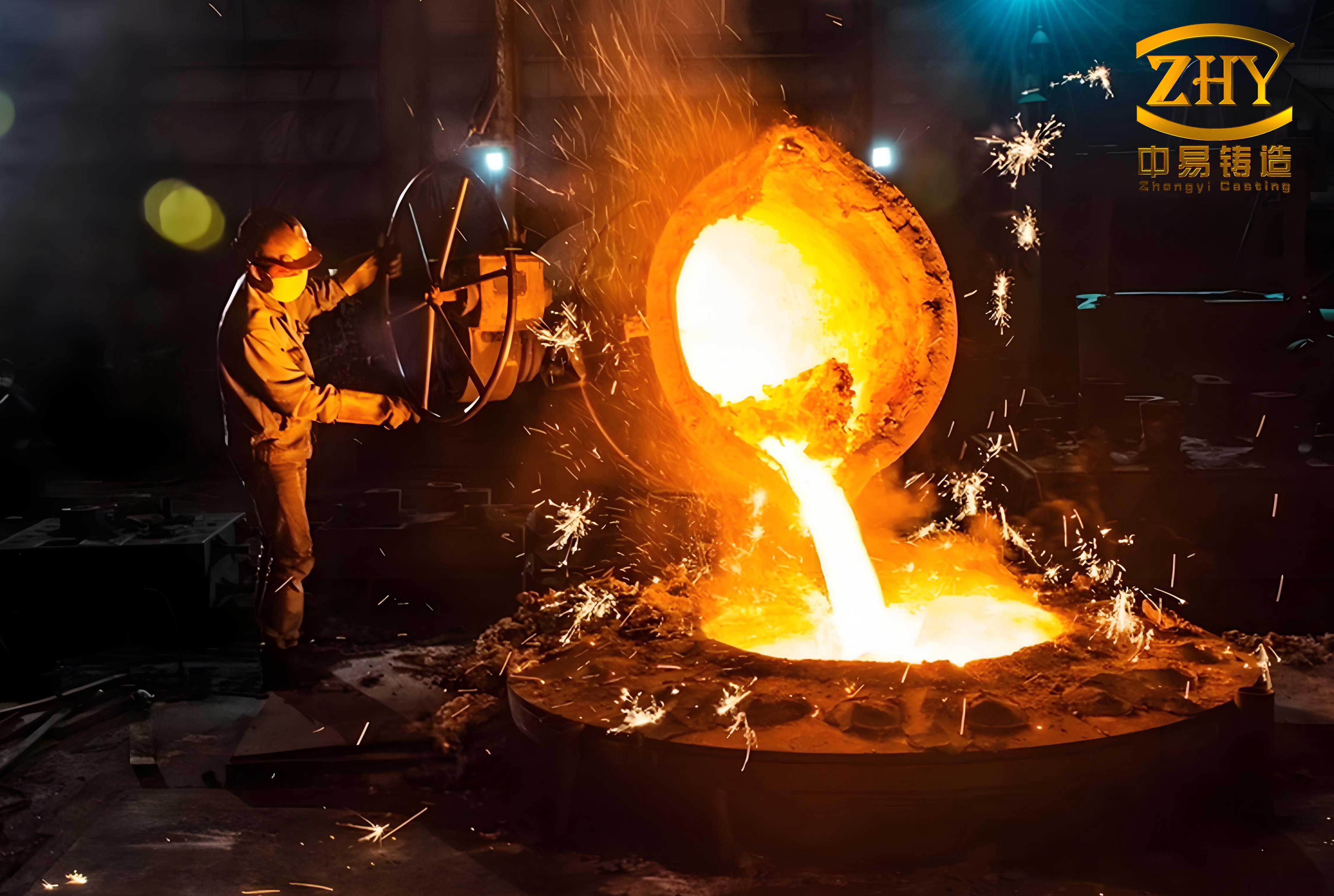
To understand the behavior of high manganese steel casting under water toughening, we first consider the fundamental metallurgy. The as-cast microstructure of high manganese steel casting typically consists of austenite with carbides and some eutectoid phases at grain boundaries. Water toughening involves heating to temperatures around 1050°C to dissolve these carbides into the austenite matrix, followed by rapid quenching in water to retain a supersaturated solid solution. This process can be described by diffusion kinetics, where the rate of carbide dissolution depends on temperature and time. For a spherical carbide particle, the dissolution time \( t_d \) can be approximated by:
$$ t_d = \frac{r_0^2}{D \cdot (C_s – C_0)} $$
where \( r_0 \) is the initial carbide radius, \( D \) is the diffusion coefficient of carbon in austenite, \( C_s \) is the saturation concentration, and \( C_0 \) is the initial carbon concentration in the matrix. In high manganese steel casting, the high manganese content (around 12-14%) stabilizes austenite, but the presence of carbides can embrittle the material if not properly dissolved. Thus, optimizing the holding time during water toughening is crucial, especially for thicker sections where thermal gradients may slow dissolution.
Our experimental approach involved preparing high manganese steel casting samples with nominal chemical composition as shown in Table 1. The material was melted and cast into cylindrical ingots, which were then machined to different thicknesses. We emphasize that the consistency of high manganese steel casting production is vital for reproducible results.
| Element | C | Si | Mn | P | S | Fe |
|---|---|---|---|---|---|---|
| Content | 1.23 | 0.65 | 12.6 | 0.07 | 0.036 | Balance |
The water toughening process was conducted in a box-type resistance furnace, with heating rate fixed at 8°C/min to 1050°C. Holding times varied: for 10 mm thick high manganese steel casting samples, times of 30, 60, 90, and 120 minutes were used; for 20 mm and 30 mm thick high manganese steel casting samples, times of 30, 90, and 120 minutes were applied. After holding, samples were quenched in water at 20°C. We then prepared specimens for microstructural analysis, hardness testing, impact toughness measurement, and friction wear tests. The wear tests involved a reciprocating ball-on-disc setup with GCr15 steel balls as counterparts, under dry conditions.
Microstructural observations revealed significant changes. In the as-cast state, high manganese steel casting exhibited a network of carbides at austenite grain boundaries. After water toughening, these carbides gradually dissolved, with complete dissolution achieved after sufficient holding time. For instance, in 10 mm thick high manganese steel casting, 60 minutes at 1050°C resulted in a fully austenitic structure. However, for thicker high manganese steel casting samples, such as 30 mm, longer times were needed to ensure homogeneous dissolution. Grain size also increased with wall thickness, which we attribute to thermal gradients during heating and slower cooling rates during quenching. The grain growth kinetics can be modeled by the classic equation:
$$ D = k \cdot t^n $$
where \( D \) is the grain diameter, \( k \) is a temperature-dependent constant, \( t \) is time, and \( n \) is the growth exponent. For high manganese steel casting, the high annealing temperature promotes grain growth, especially in thicker sections where recrystallization may be incomplete.
Mechanical properties data are summarized in Table 2, showcasing the effects of water toughening on high manganese steel casting. Hardness decreased slightly after treatment, while impact toughness improved dramatically. This trade-off is expected, as carbide removal reduces hardness but enhances ductility. We observed that holding time prolonged led to further hardness reduction and toughness increase, albeit marginally. Notably, wall thickness had minimal impact on hardness but caused a slight decrease in toughness for thicker high manganese steel casting, likely due to larger grain sizes.
| Thickness (mm) | Condition | Holding Time (min) | Hardness (HRC) | Impact Toughness (J/cm²) |
|---|---|---|---|---|
| 10 | As-cast | 0 | 22.1 | 4.7 |
| Water toughened | 30 | 19.6 | 167.1 | |
| Water toughened | 60 | 19.0 | 171.5 | |
| Water toughened | 90 | 18.6 | 178.9 | |
| Water toughened | 120 | 18.5 | 183.2 | |
| 20 | As-cast | 0 | 22.1 | 4.7 |
| Water toughened | 30 | 19.8 | 161.2 | |
| Water toughened | 90 | 18.5 | 169.0 | |
| Water toughened | 120 | 18.4 | 174.5 | |
| 30 | As-cast | 0 | 22.1 | 4.7 |
| Water toughened | 30 | 19.9 | 154.3 | |
| Water toughened | 90 | 18.4 | 161.6 | |
| Water toughened | 120 | 18.3 | 170.7 |
The friction and wear behavior of high manganese steel casting is paramount for its service life. We conducted tests under varying loads to assess wear resistance. The wear mass loss \( W \) can be related to hardness \( H \) and load \( P \) through the Archard wear equation:
$$ W = k \cdot \frac{P \cdot s}{H} $$
where \( k \) is a wear coefficient, and \( s \) is the sliding distance. Our data confirmed that higher hardness correlates with lower wear mass loss, as shown in Figure 3 (represented here conceptually). For high manganese steel casting after water toughening, the initial hardness is lower, but under wear, work-hardening occurs, dynamically increasing surface hardness. This phenomenon is described by a strain-hardening model:
$$ \sigma = K \cdot \epsilon^n $$
where \( \sigma \) is flow stress, \( \epsilon \) is strain, \( K \) is a strength coefficient, and \( n \) is the work-hardening exponent. High manganese steel casting has a high \( n \) value, leading to significant hardening during deformation.
We further analyzed wear data across loads, as compiled in Table 3. Water-toughened high manganese steel casting exhibited greater wear mass loss than as-cast material, but this loss increased with wall thickness. The friction coefficient \( \mu \) decreased with load, likely due to changes in contact mechanics. For a spherical counterpart, the friction coefficient can be expressed as:
$$ \mu = \frac{F_f}{F_n} = \frac{\tau \cdot A}{P} $$
where \( F_f \) is friction force, \( F_n \) is normal force, \( \tau \) is shear strength, and \( A \) is real contact area. Under higher loads, the area increases, potentially reducing \( \mu \). Over time, \( \mu \) increased for water-toughened high manganese steel casting, indicating progressive work-hardening and deeper embedding of the counterpart.
| Thickness (mm) | Condition | Load (N) | Wear Mass Loss (10⁻³ g) | Friction Coefficient |
|---|---|---|---|---|
| 10 | As-cast | 30 | 2.5 | 0.50 |
| 60 | 3.8 | 0.45 | ||
| 90 | 5.2 | 0.40 | ||
| 120 | 6.5 | 0.35 | ||
| Water toughened (90 min) | 30 | 6.0 | 0.70 | |
| 60 | 9.5 | 0.65 | ||
| 90 | 14.0 | 0.60 | ||
| 120 | 18.0 | 0.55 | ||
| 20 | As-cast | 30 | 2.7 | 0.52 |
| 60 | 4.0 | 0.47 | ||
| 90 | 5.5 | 0.42 | ||
| 120 | 6.8 | 0.37 | ||
| Water toughened (90 min) | 30 | 6.5 | 0.75 | |
| 60 | 10.0 | 0.70 | ||
| 90 | 15.0 | 0.65 | ||
| 120 | 19.5 | 0.60 | ||
| 30 | As-cast | 30 | 3.0 | 0.55 |
| 60 | 4.5 | 0.50 | ||
| 90 | 6.0 | 0.45 | ||
| 120 | 7.2 | 0.40 | ||
| Water toughened (90 min) | 30 | 7.0 | 0.80 | |
| 60 | 11.0 | 0.75 | ||
| 90 | 16.5 | 0.70 | ||
| 120 | 21.0 | 0.65 |
To delve deeper, we consider the microstructural evolution during wear. For high manganese steel casting, the work-hardening layer forms via dislocation accumulation and deformation twinning. The thickness of this layer \( h_w \) can be estimated from wear tests using the relation:
$$ h_w = \frac{W}{\rho \cdot A_w} $$
where \( \rho \) is density, and \( A_w \) is wear track area. In our experiments, water-toughened high manganese steel casting developed a thicker work-hardened layer than as-cast material, contributing to its changing friction coefficient. This aligns with the notion that high manganese steel casting’s wear resistance is not static but evolves with service conditions.
The impact of wall thickness on high manganese steel casting performance is multifaceted. Thicker sections experience slower heating and cooling rates, which affect phase transformations. During water toughening, the time required for complete carbide dissolution \( t_c \) scales with thickness \( d \) according to:
$$ t_c \propto d^2 $$
due to thermal diffusion limitations. Thus, for industrial high manganese steel casting components, holding times must be adjusted based on thickness to ensure microstructural homogeneity. Our data suggests that for 30 mm thick high manganese steel casting, holding times beyond 90 minutes are beneficial for toughness, though excessive times may lead to grain coarsening.
Moreover, the wear mechanism shifts with thickness. In thinner high manganese steel casting samples, the work-hardening layer may extend through the section, enhancing overall wear resistance. In thicker samples, subsurface deformation may be less pronounced, leading to higher wear rates. We propose a wear model for high manganese steel casting that incorporates thickness effects:
$$ W = \alpha \cdot P^{m} \cdot d^{-\beta} $$
where \( \alpha \), \( m \), and \( \beta \) are material constants. From our data, \( m \) is around 1.2 for water-toughened high manganese steel casting, indicating superlinear wear increase with load, while \( \beta \) is positive, meaning wear decreases with thickness due to better heat dissipation or other factors.
In practical terms, optimizing water toughening for high manganese steel casting involves balancing hardness and toughness. For high-impact applications, toughness is paramount, so longer holding times are advisable, especially for thick-walled high manganese steel casting. For abrasion-dominated scenarios, a slightly higher initial hardness might be preferred, suggesting shorter holding times. Our study provides a framework for tailoring heat treatment based on component geometry and service conditions.
Looking beyond this work, future research on high manganese steel casting could explore alloying additions to enhance work-hardening rates or improve toughness at lower manganese contents. Additionally, advanced characterization techniques like in-situ microscopy could reveal real-time deformation mechanisms in high manganese steel casting under wear. Computational modeling of heat treatment processes for high manganese steel casting could further optimize parameters, reducing trial-and-error in production.
In conclusion, our investigation underscores the critical role of water toughening in defining the properties of high manganese steel casting. We have shown that wall thickness influences microstructural evolution, mechanical properties, and wear behavior. Through systematic testing and analysis, we offer guidelines for heat treating high manganese steel casting components of varying sizes, ensuring they meet the demanding requirements of industrial applications. The versatility and enduring relevance of high manganese steel casting make it a material worthy of continued study and refinement.
To summarize key equations and relationships for high manganese steel casting:
- Carbide dissolution time: $$ t_d = \frac{r_0^2}{D \cdot (C_s – C_0)} $$
- Grain growth: $$ D = k \cdot t^n $$
- Archard wear: $$ W = k \cdot \frac{P \cdot s}{H} $$
- Strain-hardening: $$ \sigma = K \cdot \epsilon^n $$
- Thickness-dependent wear: $$ W = \alpha \cdot P^{m} \cdot d^{-\beta} $$
These models help in predicting and optimizing the performance of high manganese steel casting across diverse conditions. As we advance in materials science, the insights gained from this study will contribute to more efficient and durable use of high manganese steel casting in engineering systems worldwide.