
In my extensive experience working within manganese steel casting foundries, I have consistently encountered the formidable challenges posed by machining high manganese steel castings. These components, prevalent in industries such as mining, rail, and construction for their exceptional wear resistance and toughness, present a unique set of difficulties during secondary machining operations. The very properties that make high manganese steel desirable—its high work-hardening rate, significant toughness, and often unpredictable material behavior due to casting and heat treatment processes—render conventional tooling approaches inefficient and costly. The typical journey of a manganese steel casting from the foundry floor to the finished part is fraught with potential for tool failure, including rapid wear, chipping, and catastrophic breakage, especially when encountering casting defects like sand inclusions, gas porosity, or remnants from gate and riser removal.
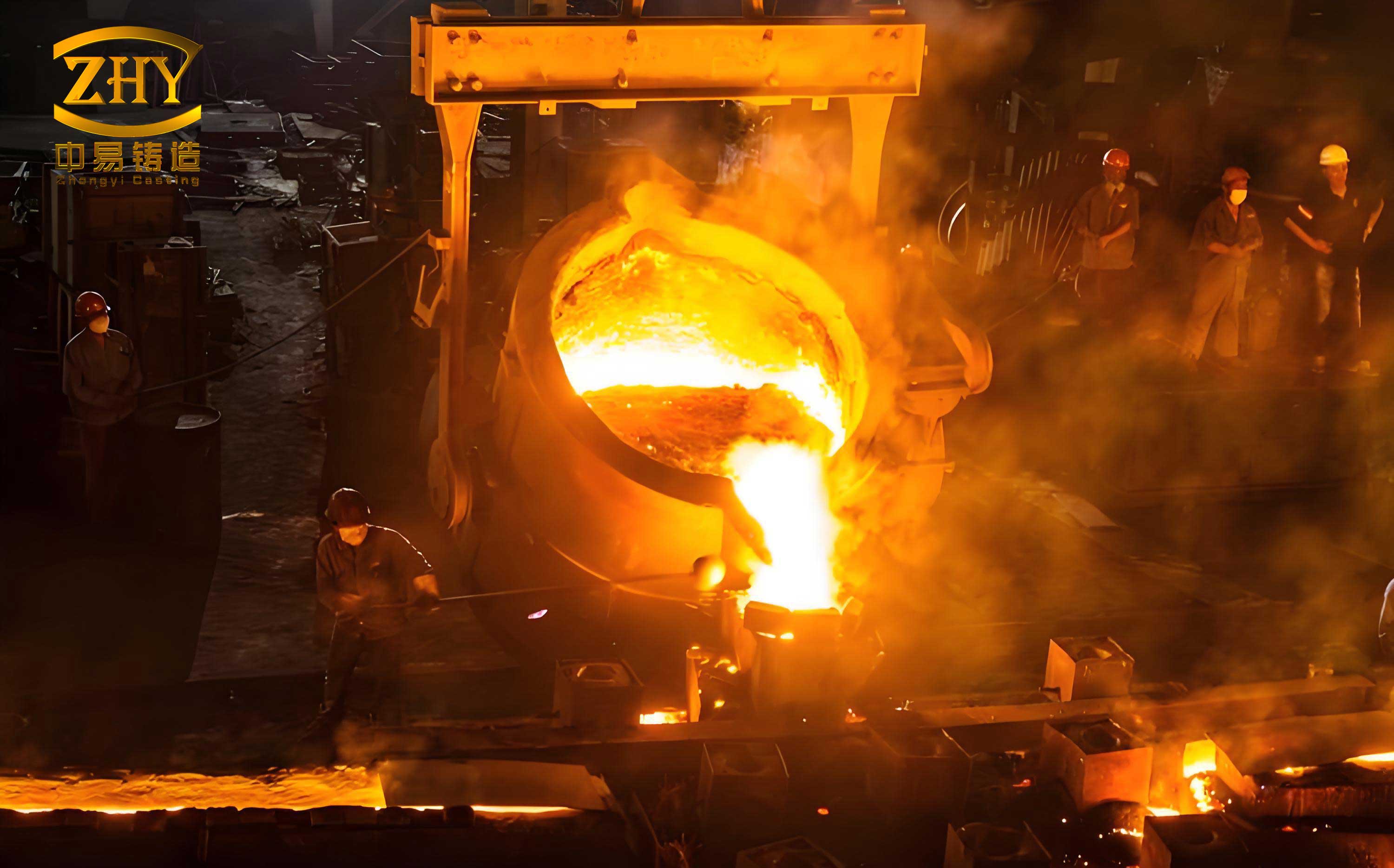
The root cause lies in the metallurgy and processing. After being cast in a manganese steel casting foundry, these components often undergo a high-temperature water quenching process. This treatment, while crucial for developing the austenitic structure responsible for the steel’s work-hardening capability, frequently induces distortion and leaves behind a surface layer with variable hardness. When a cutting tool engages, the material work-hardens rapidly beneath the cutting edge, often reaching surface hardness levels exceeding 500 HB. This, combined with intermittent cuts caused by voids or uneven surfaces, creates severe mechanical and thermal shock on the tool. For any operation in a manganese steel casting foundry aiming for profitability, overcoming these barriers is not optional; it is essential. This narrative details the practical tooling solutions I have adopted and refined to machine these tenacious materials effectively.
The cornerstone of turning operations for high manganese steel castings is a specially designed indexable turning tool utilizing a round, double-sided insert with no chip breaker groove and a neutral or negative rake geometry. The fundamental principle here is sacrificing a degree of cutting sharpness for immense edge strength. The insert is mounted on a tool holder whose pocket is engineered at a specific inclination. This simple yet brilliant design means that by merely rotating or flipping the round insert, multiple fresh cutting edges are presented, and the required negative rake angle and clearance angle are inherently achieved through the holder’s geometry. The clamping is achieved via a robust pull-down pin or lever mechanism, ensuring exceptional rigidity—a non-negotiable requirement when dealing with the intermittent cutting forces common in a manganese steel casting foundry environment.
The advantages of this system are multifaceted and directly address the core challenges. First, the round insert offers the maximum number of usable cutting edges among all indexable insert shapes. With both its top and bottom faces being identical and functional, the number of indexing positions, or “cutting corners,” is maximized. This dramatically improves the utilization rate of the expensive cemented carbide material, a critical factor for cost management in any manganese steel casting foundry. The economic benefit can be expressed by a simple formula for cost per edge, $$C_e = \frac{C_i}{N_e}$$, where \(C_e\) is the cost per cutting edge, \(C_i\) is the initial cost of the insert, and \(N_e\) is the total number of usable edges. For a round insert, \(N_e\) is significantly higher than for triangular or square inserts, directly lowering \(C_e\).
Secondly, these round inserts are regrindable. Unlike complex three-dimensional chip breaker geometries, re-sharpening involves only simple surface grinding for the rake face and cylindrical grinding for the peripheral clearance face. This regrinding process, often performed in-house at a well-equipped manganese steel casting foundry, restores the cutting geometry at a fraction of the cost of a new insert, further extending the tool’s economic life. The relationship between regrinding and total tool life can be considered as an extension: $$T_{total} = T_{new} + n \times T_{reground}$$, where \(T_{total}\) is the cumulative cutting time, \(T_{new}\) is the life from the new insert edges, \(n\) is the number of regrinds, and \(T_{reground}\) is the average life after each regrind.
Thirdly, and most importantly for machining high manganese steel castings, is the exceptional strength of the cutting edge. The absence of a chip breaker groove and the substantial cross-sectional area of the round insert create a vastly stronger cutting wedge. This design effectively resists the micro-chipping and catastrophic failure caused by the intense shock loads encountered when the tool hits a sand pocket or a hard spot in a casting from the manganese steel casting foundry. The ability to withstand vibration and impact is paramount.
The practical application of this tooling requires careful selection of cutting parameters. Based on accumulated data from numerous machining campaigns in our manganese steel casting foundry, we have established reliable starting points for machining various high manganese steel castings. The following table summarizes typical cutting parameters and the resulting performance when using the described indexable round insert tooling with a suitable carbide grade, such as those from the M30-M40 ISO classification range known for high toughness.
| Workpiece Name & Material | Carbide Grade (ISO) | Cutting Speed, \(v_c\) (m/min) | Feed Rate, \(f\) (mm/rev) | Depth of Cut, \(a_p\) (mm) | Tool Life Indicator & Performance Notes |
|---|---|---|---|---|---|
| High Mn Steel Railway Crossing | M30 | 25 – 35 | 0.15 – 0.25 | 2.0 – 4.0 | Stable wear land (VB ~ 0.3mm) after 45 mins; no chipping. |
| High Mn Steel Crusher Liner | M35 | 20 – 30 | 0.10 – 0.20 | 1.5 – 3.0 | Resists intermittent cut shock from casting scale; life ~ 60 mins. |
| High Mn Steel Bucket Tooth | M40 | 28 – 38 | 0.18 – 0.28 | 2.5 – 5.0 | Excellent for roughing distorted castings; predictable wear pattern. |
| High Mn Steel Roll Surface | M30-M35 | 22 – 32 | 0.12 – 0.22 | 1.0 – 2.5 | Good surface finish achievable; minimizes work-hardened layer. |
The underlying mechanics can be partly described by the Taylor Tool Life equation, adapted for the harsh conditions of manganese steel: $$v_c \cdot T^n = C$$, where \(v_c\) is the cutting speed, \(T\) is the tool life to a specified wear criterion, and \(n\) and \(C\) are constants dependent on the tool-workpiece combination. For high manganese steel castings, the exponent \(n\) tends to be lower, indicating that tool life is more sensitive to changes in cutting speed. Therefore, maintaining a moderate, stable speed as shown in the table is crucial. The cutting force components, especially the main cutting force \(F_c\), which is critical for machine tool power and tool deflection, can be estimated using the specific cutting force \(k_c\): $$F_c = k_c \cdot a_p \cdot f$$. For high manganese steel in its work-hardened state, \(k_c\) values are exceptionally high, often in the range of 3000-4500 N/mm², justifying the need for ultra-rigid tool holding and strong insert geometries.
Beyond turning, milling operations on high manganese steel castings present an equally daunting challenge. Small-diameter milling, required for detail work, slotting, or contouring on cast components from the manganese steel casting foundry, was historically the domain of solid high-speed steel or solid carbide tools, which wore out or broke rapidly. The breakthrough came with the adoption of a modular, flexible tooling system featuring interchangeable carbide cutting heads. This system is designed for rotating tools with diameters generally below 16 mm, making it ideal for the intricate milling work often needed on castings.
The economic argument for this system in a manganese steel casting foundry is compelling. Instead of discarding an entire solid carbide end mill after its edges are worn or chipped, only the small, inexpensive carbide head is replaced. The tool body, which constitutes the majority of the tool’s cost and complexity, remains in service indefinitely. The cost model compares favorably: Let \(C_{solid}\) be the cost of a solid carbide end mill with a life \(L_{solid}\), and \(C_{system}\) be the cost of the tool holder plus \(n\) heads, each with a life \(L_{head}\). The cost per unit machining time becomes significantly lower for the interchangeable system when $$\frac{C_{system}}{n \cdot L_{head}} < \frac{C_{solid}}{L_{solid}}$$, a condition easily met in practice when machining abrasive and shock-prone materials like high manganese steel castings.
The heart of this system is the precision-machined carbide head, manufactured from advanced coated carbide grades specifically developed for high toughness and wear resistance. The head is secured to the steel tool shank using a dedicated internal clamping screw, which, when tightened with a special wrench, ensures concentricity and a rigid connection capable of handling the high cutting forces. The cutting head typically features two primary cutting edges. Three main typologies are available to address different features on a manganese steel casting foundry component: a head with a sharp corner (zero nose radius) for milling sharp angles and slots; a head with a small defined nose radius (e.g., 0.2 mm or 0.4 mm) for milling radii and grooves; and for copy milling or profile finishing, a head where the nose radius is equal to half the diameter of the head itself, providing a large, strong contouring edge. Standard diameters for these heads commonly include 6 mm, 8 mm, 10 mm, and 12 mm, covering a wide range of detailed milling tasks.
The performance of these milling heads hinges on optimal cutting data. Due to the smaller diameters and inherent lower rigidity compared to turning tools, parameters must be chosen even more judiciously. A generalized formula for feed per tooth \(f_z\) in milling high manganese steel castings must account for the work-hardening effect: $$f_z = k \cdot \sqrt{D}$$, where \(D\) is the tool diameter and \(k\) is an empirical constant much smaller than for standard steels, ensuring the chip load is light enough to prevent excessive edge stress. The table below provides a guideline for starting parameters when using these interchangeable head mills on typical high manganese steel casting foundry workpieces.
| Operation Type | Tool Diameter, \(D\) (mm) | Cutting Speed, \(v_c\) (m/min) | Feed per Tooth, \(f_z\) (mm/tooth) | Axial Depth, \(a_p\) (mm) | Radial Depth, \(a_e\) (mm) | Key Consideration |
|---|---|---|---|---|---|---|
| Slotting | 6 | 30 – 40 | 0.03 – 0.05 | 1.0 – 2.0 | \(D\) | Use sharp corner head, full slot in multiple passes. |
| Contour Finishing | 10 (R5 head) | 35 – 45 | 0.05 – 0.08 | 0.5 – 1.5 | 0.2 – 0.5 \(\cdot D\) | Large radius head for smooth paths, minimal stepover. |
| Pocketing | 8 | 32 – 42 | 0.04 – 0.06 | 1.5 – 3.0 | 0.3 – 0.6 \(\cdot D\) | Trochoidal or adaptive milling paths highly recommended. |
| Edge Breaking/Chamfering | 12 | 38 – 48 | 0.06 – 0.10 | Variable | Variable | High rigidity required; effective for removing casting flash. |
The technological synergy between these two tooling solutions—the robust indexable turning tool and the flexible interchangeable-head milling system—creates a comprehensive machining strategy for the manganese steel casting foundry. However, the ultimate efficiency of this strategy is inextricably linked to the quality of the raw casting. Every effort made in the manganese steel casting foundry to improve casting integrity, minimize surface irregularities, and carefully remove gates and risers to leave minimal residual stock directly translates into higher machining efficiency. Reduced shock loads allow for more aggressive parameters within safe limits, further boosting metal removal rates and extending tool life beyond the conservative values listed in the tables. The relationship is synergistic: better casting practices in the manganese steel casting foundry enable more effective machining, which lowers total component cost and improves delivery reliability.
In conclusion, mastering the machining of high manganese steel castings requires a departure from standard tooling paradigms. The solutions described here, born from practical necessity in the demanding environment of a manganese steel casting foundry, leverage intelligent design to turn material disadvantages into manageable challenges. The round insert turning tool maximizes edge strength and tool material utilization, while the interchangeable-head milling system brings economic viability and flexibility to small-diameter milling. Both systems rely on the fundamental principles of extreme rigidity, negative rake geometries for strength, and carefully moderated cutting parameters to manage work hardening and shock. By integrating these tools with ongoing efforts to improve casting quality, a manganese steel casting foundry can achieve remarkable gains in productivity, cost control, and overall machining capability for these critical, wear-resistant components. The continuous evolution of carbide substrates and coatings promises even further advancements, but the core engineering principles of strength, economy, and adaptability will remain the bedrock of successful machining in the manganese steel casting foundry sector.