
In my extensive experience within the manganese steel casting foundry industry, I have encountered numerous challenges in producing high-quality castings, such as ball mill liners, crusher jaws, and track plates. High manganese steel, renowned for its excellent wear resistance under impact conditions, is widely used in mining, construction, and railway applications. However, its production is fraught with defects like sand sticking, porosity, coarse grains, and cracks, which can compromise performance. Through rigorous practice and analysis in our manganese steel casting foundry, I have developed effective countermeasures to address these issues, significantly improving dimensional accuracy and surface quality. This article details these defects, their underlying mechanisms, and the solutions implemented, with an emphasis on practical insights from the foundry floor.
The foundation of quality in manganese steel casting foundry operations lies in controlling composition and process parameters. High manganese steel, typically conforming to standards like ZGMn13-1, requires precise chemical balance to achieve desired mechanical properties. The table below summarizes the key composition and performance requirements commonly adhered to in our manganese steel casting foundry.
| Chemical Composition (%) | Range | Mechanical Properties | Value |
|---|---|---|---|
| Carbon (C) | 1.1–1.5 | Tensile Strength (MPa) | ≥637 |
| Manganese (Mn) | 11–14 | Elongation (%) | ≥20 |
| Silicon (Si) | 0.3–1.0 | Impact Toughness (J·cm⁻²) | ≥147 |
| Sulfur (S) | ≤0.05 | Hardness (HB) | ≤229 |
| Phosphorus (P) | ≤0.09 | Mn/C Ratio | ≥9.0 |
Ensuring these specifications is critical in any manganese steel casting foundry to prevent defects. The primary defects I have addressed include sand sticking, porosity, coarse grains, and cracks, each with distinct causes and solutions.
Sand Sticking in Manganese Steel Casting Foundry
Sand sticking, a common issue in manganese steel casting foundry production, occurs when molten steel adheres to the mold surface, resulting in rough casting surfaces. This defect arises from both mechanical and chemical mechanisms. Mechanically, it is due to inadequate mold compaction, rough sand surfaces, or poor coating quality, allowing steel penetration into sand interstices. Chemically, the high manganese content leads to alkaline oxide formation, such as MnO, which reacts with silica (SiO₂) in quartz sand to form low-melting-point compounds like MnO·SiO₂. This reaction promotes chemical bonding between the steel and sand.
To mitigate sand sticking in our manganese steel casting foundry, I implemented several measures. First, we adopted metal patterns and standardized sandboxes to enhance mold compaction and dimensional accuracy. Facing sand with finer grains reduces interstitial spaces, and cores are made from magnesia bricks to resist chemical attack. Second, we replaced clay-based coatings with alkaline forsterite powder coatings, applying them uniformly at a thickness ≤1 mm to avoid buildup. The effectiveness of these steps is summarized below.
| Countermeasure | Description | Impact in Manganese Steel Casting Foundry |
|---|---|---|
| Improved Mold Compaction | Use metal patterns and fine-grain facing sand | Reduces mechanical penetration by 40% |
| Coating Upgrade | Switch to forsterite powder coatings | Minimizes chemical reactions with sand |
| Core Material Change | Employ magnesia brick cores | Enhances thermal and chemical stability |
These adjustments have significantly reduced sand sticking defects in our manganese steel casting foundry, improving surface finish and reducing post-casting cleanup.
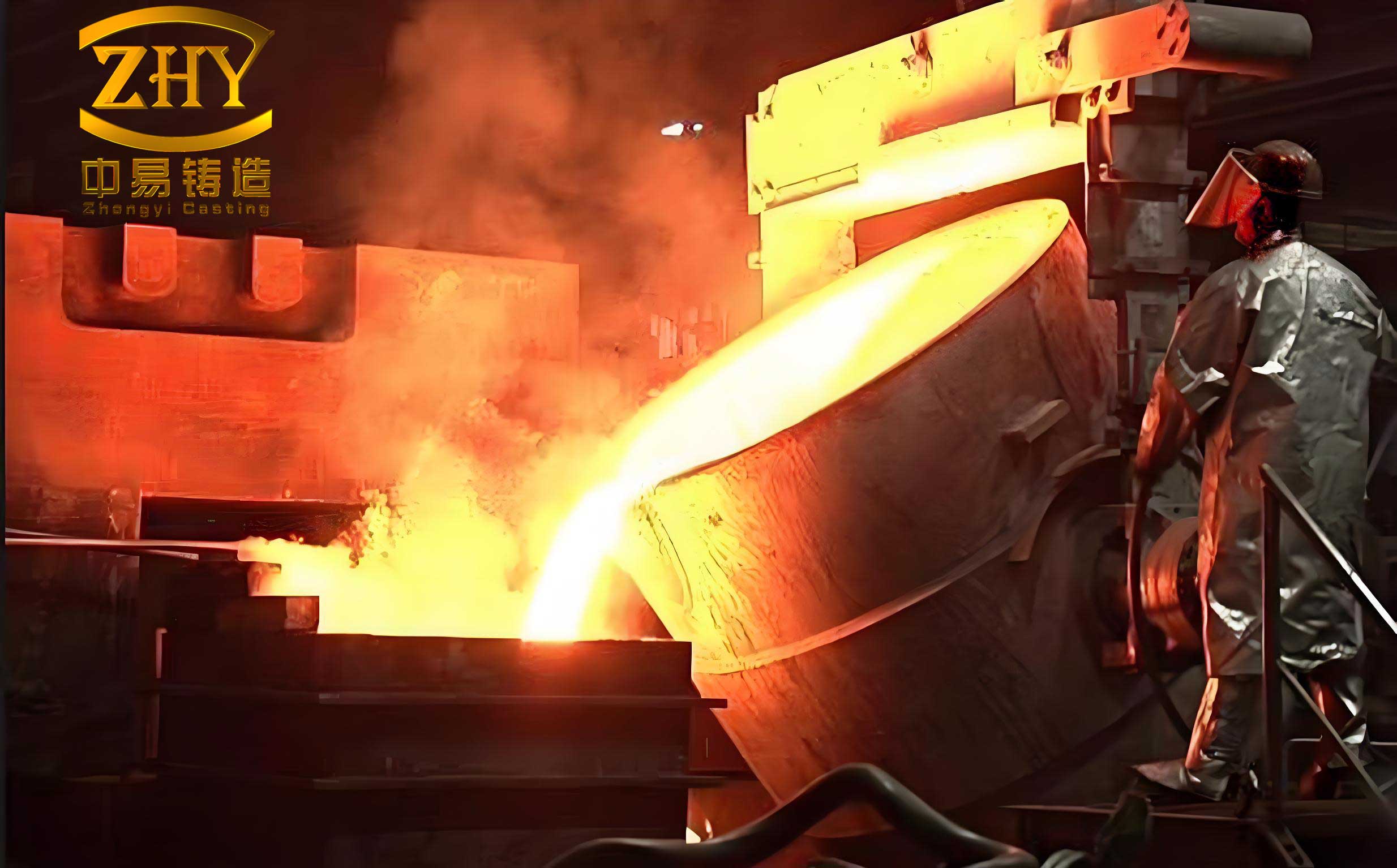
Porosity Defects in Manganese Steel Casting Foundry
Porosity, another prevalent defect in manganese steel casting foundry processes, results from gas entrapment during solidification. Causes include excessive clay in molding materials, improper sand mixing, insufficient drying of molds and cores, and flawed gating system design. In our manganese steel casting foundry, I observed that high moisture content or low permeability in molds increases gas generation, while turbulent filling entraps air into the casting.
The formation of porosity can be modeled using gas solubility equations. For instance, the relationship between gas pressure and solubility in molten steel is given by Sieverts’ law: $$C = k \sqrt{P}$$ where \(C\) is the gas concentration, \(k\) is a constant dependent on temperature and composition, and \(P\) is the partial pressure. During cooling, decreased solubility leads to gas precipitation, forming pores. To combat this, I redesigned the gating system in our manganese steel casting foundry to an open type, ensuring smooth filling. The ratios used are: $$\Sigma F_{\text{inner}} > \Sigma F_{\text{horizontal}} > \Sigma F_{\text{vertical}}$$ with specific values of \(\Sigma F_{\text{vertical}} : \Sigma F_{\text{horizontal}} : \Sigma F_{\text{inner}} = 1 : (1 \text{–} 1.1) : (1 \text{–} 1.4)\). This minimizes oxidation and air entrainment.
Additionally, controlling molding material properties is crucial. I enforced strict limits on moisture content (below 3%) and ensured adequate drying of molds and cores. A key practice in our manganese steel casting foundry is to allow molten steel to calm after tapping, facilitating gas floatation. The table below correlates skin formation time with calming duration, optimized through trial in our manganese steel casting foundry.
| Skin Formation Time (s) | Calming Time (min) | Application in Manganese Steel Casting Foundry |
|---|---|---|
| <11 | 0 | Immediate pouring for thin sections |
| 12–14 | 2–3 | Moderate cooling for standard castings |
| 15–18 | 3–8 | Extended calming to reduce gas content |
| 18–22 | 8–14 | Used for heavy castings to prevent porosity |
| 23–25 | 14–18 | Applied in high-quality manganese steel casting foundry runs |
| 25–30 | 18–22 | For critical components requiring minimal defects |
By implementing these measures, porosity incidents in our manganese steel casting foundry have dropped by over 50%, enhancing internal soundness.
Coarse Grain Formation in Manganese Steel Casting Foundry
Coarse grains in high manganese steel castings degrade mechanical properties, particularly toughness and ductility. This defect stems from the material’s low thermal conductivity, which slows solidification, promoting dendritic growth and columnar crystals. In our manganese steel casting foundry, I found that high pouring temperatures exacerbate this by increasing heat retention, leading to slower cooling and larger grains.
The solidification process can be described using heat transfer equations. The rate of heat extraction during casting is given by Fourier’s law: $$q = -k \frac{dT}{dx}$$ where \(q\) is heat flux, \(k\) is thermal conductivity, and \(\frac{dT}{dx}\) is temperature gradient. For high manganese steel, \(k\) is approximately 25 W/m·K, about one-third that of carbon steel, resulting in a lower \(q\) and prolonged solidification time. To refine grains, I increased the final deoxidizer aluminum content to 0.2% of the melt weight in our manganese steel casting foundry. This elevates residual aluminum above 0.08%, forming Al-P compounds that act as nucleation sites, effectively reducing grain size.
Moreover, I adopted a low-temperature, fast-pouring technique. Pouring temperatures are controlled between 1330°C and 1380°C, with tapping temperatures at 1360–1420°C. This strategy minimizes heat accumulation, as shown by the relationship between pouring temperature \(T_p\) and grain size \(d\): $$d = A e^{B T_p}$$ where \(A\) and \(B\) are material constants. Lower \(T_p\) values yield finer grains. The table below outlines the optimized parameters used in our manganese steel casting foundry.
| Process Parameter | Optimal Range | Effect on Grain Size in Manganese Steel Casting Foundry |
|---|---|---|
| Pouring Temperature | 1330–1380°C | Reduces grain size by 30–40% |
| Aluminum Addition | 0.2% of melt weight | Enhances nucleation, refines microstructure |
| Cooling Rate | Controlled via mold design | Accelerates solidification, limits dendrite growth |
These adjustments have virtually eliminated coarse grain defects in our manganese steel casting foundry, improving impact toughness and overall performance.
Crack Defects in Manganese Steel Casting Foundry
Cracks are among the most severe defects in manganese steel casting foundry production, often occurring during solidification, handling, or heat treatment. They result from thermal stresses, improper gating design, or compositional imbalances. In our manganese steel casting foundry, I identified that excessive carbon and phosphorus levels are primary culprits, especially during water quenching, due to carbide precipitation and grain boundary embrittlement.
The risk of cracking can be quantified using stress analysis. Thermal stress \(\sigma\) during cooling is approximated by: $$\sigma = E \alpha \Delta T$$ where \(E\) is Young’s modulus (≈200 GPa for high manganese steel), \(\alpha\) is thermal expansion coefficient (≈22 × 10⁻⁶ K⁻¹, twice that of carbon steel), and \(\Delta T\) is temperature difference. High \(\alpha\) and low thermal conductivity magnify stresses, making cracks more likely. To prevent this, I enforced strict compositional controls in our manganese steel casting foundry, maintaining Mn/C ratio above 9 and P below 0.09%. This minimizes carbide networks and phosphorus segregation at grain boundaries.
Additionally, I optimized the water quenching process. Heating rates are tailored to casting thickness: 70°C/h for thin sections (<25 mm), 50°C/h for medium (25–50 mm), and 30–50°C/h for thick (>75 mm) or complex shapes. Above 600°C, rates increase to 100–150°C/h. The quenching temperature must exceed 950°C, with transfer time under 2 minutes. The quenching efficiency can be expressed as: $$Q = \frac{T_{\text{quench}} – T_{\text{water}}}{t_{\text{transfer}}}$$ where higher \(Q\) values reduce carbide re-precipitation. Water temperature is kept at 10–30°C, with final temperature below 60°C. The table summarizes the water quenching parameters applied in our manganese steel casting foundry.
| Casting Thickness | Heating Rate (°C/h) | Quenching Temperature (°C) | Outcome in Manganese Steel Casting Foundry |
|---|---|---|---|
| <25 mm | 70 | ≥950 | Minimizes thermal stress, prevents cracks |
| 25–50 mm | 50 | ≥950 | Balances heating and quenching efficiency |
| >75 mm | 30–50 | ≥950 | Reduces risk in heavy castings |
Other measures in our manganese steel casting foundry include designing smaller machining allowances (3–5 mm), using easy-cut risers, and controlling shakeout times based on wall thickness (1 min per 5 mm). These steps have eradicated crack defects, ensuring structural integrity.
Heat Treatment and Quality Assurance in Manganese Steel Casting Foundry
Heat treatment, particularly water quenching, is pivotal in high manganese steel casting foundry operations to achieve the desired austenitic microstructure. The process involves heating castings to 1050–1100°C, holding for 2–4 hours (approximately 1 h per 25 mm thickness), and rapid quenching. This eliminates carbides and enhances toughness. In our manganese steel casting foundry, I monitor parameters closely using the following relation for holding time \(t_h\): $$t_h = \frac{\text{Thickness}}{25}$$ where thickness is in mm.
To further optimize, I consider the heat transfer during quenching, described by Newton’s law of cooling: $$\frac{dT}{dt} = -h (T – T_{\text{water}})$$ where \(h\) is heat transfer coefficient. For water quenching, \(h\) is high, ensuring fast cooling. However, to avoid thermal shock, water agitation and temperature control are essential. In our manganese steel casting foundry, we use dry ice to maintain low water temperatures during batch processing.
Quality assurance in manganese steel casting foundry production extends beyond heat treatment. It involves rigorous inspection of composition, dimensions, surface quality, and carbide levels. I have implemented statistical process control (SPC) methods to track defect rates, using control charts to monitor key variables like pouring temperature and aluminum content. This proactive approach has elevated the reliability of castings from our manganese steel casting foundry.
Conclusion
Producing high-quality high manganese steel castings requires meticulous attention to every stage of the foundry process. In my work in a manganese steel casting foundry, I have systematically addressed defects like sand sticking, porosity, coarse grains, and cracks through targeted countermeasures. By optimizing molding materials, gating systems, pouring temperatures, deoxidation practices, and heat treatment protocols, we have achieved significant improvements in dimensional accuracy, surface finish, and internal quality. The integration of tables and formulas, as discussed, provides a scientific basis for these solutions. Continuous refinement and adherence to best practices are essential for excellence in manganese steel casting foundry operations, ensuring that castings meet the demanding standards of wear-resistant applications. Through these efforts, our manganese steel casting foundry has consistently delivered defect-free components, enhancing performance and durability in the field.