
In the realm of mining machinery, the demand for durable and wear-resistant components is paramount. As a researcher focused on material science, I have extensively studied the behavior of high manganese steel castings, particularly ZGMn13, which is widely utilized in parts like excavator teeth, ball mill liners, and railway tracks due to its excellent mechanical properties and cost-effectiveness. However, a significant challenge arises when these manganese steel casting foundry products are subjected to non-intensive impact loads, leading to inadequate work-hardening and reduced wear resistance. This issue has spurred numerous investigations into refining microstructure and enhancing performance through alloy modifications and thermal processing. In this article, I present a comprehensive study on the influence of heat treatment protocols on the microstructure and mechanical properties of ZGMn13 high manganese steel, with an emphasis on optimizing processes for superior toughness and hardness. The goal is to provide insights that can benefit manganese steel casting foundry operations by improving product reliability and longevity.
The foundation of this work lies in understanding the phase transformations in high manganese steels. Based on the Fe-Mn-C ternary system phase diagram (for ~13% Mn), the austenite phase region is critical. During heating, carbides dissolve into the austenite matrix, and upon rapid cooling, a single-phase austenitic structure is achieved. However, if cooling is slow, detrimental carbides can reprecipitate. The kinetics of these transformations can be described using diffusion-based models. For instance, the dissolution of carbides during austenitization follows an Arrhenius-type equation: $$ D = D_0 \exp\left(-\frac{Q}{RT}\right) $$ where \( D \) is the diffusion coefficient, \( D_0 \) is a pre-exponential factor, \( Q \) is the activation energy, \( R \) is the gas constant, and \( T \) is the absolute temperature. This governs how quickly carbon and manganese redistribute in the manganese steel casting foundry product during heat treatment.
| Element | Content in Studied Casting | Standard Range (GB/T 5680-1998) |
|---|---|---|
| C | 0.98 | 0.90–1.30 |
| Si | 0.59 | 0.30–0.80 |
| Mn | 13.42 | 11.0–14.0 |
| P | 0.036 | ≤0.040 |
| S | 0.005 | ≤0.070 |
| Mo | 0.92 | — |
| Fe | Balance | Balance |
The material used in this investigation was a finished ZGMn13 casting sourced from a manganese steel casting foundry. Its chemical composition, as detailed in Table 1, aligns with standard specifications, ensuring relevance to industrial applications. Carbon content is crucial for work-hardening capability, while manganese stabilizes the austenite phase. The presence of molybdenum is noted, as it can form alloy carbides influencing microstructure. In the as-cast state, the microstructure consists of an austenitic matrix with various carbides dispersed at grain boundaries and within grains. These carbides, identified as (Fe, Mn)₃C and (Fe, Mo, Mn)₃C, appear as blocky, granular, and acicular morphologies. Their presence in the as-cast condition is typical for manganese steel casting foundry outputs and necessitates heat treatment to dissolve them for optimal performance.
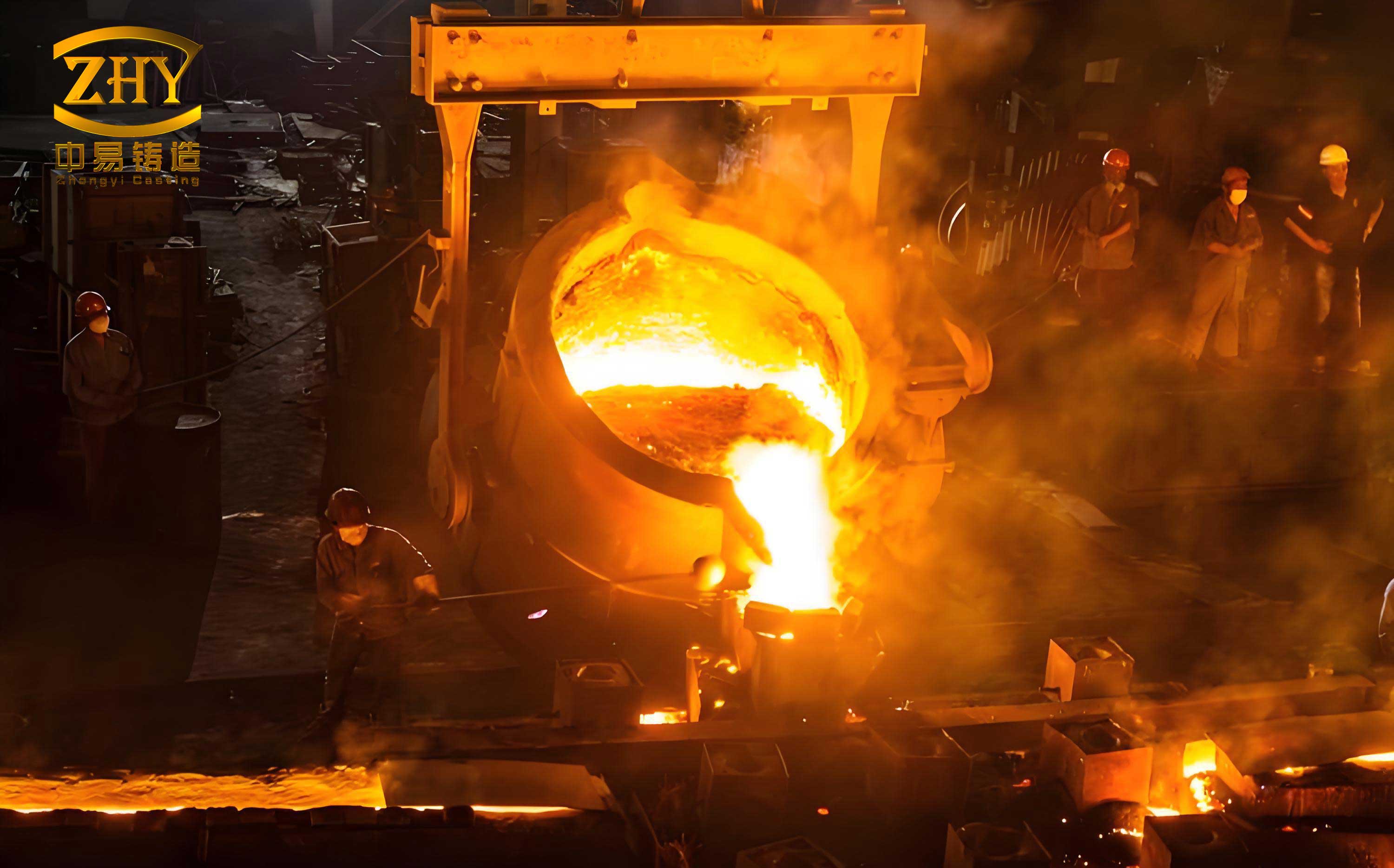
To explore heat treatment effects, I designed several thermal cycles, as summarized in Table 2. The processes involve variations in pre-isothermal holding and austenitization temperatures, aiming to refine grain structure through phase transformations. Specifically, holding at 600°C promotes pearlite formation via eutectoid reaction, which later serves as nucleation sites for new austenite grains during subsequent heating. This approach leverages phase transformation kinetics to enhance grain refinement, a key consideration for manganese steel casting foundry practices seeking improved toughness.
| Scheme ID | Heat Treatment Process | Description |
|---|---|---|
| HT1100 | Direct heating to 1100°C, hold for 2 h, water quench | Conventional solution treatment |
| HT600-1100 | Pre-isothermal at 600°C for 2 h, then heat to 1100°C for 2 h, water quench | Two-step with high austenitization |
| HT600-1050 | Pre-isothermal at 600°C for 2 h, then heat to 1050°C for 2 h, water quench | Two-step with lower austenitization |
| HT600 | Heat to 600°C, hold for 2 h, water quench | Reference for pearlite formation |
Heating rates were controlled at 100°C/h to simulate industrial conditions, and quenching was done rapidly in circulating water to avoid carbide reprecipitation. After treatment, samples were prepared for metallographic examination using optical microscopy and scanning electron microscopy (SEM), with etching in 4% nital. Mechanical testing included Brinell hardness measurements and Charpy impact tests at room temperature, following standard protocols. These methods are essential for evaluating the performance of manganese steel casting foundry products after thermal processing.
The microstructural evolution revealed significant insights. In the as-cast state, carbides are prevalent, but after full solution treatment, all samples exhibited a single-phase austenitic structure. However, grain size varied with treatment parameters. For HT1100, austenite grains were coarse, whereas HT600-1050 resulted in finer grains due to the pre-isothermal step. This refinement can be quantified using the Hall-Petch relationship, which links yield strength to grain size: $$ \sigma_y = \sigma_0 + k_y d^{-1/2} $$ where \( \sigma_y \) is the yield strength, \( \sigma_0 \) is the friction stress, \( k_y \) is a constant, and \( d \) is the average grain diameter. Although high manganese steel is austenitic and yield strength may not be directly measured here, the principle applies to hardness and toughness enhancements. Finer grains increase boundary area, hindering crack propagation and improving impact energy absorption—a critical factor for manganese steel casting foundry components under impact loads.
Specifically, the HT600 sample, which was only held at 600°C and quenched, showed partial decomposition of austenite into pearlite, confirming the eutectoid reaction. The pearlite morphology provided interfaces for new austenite nucleation during further heating. When austenitized at 1050°C, these nucleation sites led to a refined austenite grain structure compared to direct heating to 1100°C. The kinetics of pearlite formation can be described by the Johnson-Mehl-Avrami-Kolmogorov (JMAK) equation: $$ X = 1 – \exp(-kt^n) $$ where \( X \) is the transformed fraction, \( k \) is a rate constant, \( t \) is time, and \( n \) is the Avrami exponent. For pearlite in high manganese steel, this model helps predict the extent of transformation during pre-isothermal holding, guiding manganese steel casting foundry heat treatment schedules.
| Condition | Brinell Hardness (HB) | Charpy Impact Absorbed Energy (J) | Microstructure Characteristics |
|---|---|---|---|
| As-cast | ~192 | Low (brittle due to carbides) | Austenite + carbides |
| HT1100 | 190.5 | 178.1 | Coarse austenite |
| HT600-1100 | 191.8 | 225.3 | Moderately refined austenite |
| HT600-1050 | 194.1 | 249.4 | Fine austenite |
| HT600 | ~193 (with pearlite) | Not tested (brittle) | Austenite + pearlite + carbides |
The mechanical property data, compiled in Table 3, highlight the benefits of optimized heat treatment. The HT600-1050 process yielded the highest impact energy (249.4 J) coupled with a hardness of 194.1 HB. This represents a 40% improvement in toughness over HT1100, demonstrating the efficacy of grain refinement. Hardness values remained relatively consistent across treatments because the soft austenitic matrix dominates, but slight variations arise from grain size effects and residual stresses. The relationship between hardness and impact energy can be expressed as a trade-off, but in this case, refinement enhances both. For a manganese steel casting foundry, achieving such a balance is valuable for components experiencing both wear and impact.
To further analyze the results, I consider the role of carbide dissolution. During austenitization, carbon solubility increases with temperature, described by the equation: $$ C_{\gamma} = C_0 \exp\left(-\frac{\Delta H}{RT}\right) $$ where \( C_{\gamma} \) is the carbon content in austenite, \( C_0 \) is a constant, and \( \Delta H \) is the enthalpy of dissolution. At 1050°C, carbides fully dissolve, but lower temperatures might retain some, affecting properties. However, in HT600-1050, complete dissolution is achieved due to sufficient holding time. The impact energy improvement correlates with the absence of brittle carbides and fine grain structure. Additionally, the pre-isothermal step at 600°C not only promotes pearlite but also allows for stress relief, beneficial for manganese steel casting foundry products prone to residual stresses from casting.
In discussing industrial implications, it’s clear that the two-step heat treatment (600°C pre-isothermal followed by 1050°C austenitization) offers a practical route for enhancing ZGMn13 performance. This process is feasible in most manganese steel casting foundry facilities with standard heat treatment furnaces. The control of cooling rate is critical; rapid quenching suppresses carbide reprecipitation, maintaining a single-phase austenite. The quench sensitivity can be modeled using continuous cooling transformation (CCT) diagrams, where the critical cooling rate \( V_c \) to avoid carbide formation is given by: $$ V_c = \frac{T_{\gamma} – T_{s}}{t_s} $$ where \( T_{\gamma} \) is the austenitization temperature, \( T_{s} \) is the nose temperature of the carbide precipitation curve, and \( t_s \) is the time at that temperature. For ZGMn13, water quenching typically meets this requirement.
Moreover, the economic aspect is vital for manganese steel casting foundry operations. The optimized process does not require exotic equipment or extended times, making it cost-effective. By improving impact toughness, component lifespan in mining machinery can be extended, reducing downtime and maintenance costs. This aligns with broader industry trends toward sustainable and efficient manufacturing. Future work could explore variations in alloy composition, such as adding chromium or vanadium, to further enhance wear resistance without compromising toughness—a common pursuit in manganese steel casting foundry research.
In conclusion, this study underscores the importance of tailored heat treatment for high manganese steel castings. Through microstructural analysis and mechanical testing, I have demonstrated that a pre-isothermal hold at 600°C followed by austenitization at 1050°C and water quenching produces a fine-grained, fully austenitic structure with superior impact toughness (249.4 J) and adequate hardness (194.1 HB). This optimized protocol leverages phase transformation kinetics to refine grains, addressing the limitations of conventional treatments. For manganese steel casting foundry practitioners, adopting such processes can lead to more reliable and durable components for demanding mining applications. The integration of these findings into standard practices will contribute to advancing material performance in heavy industry.
To summarize key formulas and relationships, the following equations are central to understanding the behavior of manganese steel during heat treatment:
- Diffusion-controlled dissolution: $$ D = D_0 \exp\left(-\frac{Q}{RT}\right) $$
- Hall-Petch grain refinement effect: $$ \sigma_y = \sigma_0 + k_y d^{-1/2} $$
- Johnson-Mehl-Avrami-Kolmogorov transformation kinetics: $$ X = 1 – \exp(-kt^n) $$
- Carbon solubility in austenite: $$ C_{\gamma} = C_0 \exp\left(-\frac{\Delta H}{RT}\right) $$
- Critical cooling rate for carbide avoidance: $$ V_c = \frac{T_{\gamma} – T_{s}}{t_s} $$
These mathematical models provide a framework for optimizing heat treatment parameters in a manganese steel casting foundry, ensuring consistent quality and performance. Continued research in this area will further elucidate the complex interactions between composition, processing, and properties, driving innovation in material science for mining machinery.