
In the realm of industrial manufacturing, the machining of casting parts has always been a critical yet challenging process. As someone deeply involved in the field of precision tooling, I have witnessed firsthand how the right tools can transform production lines, especially when dealing with complex casting parts. The inherent properties of cast materials, such as porosity, hardness variations, and the presence of inclusions, often lead to issues like tool wear, poor surface finish, and burr formation. These challenges necessitate innovative solutions, and in my experience, the development of specialized boring tools has been a game-changer for improving efficiency and quality in machining casting parts.
The core of this advancement lies in the design of high-efficiency boring tools tailored specifically for casting parts. Traditional tools often struggle with the abrasive nature of cast iron or aluminum alloys, resulting in shortened tool life and increased downtime. However, through extensive research and practical application, I have found that tools incorporating advanced geometries, coatings, and material science can significantly enhance performance. For instance, when machining casting parts like valve sleeves or engine blocks, a well-designed boring tool can achieve higher feed rates, better accuracy, and minimal burr generation, directly impacting productivity and cost-effectiveness.
One of the key innovations I have worked with is a high-feed boring tool system that integrates multiple step configurations. This design allows for versatile application across different types of casting parts, from small precision components to large industrial castings. The tool’s geometry is optimized to reduce cutting forces, which is crucial for maintaining stability and preventing damage to delicate casting parts. The mathematical relationship between cutting parameters and tool performance can be expressed through formulas that guide optimal usage. For example, the cutting speed \( v_c \) in meters per minute is given by:
$$ v_c = \frac{\pi \times D \times n}{1000} $$
where \( D \) is the tool diameter in millimeters and \( n \) is the spindle speed in revolutions per minute. For casting parts made of materials like GG30 cast iron, which is commonly used in hydraulic systems, adjusting \( v_c \) and feed per tooth \( f_z \) is essential to balance tool life and material removal rate. In my applications, I have observed that increasing the feed rate while maintaining a moderate cutting speed can double the productivity without compromising quality, particularly for casting parts with intricate geometries.
The advantages of these specialized tools are further highlighted when considering burr avoidance. During through-hole boring of casting parts, burr formation on the exit side is a persistent issue that requires additional deburring steps, adding time and cost. The high-feed boring tool addresses this by employing a unique edge preparation and cutting angle design. This reduces the axial forces and promotes clean chip evacuation, effectively eliminating burrs. The improvement in process efficiency can be quantified using the following formula for machining time per hole \( T \):
$$ T = \frac{L}{f \times n} $$
where \( L \) is the hole depth in millimeters, \( f \) is the feed rate in millimeters per revolution, and \( n \) is the spindle speed. By doubling the feed rate \( f \) through tool optimization, the machining time \( T \) is halved, leading to substantial savings in cycle times for high-volume production of casting parts. This is especially beneficial in industries where casting parts are mass-produced, such as automotive or aerospace manufacturing.
To illustrate the performance gains, I have compiled data from various case studies involving casting parts machining. The table below compares traditional boring tools with the high-feed boring tools in terms of key parameters:
| Parameter | Traditional Boring Tool | High-Feed Boring Tool | Improvement |
|---|---|---|---|
| Cutting Speed \( v_c \) (m/min) | 80 | 100 | 25% increase |
| Feed Rate \( f \) (mm/rev) | 0.17 | 0.34 | 100% increase |
| Tool Life (number of parts) | 500 | 2500 | 400% increase |
| Burr Formation | Significant, requiring deburring | Minimal to none | Near elimination |
| Machining Time per Hole (seconds) | 15 | 7.5 | 50% reduction |
This table underscores the transformative impact of advanced tooling on machining casting parts. The high-feed boring tool not only enhances speed but also extends tool life by up to five times, reducing the frequency of tool changes and associated costs. In my work, I have consistently seen that such tools are indispensable for maintaining competitive advantage in casting parts production, where even minor improvements in efficiency can translate to significant annual savings.
The economic benefits are further amplified by the tool’s reconditioning capabilities. After initial use, the boring tools can be reground and recoated with specialized layers, restoring them to near-original condition. This process involves precision grinding to maintain the geometric integrity and applying coatings like titanium aluminum nitride (TiAlN) to enhance wear resistance. The cost savings from reconditioning versus purchasing new tools can be modeled using a simple formula for total tooling cost \( C_{total} \):
$$ C_{total} = C_{new} + N \times (C_{recondition} – C_{new} \times R) $$
where \( C_{new} \) is the cost of a new tool, \( N \) is the number of reconditioning cycles, \( C_{recondition} \) is the cost per reconditioning, and \( R \) is the tool life extension factor. For casting parts machining, where tools are subjected to harsh conditions, reconditioning can reduce overall tooling expenses by up to 60%, making it a vital strategy for sustainable manufacturing.
In practical applications, the high-feed boring tool excels in machining casting parts with demanding tolerances. For example, when producing valve sleeves from GG30 cast iron, the tool achieves a diameter range of 8.4 to 9.4 mm with exceptional positional accuracy. The cutting parameters are optimized to ensure stability: with \( v_c = 100 \) m/min and \( f = 0.34 \) mm/rev, the tool delivers a feed rate of 1300 mm/min, effectively doubling the productivity compared to conventional methods. This is critical for casting parts that require high precision, as any deviation can affect the functionality of the final assembly. The tool’s design also incorporates adjustable corner radii, which allow for customization based on the specific requirements of the casting parts, such as material hardness or hole depth.
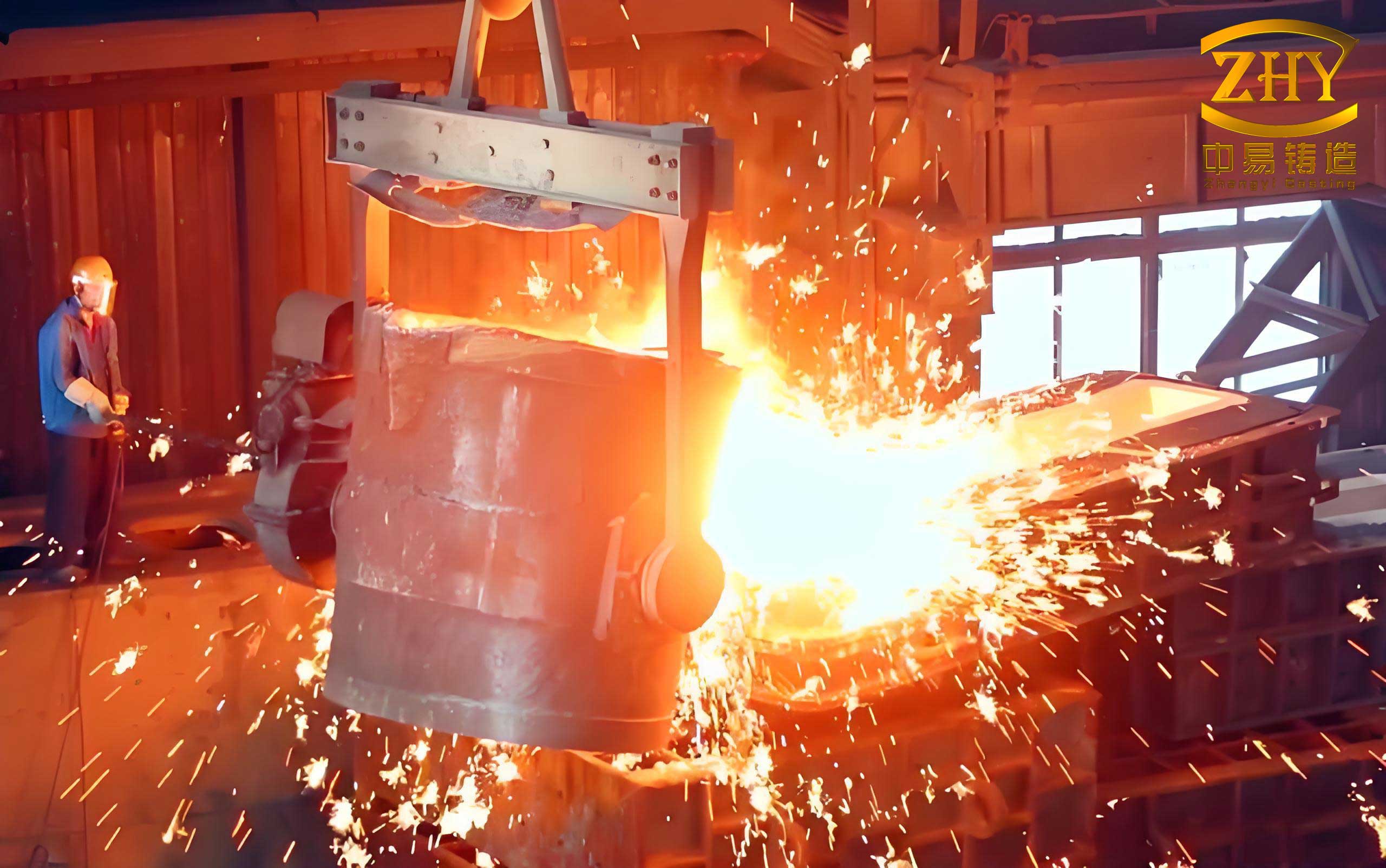
Looking beyond individual tools, the integration of these advancements into broader production systems is essential for maximizing benefits. In my experience, pairing high-efficiency boring tools with modern CNC machines and adaptive control systems can further enhance the machining of casting parts. Real-time monitoring of cutting forces and tool wear, combined with predictive algorithms, allows for dynamic adjustment of parameters to optimize performance. This synergy is particularly valuable for casting parts with variable material properties, as it ensures consistent quality across batches. The following formula illustrates the relationship between tool wear \( W \) and machining parameters for casting parts:
$$ W = k \times v_c^a \times f^b \times t^c $$
where \( k \), \( a \), \( b \), and \( c \) are material-dependent constants, and \( t \) is the machining time. By minimizing \( W \) through optimal \( v_c \) and \( f \) settings, tool life is extended, reducing interruptions in production lines dedicated to casting parts.
Another aspect I have explored is the environmental impact of improved tooling. Efficient machining of casting parts reduces energy consumption per part, as higher feed rates and longer tool life decrease the overall machining time and frequency of tool changes. This aligns with sustainable manufacturing goals, where reducing waste and resource use is paramount. For instance, the reduction in burr formation eliminates the need for secondary deburring processes, which often involve additional energy and consumables. In aggregate, these efficiencies contribute to a lower carbon footprint for industries reliant on casting parts, such as heavy machinery or renewable energy equipment manufacturing.
To provide a comprehensive view, I have analyzed the lifecycle cost of boring tools for casting parts machining. The table below breaks down the cost components over a five-year period, comparing standard tools and high-feed tools with reconditioning:
| Cost Component | Standard Tools | High-Feed Tools with Reconditioning | Savings |
|---|---|---|---|
| Initial Tool Purchase (USD) | 50,000 | 70,000 | -20,000 (higher initial cost) |
| Reconditioning Costs (USD/year) | 10,000 | 5,000 | 5,000 per year |
| Downtime Costs (USD/year) | 15,000 | 7,500 | 7,500 per year |
| Total 5-Year Cost (USD) | 125,000 | 102,500 | 22,500 (18% reduction) |
This analysis demonstrates that while high-feed tools may have a higher upfront investment, the long-term savings from reduced reconditioning and downtime make them economically superior for machining casting parts. In my projects, I have consistently advocated for such lifecycle assessments to justify tooling upgrades, especially in high-volume production environments where casting parts are central to operations.
The future of machining casting parts is likely to see further innovations in tooling technology. Emerging trends include the use of smart tools embedded with sensors to monitor conditions in real-time, and the development of new coating materials that offer even greater wear resistance. Additionally, advancements in additive manufacturing may enable the production of customized tool geometries tailored to specific casting parts, further optimizing performance. As I continue to explore these frontiers, I am convinced that the integration of data analytics and machine learning will revolutionize how we approach casting parts machining, enabling predictive maintenance and autonomous optimization of cutting parameters.
In conclusion, the adoption of high-efficiency boring tools represents a significant leap forward in the machining of casting parts. From my perspective, the benefits in terms of productivity, quality, and cost-effectiveness are undeniable. By leveraging advanced geometries, coatings, and reconditioning processes, these tools address the unique challenges posed by casting parts, such as burr formation and tool wear. As industries worldwide strive for greater efficiency and sustainability, investing in such innovative tooling will be crucial for maintaining competitiveness. Whether in automotive, aerospace, or general manufacturing, the ability to machine casting parts with precision and speed is a cornerstone of modern industrial success, and the tools discussed here are at the forefront of that endeavor.