
In the realm of hydraulic component manufacturing, the production of small, thin-walled casting parts presents a persistent and formidable challenge. These components, often weighing around 1 kg with critical wall sections under 4 mm, are notorious for their poor castability and high scrap rates. The predominant defect plaguing such casting parts is the cold shut, a flaw that appears as a seam with rounded edges where two streams of molten metal have failed to fuse completely during mold filling. This defect not only compromises the structural integrity and pressure tightness required for hydraulic applications but also severely impacts production economics, with rejection rates historically exceeding 30% in many foundries. For years, the reflexive solution has been to simply increase pouring temperature, but this is a non-systematic approach that often leads to other issues like excessive metal oxidation, sand burn-on, and degraded metallurgical properties. This article, drawn from extensive first-hand experience, delves into a comprehensive, systematic methodology for diagnosing and resolving cold shut defects in these challenging thin-walled casting parts.
The Nature and Mechanisms of Cold Shut Formation
A cold shut is fundamentally a discontinuity. It manifests as an unfused joint, often resembling a crack or wrinkle with smooth, rounded borders, within the body of the casting part. Its formation is intrinsically linked to the loss of fluidity and thermal energy in the molten metal before complete filling and fusion can occur.
Microscopic Mechanism: At the microscopic level, solidification begins with nucleation and the growth of grains. A cold shut forms when two advancing solidification fronts meet, but the liquid metal film between them has either partially solidified or its thermal energy is too depleted. Consequently, atoms from the opposing grain structures cannot diffuse across the interface to form a sound, metallic bond. The result is a weak, non-fused plane.
Macroscopic Mechanism – The Fluidity Perspective: On a macroscopic scale, cold shuts are a direct consequence of inadequate metal fluidity. The journey of molten metal from the pouring cup to the remotest corner of the mold cavity can be divided into three critical stages of fluidity loss, each corresponding to the state of the flowing metal front:
- Pure Liquid Fluidity (Stage of Frontal Collision): This initial stage governs how the metal streams initially meet. Turbulent, splashing collisions increase heat loss and oxide formation, creating ideal conditions for a cold shut at the meeting point.
- Liquid-Slurry Fluidity (Stage of Frontal Convergence): As the metal advances, its temperature drops, and solid crystals begin to form, creating a slurry. The degree to which these semi-solid fronts converge is critical. Poor convergence leads to isolated pools that solidify separately.
- Crystalline Fluidity (Stage of Frontal Solidification): In the final stage, the metal has lost so much superheat that it is on the verge of complete solidification. If two fronts meet at this stage, they are essentially solid surfaces with minimal liquid for bonding, guaranteeing a cold shut.
The interplay of these stages dictates whether a sound casting part is produced or one marred by cold shuts. The governing principle can be summarized by the fluidity length ($L_f$), which is the distance the metal can flow before stopping. It is influenced by thermal and physical properties:
$$L_f \propto \frac{\Delta T_{superheat} \cdot v \cdot \rho \cdot c_p}{h \cdot A \cdot (T_{pour} – T_{mold})}$$
Where:
– $\Delta T_{superheat}$ is the superheat above the liquidus,
– $v$ is the flow velocity,
– $\rho$ is the density,
– $c_p$ is the specific heat,
– $h$ is the heat transfer coefficient,
– $A$ is the surface area of the flowing stream,
– $(T_{pour} – T_{mold})$ is the temperature gradient.
For a thin-walled casting part, the high surface-area-to-volume ratio ($A$) is the dominant adversary, causing rapid heat loss and drastically reducing $L_f$.
A Systematic Framework for Resolution
Combating cold shuts requires a holistic attack on all factors reducing fluidity and promoting premature solidification. Relying on a single parameter adjustment, like temperature, is insufficient. The following integrated four-step methodology is essential.
1. Optimizing Melt Chemistry and Thermal Conditions
The foundation of good fluidity is laid in the furnace and ladle. For iron-based thin-walled casting parts, two parameters are paramount: Eutectic Degree (Carbon Equivalent) and Superheat.
Eutectic Composition: The fluidity of iron is maximized near its eutectic composition. As the carbon equivalent (CE) approaches 4.3% for cast iron, the freezing range minimizes, and the metal remains in a liquid state longer, allowing it to fill thinner sections. The carbon equivalent is calculated as:
$$CE = \%C + \frac{\%Si + \%P}{3}$$
The goal is to adjust the base iron chemistry and the inoculation process to achieve a post-inoculation CE as close to 1.0 (fully eutectic) as possible. This can be visualized in the relationship between carbon content and fluidity length:
| Carbon Content (wt%) | Relative Fluidity Index | State |
|---|---|---|
| 3.2 | Low (50) | Wide Freezing Range, Poor for thin walls |
| 3.6 | Medium (75) | Improved |
| 3.9 – 4.1 | High (90-100) | Near-Eutectic, Optimal |
| 4.3 | Maximum (100) | Eutectic |
Controlled Superheat: Superheat ($\Delta T_{sh}$) is the temperature of the metal above its liquidus temperature ($T_L$). It is the “driving energy” for flow. For problematic thin-walled casting parts, a high and consistent superheat is non-negotiable.
$$ \Delta T_{sh} = T_{pour} – T_L $$
Empirical evidence from production floors strongly indicates that maintaining a superheat greater than 260°C is critical. This high thermal energy delays the onset of solidification, directly extending the fluidity length $L_f$ and allowing the metal to fill complex, thin sections before the viscosity increases dramatically. The target pouring temperature ($T_{pour}$) must therefore be calculated based on the known liquidus temperature of the specific iron grade.
2. Engineering the Mold Sand System
The mold is not a passive container; it actively interacts with the molten metal. For thin-walled casting parts, the mold sand must be designed with a “Low + High” philosophy: Low Gas Evolution and High Permeability.
Why? As hot metal enters the mold, moisture and organics in the sand vaporize, generating gas. In thin sections, this gas has little opportunity to escape through the metal itself and can create back-pressure, obstructing flow or even pushing the metal stream apart, leading to a cold shut. High-permeability sand allows this gas to escape rapidly into the sand core. Low gas evolution minimizes the volume of gas created in the first place.
Optimal green sand properties for such casting parts are:
– Permeability Number: >130
– Gas Evolution: < 30 ml/g
– Compactability: ~33%
– Green Strength: ~175 kPa
3. Mastering the Pouring Technique
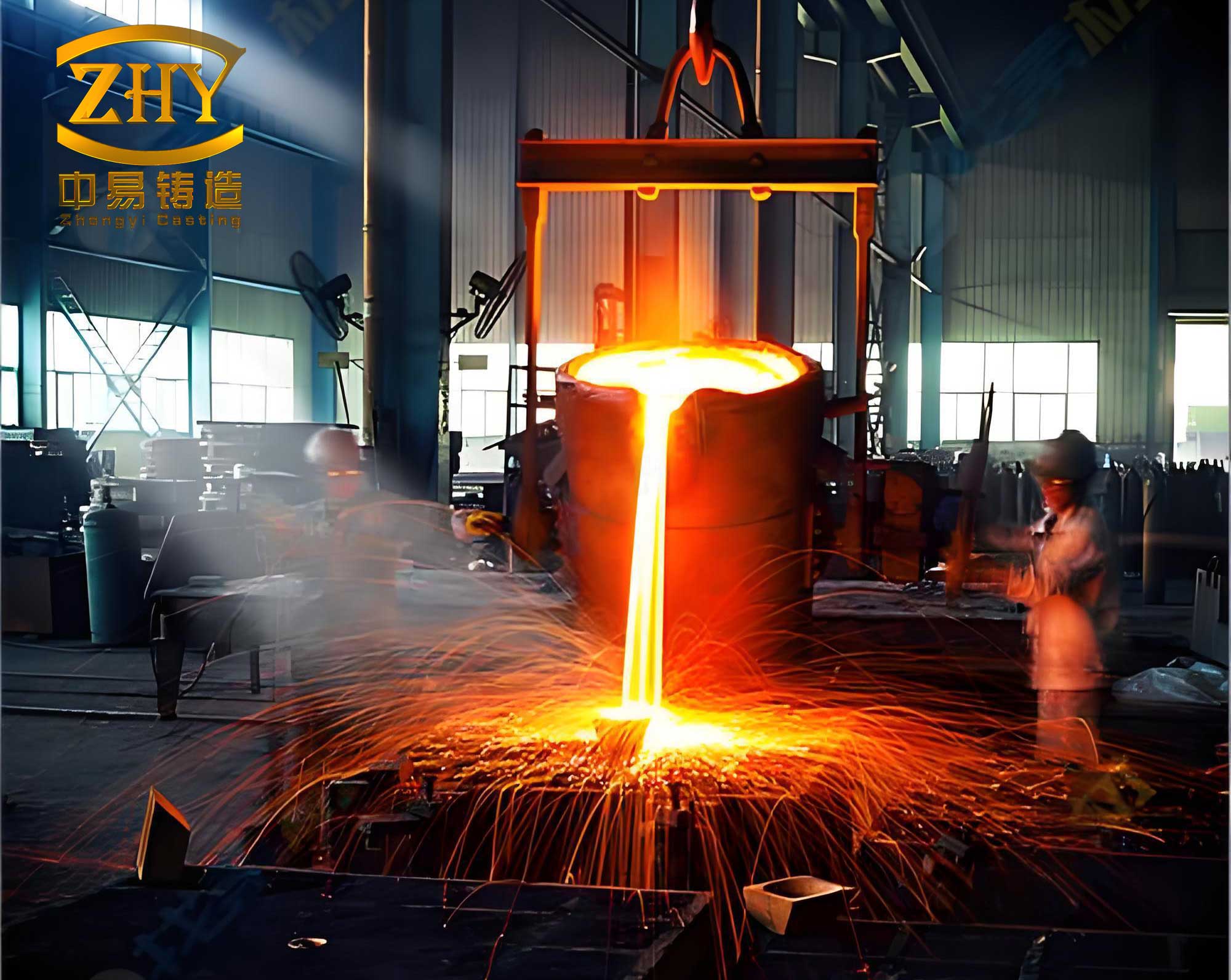
How the metal is introduced into the mold is as important as its condition. An erratic pour can ruin even perfect metal and sand. The recommended technique is a deliberate “Slow-Fast-Slow” sequence.
- Initial Slow Pour: This ensures the ladle spout is accurately aligned with the pouring cup, preventing spills and air aspiration.
- Rapid, Consistent Fill (The Critical Phase): Once aligned, the pour rate must be increased swiftly to a high, steady rate (e.g., 5-6 kg/s for medium-sized molds). This maintains a consistent, rising metal level in the sprue, which develops a dynamic pressure head ($P_d$) to force metal into thin sections:
$$ P_d = \rho g h(t) $$
where $h(t)$ is the height of metal in the sprue. A fast pour maximizes $h(t)$ quickly. - Final Slow Pour: As the mold reaches full fill, the rate is reduced to gently top up the pouring basin. This transitions the system from dynamic pressure to static pressure without creating turbulence that could damage the gates or cause erosion.
This controlled technique minimizes frontal turbulence (reducing oxide formation and heat loss at the flow front) and ensures the fastest possible fill time for the thin-walled casting part, beating the clock on solidification.
4. Strategic Gating and Venting Design
The gating system is the plumbing that delivers the metal. For thin sections, it must be designed to conserve heat and facilitate flow. The principle here is “Thick & Short” Gates paired with “Abundant” Venting.
Thick & Short Gates: The cross-section of the gates, especially the ingates that feed the casting part cavity, should be relatively large. A rule of thumb is for the ingate thickness to be up to two-thirds of the connected casting wall thickness. This minimizes choking and reduces the cooling rate of the metal stream just before it enters the cavity. Keeping the gate runners short reduces the distance and time the metal travels before entering the casting, thereby conserving its precious superheat.
Abundant Venting: Venting is the escape route for the displaced air and generated gases. Inadequate venting leads to back-pressure, which directly opposes the flow of metal into thin sections, a primary cause of cold shuts. Venting must be proactive and generous:
– Strategic placement of exhaust vents at the highest points of the mold cavity, where air is trapped.
– Use of permeable sand cores wherever possible.
– Perforating the pattern with small vent holes in non-critical areas to allow air to escape directly into the backing sand.
The total vent area should be significantly larger than the ingate area to ensure no pressure build-up.
| Process Area | Key Parameter | Target Value / Principle | Impact on Cold Shut |
|---|---|---|---|
| Melt Metallurgy | Carbon Equivalent (CE) | ~4.3% (Eutectic) | Maximizes fluidity length, minimizes freezing range. |
| Superheat ($\Delta T_{sh}$) | > 260°C | Provides thermal energy to delay solidification onset. | |
| Mold Sand | Permeability / Gas Evolution | >130 / < 30 ml/g | Allows gas escape, prevents back-pressure hindering flow. |
| Pouring Practice | Pouring Sequence | Slow-Fast-Slow | Minimizes turbulence, maximizes fill rate and pressure head. |
| Gating Design | Ingate Dimension | Thick (up to 2/3 of wall) | Reduces flow restriction and heat loss at entry point. |
| Venting | Abundant & Strategic | Eliminates air/gas back-pressure in the cavity. |
Practical Application and Validation
The efficacy of this systemic approach is not theoretical. Its application in a production environment focused on challenging thin-walled hydraulic casting parts yielded transformative results. Two representative components were targeted: a compact pump body and a complex port plate, both under 1.5 kg in weight with 3 mm wall sections. Historically, these parts suffered scrap rates near 30%, with cold shuts constituting over 95% of the defects.
By implementing the integrated four-step method—precisely adjusting the iron to a near-eutectic composition with high superheat, refining the sand to high-permeability/low-gas specs, training personnel on the controlled pour, and redesigning the gating with thick gates and explicit vents—the outcome was decisive. For the pump body casting part, production of approximately 8,000 pieces saw the scrap rate plummet to around 3%. Similarly, for the port plate casting part, a run of about 9,000 pieces achieved a scrap rate of just 5%. The virtual elimination of cold shut defects demonstrated the power of addressing the problem holistically rather than through a single variable.
Conclusion
The battle against cold shuts in small, thin-walled casting parts is won through system thinking. It requires a simultaneous and coordinated optimization of four pillars: the thermal and chemical state of the metal, the physical properties of the mold, the kinetics of the pouring process, and the design of the filling and venting pathways. Each pillar supports the others; weakness in any one can lead to failure. The presented methodology moves beyond the simplistic “pour hotter” mandate to provide a robust, reproducible framework. By controlling the eutectic degree and superheat, engineering the mold sand for minimal resistance, mastering the pouring rhythm to maximize fill velocity, and designing gating that conserves heat while ensuring gas evacuation, foundries can successfully produce these demanding, high-value thin-walled casting parts with high yields and consistent quality. This systematic approach transforms a chronic production problem into a manageable, controlled process.