
In my extensive experience with protective coatings for high-performance components, I have dedicated significant effort to optimizing the application of solvent-based inorganic zinc-rich coatings on casting parts, particularly those used in gas turbines. These casting parts are critical to the operation of gas turbines, often referred to as the “power heart” due to their role in converting thermal energy into mechanical work. The coating serves as a robust barrier against corrosion, wear, and thermal stress, akin to galvanization but with enhanced durability under harsh conditions. Through years of hands-on work, I have systematically refined the process controls necessary to ensure coating quality, focusing on surface preparation, environmental factors, material handling, application techniques, and curing. This article shares these insights, emphasizing the importance of each step for casting parts, and incorporates practical tools like tables and formulas to summarize key concepts. By adhering to these controls, we can achieve consistent, high-performance coatings that extend the lifespan of casting parts in demanding applications.
The foundation of any successful coating process lies in surface treatment. For casting parts, which often have complex geometries and inherent surface irregularities from the manufacturing process, thorough preparation is non-negotiable. I have observed that inadequate surface treatment directly leads to adhesion failures, premature corrosion, and coating defects. The goal is to create a clean, dry, and appropriately rough surface that maximizes the bond between the coating and the casting part substrate. This involves mechanical methods such as abrasive blasting or power tool cleaning, followed by rigorous assessments of roughness and cleanliness.
Roughness, typically measured as $R_z$ (mean roughness depth), is crucial for mechanical anchoring of the coating. For casting parts, I recommend a surface roughness in the range of 38 μm to 75 μm, although for sand-cast parts, up to 100 μm may be acceptable. The roughness can be quantified using the replica tape method per ISO 8503-5, where the measured imprint thickness minus the tape base thickness gives the actual $R_z$. A formula to estimate the required abrasive volume for achieving a target roughness on casting parts could be derived from empirical data: $$V_a = k \cdot A \cdot (R_z – R_0)$$ where $V_a$ is the abrasive volume, $A$ is the surface area of the casting part, $R_z$ is the target roughness, $R_0$ is the initial roughness, and $k$ is a material-specific constant. This helps in planning blasting operations efficiently.
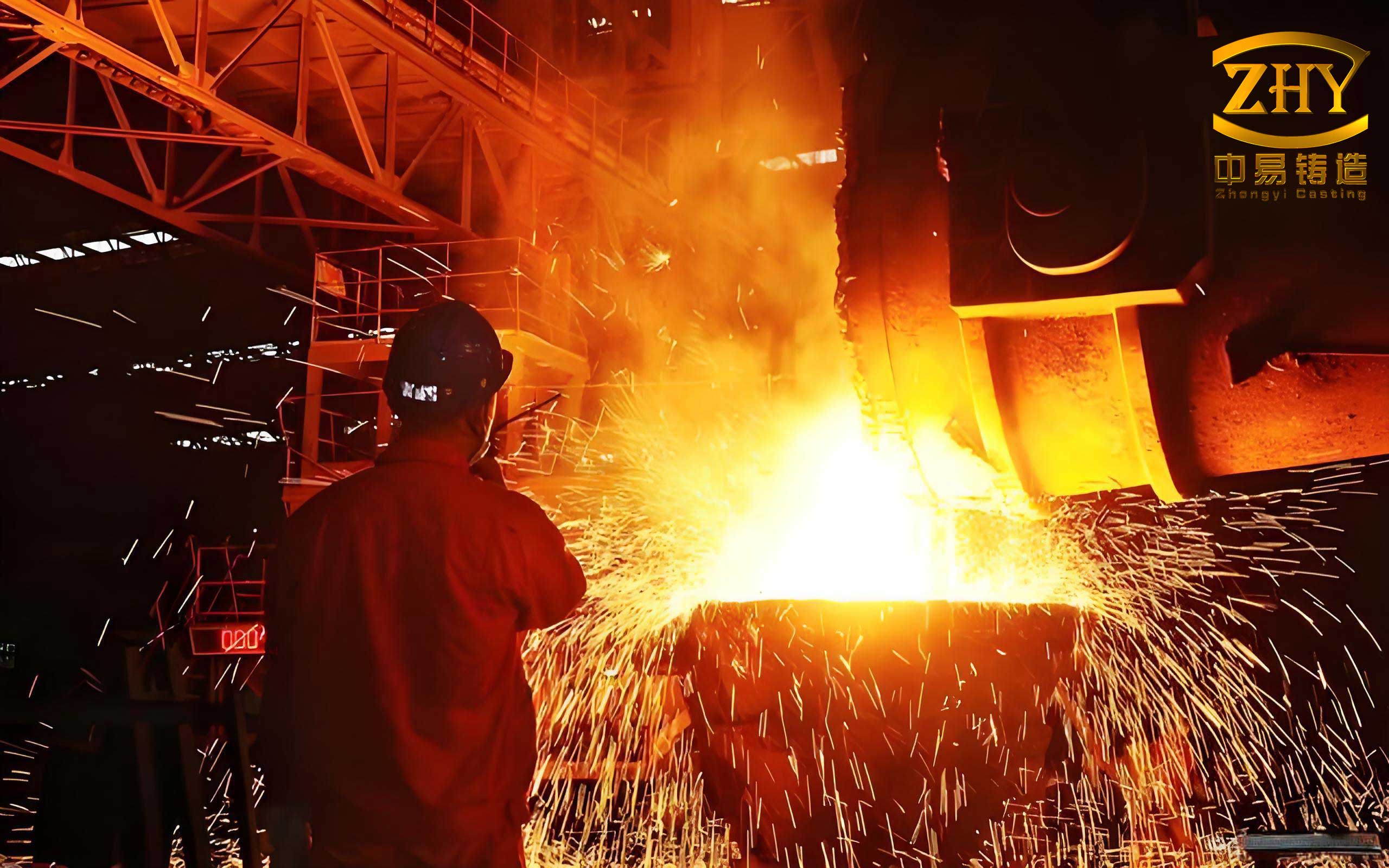
Cleanliness encompasses the removal of contaminants like rust, oil, and dust. For casting parts, I insist on achieving ISO 8501-1 Sa2.5 for blast-cleaned surfaces or St3 for tool-cleaned areas, ensuring no visible impurities. Dust contamination, assessed per ISO 8502-3 Level 2, must be minimized, as particles can create weak points in the coating. Oil and grease removal is verified via wipe tests per ISO 8503-7. Table 1 summarizes the surface treatment standards for casting parts, which I have found essential for repeatable results.
| Parameter | Standard | Target for Casting Parts | Measurement Method |
|---|---|---|---|
| Roughness ($R_z$) | ISO 8503-5 | 38–75 μm (max 100 μm for sand-cast) | Replica tape |
| Cleanliness (rust/scale) | ISO 8501-1 | Sa2.5 or St3 | Visual comparison |
| Dust level | ISO 8502-3 | Level 2 (≤ 50–100 μm particles) | Tape lift or inspection |
| Oil/grease | ISO 8503-7 | None detectable | Wipe test |
Environmental conditions during application profoundly influence coating performance on casting parts. I have learned that even minor deviations in temperature, humidity, or dew point can lead to defects like cracking, poor adhesion, or slow curing. For solvent-based inorganic zinc-rich coatings, the ideal range is 5°C to 37°C for air temperature and 35% to 85% for relative humidity. However, these ranges must be adapted based on the specific casting part geometry and ambient factors.
Temperature affects viscosity and curing kinetics. At high temperatures, solvent evaporation accelerates, potentially causing pinholing or dry spray; at low temperatures, viscosity increases, leading to uneven application and cracking. The relationship between viscosity $\eta$ and temperature $T$ can be approximated by the Arrhenius equation: $$\eta = \eta_0 \cdot e^{\frac{E_\eta}{RT}}$$ where $\eta_0$ is a constant, $E_\eta$ is activation energy for flow, and $R$ is the gas constant. This highlights the need for temperature control when coating casting parts.
Humidity is critical for the curing reaction, as water vapor participates in the hydrolysis and condensation of silicates in the coating. Low humidity (<40%) can delay curing, while high humidity (>85%) may cause moisture condensation on the casting part surface, leading to flash rust. Dew point management is essential: the surface temperature of the casting part must be at least 3°C above the dew point to prevent condensation. I use the formula for dew point $T_d$ based on air temperature $T$ and relative humidity $RH$: $$T_d = \frac{243.12 \cdot \left(\ln\left(\frac{RH}{100}\right) + \frac{17.62 \cdot T}{243.12 + T}\right)}{17.62 – \left(\ln\left(\frac{RH}{100}\right) + \frac{17.62 \cdot T}{243.12 + T}\right)}$$ where $T$ and $T_d$ are in °C. This calculation helps in scheduling coating operations for casting parts.
Table 2 outlines environmental control parameters that I monitor closely during the coating of casting parts.
| Environmental Factor | Optimal Range | Impact on Casting Part Coating | Corrective Actions |
|---|---|---|---|
| Air Temperature | 5–37°C | Affects viscosity, drying, and curing | Use heaters or coolers; adjust solvent |
| Relative Humidity | 35–85% | Drives curing reaction; prevents dry-out | Humidifiers or dehumidifiers; water misting |
| Dew Point Difference | ≥3°C above | Avoids condensation and flash rust | Pre-heat casting parts; delay coating |
| Ventilation | Adequate airflow | Removes solvent fumes; ensures safety | Explosion-proof fans; enclosed booths |
Proper mixing and handling of the coating material are pivotal. Solvent-based inorganic zinc-rich coatings are typically two-component systems comprising a base (silicate binder) and a hardener (zinc powder). I follow a strict protocol: first, stir the base component thoroughly to ensure homogeneity; then, gradually add the hardener while stirring continuously; finally, add diluent as needed to achieve spray viscosity. The pot life, usually up to 8 hours, is temperature-dependent and must be respected to avoid gelation. For casting parts, I calculate the required volume $V_c$ based on surface area $A$ and target dry film thickness $DFT$: $$V_c = \frac{A \cdot DFT}{\sigma \cdot (1 – \phi)}$$ where $\sigma$ is the volume solids content and $\phi$ is the loss factor due to overspray. This minimizes waste and ensures consistency across casting parts.
Application techniques must be tailored to the intricate shapes of casting parts. I exclusively use airless spraying for uniform coverage, supplemented by brush touch-ups for inaccessible areas. The spray equipment, including pumps, hoses, and guns, must be clean and calibrated. Key parameters include spray pressure (typically ≥0.4 MPa), nozzle size (e.g., 0.015–0.021 inches for fine atomization), and spray distance (30–50 cm). For casting parts, I employ a sequential approach: pre-coat edges, welds, and corners; then spray internal cavities; and finally cover external surfaces. This ensures complete coverage without sagging or dry spray. The film thickness $DFT$ can be monitored using the wet film thickness $WFT$ and volume solids $\sigma$: $$DFT = WFT \cdot \sigma$$ Regular checks with gauges are necessary, as excessive thickness on casting parts can lead to mud-cracking.
Table 3 provides a summary of application parameters I recommend for casting parts.
| Application Aspect | Specification | Rationale for Casting Parts |
|---|---|---|
| Spray Method | Airless spray | Uniform film; minimizes contamination |
| Nozzle Size | 0.015–0.021 inches | Balances atomization and flow rate |
| Spray Pressure | ≥0.4 MPa | Ensures proper atomization |
| Spray Distance | 30–50 cm | Avoids dry spray or runs |
| Film Thickness | 75–100 μm dry | Optimal protection without cracking |
| Pre-coating | Brush for edges/corners | Prevents thin spots on complex casting parts |
Curing and drying are the final critical phases. Solvent-based inorganic zinc-rich coatings cure through a moisture-assisted reaction, so humidity control post-application is vital. I have developed a curing model based on temperature $T$ and humidity $H$: $$t_c = t_0 \cdot \exp\left(-\alpha \cdot T + \beta \cdot H\right)$$ where $t_c$ is the curing time to reach a specific hardness (e.g., 2H pencil hardness), $t_0$, $\alpha$, and $\beta$ are empirical constants derived from testing on casting parts. Under standard conditions (50% RH, 24°C), the coating may handle in 1 hour, be dry for topcoating in 48 hours, and fully cure for immersion in 72 hours. However, for casting parts in low-humidity environments, I implement moisture enhancement, such as water misting for at least 8 hours after initial setting. Table 4 expands on drying times under various conditions, which I use to plan production schedules for casting parts.
| Surface Temperature (°C) | Relative Humidity (%) | Dry-to-Handle (hours) | Dry-to-Topcoat (hours) | Full Cure (hours) |
|---|---|---|---|---|
| 4 | 50 | 3 | 72 | 168 |
| 16 | 50 | 0.75 | 48 | 120 |
| 24 | 50 | 0.5 | 24 | 72 |
| 27 | 50 | 0.25 | 18 | 48 |
| 38 | 50 | 0.25 | 14 | 36 |
| 24 | 30 | 1.5 | 48 | 96 |
| 24 | 70 | 0.25 | 16 | 48 |
In conclusion, the process control for solvent-based inorganic zinc-rich coatings on casting parts is a multifaceted endeavor that demands meticulous attention to detail. From surface preparation to final curing, each step interlinks to determine the coating’s performance. I have found that by implementing rigorous standards for roughness, cleanliness, environmental conditions, material mixing, application techniques, and drying protocols, we can achieve durable, high-quality coatings that protect casting parts in extreme environments. The use of formulas and tables, as shared herein, aids in standardizing these controls and optimizing resource allocation. Ultimately, the synergy between proper process management and the inherent properties of the coating ensures that casting parts, such as those in gas turbines, maintain integrity and longevity, underscoring the adage that “the coating is only as good as its application.” Through continuous refinement and adherence to these principles, we can advance the reliability of casting parts across industries.